
A reading room
Philosophy & Legacy
What it means to endure, to detach, to lead and to leave something behind. Philosophy read through history, and legacy measured by what actually lasted.
Philosophy and legacy examined through the civilizations that carried them
This is a reading room, not a catalogue. It holds six essays in two lines of reading. One asks a personal question: can a person stay stable without withdrawing? The other asks a civilizational one: why does power need cohesion, belief and legitimacy, and what happens when they thin out?
Two kinds of connection appear on this page. Linked by the essay means the essay itself points there. Editorial order is a suggested reading sequence, not a claim made by the essays.
Two lines of reading
Begin with a question, then read in order
Line A · A series
Between Detachment and Sincerity
Is distance strength, or protection from exposure? And how does someone stay stable without closing off?
-
Part 0
Detachment vs Sincerity: Introduction
Introduces the question whether stability requires emotional distance, and names the Validation Dependency Loop as the problem that detachment leaves untouched.
-
Part 1
The Myth of Detachment
Argues that what looks like strength in detachment is usually protection after being hurt, and that its stability depends on distance.
-
Part 2
Philosophy Misunderstood
Reads the popular defence of detachment through Stoicism and argues that Stoicism asks for discipline within engagement, not withdrawal.
Order: the essays themselves. Part 0 links to Part 1, Part 1 links to Part 2.
Line B · A pillar and its essays
Ibn Khaldun and the life of institutions
Why does power need cohesion, belief and legitimacy, and what happens when they thin out?
-
Short entry
Why Empires Need Stories More Than Armies
Argues that durable empires turn power into accepted authority through narrative, using a four-layer framework and cases from Rome, the Ottomans, the VOC and the Soviet Union.
-
Pillar
Ibn Khaldun and the Cycle of Asabiyyah
Reads the Muqaddimah as a structural model of how cohesion builds power and comfort erodes it, then applies it to institutions, software and security.
-
Applied case
The VOC Was a Belief System Before It Was a Company
Presents the VOC as an institution that moved trust from persons to charters, ledgers and shares, then reads its decline through Ibn Khaldun’s cycle.
Order: editorial for the first step; the pillar names the short essay as part of its cluster. The VOC essay itself names the pillar as its previous essay.

Signature instrument
The Commonplace Book
Readers once kept a commonplace book: a notebook of ideas gathered under headings. This one holds fourteen concepts these essays work with. Choose one to see what it means here, where it appears, what the essays themselves connect it to, and where to read next.
- Term of the essay named and defined by an essay
- The series’ reading an interpretation the essays argue for
- Historical term, as read a historical author’s term, as the essay presents it
- Darja Rihla framing a frame these essays add

Validation Dependency Loop
A person feels independent while their mood, confidence and sense of self still follow outside reactions. Part 0 describes the loop as: external reaction, internal state, behavioural adjustment, renewed dependence.
- Where it appears
- Detachment vs Sincerity: Introduction introduced
- The Myth of Detachment referred to
- Connected by the essays
- DetachmentPart 0: detachment does not resolve the loop; it only reduces exposure to it.
- Internal anchoringPart 0: stability anchored in an internal structure, not in validation.
Detachment
Often presented as strength: care less, need no one, stay unbothered. The series reads it as reduced exposure, usually a protection after being hurt, whose stability lasts only as long as the distance does.
- Where it appears
- Detachment vs Sincerity: Introduction framed
- The Myth of Detachment argued
- Philosophy Misunderstood tested against Stoicism
- Connected by the essays
- Validation Dependency LoopPart 1: the dependence is still there; it is simply less visible.
- Connection without dependencyPart 1 names this as the harder alternative.
- Stability versus indifferencePart 2 separates the two.
Same word, other meaning. In the VOC essay, “Elite Detachment” names a phase in which an institution’s leadership loses contact with operational reality. That is an institutional concept, not this one.
Internal anchoring
The goal Part 0 proposes: stability anchored not in outcomes, people or validation, but in an internal structure that can sustain both connection and discipline.
- Where it appears
- Connected by the essays
- Validation Dependency LoopPart 0 sets it against stability that follows validation.
- Connection without dependencyPart 0: an inner stability that allows connection without losing control.
Connection without dependency
The alternative Part 1 names when detachment is set aside: to care without losing stability, and to engage without needing validation.
- Where it appears
- The Myth of Detachment named
- Connected by the essays
- DetachmentPart 1: the goal is neither dependence nor detachment.
- Internal anchoringPart 0 frames the same aim as internal anchoring.
Stability versus indifference
From the outside both look calm. Part 2 separates them: a stable person can care deeply without collapsing; an indifferent person avoids caring to stay safe.
- Where it appears
- Philosophy Misunderstood distinguished
- Connected by the essays
- DetachmentPart 2 uses the distinction against detachment as a shield.
- Stoic discipline, as read herePart 2 draws the distinction while reading Stoicism.
Stoic discipline, as read here
Part 2 argues that Stoicism teaches discipline in how a person relates to emotion, not emotional numbness: the Stoic does not eliminate feeling but refuses to be ruled by it.
- Where it appears
- Philosophy Misunderstood argued
- Detachment vs Sincerity: Introduction one of three frameworks
- Connected by the essays
- Stability versus indifferencePart 2.
- DetachmentPart 2: popular Stoic quotes are used to defend detachment.
Note on evidence. Part 2 names Epictetus and Marcus Aurelius but does not quote passages. Treat this as the essay’s reading, not as a summary of Stoic scholarship.
Asabiyyah
Ibn Khaldun’s term, as the pillar essay presents it: group solidarity, collective discipline and shared social force. The bond that lets people absorb hardship together and coordinate faster than richer rivals.
- Where it appears
- Connected by the essays
- Asabiyyah as negative entropyThe pillar’s own reframing.
- Stored and living cohesionThe pillar: institutions store cohesion.
- Narrative controlThe pillar calls narrative legitimacy “the psychological layer of asabiyyah”.
- Entropy engineThe VOC essay reads the company through the cycle.
Asabiyyah as negative entropy
A modern reframing the pillar adds to Ibn Khaldun: cohesion as the social anti-entropy that holds complexity together. The essay presents this as its own reading, not as Ibn Khaldun’s vocabulary.
- Where it appears
- Connected by the essays
- AsabiyyahThe pillar.
Shared word. “Entropy” also appears in the empires essay (entropy management) and the VOC essay (the entropy engine). The essays do not define it identically.
Stored and living cohesion
An institution is what happens when living cohesion becomes structure. The structure stores past coordination, which is why late systems can look strongest while the energy that made them adaptive is no longer renewing.
- Where it appears
- Connected by the essays
- AsabiyyahThe pillar.
Strategic legitimacy
The empires essay’s answer to what sustains rule beyond force: strategic legitimacy, shared memory, institutional continuity and a story people are willing to live inside.
- Where it appears
- Connected by the essays
- Narrative controlThe empires essay: narrative control is “the operating system of legitimacy”.
Narrative control
The fourth layer of the empires essay’s framework: religion, law, identity, education, civilizational myths and moral justification that explain why rule should exist. Not propaganda in the shallow sense, the essay says.
- Where it appears
- Why Empires Need Stories More Than Armies defined
- Ibn Khaldun and the Cycle of Asabiyyah as narrative legitimacy
- Connected by the essays
- Strategic legitimacyThe empires essay.
- AsabiyyahThe pillar: narrative lowers the cost of coercion.
Protocol trust
The shift the VOC essay describes: from trust anchored in persons (family, oath, presence) to trust anchored in systems (archives, ledgers, charters, certificates).
- Where it appears
- Connected by the essays
- Trust stackThe VOC essay: the layers that made it possible.
Trust stack
Six layers the VOC essay uses to explain institutional scale: cultural kernel, financial abstraction, juridical API, infrastructure compression, the archive as data layer, and institutional immortality.
- Where it appears
- Connected by the essays
- Protocol trustThe VOC essay.
Entropy engine
The VOC essay’s reading of the company’s decline through Ibn Khaldun’s cycle, in four phases: founding, expansion, abstraction and collapse.
- Where it appears
- Connected by the essays
- AsabiyyahThe VOC essay names the pillar as its previous essay and uses its cycle.
Relations shown in this book are only those the essays state themselves. Words that recur across essays are noted, not connected.
Living Legacies
Lives, work and ideas that keep unfolding
Editorial portraits of lives and projects whose meaning becomes visible in what they set in motion.
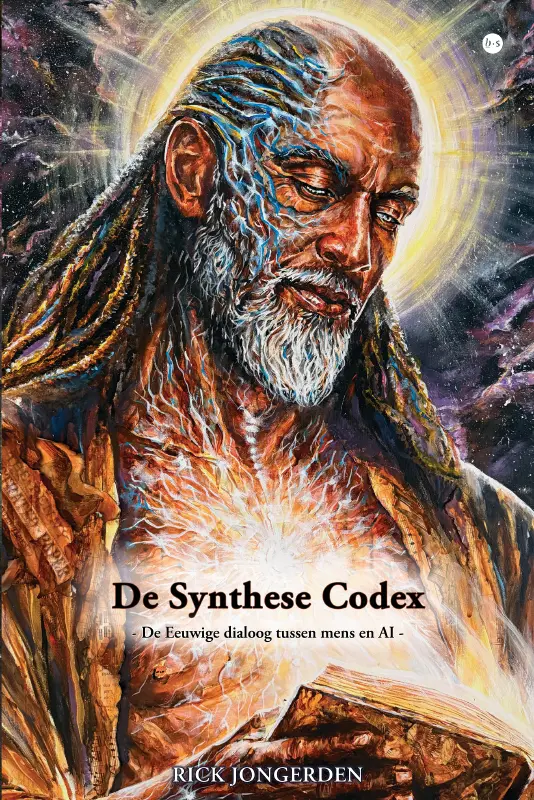
Book portrait
The Synthese Codex Rick Jongerden
After personal loss, Rick Jongerden began a search that became The Synthese Codex: a book about humanity, imagination and a dialogue with artificial intelligence. The portrait follows the book into Moonaix, the creative world that grows around it.
Where to begin
-
If your question is personal
Start with Detachment vs Sincerity: Introduction, then follow the series in order.
-
If your question is about power
Start with the short Why Empires Need Stories More Than Armies, then read the pillar, Ibn Khaldun and the Cycle of Asabiyyah.
-
If you arrive with a word
Look it up in the Commonplace Book and follow it to the essay that uses it.
Texts and traditions referenced by the essays
- Enchiridion of Epictetus cited in Part 0
- Meditations, Marcus Aurelius (Project Gutenberg) Marcus Aurelius is named in Part 2
- Ibn Khaldun, Muqaddimah, translated by Franz Rosenthal cited in the pillar