Climate and public life | Tunisia | July 2026
The Tunisia heatwave 2026 pushed temperatures towards 48 to 49°C in several parts of the country. Electricity and water supplies failed across multiple regions at the same time. Behind the numbers lies a wider story: an electricity grid under severe pressure and daily life forced to adapt.
01 | System under pressure
What happened during the Tunisia heatwave 2026
Power cuts followed one another from mid-July. During the night of 14 to 15 July, millions of households lost electricity. Tunisia’s state electricity and gas company, STEG, later reported demand of about 6 gigawatts, a record level. Heavy air-conditioner use pushed consumption even higher during the hottest hours.
STEG temporarily disconnected different areas to prevent the entire network from collapsing. Some residents reported outages lasting six hours or more. Many interruptions occurred in the afternoon, precisely when electricity demand was at its highest.
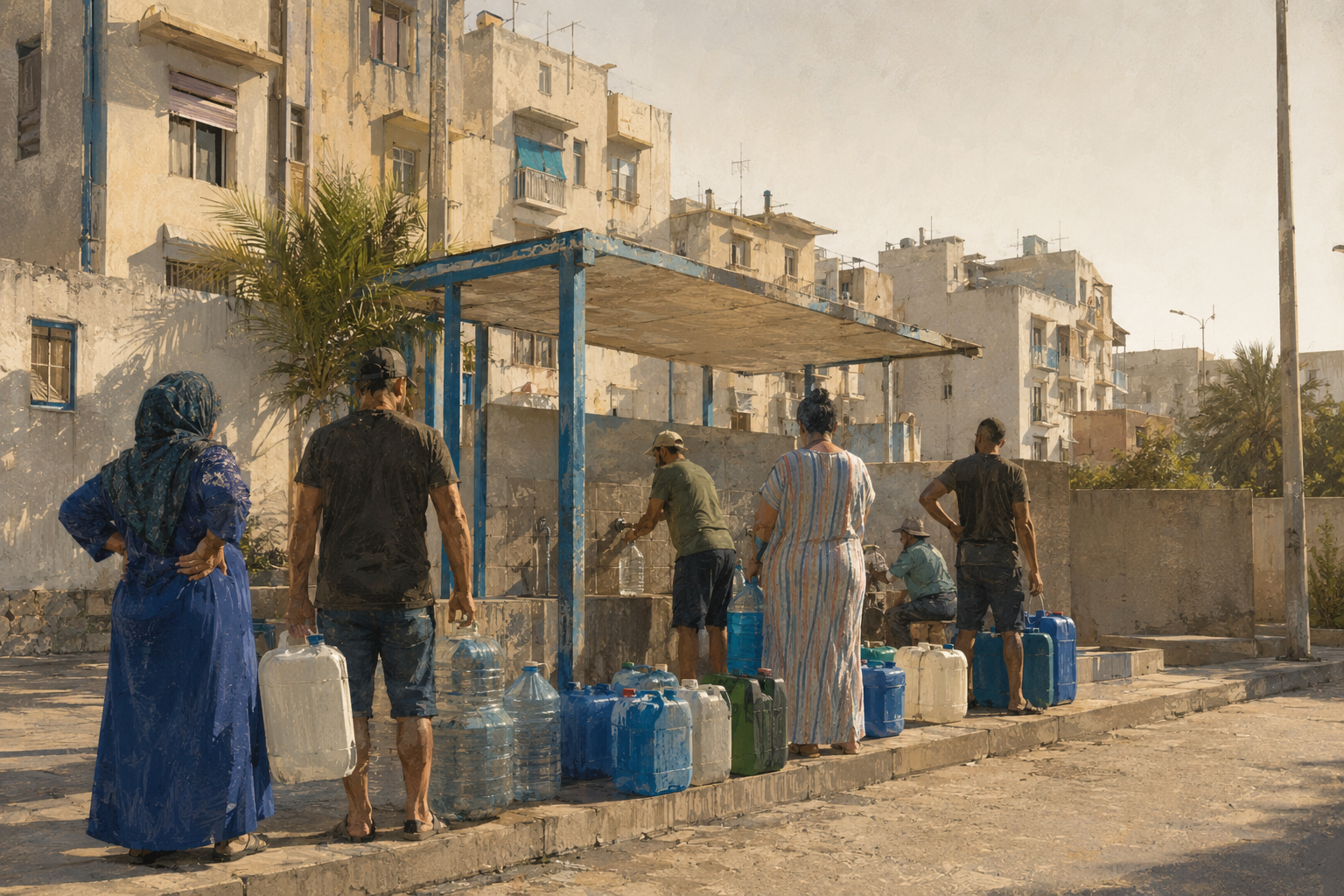
The electricity failures also affected the water supply. SONEDE, Tunisia’s national water utility, explained that power cuts disrupted pumping stations. In several regions, interruptions to water and electricity lasted more than 24 hours.
An incident at Sidi Okba in eastern Algeria added to the pressure. Tunisia relies on electricity exchanges with Algeria during peak periods to help balance its national grid. When the incident reduced the energy available from Algeria, Tunisia had less support at the moment it needed it most.
On 22 July, President Kaïs Saïed summoned ministers and the leadership of STEG and SONEDE to a crisis meeting at Carthage Palace. He called interruptions lasting more than 24 hours unacceptable and demanded that services be restored quickly.
Extreme heat triggered the immediate crisis, but it was not the only cause. Tunisian electricity generation depends overwhelmingly on natural gas, while domestic gas production has declined for years. Investment and maintenance have fallen behind demand, and STEG’s financial position limits how quickly new capacity can be added. An exceptional peak can therefore hit an already vulnerable system very hard.
This is why the July breakdown should be understood as a stress test rather than a single technical accident. World Bank analysis found that Tunisia’s peak electricity demand grew by about 5 percent a year between 2010 and 2022, despite limited economic growth. Demand therefore kept rising while generation, transmission, fuel security and the finances of the public utility all needed investment at the same time.
Controlled disconnection can protect the national network in the short term, but it transfers the consequences to households, shops, factories and public services. A decision that is technically rational for the grid can still be socially damaging when people receive little warning, cannot protect refrigerated goods or depend on electric pumps for water. Reliability is therefore not only an engineering measure. It is also a question of communication, public trust and who has the resources to absorb an interruption.
Cooling demand rose while equipment performance came under pressure.
Demand moved beyond the electricity that could be supplied reliably.
STEG disconnected areas to reduce the risk of wider grid collapse.
Power failures then affected pumping stations and essential services.
02 | Coupled infrastructure
Why electricity failure quickly becomes a water crisis
Electricity and water are often discussed as separate public services, but they form one operating chain. Electricity powers pumping, treatment, pressure control and distribution. During a blackout, stored water may keep part of the system functioning for a limited period, but prolonged or repeated cuts reduce the ability to refill reservoirs and maintain pressure. The result can reach neighbourhoods far beyond the location of the original electrical fault.
This connection matters particularly in a country already facing severe water stress. UNICEF reports that 78.1 percent of Tunisia’s population had improved drinking water available on premises in the 2023 MICS survey, with a gap between urban areas at 80 percent and rural areas at 73 percent. It also reported E. coli contamination at the supply source for 12.5 percent of people nationally and 21 percent in rural areas. These figures describe a wider water challenge, not the direct result of the July blackouts, but they show why an additional interruption can fall on very unequal starting conditions.
Infrastructure losses add another layer. The World Bank’s Tunisia climate report states that losses in SONEDE’s distribution system rose from 25 percent in 2010 to 34 percent in 2021. That does not mean one third of every local supply disappears in the same way, but it does indicate a system under pressure from leakage, ageing assets and operating constraints. When electricity fails, the water network has less room to compensate.
Pumps, treatment equipment and pressure management depend on reliable electricity.
National access figures conceal differences in availability, quality and household storage.
Cooling raises electricity use while people, farms and businesses need more water.
Prioritised feeders, local storage and renewable backup can reduce cascading service failure.
03 | Lived impact
How extreme heat changes the rhythm of daily life
The same heatwave does not feel the same everywhere. In an oasis city such as Tozeur, severe summer heat is familiar, but a home can quickly become unbearable when air conditioning fails during the hottest part of the day. Along the coast, summer demand rises with tourism and the return of Tunisians living abroad. In agricultural areas around Jendouba and Kairouan, electricity and water failures can also threaten irrigation and income.
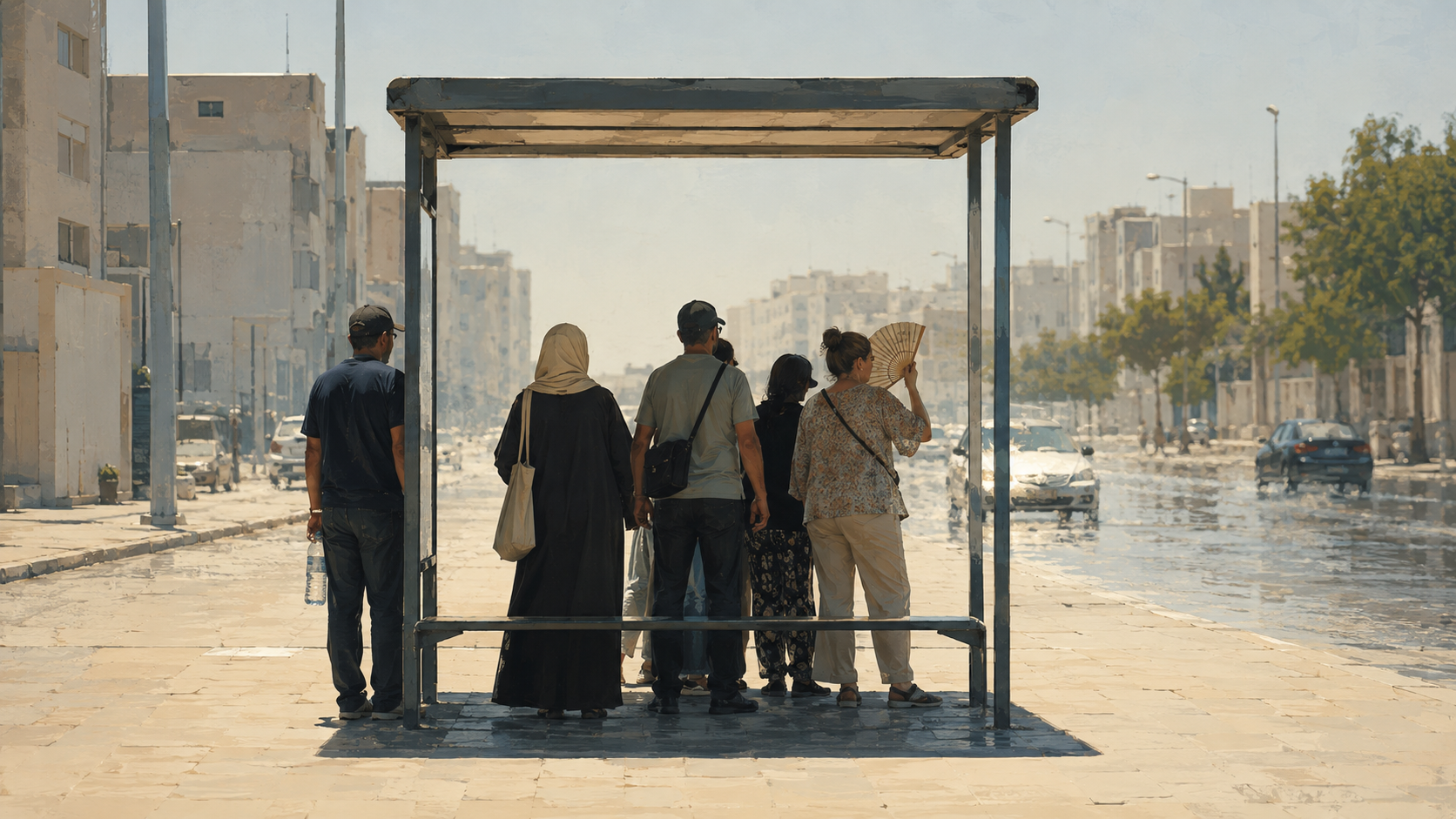
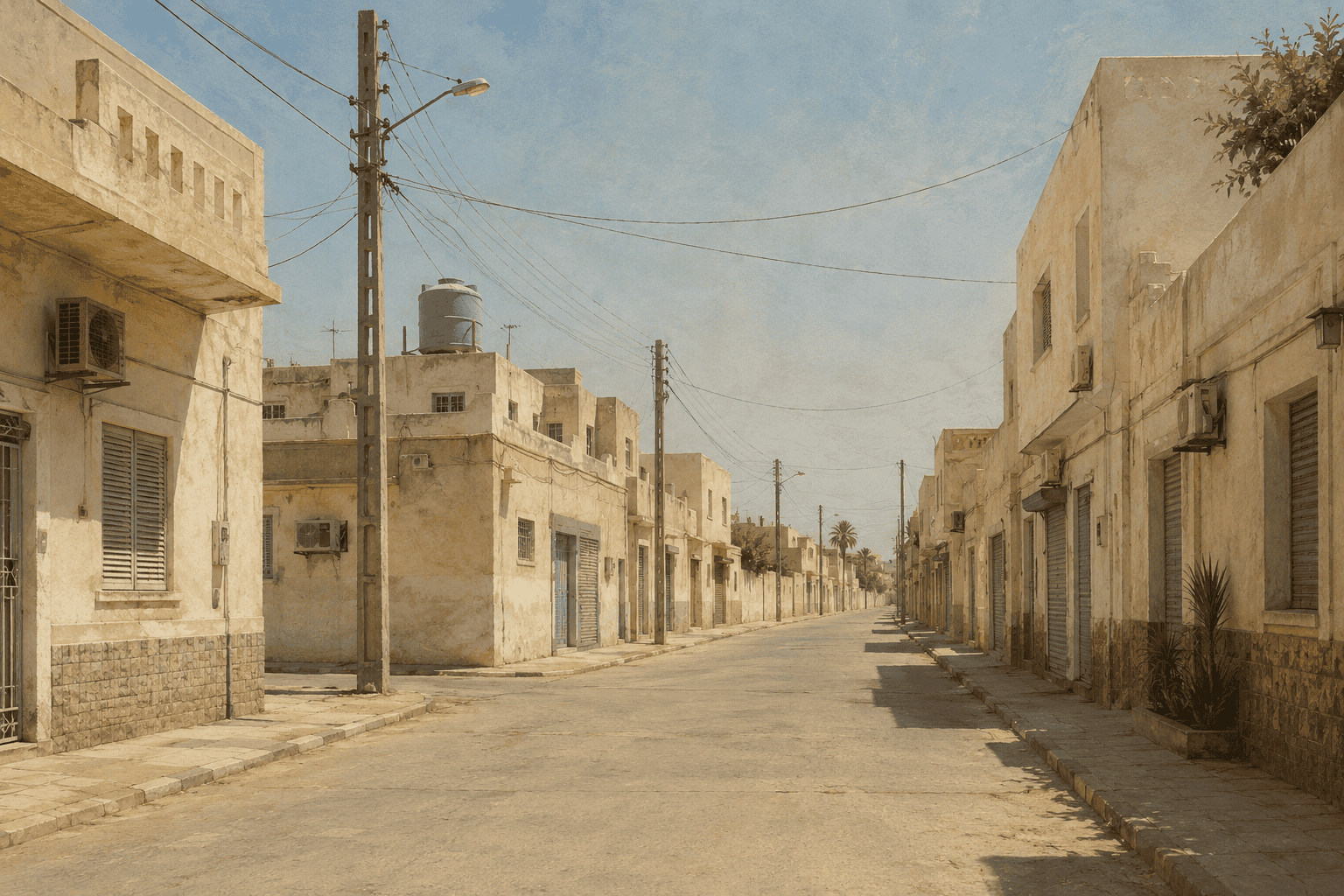
These regional examples are not separately verified reporting scenes. They illustrate how the effects can vary. Many communities share a long-established pattern of adaptation: shutters remain closed during the day, activity moves towards the early morning and evening, and outdoor spaces become more important once temperatures begin to fall.
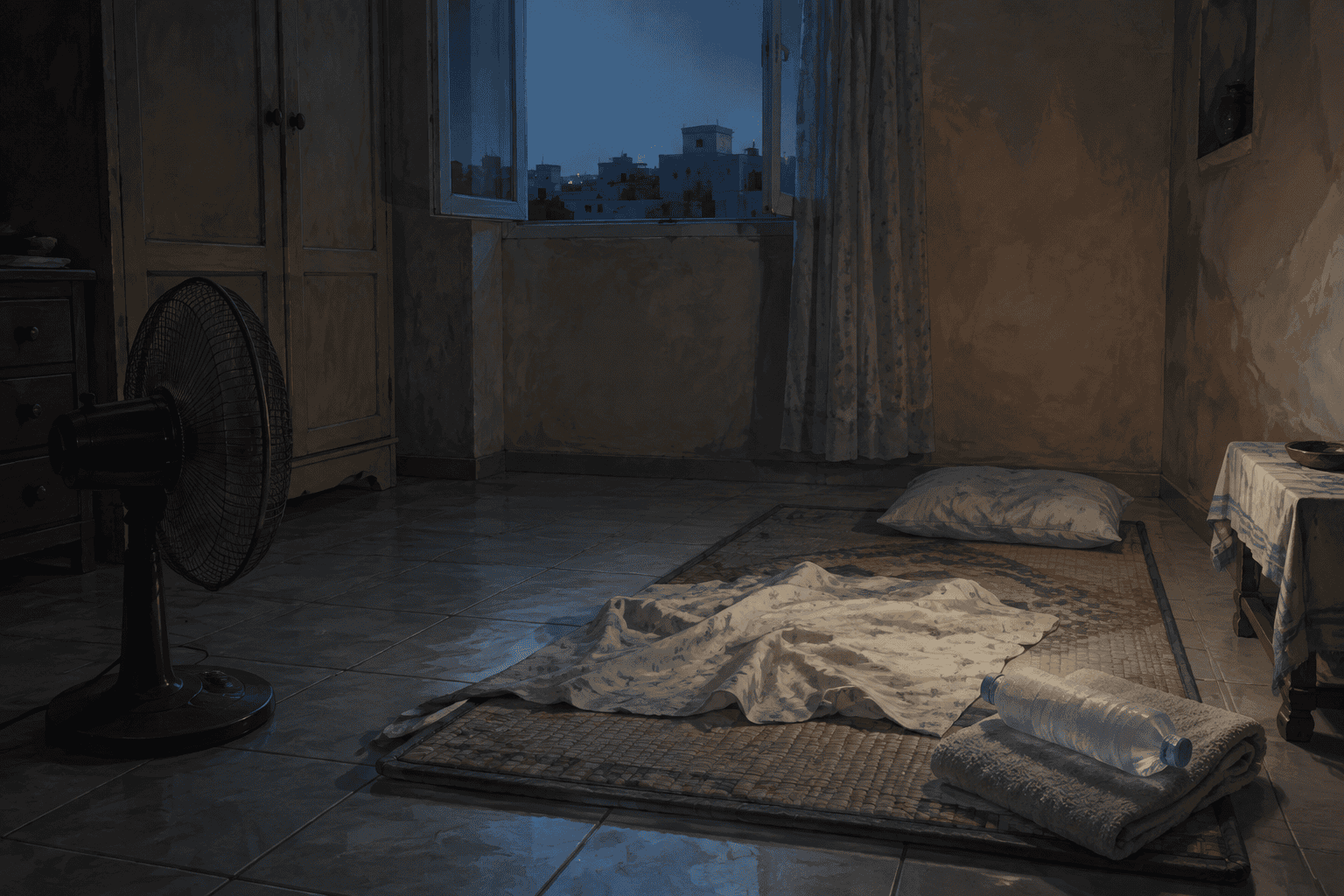
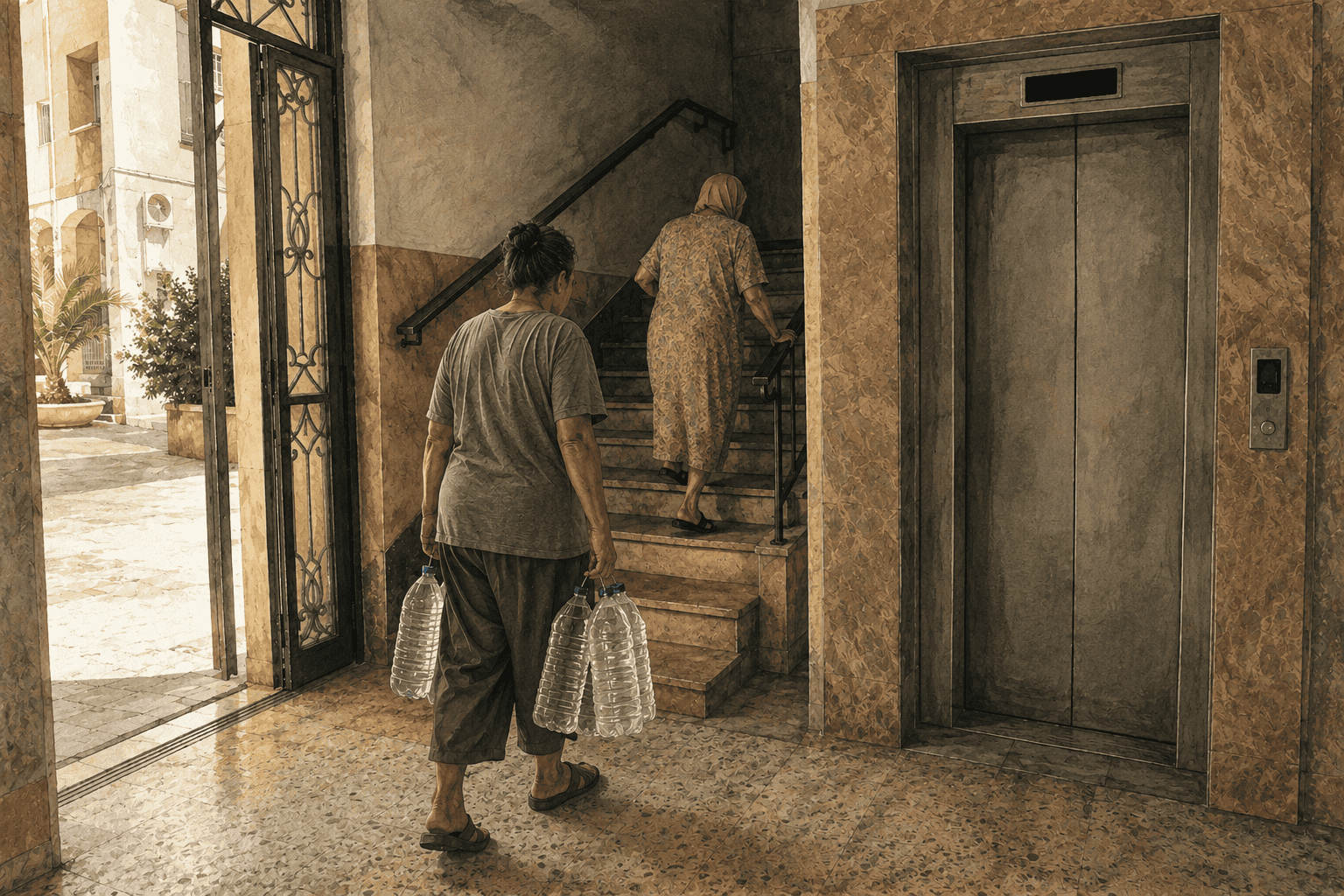
Improvisation does not make the disruption less serious. People without air conditioning, stored water or a financial safety net are affected more severely. Small businesses can lose income and refrigeration can fail. Adaptability is not a substitute for reliable electricity, water and infrastructure maintenance.
The burden is shaped by housing, income, age, health, location and employment. A household with insulated rooms, a water tank and enough money for backup equipment experiences the same outage differently from a family in a top-floor apartment with no cross-ventilation. An office worker may be able to shift hours, while a street vendor, agricultural worker or factory employee remains exposed to heat or lost production.
Night-time heat deserves particular attention because the body and the home have less opportunity to recover. The World Bank’s climate risk profile identifies Tozeur and Kebili as areas already highly exposed to very hot nights and projects that this exposure will expand into central, coastal and eventually northern regions. Those are projections, not a forecast for one particular summer, but they show why cooling, building design and reliable nighttime electricity are becoming public-health and urban-planning questions.
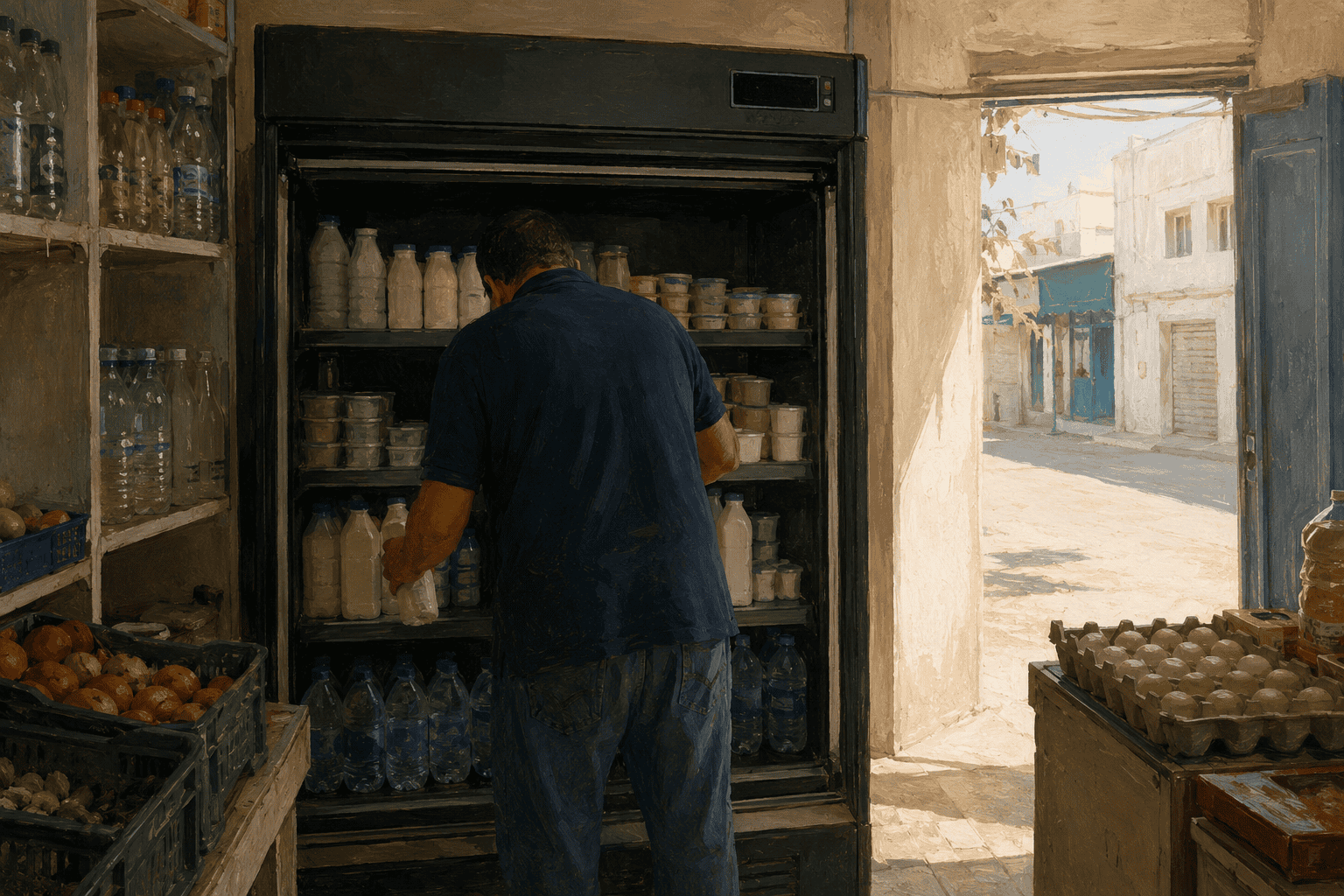
Small enterprises sit close to the same edge. A supermarket may have generators and insurance; a neighbourhood grocer, café, butcher or workshop may not. Lost refrigeration, voltage fluctuations and stopped machinery turn an infrastructure failure into spoiled stock, repair costs and missing wages. The economic damage is therefore distributed through thousands of ordinary transactions that national electricity statistics do not fully capture.
04 | Climate pressure
One heatwave inside a hotter and more exposed future
No event-attribution study is cited here, so this article does not claim that climate change caused this specific July episode. The broader direction is nevertheless clear. The World Bank’s Climate Change Knowledge Portal projects expanding exposure to hot days, hot nights and dangerous combinations of heat and humidity across Tunisia under continued warming.
Heat risk is not temperature alone. It combines hazard with exposure and vulnerability: where people live, whether homes can cool down, what work they perform, whether water is available and whether electricity remains reliable. A 45°C day in a sparsely populated area is a different public risk from a slightly lower temperature in a dense neighbourhood where night-time temperatures remain high and power repeatedly fails.
The same systems also interact economically. Tunisia’s climate and development report warns that water scarcity threatens agriculture, businesses and employment, while dependence on imported fossil fuels exposes the economy to external prices and supply conditions. Heat then increases demand precisely when the electricity and water sectors are least able to tolerate disruption. This is a reinforcing loop, not a sequence of unrelated problems.
05 | From pressure to transition
What is changing, and what remains unfinished
Tunisia is not standing still. The 120 MWp Kairouan solar plant entered operation in December 2025. The African Development Bank described it as the country’s first renewable project above 100 MW and the first to feed renewable electricity into STEG’s 225 kV high-voltage network. That is delivered capacity, not merely an announced target.
Official energy indicators reported 1,134 MW of installed renewable capacity by the end of May 2026. Other projects were at different stages. A March 2026 tender sought a 300 MW photovoltaic plant at Bazma in Kebili with 150 MW and 540 MWh of battery storage. Because that project was still being tendered, it should be treated as planned capacity rather than electricity already available during the July crisis.
The distinction between operation and intention is essential. Tunisia has strong solar and wind resources, but generation alone does not solve reliability. New plants need transmission capacity, storage or flexible backup, predictable procurement, financially workable contracts and a utility capable of maintaining the network. Otherwise impressive megawatt announcements can coexist with local service failures.
The World Bank’s five-year TEREG programme, approved in 2025, links renewable expansion to reliability, efficiency and governance. Its stated goals include improving STEG’s financial and operational performance and mobilising investment for 2.8 GW of additional solar and wind capacity by 2028. Those are programme targets, not guaranteed outcomes. Their public value will depend on delivered projects, lower losses, transparent oversight, affordable service and benefits that reach households and businesses beyond the coast.
The 120 MWp plant marks a measurable addition to Tunisia’s renewable system.
The official indicator shows expansion, while the overall electricity mix remains gas-heavy.
The Bazma tender combines generation and storage, but had not yet become operating capacity.
Track commissioning, grid connection, local jobs, affordability, land, water and service reliability.
06 | Beyond the travel frame
Tunisia heatwave 2026: resilience is not a travel slogan
A report about blackouts and water shortages is not automatically a reason to dismiss Tunisia as a destination. It is a reason to see the country in full: not simply as a place of beaches and sunshine, but as a society managing the combined pressure of extreme heat and vulnerable infrastructure.
That perspective avoids two caricatures. Tunisia is neither only a backdrop of beaches and sunsets nor simply a country in crisis. Its reality includes hospitality and frustration, adaptation and inequality, evenings returning to life and infrastructure that urgently needs strengthening.
Anyone travelling to Tunisia during extreme heat should follow current local information, prepare for possible service interruptions and avoid romanticising the burden placed on vulnerable residents. Resilience is visible, but its cost is not distributed equally.
A responsible travel perspective also asks what visitors consume. Hotels, pools, transport and air conditioning add to seasonal demand, particularly in coastal areas. Individual travellers do not control the national grid, but they can avoid waste, respect local restrictions, choose accommodation that explains its water and energy practices and respond calmly when services are interrupted.
The deeper lesson is not that Tunisia should be viewed through crisis. It is that travel writing becomes more honest when infrastructure, labour and unequal access remain visible alongside beauty and hospitality. The country is not a postcard and its people are not props in a story about resilience.
07 | Evening note
Journal
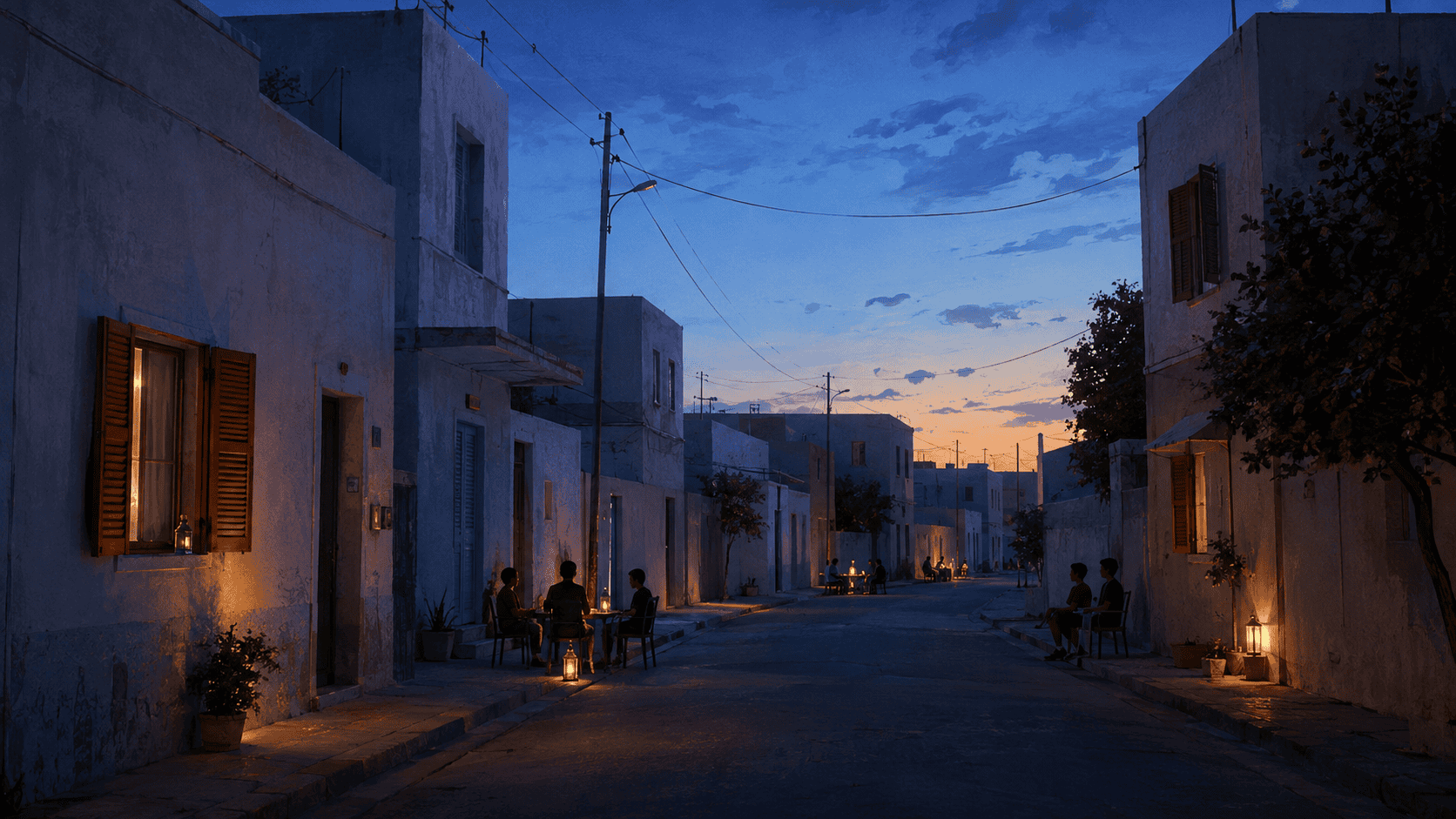
An evening without electricity is not an evening without life. Windows open instead of air conditioners switching on. Outside becomes busier as indoors grows quieter. It is not how things should be, but it shows how a place keeps moving when the grid stops.
08 | Public-interest routes
Where this story leads
The heatwave is one event inside a larger social story. Future reporting should follow who receives reliable water and electricity, who carries the cost of weak infrastructure, why interior regions face fewer opportunities, and where Tunisians are already building practical alternatives. It should also follow public procurement and delivery: which projects become operational, which remain delayed, how costs are shared and whether local communities gain durable work and more reliable services.
Follow water quality, interruptions, rural access, schools, health centres and the people responsible for essential services.
Examine education-to-work transitions, informal employment, women graduates and the gap between coastal and interior regions.
Report what supported enterprises create, who benefits, and whether local jobs survive after project funding ends.
Track investment, grid reform, affordability, jobs, land use and the difference between targets and delivered capacity.
09 | Evidence
Sources
- Extreme heat wave grips Tunisia as wide power cuts fuel frustration | AFP via Phys.org
- Tunisie : la crise de l’électricité en chiffres | Inkyfada
- The Algerian incident and Tunisia’s power cuts | La Presse de Tunisie
- Head of State warns against prolonged outages | Tunis Afrique Presse
- Power cuts disrupt water pumping stations | Business News
- National Energy Balance 2024 | Tunisia Ministry of Industry, Mines and Energy
- Official energy indicators and renewable project updates | Tunisia Ministry of Industry, Mines and Energy
- Green, affordable and viable energy production in Tunisia | World Bank
- Tunisia Country Climate and Development Report | World Bank
- Tunisia compounded heat risks | World Bank Climate Change Knowledge Portal
- Water, sanitation, hygiene and climate change in Tunisia | UNICEF
- Commissioning of the 120 MWp Kairouan solar plant | African Development Bank
- Bazma-Kebili solar and battery tender | Tunisia Ministry of Industry, Mines and Energy
- Tunisia Energy Reliability, Efficiency and Governance Improvement Program | World Bank