
The VOC Was a Belief System Before It Was a Company
The VOC belief system did not spread through ideology or scripture. It spread through ledgers, charters, and share certificates – instruments that taught millions of people to place their trust not in kings or gods, but in an abstract, immortal institution. Understanding how that shift happened is understanding how the modern world was built.

The VOC Belief System: From Blood to Protocol
Before 1602, power was personal. A Venetian merchant trusted his partner because he knew his family. A Carthaginian trader sealed agreements through kinship networks and sworn oaths. A Hanseatic guild member paid his dues to a community of faces, not a board of anonymous investors. Trust was human, embodied, and bounded by geography and mortality.
The VOC belief system dissolved all of that. When the States-General of the Dutch Republic chartered the Vereenigde Oost-Indische Compagnie in 1602, they did not simply create a trading company. They created a protocol for civilization-scale trust: a legal architecture that allowed strangers, separated by oceans and centuries, to coordinate around an abstract entity that could not bleed, could not die, and could not be bribed with wine or kinship.
The Darja Rihla doctrine is clear on this: the architecture of complex systems is never about what moves through the network. It is about how trust is verified across it. The VOC belief system solved that problem first, and everything that followed from modern finance to cloud infrastructure is an elaboration of its answer.
This is why the VOC belongs not only to maritime history, but to the Darja Rihla map of culture and identity, systems thinking and strategy, and Ibn Khaldun’s cycle of asabiyyah. It reveals how abstraction replacing human proximity becomes civilizational infrastructure.

The shift from trust anchored in persons, family, blood, oath, and presence, to trust anchored in systems: archives, ledgers, charters, and certificates. The VOC belief system was the first institution to achieve this at civilizational scale. It is one of the founding acts of modernity.
The Trust Stack: Six Layers of Institutional Scale
The VOC belief system did not emerge from genius alone. It was assembled, layer by layer, from existing Dutch capacities, each one amplifying the next. Understanding the architecture explains why it worked and why modern systems replicate it so faithfully.
 Cultural Kernel
Discipline, deferred gratification, and profit as moral signal.

Calvinism did not cause the VOC belief system. But it helped create the cohesion architecture that made it possible: sober capital, reinvested surplus, procedural trust, and a merchant class trained to see discipline as destiny.
 Financial Abstraction
Permanent capital and transferable shares made trust liquid.
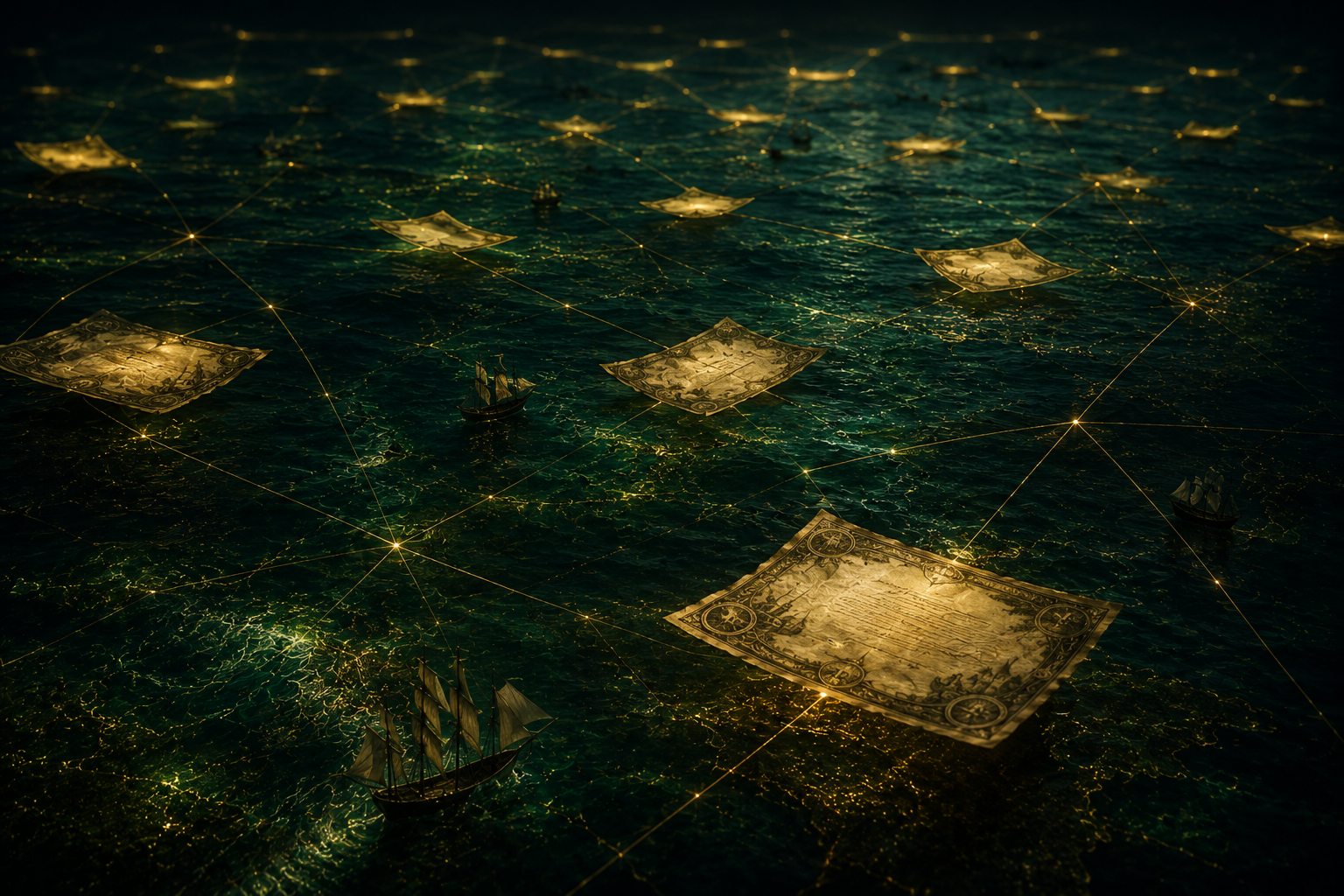
Before the VOC, capital followed voyages. The VOC belief system locked capital inside an institution and made ownership transferable. The company could now outlive investors, captains, directors, and fleets.
 Juridical API
The Dutch Republic delegated war, treaties, territory, and justice.
The VOC charter exported sovereignty through a corporate interface. The company became a state that could file accounts, wage war, sign treaties, and administer distant territories.
 Infrastructure Compression
Ports and stations became latency reduction nodes in a global network.

The VOC did not conquer geography. It administered it through resupply nodes, repair depots, intelligence hubs, and coercive checkpoints. Infrastructure made distance governable.
The VOC belief system produced one of the most comprehensive archives of maritime, commercial, and geographic data in the world. Whoever held the logbooks held the routes. The data layer was not a record of the empire. It was the instrument of control.
When a VOC director died, the company continued. When a fleet sank, the company continued. When wars reshaped Europe, the company continued. This was not resilience by accident. It was designed immortality.
A VOC share was not a claim on ships or pepper. It was a claim on the future continuity of a system. Buying one required you to believe that an abstract legal entity would outlast your own life. That act of belief, repeated by thousands of investors, is what made the VOC function as a civilization.
Banda: Where the VOC Belief System Rewrote Reality

Every belief system eventually confronts a moment where its internal logic collides with human reality. For the VOC belief system, that moment was the Banda Islands in 1621.
The Banda archipelago in the Maluku sea was, at that time, the only place on earth where nutmeg and mace grew in commercial quantities. The VOC had promised its investors a monopoly. The Bandanese, a maritime trading people with centuries of commercial relationships across Asia, declined to honor that monopoly. They sold to whoever offered better terms. From the Bandanese perspective, this was rational commerce. From the VOC perspective, it was a systems error.
Jan Pieterszoon Coen’s response was not emotionally chaotic. It was administratively rational. Between 1609 and 1621, VOC campaigns destroyed or displaced an estimated 90 percent of the Banda population. The islands were then repopulated with enslaved labor and managed by perkeniers: Dutch operators who held plantation licenses from the VOC.
Banda reveals what happens when a system’s internal logic becomes more real to its operators than the human world outside. In Amsterdam, directors saw dividend projections. In Batavia, administrators saw supply chain reports. On Banda, soldiers executed orders. Nobody saw the complete picture. The system fragmented moral responsibility until nobody felt personally accountable for any of it.
The genocide was not an act of passion. It was an act of optimization. The Bandanese were not enemies to be defeated. They were variables that disrupted a function.
Darja Rihla Doctrine on the Banda Conversion
The Perkenier Stack: The First Platform Dependency Model
The perkenier system that replaced the Bandanese trading networks was structurally remarkable. The VOC provided infrastructure, military security, and exclusive distribution. The perkeniers provided labor and local management. In exchange, perkeniers were required to sell all their nutmeg to the VOC at prices set by the VOC. They could not trade with anyone else.
This is platform logic. It predates the App Store by centuries, but the architecture is familiar: access to a captive market, controlled through infrastructure ownership, with the platform extracting margin from every transaction while the operator bears production risk. The perkenier thought he was a free citizen building a business. He was an API-dependent contractor inside someone else’s system.
The process by which a living, high-entropy ecosystem, characterized by distributed relationships, flexible exchange, and human negotiation, is reduced to a low-entropy administrative grid: auditable, controllable, predictable, and extractable. Systems scale by flattening reality into manageable objects.
Cybersecurity as Maritime Governance

The most counterintuitive layer of this doctrine is also the most structurally precise. The architecture of modern cybersecurity is not a product of the digital age. It is a translation of maritime governance into digital infrastructure.
Both systems are built to solve the same problem: trusted movement through hostile environments. A VOC fleet crossing the Indian Ocean and a data packet crossing the internet face structurally identical challenges: identity verification, payload protection, routing through adversarial territory, and logging every transaction for later audit.
The VOC did not merely move spices. It scaled trust, governance, contracts, risk, information, and belief across oceans. Modern digital platforms operate similarly. They transform human coordination into abstract infrastructure. A cloud platform, app store, payment processor, or certificate authority is not simply a service provider. It is institutional software: an administrative belief system that decides who can enter, what can move, which identities are trusted, and which forms of exchange become legitimate.
Armed convoys protected cargo through waters controlled by rival powers. Secure tunnels encrypt and route data through networks controlled by adversaries.
A VOC seal verified a captain’s authority without the Heeren XVII being physically present. A TLS certificate verifies a server’s identity without the certificate authority being present.
Each fortified trading station was a trusted point of interaction inside an untrustworthy region. Edge servers and Hardware Security Modules perform the same function.
Control the source, control the market. The Banda monopoly made the VOC indispensable by eliminating alternatives. Cloud vendor lock-in uses the same logic.
Cybersecurity is the continuation of maritime governance by digital means. The shift from seals to certificates, from convoys to VPNs, from factorijen to edge servers, is not metaphor. It is the same institutional logic operating in a different medium.
This connects directly to the systems thinking framework at the core of Darja Rihla. The VOC belief system’s lasting innovation was not its ships or its spices. It was its verification architecture: a set of protocols that allowed trust to operate at scale without requiring personal knowledge of any individual actor.
The Entropy Engine: Why Systems That Outlive Humans Eventually Destroy Themselves
The Ibn Khaldun framework at Darja Rihla provides the terminal equation. His theory of asabiyyah, the social cohesion and collective energy that builds institutions, describes a cycle that the VOC followed with mechanical precision.
The early VOC was built by merchants who understood the sea, the cargo, and the risk. High cohesion. Direct operational knowledge. Decisions made by people who knew what a sinking ship actually meant.
Success produces bureaucracy. Bureaucracy produces procedure. Procedure replaces judgment. The system begins to serve its own administrative logic rather than its original purpose.
The bewindhebbers in Amsterdam become rent-seekers. Dividends are extracted from an empire they can no longer understand. Operational reality is replaced by financial reporting.
The VOC dissolved in 1799, bankrupt and institutionally exhausted. Not because it ran out of spices, but because the abstraction layer had become heavier than the infrastructure could support.
The Ibn Khaldun entropy cycle is observable in large institutions: corporations, states, platforms, and empires. The question is never whether a system will enter the abstraction phase. The question is how long it takes, and what the abstraction cost will be for the people operating inside and beneath the system.
Test the VOC Belief System Doctrine
What was the VOC’s most structurally significant innovation?
What does the Banda Conversion describe in Darja Rihla doctrine?
The perkenier system most closely resembles which modern structure?
Score:
Is It a Company or a Belief System? The Diagnostic Engine
The institutional architecture the VOC belief system pioneered did not disappear when the company dissolved in 1799. It was inherited. The indicators below are drawn from the VOC’s structural profile. Apply them to any institution, corporate, governmental, or digital, and assess the answer honestly.
The VOC controlled the ports, supply chains, and fortified nodes. Without VOC infrastructure, trade in the Indo-Pacific could not operate at scale. When the infrastructure is yours, the dependency is theirs.
The VOC controlled what counted as legitimate commerce in the regions it dominated. Today, payment processors decide what commerce is acceptable. App stores decide what software can exist. Certificate authorities decide what servers are trusted.
The VOC’s Heeren XVII changed composition constantly. Individual directors died, retired, and were replaced. The system continued. That is institutional immortality.
The VOC turned the Banda Islands into rows in a ledger: nutmeg production per perkenier, shipping costs per route, profit per year. Every modern platform performs a related operation when human attention becomes engagement data.
The VOC’s true product was not nutmeg. It was the belief that your investment would retain value across decades, that the institution would persist, and that the system was stable.
The Final Doctrine: Empires No Longer Needed Kings
The VOC belief system completed a civilizational transition. Power no longer needed a person at its center. No king. No dynasty. No sacred bloodline. Only protocol, ledger, charter, and archive: instruments that could outlive any human being and continue generating compliance, profit, and order across generations.
Banda was not an aberration. It was the doctrine made visible. When the system’s internal logic becomes more real than human reality, the system begins to rewrite the world rather than serve it. That process did not end in 1621. The actors change. The architecture persists.
The most important question for anyone studying philosophy and the nature of institutional power is not historical. It is diagnostic: at what point does the institution you work inside, invest in, or depend upon cross the threshold from company to belief system?
Empires no longer needed kings once systems learned how to outlive humans. The VOC belief system was the proof of concept. The cloud is the current iteration. The architecture is the same. Only the medium has changed.
The Scope of the First Trust Machine
0 in founding capital.
0 of continuous operation, outlasting every human who built it.
Approximately 0 of the indigenous Banda population.
Connected Essays
The VOC belief system is part of a larger Darja Rihla doctrine: civilizations are not held together by territory alone, but by cohesion architecture, institutional memory, scalable trust, network legitimacy, and the abstraction layers that turn human proximity into civilizational infrastructure.
How cohesion, discipline, and legitimacy determine the rise and decline of civilizations.
Culture & Identity Culture & Identity ArchiveHow civilizations survive through shared meaning, memory, language, and collective identity.
Systems Thinking Systems Thinking & StrategyInstitutional systems, abstraction, governance, feedback loops, and strategic infrastructure.
Cybersecurity & Tech Cybersecurity & TechHow verification, protocols, networks, and digital trust continue the logic of maritime governance.
- Dutch East India Company – Wikipedia: institutional history and charter analysis
- Banda Massacre – Wikipedia: historical record of the 1621 campaigns
- The Muqaddimah, Ibn Khaldun – University of Chicago Press translation
- The Nutmeg’s Curse, Amitav Ghosh – on extractive modernity and Banda
- Ibn Khaldun and the Cycle of Asabiyyah – Darja Rihla
- Carthage: The Network Power Model – Darja Rihla
- What Is a Complex System – Darja Rihla
- Cybersecurity and the Modern World – Darja Rihla
The VOC belief system is one node in a larger civilizational analysis. Follow the complete architecture from Carthage to the cloud across the Darja Rihla cluster map.