Category: Cybersecurity & Tech

  • Why Session Cookies Matter More Than Your Password

    Why Session Cookies Matter More Than Your Password


    Most people still think the password is the main thing protecting an account.

    It is not.

    Why session cookies matter more than your password becomes clear the moment you understand what happens after login. Your password only matters at the front door. After authentication, the system shifts trust to something else entirely: the session.

    Once a user signs in, the application stops checking the password on every request. It checks whether the browser presents a valid session token.

    That changes everything.

    Modern attackers don’t always need credentials anymore. If they can steal the active session, they can bypass login, bypass MFA, and inherit access instantly.
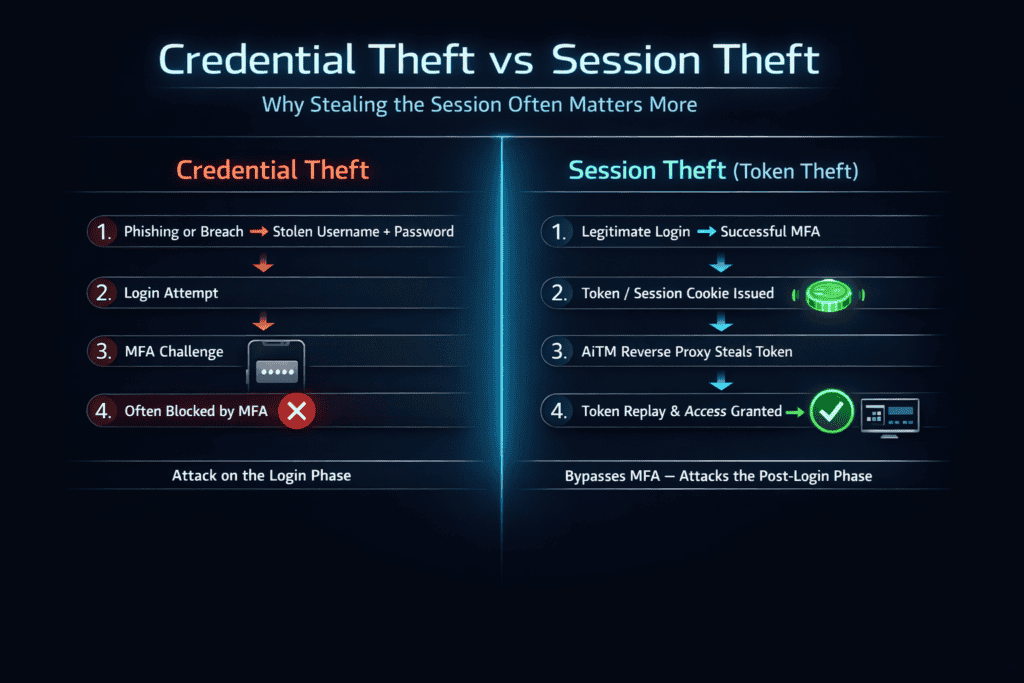

    credential theft vs session theft diagram showing MFA bypass with session cookies
    Credential theft targets the login. Session theft bypasses it completely.


    HTTP is stateless. Every request is independent unless the application adds memory.

    That memory is the session.

    After login, the server issues a session cookie. The browser automatically sends it with every request. The application treats those requests as authenticated.

    Key insight:

    The password gets you in once.
    The session keeps you in.

    This is exactly why session cookies matter more than your password becomes a critical concept in modern identity security.


    Why Session Cookies Matter More Than Your Password

    1. A session cookie can bypass authentication entirely

    A password is used to create trust. A session cookie represents trust that has already been granted.

    If an attacker steals a valid session cookie, they usually do not need to know the password at all. They also may not need to pass MFA, because MFA was already completed during the original sign-in flow. The attacker simply reuses the authenticated session.

    This is what makes session hijacking so dangerous. The attacker is not attacking the login process. They are skipping it.

    2. Session theft is often faster than credential theft

    Credential attacks usually require one or more steps:

    • phishing the victim
    • cracking weak passwords
    • reusing breached credentials
    • bypassing or intercepting MFA
    • avoiding login-based detections

    Session theft removes much of that work.

    If malware, an AiTM phishing proxy, a malicious browser extension, or a browser compromise can extract the active session, the attacker gets immediate usable access. In many cases, that is operationally easier than stealing credentials and then dealing with the controls that sit around th

    3. A valid session looks legitimate to the application

    That is one of the hardest realities in identity security. Many detections are designed around authentication events such as impossible travel, new-device sign-ins, unusual IP addresses, failed login bursts, or MFA fatigue patterns. But once a request arrives carrying a valid session token, the platform may treat it as normal application traffic.

    That makes session abuse quieter than credential abuse.

    4. Sessions can remain active for a long time

    Many users assume a session lasts only a few minutes. In reality, that is often false.

    Modern applications may keep users signed in for days or weeks. Some use refresh tokens, silent reauthentication, or “remember this device” behavior that extends practical access even further. In SaaS environments, that can give an attacker a large post-compromise window.

    A stolen password is dangerous. A stolen active session is dangerous right now.

    5. MFA protects the login event, not the ongoing session

    This is the misunderstanding that causes false confidence.

    MFA is valuable. It raises the cost of account compromise and blocks many basic attacks. But MFA does not automatically protect the session that exists after the user signs in. Once the platform has issued a valid session token, possession of that token may be enough to act as the user.

    This is exactly why session-based attacks keep growing. Organizations celebrate MFA adoption while attackers move one layer deeper.

    6. Modern attackers increasingly target sessions instead of passwords

    The industry is slowly learning that identity attacks are shifting from credential collection to session capture.

    That shift shows up in several places:

    • AiTM phishing kits that proxy the real login flow and steal the post-authentication session
    • info-stealer malware that extracts browser cookies and tokens
    • malicious browser extensions with excessive permissions
    • cloud identity attacks that focus on token replay rather than password guessing

    The logic is simple. Stronger passwords and wider MFA deployment made direct credential abuse harder

    7. The session is the real operational identity layer

    Security teams often talk about identity as if it begins and ends with passwords, MFA apps, or passkeys.

    That is incomplete.

    Operationally, the session is what the application trusts on each request. That makes session management one of the most important and most underestimated layers in account security. If the session is weak, poorly scoped, too long-lived, or easy to steal, then the strength of the password matters much less than people think.


    Understanding this attack surface is essential to grasp why session cookies matter more than your password in real-world breaches.

    Session cookie theft does not require one single technique. It can happen through multiple attack paths, and that is what makes it dangerous.

    AiTM Phishing

    Reverse proxy attacks capture sessions after MFA.


    How Cyber Attacks Happen: Step-by-Step Breakdown
    What Is AiTM Phishing and Why It Bypasses MFA


    In an adversary-in-the-middle phishing attack, the victim is lured to a phishing site that sits between them and the legitimate service. The victim enters credentials, completes MFA, and the real site issues a valid session. The phishing proxy captures that session token and hands it to the attacker.

    The attacker never needs to defeat MFA directly. They inherit the result of a legitimate MFA flow.

    Info-stealer malware

    Many modern malware families are designed to scrape browsers for stored credentials, cookies, and tokens. In practice, this means they are not just stealing usernames and passwords. They are stealing already authenticated states.

    That can give the attacker immediate access to email, development platforms, enterprise SaaS tools, and cloud-admin surfaces.

    XSS

    If a website is vulnerable to cross-site scripting and cookies are not properly protected with HttpOnly, malicious scripts may be able to read and exfiltrate them. That turns a client-side injection flaw into a session compromise.

    Malicious or over-permissioned browser extensions

    Extensions are often ignored in security conversations, but they can become a direct path into sessions. If an extension can read page content, intercept traffic, or access browser storage in dangerous ways, it may expose authentication artifacts.

    Unsecured transport or legacy weaknesses

    Plain HTTP, weak internal apps, bad reverse proxies, and poorly designed legacy systems can still expose session data in transit. This is less common than before, but it still matters in older environments and internal tooling.

    Physical access to an unlocked device

    Not every session attack is advanced. If a browser is open and the user is authenticated, an attacker with device access may not need the password at all. They already have the session in front of them.


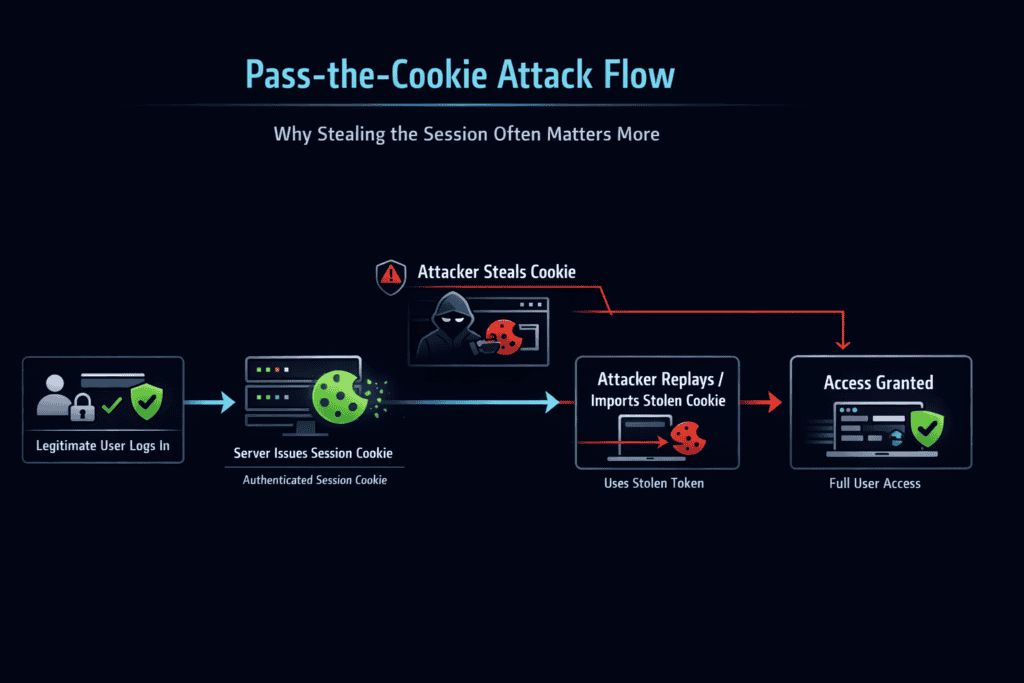
    pass the cookie attack flow showing how stolen session cookies bypass MFA and grant access
    A stolen session cookie allows attackers to replay an authenticated session and gain full access without needing a password or MFA.

    This is why session hijacking and pass-the-cookie attacks are more dangerous than traditional credential theft.

    Pass-the-cookie is the simplest way to explain the risk.

    The attacker obtains the cookie. Then they replay it.

    If the application accepts that cookie as valid, the attacker is treated as the user. They get the same permissions, the same active session context, and the same access level.

    This is why the phrase “stealing the password” can be misleading in modern identity incidents. In many cases, the attacker is not stealing identity at the credential layer. They are replaying it at the session layer.


    Session Fixation: A Different Route to the Same Outcome

    Session theft usually means stealing an already active session. Session fixation is different.

    In a session fixation attack, the attacker forces or tricks the victim into using a session ID that the attacker already knows. If the application fails to rotate the session ID after login, the attacker can later reuse that same authenticated session.

    The weakness here is not theft after login. It is bad session lifecycle management during login.

    A secure application must issue a fresh session after successful authentication. If it does not, it risks turning an unauthenticated session into an authenticated one that the attacker can predict or control.


    Session Prediction: When the Session ID Itself Is Weak

    Some systems fail even earlier.

    If session IDs are predictable, low-entropy, sequential, timestamp-based, or built from guessable values, attackers may be able to predict valid sessions without stealing or fixing them first. This is session prediction.

    This is mostly a legacy or custom-implementation problem now, but it still matters in badly designed applications. Strong session management depends on randomness. If the token is guessable, the whole model collapses.


    Why Defending the Session Is Harder Than People Think

    Developers and defenders do have controls available, but none of them are perfect on their own.

    OWASP Session Management Cheat Sheet
    Microsoft identity security guidance

    HttpOnly

    This helps prevent JavaScript from reading cookies. It is critical against some XSS-based theft paths. But it does not stop every kind of session abuse, and it does nothing against malware already running on the endpoint.

    Secure

    This ensures cookies are only sent over HTTPS. It is necessary, but it does not protect a session once the endpoint itself is compromised.

    SameSite

    This reduces some cross-site abuse patterns, especially around CSRF. It is useful, but it is not a complete defense against cookie theft or token replay from the user’s own environment.

    Short session lifetime

    Reducing session duration limits attacker dwell time, but it also creates friction for users. Most organizations compromise here, and attackers benefit from that tradeoff.

    Reauthentication for sensitive actions

    This is one of the better controls. Even if the session exists, the application can demand fresh proof before allowing high-risk actions such as password changes, payment updates, admin role changes, or privileged operations.

    Device and risk binding

    Some platforms bind sessions to device posture, browser characteristics, IP signals, or conditional access policies. These controls can reduce replay success, but they need careful tuning because legitimate users move, roam, and change networks constantly.

    This complexity further explains why session cookies matter more than your password in modern attack scenarios.


    What Users Can Do

    Users cannot solve session security alone, but they can reduce exposure.

    Log out of sensitive accounts when you are done, especially on shared or semi-trusted devices. Keep browsers updated. Avoid random extensions. Treat extension permissions seriously. Use reputable endpoint protection. Be cautious with phishing links even if they appear to support MFA. Review active sessions on major platforms and revoke sessions you do not recognize.

    The important mental shift is this: do not think only about protecting the password. Think about protecting the live authenticated browser.


    What Organizations Need To Change

    Organizations need to stop treating “MFA enabled” as the end of the identity story.

    A stronger model includes:

    • session-aware detection
    • stronger endpoint security against info-stealers
    • phishing-resistant authentication where possible
    • reauthentication for sensitive actions
    • shorter token lifetime for privileged access
    • conditional access and risk-based session controls
    • secure cookie configuration
    • session revocation and visibility for users and admins
    • testing for fixation, prediction, replay, and token handling flaws

    In other words, identity security has to extend beyond the login page.


    The Real Bottom Line

    Why session cookies matter more than your password comes down to one uncomfortable fact: once a session is active, the application usually trusts the session more than the credentials that created it.

    That is why attackers increasingly go after cookies, tokens, and authenticated browser state. It is faster than cracking passwords, often bypasses MFA, and can look like perfectly normal user activity.

    The password opens the door.

    The session decides who the system believes is already inside.


    Conclusion

    The traditional model of account security starts with credentials. The modern attack model starts after credentials.

    This is ultimately why session cookies matter more than your password in modern cybersecurity.

    That is the shift many teams still underestimate.

    If you only protect the login, but fail to protect the session, you are securing the entrance while leaving the occupied building exposed. Session cookies are not a minor implementation detail. They are the operational trust layer of the modern web.

    That is why session cookies matter more than your password in day-to-day account security, incident response, and modern identity defense.


    Want to understand how modern identity attacks really work beyond passwords and MFA?

    Read these next:

    If you are building a security strategy in 2026, start by asking a harder question:

    What happens after login?

  • How Conditional Access Reduces Identity Attack Damage: 7 Critical Security Layers

    How Conditional Access Reduces Identity Attack Damage: 7 Critical Security Layers


    Introduction

    Conditional Access reduces identity attack damage by shifting security from a one-time login check to continuous validation.

    Modern attackers do not break in. They log in.

    Using techniques such as AiTM phishing, token theft, and session hijacking, they bypass MFA and operate inside your environment as legitimate users.

    That means the real battle starts after authentication.

    Conditional Access, combined with Continuous Access Evaluation (CAE) and Token Protection, transforms identity security into a system that limits how long an attacker can stay and how much damage they can do.


    Why Identity Attacks Now Focus on Sessions

    Attackers have shifted from stealing passwords to stealing sessions and tokens.

    Related concept: Session Hijacking

    Once a user logs in, systems rely on tokens instead of rechecking credentials. If an attacker steals that token, they inherit access instantly.

    This is why AiTM phishing works:

    • MFA is completed legitimately
    • Token is captured
    • Session is reused
    • No further authentication required

    The password becomes irrelevant.


    How Conditional Access Reduces Identity Attack Damage

    Conditional Access reduces identity attack damage by continuously validating context.

    Implemented through Microsoft Entra ID, it evaluates:

    • Identity
    • Device
    • Location
    • Risk
    • Behavior

    Instead of granting full trust after login, it enforces conditional trust at every step.


    The Core Mechanism: From Login to Continuous Validation

    Conditional Access does not simply operate as a linear post-login control. In a technically accurate Zero Trust model, policy evaluation happens before access is fully granted.


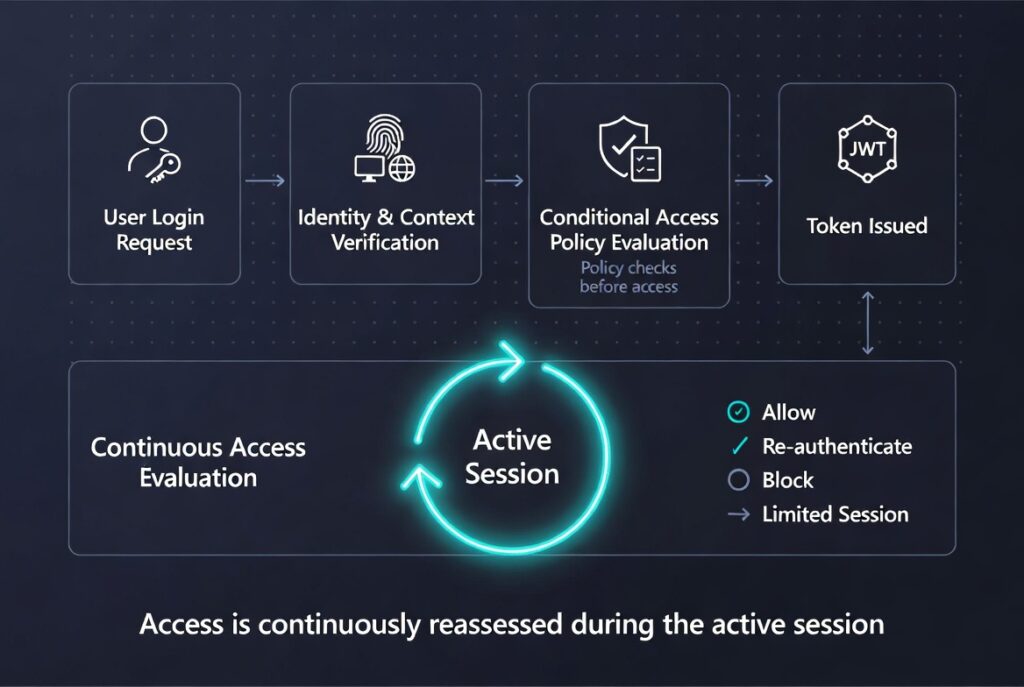
    The diagram below illustrates how Conditional Access and Continuous Access Evaluation work together in a Zero Trust model.

    Rather than granting permanent trust after login, the system continuously reassesses the session based on identity, context, and risk signals.

    Conditional Access flow diagram showing login verification, token issuance, active session loop and continuous access evaluation
    Conditional Access validates access before token issuance, while Continuous Access Evaluation continuously reassesses trust during the active session.

    The flow starts with the user login request and proceeds through identity and context verification before Conditional Access policies are evaluated.

    Only after these checks pass is the token issued and the session activated.

    From that point onward, Continuous Access Evaluation continuously reassesses the active session and can dynamically allow, challenge, block, or restrict access.


    The correct enterprise flow is:

    1. User Login Request
    2. Identity Verification
    3. Conditional Access Policy Evaluation
    4. Token Issuance
    5. Session Activation
    6. Continuous Access Evaluation (ongoing loop)
    7. Session Decision

    This means access is not trusted by default after authentication.

    Before the access token is issued, Microsoft Entra ID evaluates critical policy conditions such as:

    – MFA requirement
    – device compliance
    – trusted location
    – risk signals
    – user role sensitivity
    – application sensitivity

    Only if these conditions are satisfied is the token issued and the session activated.

    After the session starts, Continuous Access Evaluation acts as an ongoing validation loop rather than a separate linear step.

    This is a core Zero Trust principle:

    trust is temporary and continuously reassessed.


    Key Control Layer

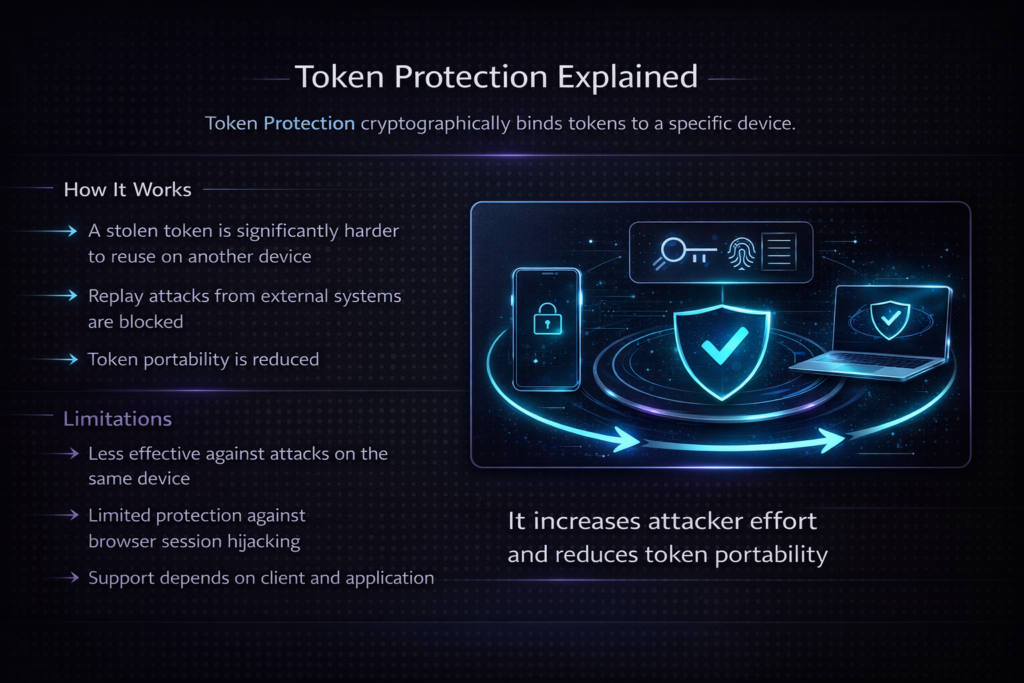
    Token Protection Explained

    Token Protection cryptographically binds tokens to a specific device.

    This means:

    • stolen tokens are significantly harder to reuse
    • replay attacks from external systems are blocked
    • token portability is reduced

    Limitations:

    • less effective against same-device attacks
    • browser session hijacking remains possible
    • support depends on client and application

    It increases attacker effort and reduces token portability.

    Token Protection diagram showing device-bound tokens, replay attack prevention and browser session hijacking limitations
    Token Protection cryptographically binds tokens to a device, making replay attacks significantly harder while reducing token portability across systems.

    Continuous Access Evaluation (CAE) Explained

    Continuous Access Evaluation introduces near real-time control.

    Triggers include:

    • Password change
    • Risk detection
    • Location change
    • Account disablement

    Instead of waiting for token expiration, access can be revoked quickly.

    This turns sessions into unstable environments for attackers.


    Why Continuous Evaluation Is a Loop, Not a Step

    Continuous Access Evaluation should not be visualized as a one-time stage after Conditional Access.

    Technically, it functions as an event-driven feedback loop during the active session.

    Risk events such as:

    – password reset
    – account disablement
    – impossible travel
    – IP location change
    – sign-in risk increase
    – device posture change

    can immediately trigger a re-evaluation of session trust.

    This can result in:

    – session continuation
    – forced re-authentication
    – limited access
    – immediate session revocation

    In Zero Trust architecture, every request can change the trust level of the session.


    Real-World Attack Scenario

    Without Conditional Access

    • Token stolen
    • Attacker logs in silently
    • Session remains valid
    • Data is accessed and exfiltrated

    Result: full compromise

    With Conditional Access

    • Unknown device blocked
    • Suspicious location triggers re-auth
    • Risk triggers session termination
    • Token replay fails

    Result: limited damage


    7 Critical Conditional Access Policies

    1. Block legacy authentication
    2. Require MFA for all users
    3. Enforce device compliance
    4. Restrict access by location
    5. Enable risk-based policies
    6. Limit session lifetime
    7. Require phishing-resistant MFA for admins

    These controls directly reduce attacker dwell time and limit post-login damage.


    Why MFA Alone Fails

    MFA protects the login event.

    It does not protect:

    • Session reuse
    • Token theft
    • Post-authentication actions

    Conditional Access replaces static trust with dynamic validation.


    Implementation Strategy

    1. Enforce MFA and block legacy authentication

    2. Add device compliance and location policies

    3. Enable CAE and risk-based access

    4. Implement Token Protection

    5. Simulate attacks and optimize policies


    Final Insight

    Identity security does not fail at the login moment. It fails when trust becomes static after access is granted.

    Conditional Access enforces trust before token issuance.

    Continuous Access Evaluation ensures that trust remains dynamic throughout the active session.

    Security is therefore not a one-time authentication event.

    It is a continuous trust lifecycle.


    Test Your Identity Security Before Attackers Do

    Most environments are secure at login but vulnerable after authentication.

    I help organizations identify:

    – token theft exposure
    – weak Conditional Access configurations
    – session control gaps
    – Zero Trust policy weaknesses

    Book a Conditional Access Security Audit and discover how long an attacker could remain inside your environment.


    Next in This Series

    Session vs Credential Theft

    Why attackers now prefer stealing active sessions instead of passwords, and what this means for Zero Trust security.

  • Zero Trust Identity Security: The Modern Defense Framework for Access Control


    Why identity has become the control plane of modern cybersecurity.


    ARCHIVE NOTE. This article is an earlier Darja Rihla treatment of Zero Trust and is preserved as part of the publication history. Newer research expands the model into post-login trust, session state, tokens and revocable authority. Continue with After Login: Zero Trust, Tokens and Revocable Trust in 2026.


    There was a time when cybersecurity was built around borders.

    The network was the fortress.
    The firewall was the gate.
    The assumption was simple: once a user entered the perimeter, trust followed almost automatically.

    That model no longer reflects reality.

    Modern organizations no longer operate inside a single physical boundary. Users authenticate from home networks, mobile devices, cloud applications, unmanaged endpoints, contractor systems, and third-party platforms. Data moves across SaaS ecosystems, APIs, collaboration tools, and identity providers. The perimeter has dissolved.

    What remains is identity.

    Identity is no longer one security control among many. It has become the control plane through which access to systems, applications, and data is granted, limited, or denied. This is why Zero Trust, at its core, is not simply a network philosophy. It is an identity philosophy.

    NIST’s Zero Trust framework formalizes this shift by rejecting implicit trust based on network location or asset ownership and replacing it with continuous verification of every access request.

    The modern question is no longer:

    “Are you inside the network?”

    The modern question is:

    “Can you continuously prove that you should still be trusted right now?”

    That is the real foundation of zero trust identity security.


    The Collapse of the Traditional Trust Model

    Traditional security models were built around permanence.

    A user logged in once.
    A session was created.
    Trust persisted.

    This persistence was convenient for operations, but it created a structural weakness: attackers no longer need to break in through hardened infrastructure if they can simply inherit trust.

    A stolen password.
    A phished MFA approval.
    A hijacked session cookie.
    A replayed access token.

    In each case, the attacker is not breaking the wall.

    They are borrowing legitimacy.

    This is why modern attacks increasingly target identity workflows rather than raw infrastructure exposure.

    The shift from perimeter compromise to identity compromise is one of the defining cybersecurity realities of 2026.

    Microsoft now explicitly treats identity protection and phishing-resistant authentication as foundational Zero Trust controls, not optional hardening layers.

    That shift matters.

    Because once identity becomes the new perimeter, every weakness in human trust, device assurance, session continuity, and policy design becomes part of the attack surface.


    How Zero Trust identity security actually works

    At a technical level, Zero Trust identity security is a continuously evaluated trust system.

    It is not a login screen.

    It is a sequence of trust decisions.

    1. Identity Claim

    A user, administrator, service account, or workload initiates an access request.

    This begins with a claim:

    “I am this identity.”

    That claim may be represented by:

    • username and password
    • passkey
    • certificate
    • smart card
    • workload identity
    • managed identity

    The claim itself is not trust.

    It is only the start of a validation process.

    2. Authentication Strength Validation

    Modern systems increasingly separate weak trust from resilient trust.

    Not all MFA is equal.

    SMS codes, email OTPs, and push prompts are all forms of MFA, but they remain vulnerable to phishing, fatigue attacks, SIM swaps, and social engineering.

    This is why Microsoft and CISA emphasize phishing-resistant MFA as the modern baseline for privileged access and sensitive environments.

    Passkeys and FIDO2 change the trust model entirely.

    Instead of transmitting a reusable secret, they rely on origin-bound public key cryptography.

    This means the credential is cryptographically tied to the legitimate relying party.

    A fake phishing domain cannot replay the same proof in the same way.

    That is not merely stronger MFA.

    That is a fundamentally different authentication mechanism.


    The Real Shift: From Credential Theft to Trust Theft

    Attackers are no longer focused only on credentials.

    They increasingly target trust itself.

    This includes:

    • password theft
    • session token theft
    • MFA fatigue
    • helpdesk impersonation
    • recovery workflow abuse
    • device trust bypass
    • browser session replay

    This is the real battlefield.

    An attacker who steals a valid session token may not need to reauthenticate at all.

    This is why strong login security alone is insufficient.

    The modern access chain looks like this:

    identity → authentication → token issuance → session continuity → authorization

    A weakness anywhere in that chain creates a usable trust artifact.

    And attackers only need one.


    Where the System Really Breaks: After Login

    Users often over-focus on the login moment.

    Psychologically, authentication is seen as the main security event.

    But modern attackers increasingly operate after successful authentication.

    After authentication, the system typically issues:

    • access tokens
    • refresh tokens
    • session cookies
    • device assertions
    • privilege claims

    These become the new trust objects.

    If these objects are stolen, replayed, or abused, the attacker can inherit the session without repeating the original challenge.

    This is why token protection and session control are no longer secondary features.

    They are core defense layers.

    Zero Trust becomes real not only by proving who the user is, but by continuously proving that the active session still deserves trust.


    The Human Behaviour Layer: Why Users Still Misunderstand Identity Security

    The failure is not only technical.

    It is behavioural.

    People naturally think in doors.

    A door is either open or closed.

    Logged in or logged out.

    Allowed or denied.

    But Zero Trust does not work like a door.

    It works like a negotiation.

    Trust is dynamic.

    Trust decays.

    Trust must be re-earned.

    Once users successfully authenticate, many mentally conclude:

    “I am safe now.”

    That assumption is dangerous.

    Because security does not end at login.

    The actual high-risk layer often begins there.


    Security Theater and False Confidence

    People often mistake visible friction for actual strength.

    Examples include:

    • extra prompts
    • multiple codes
    • repeated push approvals
    • forced password resets

    These feel secure because they are visible.

    But visible friction is not the same as phishing resistance.

    A cryptographically bound passkey may be both faster and substantially stronger than a slower SMS-based MFA flow.

    This creates a psychological paradox:

    users trust what feels harder, not always what is architecturally stronger.


    Operational Psychology: The Helpdesk Problem

    Support teams are often rewarded for restoring access quickly.

    That incentive structure creates exploitable behaviour.

    An attacker who convincingly impersonates a user under time pressure can manipulate:

    • password resets
    • MFA re-enrollment
    • account recovery
    • device registration
    • emergency exceptions

    The weakness is not always the technology.

    It is the pressure environment around it.

    The system breaks where humans optimize for continuity over verification.

    That is a systems design flaw.


    Zero Trust as a Living Control Framework

    Zero Trust is not a product.

    It is not Microsoft Entra.
    It is not Okta.
    It is not passkeys.
    It is not Conditional Access.

    It is a living access philosophy.

    Every access decision must be:

    • explicitly verified
    • context-aware
    • least privileged
    • continuously re-evaluated

    Trust must be influenced by:

    • user risk
    • device compliance
    • geo anomalies
    • time-based patterns
    • impossible travel
    • privilege sensitivity
    • session anomalies

    This is why Continuous Access Evaluation is strategically important.


    The Deeper Truth

    Security is moving from:

    protecting places

    to

    validating claims

    That is a profound shift.

    The future of access control is not walls.

    It is trust economics.

    Who gets believed, for how long, under what conditions, and with what proof.

    That is the real Zero Trust question.


    Final Synthesis

    Zero Trust identity security recognizes a hard reality:

    trust is the most valuable asset inside any digital system.

    Attackers increasingly target people, sessions, tokens, recovery workflows, and mental assumptions rather than just infrastructure.

    The strongest organizations in 2026 are not the ones with the most prompts.

    They are the ones that understand how trust is created, abused, inherited, and continuously challenged.

    That is where security becomes strategy.


    Frequently asked questions

    What is Zero Trust identity security?
    A framework where every access request is continuously verified based on identity, device, and risk context.

    Why is phishing-resistant MFA important?
    Because legacy MFA methods remain vulnerable to phishing and fatigue attacks.

    Can attackers bypass login security?
    Yes, through stolen session tokens and trust artifacts.