Category: The Continuity Project

  • Before the Dutch State Navy: How Zeeland Governed Violence at Sea

    SYSTEMS & STRATEGY / THE CONTINUITY PROJECT / CH-011 / EVIDENCE NOTE 002

    Commissions, prize courts and the limits of historical continuity, 1572-1577.

    Evidence Note 002 | CH-011
    Published historical edition and archival finding-aid research
    Direct institutional descent unresolved

    When a government tries to govern violence at sea, the decisive question is not simply who sailed. It is who could commission, register, judge and account.

    Darja Rihla research framing

    A question about rule, not origins

    Did the Sea Beggars become the Dutch state navy? It is an appealing question because it turns a turbulent revolt into a clear institutional origin story. The surviving evidence asks us to be more precise. Between 1572 and 1577, how did Zeeland’s authorities try to decide who could take ships, claim prizes, command at sea and account for the proceeds?

    The answer is not that a ready-made navy emerged from private violence. A published historical edition shows a provincial effort to place maritime force within commissions, registers, a court and fiscal rules. It also shows that rules changed when practice exposed their limits. What it does not show is a documented chain from a particular Sea Beggar crew, vessel, commission or record to the five admiralty colleges settled in 1597. That distinction is the substance of this note, not a reservation at its margins.

    Before the rupture: maritime authority already existed

    The Revolt did not start from an institutional blank slate. A Leiden research overview, drawing on the work of Louis Sicking, describes a Netherlands admiralcy before 1572, ordinances in 1488 and 1540, and a 1565 settlement over Holland’s maritime jurisdiction.1 It reports that the 1540 framework narrowed the admiral’s jurisdiction to matters connected with war and violence, while Holland retained a distinctive position in the later dispute.

    That background supplies a rival explanation for later similarities. An admiral, prize jurisdiction and maritime authority did not have to be invented by former rebels in order to appear in post-1572 Zeeland. But neither does the overview prove that a given 1574 provision was inherited from an earlier ordinance. The underlying ordinances and Sicking’s page-level argument were not independently examined for this note. The pre-Revolt administration is therefore a documented context and an open comparison, not a demonstrated ancestor.

    Sea Beggars and the political break

    The capture of Brielle in 1572 is central to the established public story of the Sea Beggars, but it is not used here as proof of later institutional descent.2 The more immediate documentary setting is the first free States of Holland meeting at Dordrecht, 19-23 July 1572. The Nationaal Archief identifies its minute booklet as collection 3.01.04.01, inventory 324B. The digital images are available, but the decisive maritime text has not been independently transcribed in this research.3

    The Nationaal Archief’s historical introduction to the Admiralty Colleges reports that, on 20 July, Holland placed supreme maritime direction with William of Orange, required existing sea commissions to be cancelled, and envisaged appointments through a sovereign admiral with advice from water towns.4 This is evidence of a reported constitutional design. It is not evidence that every earlier commission was cancelled, that the cancelled documents belonged to Sea Beggars, or that identifiable captains received replacements.

    Zeeland faced a more fragmented situation. Van Grol wrote that Middelburg did not pass to the revolt until February 1574 and that the provincial terrain was not yet politically coherent. His article presents the 2 March 1574 governmental instruction as the first arrangement for the administration of Zeeland.5

    Zeeland’s regulatory experiment in 1574

    Van Grol printed and discussed passages of the 2 March 1574 instruction. Article 8, as he transcribed it, divided civil prize and admiralty matters at a threshold of 1,000 Carolus guilders. Cases exceeding that amount belonged to the governors and council; cases valued at that amount or below belonged to an admiralty council selected by the admiral, with recourse to the governors and council. The same article required that notes and a good register be kept for prizes and booty.5

    The threshold needs careful treatment. In the printed 1574 text, the rule allocated cases above 1,000 Carolus guilders away from the admiralty council. It does not prove that every case was entered, that every entry survives, or that the register was transferred to a later institution.

    Article 15, in Van Grol’s account, provided for four notable councillors as well as a fiscal officer, secretary and chamber officer. Article 27 provided that captains should receive commissions under the prince’s seal and signature, revoking earlier authorisations granted to other freebooters.5 This is the clearest available evidence of a programme of formalisation. It does not prove that “the Sea Beggars were finished,” which is Van Grol’s own interpretation after the passage.

    What the surviving published proceedings show

    The published material is not a complete court archive. Van Grol said that he reduced the minutes to a list, and on p. 242 described two sixteenth-century manuscript volumes that he had found in the municipal archive of Vlissingen. He identified them as the registers required by article 8: one runs from 1575 to 19 April 1576 and the other from 26 April 1576 to 4 April 1577.6 This is a valuable archival identification by Van Grol, but the manuscripts themselves have not been independently inspected here.

    An earlier proceeding, dated 10 May 1576, concerns Captain David Jansz. The council, advised by people commissioned by the admiral, required him to appear and acknowledge misconduct after he had allegedly left the fleet near Brouwershaven without permission. It imposed a fine drawn from the portion of prize due to him, his owners and crew, with sums for the common cause and Vlissingen’s poor.8 Here a published entry shows discipline connected to command, prize income and a public-purpose payment. It does not tell us how often such discipline occurred or whether this procedure descended from pre-Revolt practice.

    When practice changed the rules

    On 22 September 1576, according to Van Grol, a separate ordinance on admiralty matters was issued at the same time as a revised governmental instruction. He characterised it as setting down what practical experience had made desirable and what had in fact been carried out. That characterisation is his interpretation, not a direct report by this research from the original ordinance.9

    The printed account nevertheless identifies an important institutional change. It says that the 1574 division at 1,000 Carolus guilders was never put into practice; instead, the admiralty had issued all judgments from the beginning. Article 15 of the 1576 ordinance accordingly gave the admiralty council jurisdiction over prizes at sea without exception, subject to appeal to the governors and council. It also provided for a Vlissingen-based council, letters of marque, a prohibition on councillors fitting out their own privateering ships, and a treasurer responsible for licences, convoy money and proceeds found to be good prize.9

    A later January 1577 dispute records two captains who had both a commission and an appointment, sailing with their masters’ ships under promises made before departure. Their dispute concerned a share in prize proceeds.7 The entry demonstrates that the printed record refers to commissioned captains, ships, a superior and prize-sharing claims. It does not establish a universal chain of command or a state-owned fleet.

    Evidence comparison: prescribed rules, actual cases and later revision

    Reading key: four dated snapshots, ordered by event, not arrows between institutions. Van Grol describes manuscript volumes spanning 1575-1577; the selected cases occurred on different sides of the September 1576 revision.

    1574: prescribed

    • Cases above 1,000 Carolus guilders allocated to governors and council; 1,000 or below to the admiralty council.
    • Registers required; sealed commissions prescribed; earlier freebooter authorisations revoked.

    Evidence level: 1574 text as printed by Van Grol; execution not established.5

    1575 to May 1576: early proceedings

    • Van Grol describes two surviving manuscript registers, beginning in 1575; they have not been independently inspected.
    • The published 10 May 1576 ruling against David Jansz concerns discipline and a fine from prize proceeds.

    Evidence level: Van Grol’s edition, register identification and selected case.68

    22 September 1576: revised

    • Van Grol reports that the 1,000-guilder division was not put into practice.
    • The new ordinance gave the admiralty wider prize jurisdiction, subject to appeal, and specified fiscal roles.

    Evidence level: Van Grol’s account of the revised ordinance, not direct manuscript inspection.9

    January 1577: subsequent dispute

    • A printed case concerns two captains with commission and appointment and contested shares of prize proceeds.
    • This case demonstrates a specific proceeding, not a continuous Watergeuzen-to-admiralty lineage.

    Evidence level: Selected proceedings as printed in the historical edition.7

    Applying the Continuity Framework

    The Continuity Framework asks whether a defined property has been transmitted through an evidenced carrier. The evidence supports component-specific observations: commissions under seal were prescribed; a register was required; a Zeeland prize-court record was published; prize proceeds and public revenues were governed; and discipline was exercised in a recorded case.5789

    None is a demonstrated Watergeuzen-to-state-navy chain. Direct transfer lacks a named predecessor and receiving record. Pre-1572 inheritance remains a live alternative. A mixed origin is possible only if each contribution is separately shown. Visible redesign strengthens the case for wartime innovation, while Zeeland’s legal and fiscal route strengthens the case for regional divergence. These are rival explanations, not a ranking of certainties.

    What the evidence cannot establish

    The note cannot identify the makers of all commissions, the recipients of all revoked authorisations, the contents of every register, or the ownership and funding of the ships involved. The Van Dorp inventory locates ship-operation papers connected with Louis Boisot, Martin Lenglen’s account for Boisot as admiral of Zeeland, and an undated blank commission from Orange for a sea captain under Boisot.10 These descriptions are leads, not read ship accounts or executed commissions.

    Nor can the 1579 Holland register order settle the question. The Admiralty Colleges finding aid reports an order to deliver a register of commissions, appointments and resolutions to a new commission. It does not demonstrate delivery, receipt, later use, contents or any Watergeuzen entry.4 Nothing in the examined evidence permits a direct genealogical arrow from Zeeland’s 1574-77 arrangements to the five colleges settled in 1597.

    The next documents that could change the finding

    The next decisive documents are concrete: a human transcription of the maritime passage in Dordrecht minute book 324B; manuscript-level comparison of the original 1574 instruction, the two Vlissingen registers and the 1576 ordinance; consultation of Van Dorp files 1169-1176 for ownership, costs, authority, revenues and any completed commission; and a comparison of the 1488, 1540 and 1565 materials with post-1572 texts.

    This is enough for a limited evidence note, not an origin myth. Zeeland’s records show people trying to govern violence at sea through rules, offices, books and adjudication. They do not yet tell us, component by component, what survived the rupture and through whom.

    Research context: This Evidence Note belongs to The Continuity Project. For the earlier editorial background, read The Sea Beggars and 5 Powerful Lessons from the Sea Beggars. These earlier articles are context, not primary evidence for the institutional findings here.

    Sources and notes

    1. Universiteit Leiden, “Admiraal van de zee”, accessed 20 October 2026. Research summary drawing on Louis Sicking; the book and original ordinances were not independently inspected.
    2. Darja Rihla, “The Sea Beggars: Dutch Private Violence Before the VOC”, used only to identify earlier editorial framing, not as authority for this note’s institutional claims.
    3. Nationaal Archief, 3.01.04.01, inv. 324B, “Notulen van de eerste vrije Statenvergadering gehouden te Dordrecht, 1572 juli 19-23.”
    4. Nationaal Archief, 1.01.46, “Admiraliteitscolleges, 1586-1795,” historical context. Finding-aid narrative, not the original resolutions.
    5. H.G. van Grol, “Het Zeeuwsche prijzenhof te Vlissingen 1575-1577”, Bijdragen en Mededeelingen van het Historisch Genootschap 37 (1916), 236-38. Printed historical edition/article; original manuscripts were not independently examined.
    6. Van Grol, 242.
    7. Van Grol, 334-35.
    8. Van Grol, 335-36.
    9. Van Grol, 238-39.
    10. Nationaal Archief, 1.10.25, Dorp, van, inventory, 178-79, nos. 1169-1176. Finding aid only.
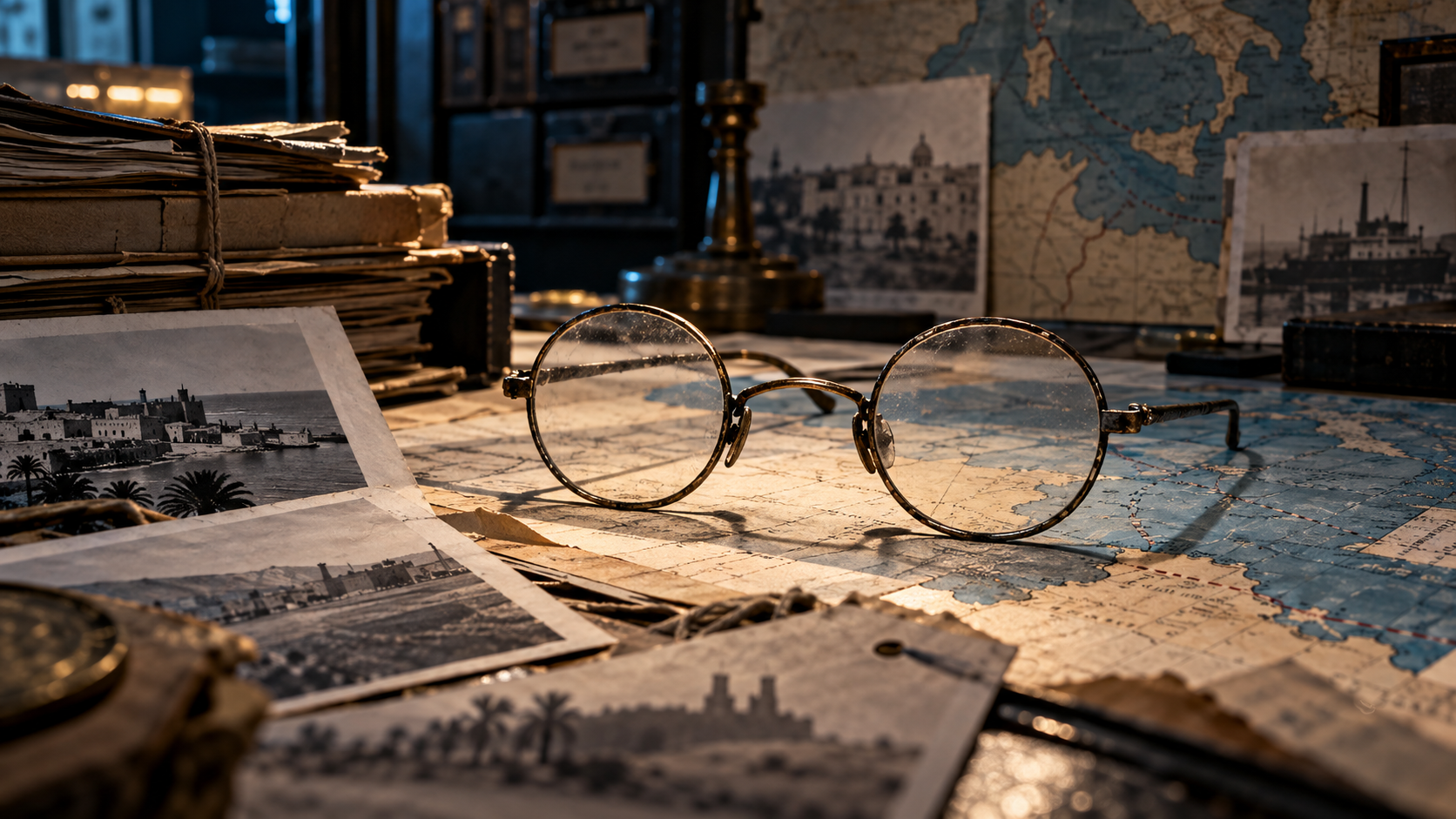
  • The Glasses of Omar al-Mukhtar: What the Evidence Can and Cannot Tell Us

    SYSTEMS & STRATEGY / THE CONTINUITY PROJECT / EVIDENCE NOTE 001

    A literature-based investigation into contested objects, colonial collections, restitution and the limits of provenance.

    Evidence Note 001
    Literature-based investigation
    Provenance unresolved

    A pair of glasses can survive its owner. Its story can survive even longer. But when different museums attribute different objects to the same historical figure, what exactly has been preserved: the original object, its memory, or a later claim?

    This note concerns objects attributed to Omar al-Mukhtar, the Libyan anti-colonial leader executed by Italian authorities in 1931. It does not establish that any identified pair belonged to him. It asks a narrower question: what can published scholarship, museum interpretation, public memory and journalism tell us about the competing stories, and where do those sources stop?

    A question of objects, and of stories

    Beatrice Falcucci’s 2024 study follows glasses attributed to al-Mukhtar as they appear in museums, in the antiquities trade, in writing and in film. Its central contribution is not an authentication. It is an account of how objects, copies and competing attributions can acquire different political and memorial meanings.1

    That distinction matters. An attribution can have real historical force without proving physical identity. A museum label can record how an object has been presented. A personal memory can preserve an important story. None of these, by itself, demonstrates that a present-day object is the same pair once worn by al-Mukhtar, or shows how it travelled from one holder to another.

    The Continuity Project therefore separates three questions that are often collapsed: whether an object is authentic, how an object came into a collection, and how a claim about an object has circulated. This article addresses the third question most directly. The first two remain open.

    Rome: an institutional setting, not a completed provenance

    Falcucci describes glasses attributed to al-Mukhtar in the former Museo Coloniale collections in Rome, now held within the Museo delle Civiltà. Her article treats the route to Rome cautiously, using language that signals an apparent rather than demonstrated transmission.1

    In 2023, the Museo delle Civiltà presented Malak Yacout’s Searching for Appendices to Truths Lost: The Broken Sunglasses of Omar Al Mukhtar, an installation with an artist’s book. The museum’s page says that Yacout’s research focused on sunglasses that most likely belonged to al-Mukhtar. It describes a maker’s mark on a leather case, research connected to Maroun Ayac in Alexandria, interviews with descendants, and a research conclusion about an interrogation by Rodolfo Graziani.2

    This is valuable research context. It is not an accession card, a custody record or a technical examination of the historical object. The museum page identifies a contemporary artwork and summarizes the artist’s investigation. It does not supply the documentary chain needed to identify a particular historical pair.

    Tripoli: a reported display, an unrecorded route

    Falcucci also describes a pair displayed at Tripoli’s Assaraya Alhamra, or Red Castle, museum as belonging to al-Mukhtar. Her earlier 2020 essay presented the same setting within a discussion of relics, display and public memory.13

    A 2026 report by Khalifa al-Bashbash for Libya Alahrar likewise describes a Tripoli label for historical glasses used by al-Mukhtar, while stressing the absence of a published object number, acquisition date, donor, or route into the museum. That absence does not prove the claim false. It means the claim cannot yet be tested as provenance.4

    Rome and Tripoli should therefore remain separate attributed-object leads. Published accounts provide reasons to research both. They do not establish that the two pairs are the same, that either descends from a documented 1931 pair, or that one travelled from Rome to Tripoli.

    Aleppo: an attribution history, not a third established object

    Falcucci records a 2015 Aleppo market story in which glasses were attributed to al-Mukhtar. The later Libya Alahrar report adds an important qualification: it reports that the holder interviewed by the journalist did not claim the pair was al-Mukhtar’s, but said it resembled a type of glasses that was common at the time.14

    The Aleppo account belongs in the history of attribution and circulation. It does not establish a third original pair, and it should not be used to settle the Rome or Tripoli question.

    The 1931 stories: source trails, not a recovered chain

    Falcucci cites Rodolfo Graziani’s 1932 account of glasses with gold temples and a silver case, and a published transcription of the Benghazi interrogation that refers to glasses lost in an earlier encounter. Those sources, if independently checked, could be relevant to an alleged predecessor pair. In this note they remain reported citations within Falcucci’s scholarship, not primary documents examined by Darja Rihla.1

    A relevant Libyan News Agency report shows how the battle-loss story functions in present national memory: it narrates spectacles lost in battle and later shown during captivity. It provides no archival citation or route to a museum object. Its value here is evidence of public memory, not evidence of physical transmission.5

    Translation adds another caution. Libya Alahrar reports that an Arabic translation of Graziani described a silver frame, while the Italian wording reproduced by Falcucci describes gold temples and a silver case. The Arabic edition itself has not been inspected for this note. The reported difference should be investigated, not converted into a material identification.

    1955: a documented research lead, not a demonstrated outcome

    Falcucci’s 2024 article gives the most precise published account of the 1955 question. She writes that the Museo Coloniale received a formal Libyan request for objects belonging to leaders of the resistance, with a list that included al-Mukhtar’s glasses and wallet. She cites two records in the MAI/Ufficio Studi series, dated 7 and 9 March 1955.1

    Falcucci further reports that Massimo Adolfo Vitale recorded informal ministerial willingness to return some objects while official instructions were still awaited. She then finds no further mention of the objects in the later ministerial files she reviewed. This is a carefully attributable scholarly finding. It is not the same as direct inspection of the correspondence, and it does not establish authorization, dispatch, receipt, refusal or return.

    The official Italian inventory adds a separate, useful locator: its printed page 59 records busta 17, fascicolo 174, “Materiale ceduto al governo libico,” with listed subfiles for returns and gifts, including a 1955 subfile. The inventory does not reveal the contents of those files or prove that any glasses were included.6

    These trails must remain separate until the archive establishes a documentary relationship between them. The 2020 Falcucci essay called the request apparently ignored. The 2024 article is more specific about informal willingness, pending instructions, and the end of the documented trail. Neither formulation permits a final conclusion about what physically happened to a pair of glasses.

    A competing account: two pairs, or a story seeking resolution?

    Paola Caridi has offered a striking journalistic account: Graziani brought two pairs, one for vision and one for sun, and Italy later returned one while retaining the other.7 If documented, that account could explain why attributed pairs appear in both Rome and Tripoli. But the article supplies no primary records, object numbers, or transfer documents for the two-pair route. It is therefore a hypothesis-generating narrative, not a solution.

    Its importance is methodological. A persuasive explanation should not be mistaken for evidence simply because it makes multiple facts appear to fit. The task is to ask what record would make the explanation testable: an accession entry, a dispatch list, a receipt, a contemporaneous photograph, or a material comparison.

    Five live hypotheses

    The Continuity Project keeps five rival explanations open. They are tools for avoiding a premature single story, not findings about the objects.

    • H-01: the Rome pair descends from a pair demonstrably connected to al-Mukhtar.
    • H-02: the Tripoli pair descends from such a pair.
    • H-03: the Rome and Tripoli pairs descend from different predecessor pairs.
    • H-04: one or both pairs preserve an attribution without demonstrated physical descent.
    • H-05: an earlier line ended and a later attribution or substitution created the appearance of survival.

    At present, the literature does not rank these hypotheses. The first two require object-specific documentation. The third and fifth cannot be resolved by narrative resemblance. The fourth is not a dismissal of memory; it is a reminder that the history of an attribution and the history of a material object can diverge.

    What the evidence can say now

    Published scholarship, museum research and Libyan reporting show that the glasses attributed to al-Mukhtar carry powerful and contested meanings across Rome, Tripoli and, in a different way, Aleppo. They also identify concrete paths for further research: the March 1955 MAI/Ufficio Studi records, the Museo Coloniale restitution files, and the independent collection records of each attributed pair.

    They do not establish physical identity, a continuous chain of custody, a transfer from Rome to Tripoli, or the outcome of the 1955 request. Those are not minor caveats. They are the boundary between a documented story about objects and a proven provenance for an object.

    That boundary is also the point of the investigation. The history of these glasses is not diminished by uncertainty. It becomes more legible when the sources that preserve memory, institutional attribution, archival reference and physical transmission are allowed to speak in their own, unequal registers.

    Notes and sources

    1. Beatrice Falcucci, “Una ‘reliquia coloniale’: Le apparizioni degli occhiali di Omar al-Mukhtar tra Roma e Tripoli,” Quellen und Forschungen aus italienischen Archiven und Bibliotheken 104 (2024): 102-121, especially pp. 113 and 116-121. The original archival documents cited in the article were not independently inspected for this note.
    2. Museo delle Civiltà, “Searching for Appendices to Truths Lost: The Broken Sunglasses of Omar Al Mukhtar”, work dated 2023.
    3. Beatrice Falcucci, “Gli occhiali di Omar Al-Mukhtar,” il lavoro culturale, 2020. This earlier essay belongs to the same authorial research family as note 1 and is not an independent confirmation.
    4. Khalifa al-Bashbash, “نظّارات عمر المختار.. سرّ بين روما وطرابلس,” Libya Alahrar, 16 September 2026. Arabic source; translations in this note are paraphrases.
    5. Soma Harb, “On the 95th Anniversary of His Martyrdom: Omar Al-Mukhtar Retains His Place in the National Memory,” Libyan News Agency, 16 September 2026.
    6. MAECI, Inventario Museo Coloniale, printed p. 59. The inventory is a finding aid, not the underlying dossier.
    7. Paola Caridi, “Le lenti scheggiate della nostra memoria,” L’Espresso, 16 August 2026. The two-pair account is reported here as journalism, not accepted as a demonstrated chain.
  • Omar al mukhtar glasses continuity investigation

    Omar al mukhtar glasses continuity investigation

    THE CONTINUITY PROJECT INVESTIGATION CH-001

    Research in progress

    The Glasses of Omar al-Mukhtar: Can an Object Survive a Historical Rupture?

    A research investigation into a difficult provenance question: not whether a later object resembles a remembered relic, but what evidence could connect it to a specified pair of eyeglasses through rupture, custody, institutional transfer and later attribution.

    01

    Are these Omar al-Mukhtar’s glasses?

    It is a deceptively simple question. A pair of eyeglasses can carry an attribution. It can appear in a collection, in a catalogue, in an institutional memory or in later retellings. None of those facts, by themselves, identifies a physical object across time.

    CH-001 begins by turning the question around. What evidence connects a later object to a specific pair demonstrably possessed by Omar al-Mukhtar before or at the time of his capture in 1931? The change matters. The first question asks for an answer. The second asks for a genealogy.

    That distinction is the working principle of The Continuity Project. Similarity is not continuity. Historical continuity requires demonstrated transmission.

    02

    The object is not the evidence

    A museum label can preserve an attribution. A later author can repeat it. An object can look compatible with a photograph, a remembered description or an expected period style. These are not trivial observations, but they do not demonstrate a path from one specified pair to another.

    For this investigation, a physical match and a provenance match are different propositions. Material clues may later narrow the field. A description, an accession number, a transfer list or an image may be relevant. Yet the Framework does not allow resemblance to stand in for descent. The relevant claim becomes stronger only when the path between predecessor and descendant is evidenced.

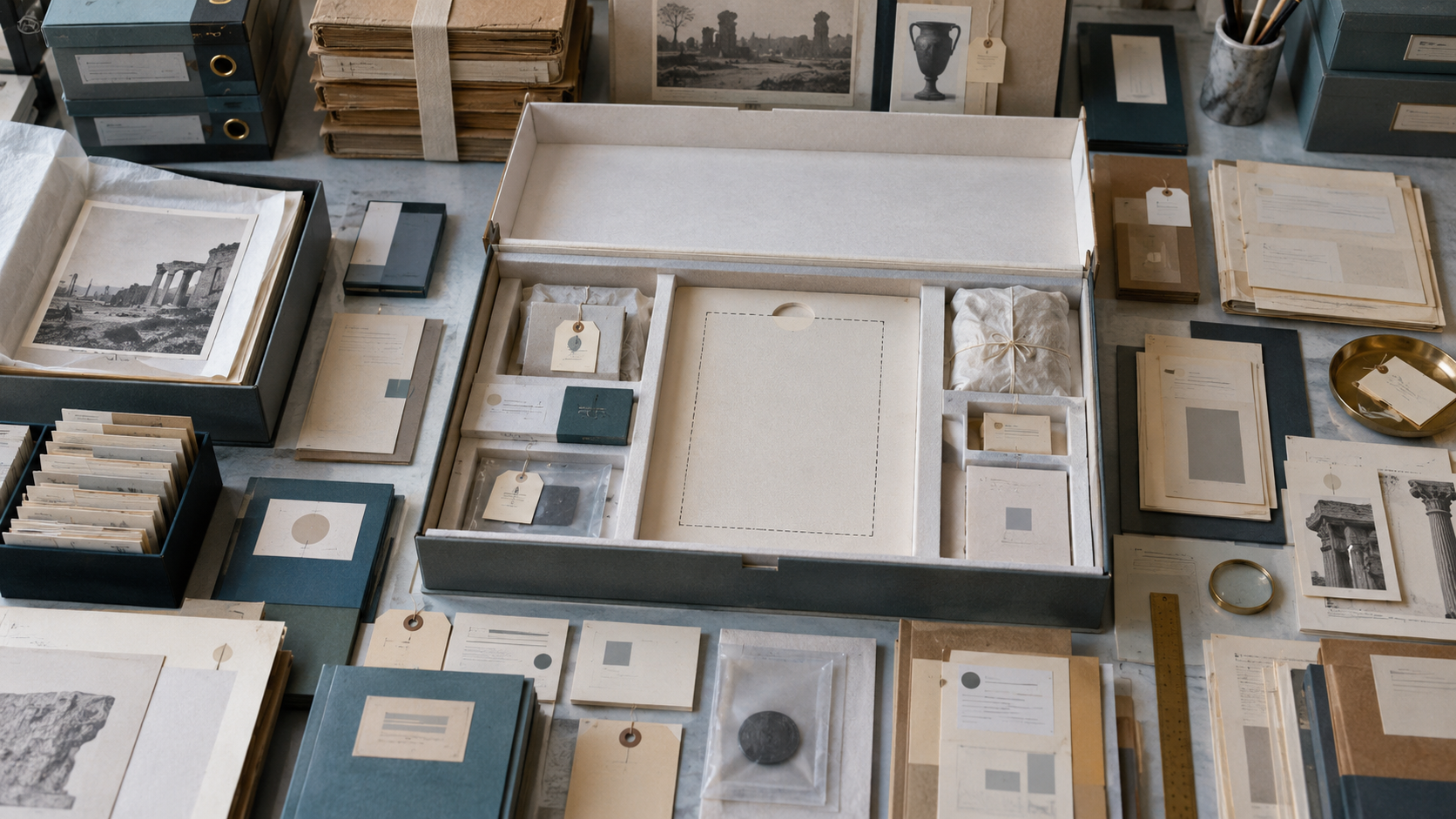
    Interpretative editorial illustration of an archive workspace with a deliberately empty object space among files and document boxes.
    Interpretative editorial image: an empty space in an archival workflow. It does not depict a known Omar al-Mukhtar object, file or archive.

    Historical continuity does not require identity across time. It requires demonstrable descent through transmission.

    03

    Specify the predecessor before following it

    The project does not test the broad phrase “the glasses of Omar al-Mukhtar.” Its frozen target property is the identity and provenance of a physical pair of eyeglasses formerly possessed by Omar al-Mukhtar. Physical custody, legal ownership, museum accession, attribution, symbolic meaning and classification as relic or museum object are deliberately kept separate.

    That separation prevents a common slide in provenance writing. A later institution may hold an object. The object may be called a relic. Its political or memorial meaning may be powerful. None of this alone answers whether it is the same physical pair.

    The case therefore names an alleged predecessor, A, and two candidate descendants: B-Rome, an object attributed in an Italian institutional collection, and B-Tripoli, an object attributed in a Libyan collection. The naming is not authentication. It is a way to make the question testable.

    04

    Rupture is not a single event

    A provenance problem can be obscured when the final capture is treated as the only relevant threshold. The Framework instead asks where an object’s route may have changed: loss, seizure, transport, cataloguing, reclassification, institutional transfer, archive administration or later attribution. Each is a possible event in a system, not proof that it happened to this specified object.

    For CH-001, the present records do not enter a custody chain, a transmission edge or a timeline event. The absence of entered evidence is not proof of disappearance. It means the physical route has not been demonstrated in the reviewed project records. The research task is to locate evidence that can discriminate between a gap and a documented passage.

    05

    Two candidate objects, one provenance problem

    The available case specification identifies a Rome-attributed object and a Tripoli-attributed object. It does not establish that either is authentic, that they are related, or that either descends from the same predecessor. It also leaves open the possibility of multiple predecessor pairs.

    This is why a single, elegant line of descent would be misleading. The evidence may ultimately identify one physical route, two separate routes, an attribution that travelled further than the object, or a claimed line that ended before a later substitution. The article does not add stories about other objects without a reviewed source. In particular, no local case record presently supports an Aleppo object, duplicated wallets, a maker mark, a case description or a photographic comparison.

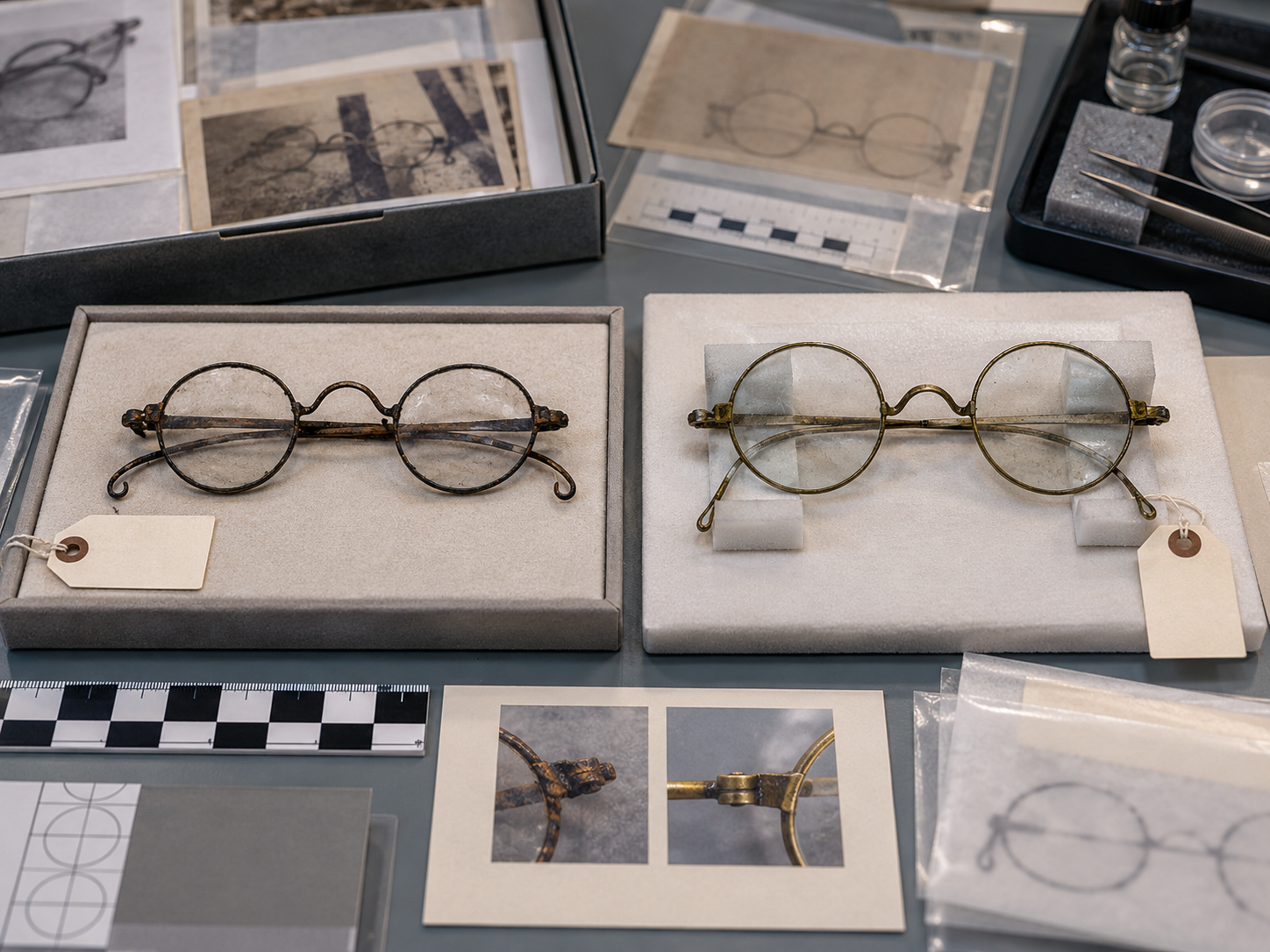
    Interpretative editorial illustration of two different pairs of antique eyeglasses arranged for archival comparison.
    Interpretative editorial image of competing object candidates. It is not a record of either CH-001 candidate object and does not establish a comparison result.

    06

    From personal possession to institutional meaning

    Objects do not cross historical ruptures alone. If a pair of eyeglasses moved, it would do so through carriers and mechanisms: people, military or administrative custody, cataloguing systems, museum practice, state files, transport and later memory institutions. This is the structural layer of the inquiry.

    At each point, the object can acquire another role. A personal possession could be described as captured material, an institutional object, a museum item, a political object or a memory object. These transformations matter for historical interpretation. They do not, however, bridge an unrecorded transfer. A change of label can preserve narrative continuity while leaving physical genealogy unresolved.

    Operational view

    Problem
    Not “which glasses are real?” but which specified descendant can be connected to which specified predecessor through demonstrated transmission.
    System
    Personal possession, possible loss or seizure, administration, museum acquisition, cataloguing, state custody, restitution process, national memory, provenance research.
    Weaknesses
    Provenance gaps, duplicate attributions, missing transfer records, catalogue dependence, source-lineage problems and archival silence.
    Leverage points
    Correspondence, accession registers, inventory numbers, object descriptions and cross-file references.

    07

    The continuity graph

    A continuity chain is a research procedure. A continuity graph is a representation of historical relationships. The graph below is intentionally incomplete: its unjoined branches are a record of what the present evidence environment does not demonstrate.

    The lines above are not claims of transfer. The 1955 node marks an inspection target, not a proven connection or outcome.
    Interpretative editorial illustration of a fragmented network of documents, places and unresolved connection points in blue and gold.
    Interpretative editorial image of a fragmented provenance network. It visualises the method’s unresolved branches; it is not a demonstrated CH-001 route.

    08

    The 1955 node is a target, not a conclusion

    The primary archival target is Archivio Storico Diplomatico del MAECI, IsIAO, Museo Coloniale, busta 17, fascicolo 174, with priority on sottofascicolo 3, “Restituzione e doni di materiale al governo libico,” dated 1955. The project records the locator. It does not record the contents of the dossier as inspected evidence.

    The provisionally accepted Phase 4A assessment classifies the 1955 restitution request as Demonstrated. That status does not identify the dossier’s uninspected contents here, and it does not establish an outcome for any specified object. A request is not authorization. Authorization is not dispatch. Dispatch is not receipt. Until the material is captured, read, critiqued and entered into the evidence ledger, U-07 remains a targeted unknown.

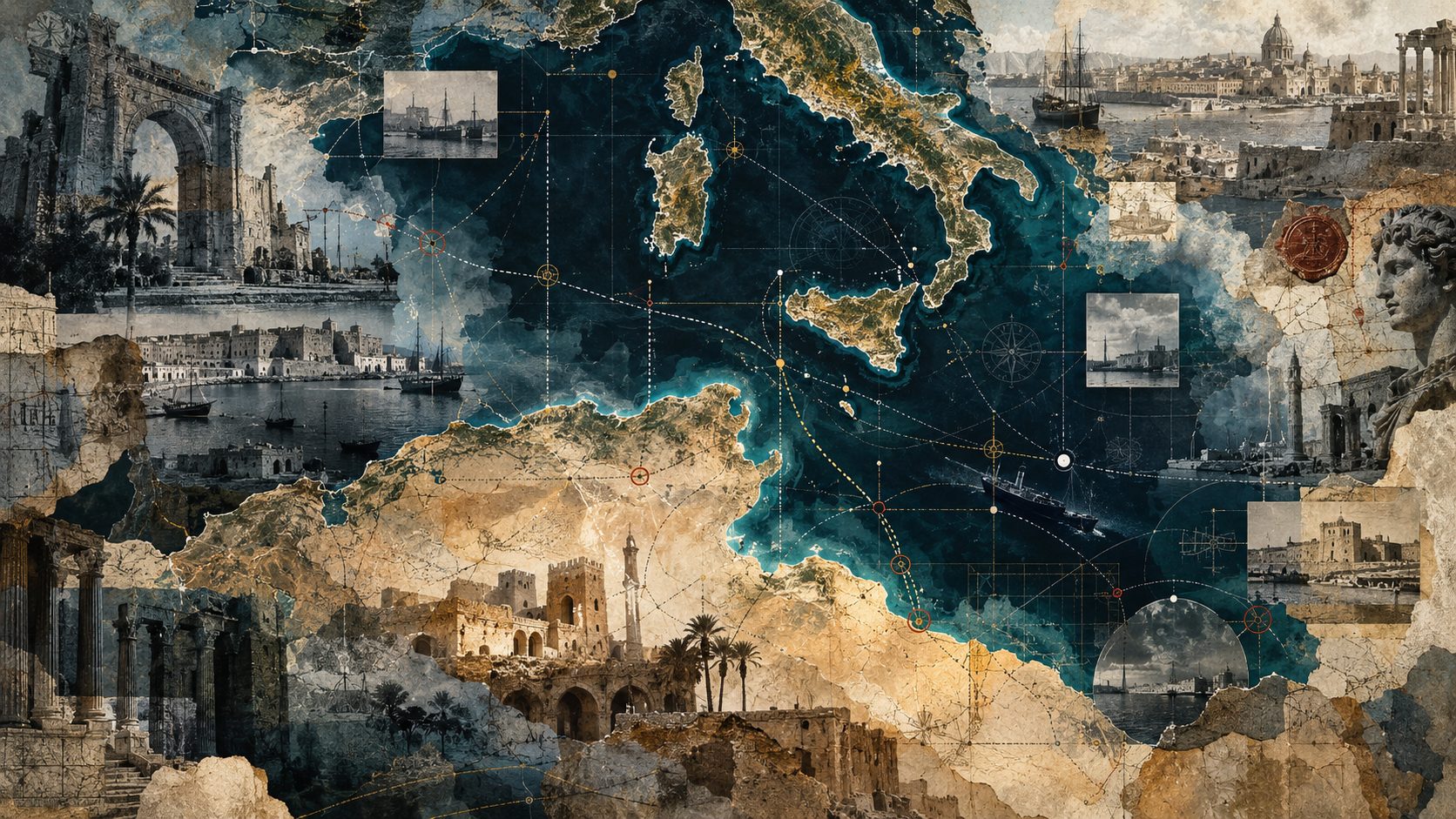
    Interpretative editorial collage of the Mediterranean with layered maps, ports, documents and interrupted route lines.
    Interpretative editorial map collage. It does not depict a proven route, transfer or restitution outcome for the object under investigation.

    09

    Physical continuity and narrative continuity

    Physical genealogy asks whether a later pair is the same physical pair, or a descendant of the specified predecessor through a documented transmission path. Attribution genealogy asks a different question: can the persistence of the statement “these are Omar al-Mukhtar’s glasses” itself be traced through catalogues, institutions and retellings?

    The second question may become answerable before the first. An attribution can have a history even where the physical provenance remains unresolved. That history can show how institutional meaning changed between colonial, postcolonial and contemporary settings. It cannot be silently promoted into physical continuity.

    This distinction also has a human dimension. An attributed relic can matter in public memory because it helps people encounter a historical figure, a struggle or a loss. The emotional and cultural force of that encounter does not remove the obligation to state what its evidence can and cannot carry.

    10

    Rival descent test

    The relevant question is not whether one preferred story sounds plausible. It is whether B could plausibly have arisen without transmission from A. The Framework therefore keeps competing explanations in view.

    1. H-01B-Rome descends from the specified predecessor.Undemonstrated
    2. H-02B-Tripoli descends from the specified predecessor.Undemonstrated
    3. H-03B-Rome and B-Tripoli descend from different predecessor pairs.Indeterminate
    4. H-04One or both later objects preserve attribution without demonstrated physical-object descent.Undemonstrated
    5. H-05A claimed line ended and a later attribution or substitution produced apparent survival.Undemonstrated

    These are not a ranking. They are a discipline against premature closure. The evidence may eventually support, narrow, disconfirm or leave any of them indeterminate.

    11

    What would falsify a claim?

    CH-001 must be able to fail. An incompatible accession history, a demonstrated earlier provenance to another owner, an impossible chronology, a documented separate pair, or records that contradict a proposed transfer route could disconfirm a specified genealogy. Positive evidence of destruction, loss, substitution or termination could establish discontinuity. Archival silence alone cannot do that work.

    The frozen protocol requires relevant chronology, component identity, property, rupture-crossing, transmission, extinction, rival-origin, independence, transformation and source-asymmetry tests. A compelling narrative that fails these tests remains a narrative, not a demonstrated descent.

    12

    The material object is evidence, when its evidence is available

    Physical descriptions, marks, cases, photographs and inventory identifiers could eventually help distinguish objects and narrow competing hypotheses. No such item is entered in the reviewed CH-001 evidence ledger for this build. The present article therefore does not infer a match from appearance, repeat an unverified detail or use an illustrative object as proof.

    Material evidence would be one part of a case. It would still need to sit beside custody, accession, transfer and source-lineage evidence. Material similarity alone does not demonstrate descent.

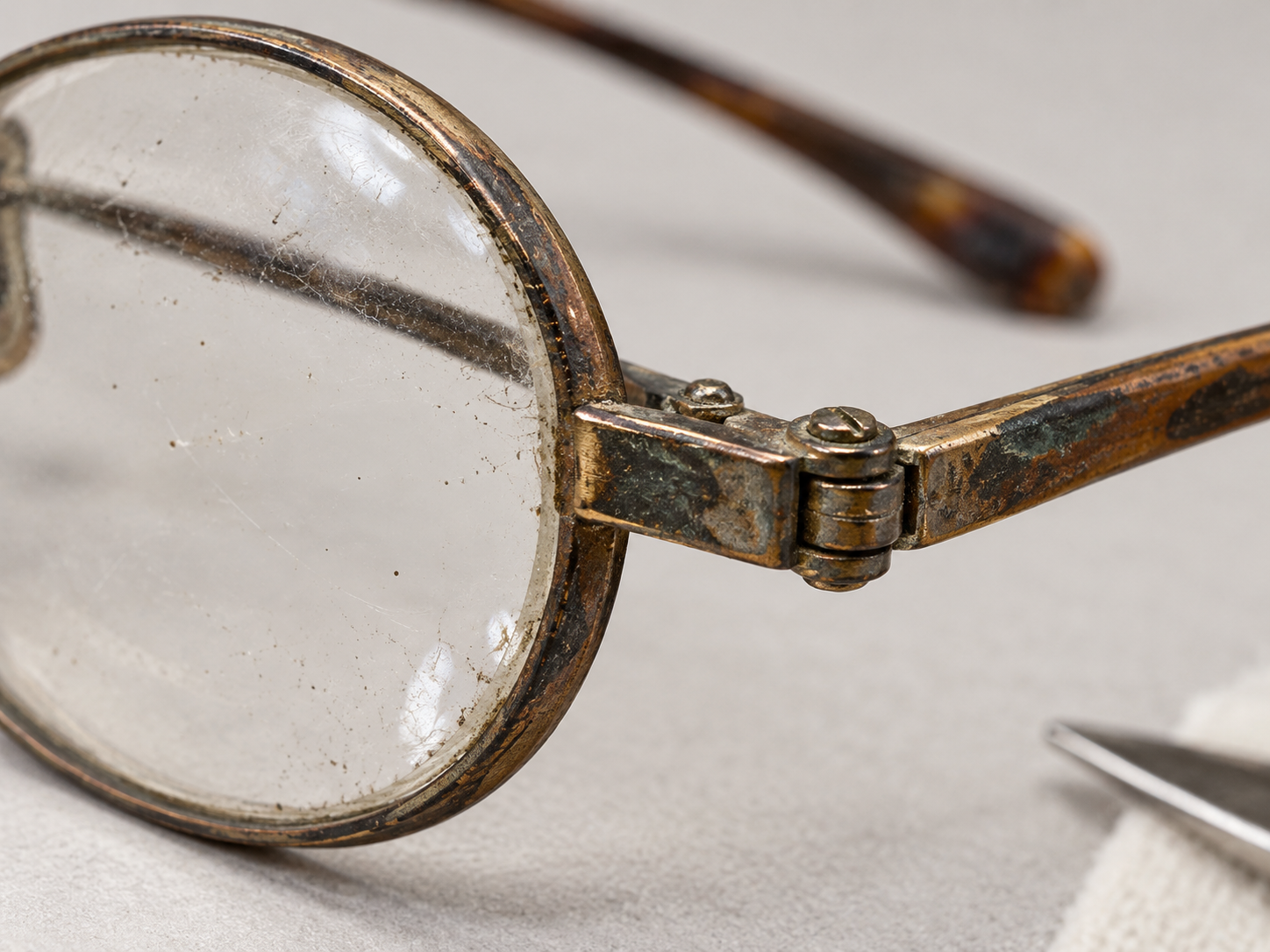
    Interpretative editorial close-up of the hinge of an aged pair of eyeglasses, showing patina and construction detail.
    Interpretative editorial image of material examination. This is not a photograph of a proven Omar al-Mukhtar artifact and does not support an identification claim.

    13

    Current assessment

    Known

    The pilot’s specified question, candidate nodes, methodological rules and archival locator are recorded.

    Supported

    The case requires a graph, rival testing and an object-specific distinction between attribution and physical provenance.

    Unknown

    The physical genealogy of B-Rome and B-Tripoli, their relation to each other, and the outcome of the 1955 process.

    Targeted unknown

    U-07: the relevant 1955 archival process, beginning with the priority file.

    The provisional Phase 4A assessment records the Rome-related chain as Plausible, pending Phase 4B; the Tripoli chain as Undemonstrated; and their relationship as Indeterminate. It records institutional custody as Strongly Supported where documented and legal ownership as Indeterminate where records do not determine title. Neither object can be presented as an authenticated historical pair. The 1955 outcome cannot be presented as a refusal or a return. The Framework cannot be presented as empirically validated. Those are boundaries of the investigation, not shortcomings to write around.

    14

    Phase 4B: targeted archival verification

    The next work is primary-document investigation. Capture comes before interpretation. Folder labels, covers, complete rectos, relevant versos, stamps, signatures, marginalia, lists, receipts, acknowledgements, object identifiers and cross-references must be preserved before a document is reduced to a claim.

    Public-safe capture identifiers follow the frozen pattern B17-F174-S3-DOC###-P##. Intake metadata should record title, date, sender, recipient, folio, stamps, object identifiers, inventory identifiers and cross-references. Only then can a source be assessed for what it establishes, what it does not establish and which edges it affects.

    Evidence lineage is central. Repeated statements are not independent confirmation when they derive from the same unexamined source. The research flow is therefore: claim, source, source lineage, property, custody event, transmission event, rival explanation and archival test.

    15

    What this case tests

    CH-001 tests more than a difficult object genealogy. It tests whether rival explanations can be held open without flattening the historical stakes, whether a provenance gap can be stated plainly, and whether a framework can guide evidence acquisition without inventing evidence it does not have.

    Framework v0.9 is frozen for empirical validation. It is not a verdict awaiting decorative confirmation. It is a set of rules being stressed by a real research problem: historical continuity does not require identity across time. It requires demonstrable descent through transmission.

    Systems & Strategy is the parent world for this inquiry. The Continuity Project asks its questions at the object level first, then follows only the connections that the evidence can bear.

    Research note

    This investigation is ongoing. Conclusions may change as new primary-source evidence is inspected.

    This article is a local publication candidate based on reviewed records in the Darja Rihla Continuity Project. It does not report the contents of uninspected archival material.