Tag: system dynamics

  • The Hidden Logic of Complex Systems | How Systems Really Work

    The Hidden Logic of Complex Systems | How Systems Really Work

    Darja Rihla Systems Thinking

    The Hidden Logic of Complex Systems

    Why outcomes in complex systems rarely follow the intentions of the people inside them, and why the modern world increasingly punishes linear thinking.

    Article Type Systems essay
    Core Lens Feedback, emergence, incentives
    Applies To Institutions, markets, platforms, policy
    Reading Time 12 min read
    Core principle Intentions fail When structures, incentives, and interactions overpower individual plans.
    Driver Feedback loops Outputs do not end the process. They alter the next round.
    System effect Emergence Patterns appear that no participant explicitly designed.
    Strategic lesson Read structure Outcomes make more sense when you follow relationships, not events.

    Opening observation

    Modern life runs on systems we rarely see clearly. Governments operate through bureaucratic systems. Economies move through financial systems. Platforms scale through algorithmic systems. Even daily routines are shaped by networks of incentives and habits that become invisible through repetition.

    Yet these systems keep producing outcomes that surprise the people inside them. Policies generate unintended consequences. Technologies reorganize social behavior. Institutions built to solve problems begin reproducing them in new forms.

    The hidden logic of complex systems begins where intention stops being enough.

    01 · Context

    The World We Built Runs on Systems

    At first glance, many outcomes in society look like the result of individual decisions. A company launches a product. A government introduces regulation. A platform deploys an algorithm. These moves are easy to narrate because they can be attached to visible actors.

    But once we step back, patterns emerge that no single decision can explain. Financial crises rarely happen because one person failed. They emerge through networks of expectations, leverage, incentives, and mutual dependence across thousands of actors. Each participant may behave rationally inside a local context while the broader system drifts toward fragility.

    The same holds for digital platforms. Social media systems did not begin with the explicit goal of destabilizing discourse. Yet the interaction between ranking algorithms, user behavior, monetized attention, and emotional contagion produced precisely the kinds of environments that reward amplification over reflection.

    Systems become decisive when the pattern matters more than any single participant.
    02 · Structure

    When Intentions Collide with System Behavior

    One of the most persistent misunderstandings about complex systems is the assumption that outcomes follow intentions. In simple systems that often seems true. Replace a broken part in an engine and the machine may work again. Cause and effect remain close together.

    In complex systems, causality is distributed. Reforms introduced to improve efficiency can interact with institutional culture, hidden incentives, informal power networks, and reporting metrics in ways that produce the opposite of what leaders wanted. A policy can be sincere and still fail because the system it enters is already configured to reinterpret, resist, or distort it.

    Once structures, feedback, and incentives begin interacting, the system develops a logic of its own. Participants still matter, but they no longer control the full field of consequences.

    Linear thinking
    • Looks for one clear cause
    • Assumes direct chains of effect
    • Focuses on visible actors
    • Overestimates intention
    • Misreads delayed consequences
    Systems thinking
    • Tracks distributed causality
    • Follows networks of interaction
    • Reads structures and incentives
    • Expects unintended outcomes
    • Looks for propagation patterns
    In complex systems, what people want and what the system produces are often different questions.
    03 · Mechanism

    The Role of Feedback Loops

    A key part of hidden system logic is the presence of feedback loops. Outputs do not simply conclude a process. They return to influence future behavior. Some loops stabilize a system. Others accelerate it toward instability.

    A thermostat offers the simplest case. Temperature falls, heating activates, equilibrium is restored. But social, financial, and digital systems are rarely so clean. There, feedback often reinforces behavior instead of dampening it.

    Financial markets provide a classic example. Rising prices attract new investors. New capital pushes prices even higher. The increase itself becomes evidence in favor of the trend. What began as movement becomes belief, and belief feeds further movement. The system amplifies itself.

    Online platforms work similarly. Content that triggers high engagement receives wider distribution. Wider distribution creates further engagement. The loop rewards intensity, speed, outrage, and emotional charge because those behaviors fit the internal metric logic of the platform.

    signal reaction amplification reinforcement new baseline
    System warning Small inputs can create disproportionate outcomes when a reinforcing loop is already in motion.
    A system reveals its priorities through the behaviors its feedback loops repeatedly reward.
    04 · Emergence

    When the Whole Becomes Something Else

    Another defining characteristic of complex systems is emergence. Emergence appears when the interactions between many components generate patterns that cannot be explained by inspecting the parts in isolation.

    Cities are a familiar example. No single planner determines the exact cultural, economic, or social identity of a large metropolis. Yet through migration, infrastructure, capital flows, informal behavior, and daily coordination, a city develops a recognizable character and systemic logic of its own.

    Digital networks behave the same way. Millions of users interact through simple interface rules, yet the aggregate result can reshape elections, cultural trends, social norms, and political discourse. The whole becomes something that no individual user intended to build.

    Emergent behavior often surprises designers because it is not coded directly. It arises from relationships. A system is never just a collection of parts. It is a field of interactions.

    Emergence begins where interaction starts producing realities that no participant explicitly authored.
    05 · Institutions

    Institutions as Systems of Incentives

    Institutions such as governments, corporations, financial markets, and platforms do not simply contain behavior. They shape it. Their hidden logic often lives inside incentive structures more than inside mission statements.

    If an organization rewards quarterly performance above long-term resilience, people will optimize for immediate gain. If a platform rewards engagement above truth, content will gradually adapt toward attention capture. If a bureaucracy rewards procedural compliance above strategic learning, reports may improve while reality worsens.

    Over time, institutions become ecosystems optimized around their internal reward architecture. From the outside this can look irrational. From the inside it often feels normal because each local actor is responding to what the system makes legible, measurable, and desirable.

    Government

    Compliance over consequence

    When systems reward procedural success more than real-world outcomes, institutions can look orderly while problems deepen underneath the reporting layer.

    Platform

    Attention over accuracy

    Once engagement becomes the dominant metric, the platform does not merely host behavior. It gradually selects for emotionally efficient content.

    Market

    Yield over resilience

    Short-term reward systems routinely compress risk visibility. Fragility becomes visible only after the reinforcing loop has matured.

    Organization

    Metrics over mission

    Teams rarely betray goals on purpose. They adapt to what gets measured, promoted, funded, and defended.

    Institutions do not simply express values. They operationalize incentives.
    06 · Case Studies

    Three Real-World System Patterns

    Cybersecurity

    Supply-chain exposure

    One trusted vendor can become an attack path into thousands of organizations. Local trust creates global vulnerability when dependency chains are tightly coupled.

    Finance

    Bubble mechanics

    Expectation attracts capital. Capital lifts price. Price validates expectation. By the time the narrative breaks, the system has already built its own instability.

    Platforms

    Outrage amplification

    Emotion drives interaction. Interaction drives visibility. Visibility rewards emotional formatting. The platform optimizes what users slowly become.

    A modern system often fails at the point where local efficiency creates network-wide fragility.
    07 · Psychology

    The Limits of Linear Thinking

    One reason the hidden logic of systems remains difficult to see is that human intuition favors linear explanations. We prefer stories with one cause, one decision point, and one identifiable actor. These narratives are cognitively cheap and morally satisfying.

    Complex systems rarely cooperate with that preference. Small changes can produce large consequences if they propagate through tightly connected networks. Large interventions can produce weak results if the structural configuration remains unchanged. Delays, loops, indirect effects, and hidden constraints all obscure straightforward causality.

    This mismatch between human intuition and systemic reality is one reason policy failures, technological misjudgments, and strategic errors recur so often. We keep acting as if events are primary when structure is often the more powerful layer.

    The mind wants a story. The system runs on interactions.
    08 · Reflection

    Seeing the Structure Beneath Events

    When viewed from a systems perspective, many recurring historical patterns begin to look less mysterious. Economic cycles, platform crises, political polarization, institutional drift, and technological disruption often emerge from tensions already embedded within the system itself.

    Growth creates pressure. Innovation rearranges incentive structures. Networks amplify some behaviors while muting others. Over time the accumulation of interactions alters the trajectory of the whole.

    Recognizing these dynamics does not eliminate uncertainty. Complex systems remain partly unpredictable because they evolve through countless distributed interactions. But structural understanding gives us something more useful than false certainty. It gives pattern recognition.

    And pattern recognition changes what becomes thinkable, actionable, and visible.

    Systems thinking does not promise perfect prediction. It offers deeper intelligibility.
    09 · Final position

    The Defensible Claim

    My position is that the hidden logic of complex systems lies in the relationships between their parts, not in the intentions of the individuals moving inside them. Outcomes emerge through the interaction of incentives, feedback loops, network effects, and institutional constraints. This is why modern societies repeatedly misread their own crises. They explain events at the level of actors while the decisive logic operates at the level of structure. Those who focus only on events remain trapped in reaction. Those who understand systems begin to see where change truly begins.

    10 · FAQ

    Frequently Asked Questions

    Why do complex systems create unintended consequences?

    Because many interacting components alter one another over time. A decision enters an environment shaped by incentives, hidden constraints, delays, and feedback loops. The result is rarely a direct extension of the original intention.

    What is emergence in a complex system?

    Emergence is the appearance of larger patterns that cannot be explained by examining individual parts in isolation. The pattern exists because of interaction, not because any single element contains the whole design.

    Why do institutions behave irrationally?

    They often behave rationally relative to their internal metrics and incentive structures while producing outcomes that appear irrational from the outside. The mismatch comes from what the institution optimizes for.

    Explore the full Systems Thinking pillar

    Continue through Darja Rihla’s systems essays on complex systems, feedback loops, emergence, institutions, and structural analysis.
    Darja Rihla · Systems Thinking · Premium Editorial Layout
  • Feedback Loops in Systems: The Invisible Force Behind Complex Systems

    Feedback Loops in Systems: The Invisible Force Behind Complex Systems

    Darja Rihla Systems Thinking

    Feedback Loops in Systems

    The invisible engine behind growth, stability, collapse, and emergence across markets, institutions, technologies, ecosystems, and everyday life.

    Core concept Circular causality
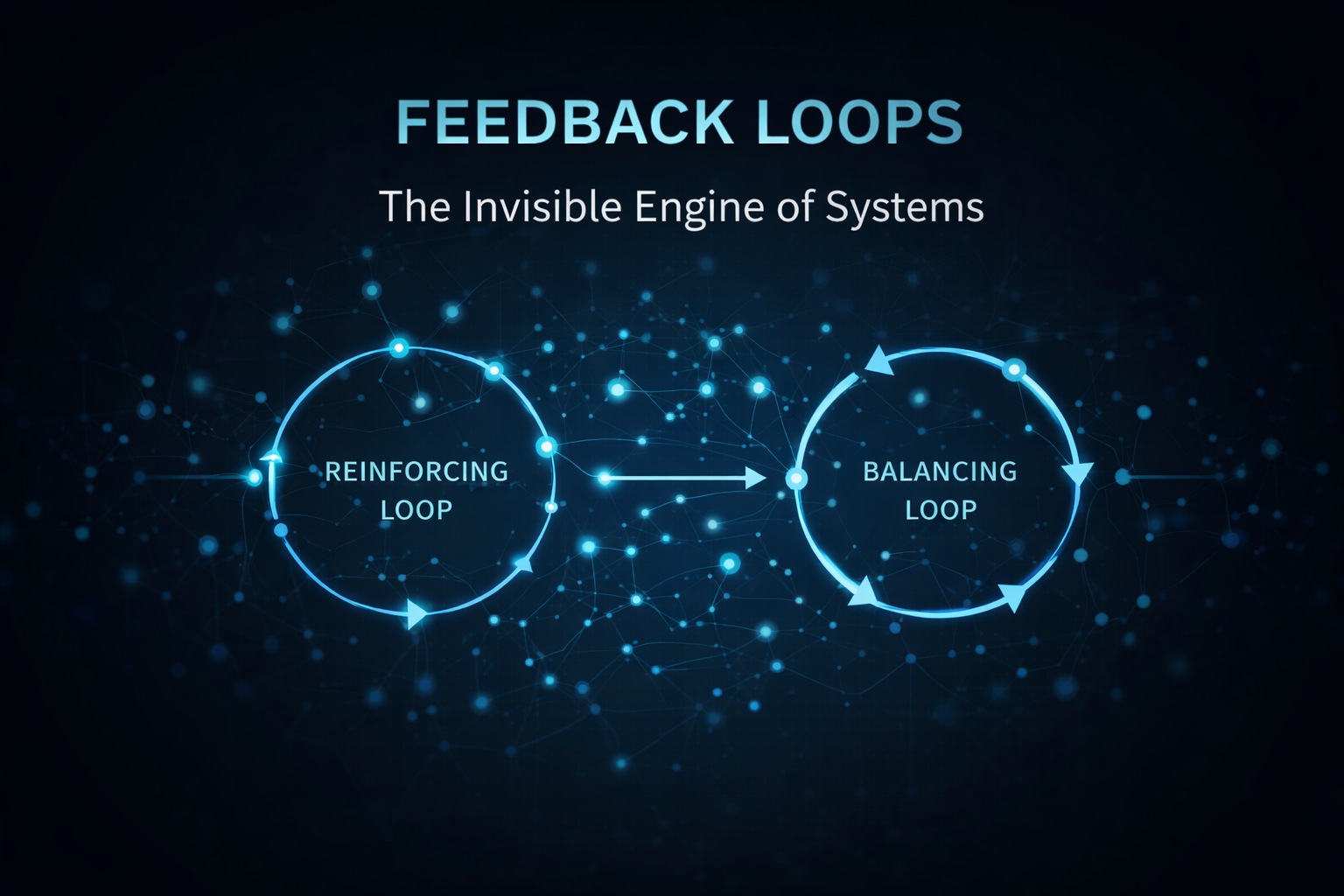
    Loop types Reinforcing + balancing
    Applies to Systems, markets, habits
    Reading time 9 min read
    Mechanism Feedback Outputs re-enter the system and shape what happens next.
    Loop A Reinforcing Amplifies movement, growth, bubbles, and virality.
    Loop B Balancing Pushes the system back toward equilibrium.
    Result Emergence Complex patterns arise from recursive interaction.
    01 · Introduction

    The Hidden Engine of Complex Systems

    Feedback loops are one of the most important mechanisms in systems thinking. Many systems appear stable and predictable on the surface, yet beneath that stability lies a structure that continuously reshapes behavior.

    Governments, companies, ecosystems, digital platforms, and even personal routines all depend on feedback. These loops determine whether a system corrects itself, accelerates, or drifts into collapse.

    If you understand the feedback structure, you begin to understand the system itself.
    02 · Definition

    What Is a Feedback Loop?

    A feedback loop occurs when the output of a system influences its future behavior. Instead of a straight line of cause and effect, the relationship becomes circular.

    action result feedback new action

    This circular structure exists in biological systems, economic networks, organizations, ecosystems, and technological infrastructures. Without feedback, systems cannot adapt or regulate themselves over time.

    03 · Core types

    Two Fundamental Types of Feedback

    Type A

    Reinforcing loops

    These loops amplify movement in the same direction. They accelerate growth, virality, speculation, momentum, and sometimes collapse.

    Type B

    Balancing loops

    These loops stabilize the system by counteracting drift and pushing behavior back toward equilibrium.

    Every complex system is shaped by the tension between amplification and correction.
    04 · Reinforcement

    Reinforcing Feedback Loops

    Reinforcing loops amplify change. The result of an action increases the probability that the same action will happen again.

    growth more resources more growth
    Platforms

    Social media algorithms

    Content receives engagement, the algorithm boosts visibility, and the added visibility generates even more engagement.

    Economy

    Economic growth

    Investment increases productivity, which increases profits, enabling further investment.

    Finance

    Asset bubbles

    Rising prices attract buyers, pushing prices even higher until confidence breaks.

    Reinforcing loops often produce exponential behavior, both positive and destructive.
    05 · Stabilization

    Balancing Feedback Loops

    Balancing loops act as correction mechanisms. They reduce drift and move the system back toward equilibrium.

    change correction stabilization
    Biology

    Body temperature

    Sweating and shivering regulate body heat to maintain internal stability.

    Markets

    Supply and demand

    High prices suppress demand, low prices stimulate it, creating market correction.

    Organizations

    Operational controls

    Monitoring and corrective processes prevent drift in large institutions.

    Balancing loops do not remove change. They shape the boundaries within which change remains stable.
    06 · Systemic risk

    When Feedback Loops Become Dangerous

    Poorly designed feedback structures can create systemic failure. Policy incentives, financial leverage, and algorithmic amplification often contain hidden reinforcing loops.

    Examples include subsidy cycles, speculative bubbles, panic selling, and political polarization on digital platforms.

    Systems often fail not because of one event, but because loops intensify the event over time.
    07 · Emergence

    Feedback Loops and Emergence

    Feedback loops are central to emergence. Simple local interactions can create sophisticated collective behavior.

    Ant colonies, cities, digital ecosystems, and financial markets all exhibit emergent order driven by recursive signals and repeated feedback.

    Emergence is what feedback looks like at scale.
    08 · Everyday systems

    Seeing Feedback Loops in Daily Life

    Feedback loops also shape habits and routines.

    Exercise increases energy, energy improves motivation, and motivation reinforces the habit. Stress can create negative loops that intensify unhealthy behavior.

    Recognizing these structures helps design better personal systems and routines.

    09 · Conclusion

    Why Feedback Is Central to Systems Thinking

    Feedback loops are the hidden engines of complex systems. Reinforcing loops accelerate change. Balancing loops maintain stability.

    Together they explain how systems grow, stabilize, adapt, and sometimes collapse.

    Once you begin to see feedback loops, it becomes difficult to see systems any other way.

    Continue the systems pillar

    Move deeper into how complex systems behave through hidden logic, emergence, and structural dynamics.

    Darja Rihla · Feedback Loops · Premium Systems Editorial
  • How to Build Personal Systems That Actually Work

    How to Build Personal Systems That Actually Work

    Personal systems · Systems & Strategy · Apply

    Build for the day you actually have.

    Personal systems work when they support action on ordinary days, including days with limited energy, attention or time. Trace one recurring outcome, find the structure producing it, and change one relationship you can observe for seven days.

    Start with the system canvas

    When an outcome repeats, look beyond the latest event.

    A missed workout, an unfinished task or an evening lost to distraction can look like a single failure. Repetition changes the question. What keeps producing this outcome? Which conditions arrive before it? What reward, delay or friction keeps the pattern in place?

    This page turns the ideas in Why Systems Thinking Matters in a Complex World into a small practice. You do not need to redesign your life. You need one recurring outcome, enough evidence to describe it, and one bounded intervention.

    What personal systems actually contain

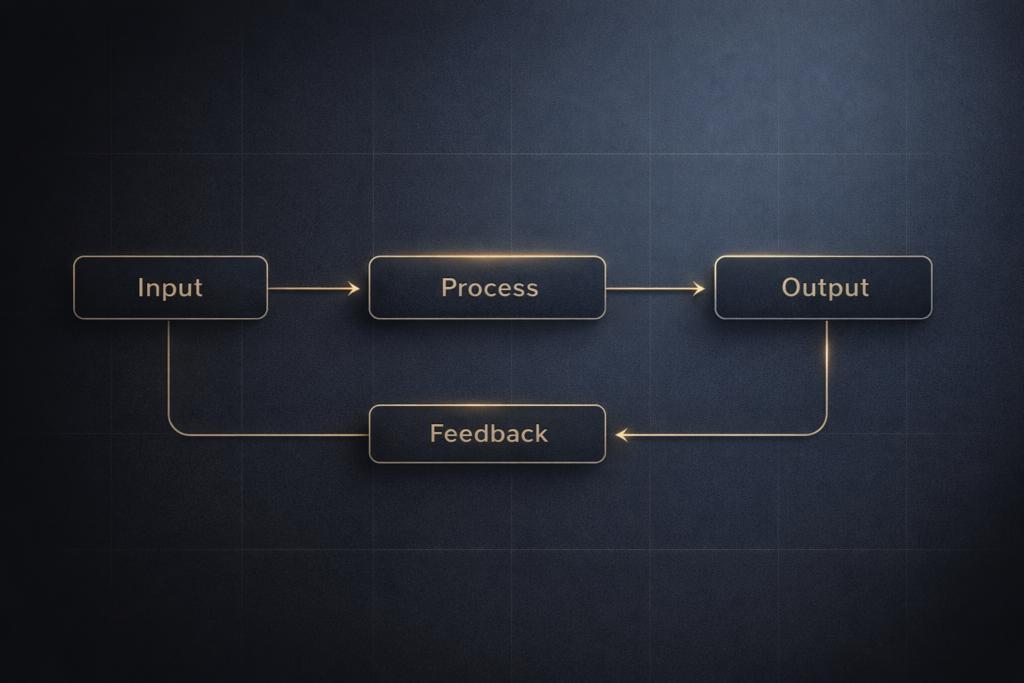
    A to-do list records tasks. A routine repeats actions. Personal systems connect the conditions that feed those actions with the feedback that helps you adjust them.

    1. InputTime, energy, attention and resources
    2. ProcessCues, habits, workflows and boundaries
    3. OutputThe observable result the system produces
    4. FeedbackEvidence used to keep, adjust or stop

    Five patterns that make a system look like a personal failure.

    These patterns are diagnostic prompts, not psychological diagnoses. More than one may be active at the same time.

    1. 01

      The museum problem

      The system was built for a life, workload or energy level that no longer exists.

    2. 02

      The showcase problem

      The tools and workflow look complete, but execution requires too many steps.

    3. 03

      Willpower dependency

      The desired action has no support when energy or attention is limited.

    4. 04

      The missing trigger

      Nothing reliably connects the intended action to a time, place or preceding event.

    5. 05

      The vague inventory

      Items such as “fix finances” hide several undefined decisions and next actions.

    Expressive breakdown of personal systems as connected structures breaking around a central point
    Expressive layer. A visual metaphor from the original draft for a system whose relationships are breaking down; it is not a diagnostic model.

    Trace the route from signal to review.

    Move in order. Each stage changes the object you are looking at: from a felt problem to evidence, structure, action and learning.

    1. STATE → EVIDENCE

      Name the recurring outcome

      Write what repeatedly happens without turning it into a verdict about your character. Use an observable sentence: “I begin important work after 11:00,” not “I am lazy.”

      Write
      One outcome you can observe.
      Avoid
      Identity labels and explanations you have not tested.
    2. EVIDENCE → SEQUENCE

      Find the pattern around it

      Look at three recent occurrences. Note what happened before, during and after. Repetition matters more than a perfect explanation.

      Before
      Time, place, cue, available energy and competing demands.
      After
      Immediate relief, reward, delay or new pressure.
    3. SEQUENCE → STRUCTURE

      Map what keeps the pattern alive

      Separate parts from relationships. A phone, a deadline and tiredness are parts. “Late work increases tiredness; tiredness increases avoidance; avoidance creates later work” is a reinforcing relationship.

      • What makes the unwanted action easy?
      • What makes the wanted action difficult?
      • Which delay hides the consequence?
      • Where does the system reward the current pattern?
    4. STRUCTURE → ACTION

      Change one relationship

      Choose an intervention small enough to test and close enough to the structure to matter. Change a cue, reduce friction, shorten a delay, add a boundary or make feedback visible.

      • Trigger: what will make the first action visible at the right moment?
      • Minimum version: what can still be completed on a low-energy day?
      • Friction: which unnecessary step can be removed?
      • Feedback: what simple signal will show whether the change helped?

      Do not ask, “What is the ideal routine?” Ask, “Which relationship can I change this week?”

    5. ACTION → LEARNING

      Review evidence, not motivation

      After seven days, compare the outcome with your baseline. Keep the change if the relationship improved. Adjust it if the signal moved but the cost was too high. Stop it if it produced no useful change.

      Keep
      The outcome improved without unacceptable cost.
      Adjust
      The direction is useful, but the design needs refinement.
      Stop
      The intervention did not affect the relationship you mapped.
    Illustrative comparison between a tangled network and an orderly connected structure
    Expressive comparison. The image contrasts tangle and order. Real personal systems remain adaptive and imperfect; the ordered side is a metaphor, not the required end state.

    From “I never start on time” to a testable change.

    Before

    A character verdict

    “I need more discipline. Tomorrow I will force myself to start early.”

    No evidence · no boundary · no review signal

    After

    A bounded intervention

    “For seven days, the first work file stays open before I leave the desk. The phone charges outside the room. I record the actual start time.”

    Changed cue · reduced friction · visible evidence

    What changed? Not the ambition. The relationship between the evening environment, the morning cue and the first action.

    Run one seven-day experiment.

    Use paper, a note app or a calendar. The tool is secondary; the observation is the work.

    1. 01

      Outcome

      Write one repeated result in observable language.

    2. 02

      Baseline

      Record three recent examples or the current frequency.

    3. 03

      Relationship

      Draw one “more of this leads to more or less of that” connection.

    4. 04

      Intervention

      Change one cue, friction, delay, boundary or feedback signal.

    5. 05

      Review

      Choose in advance what will make you keep, adjust or stop it.

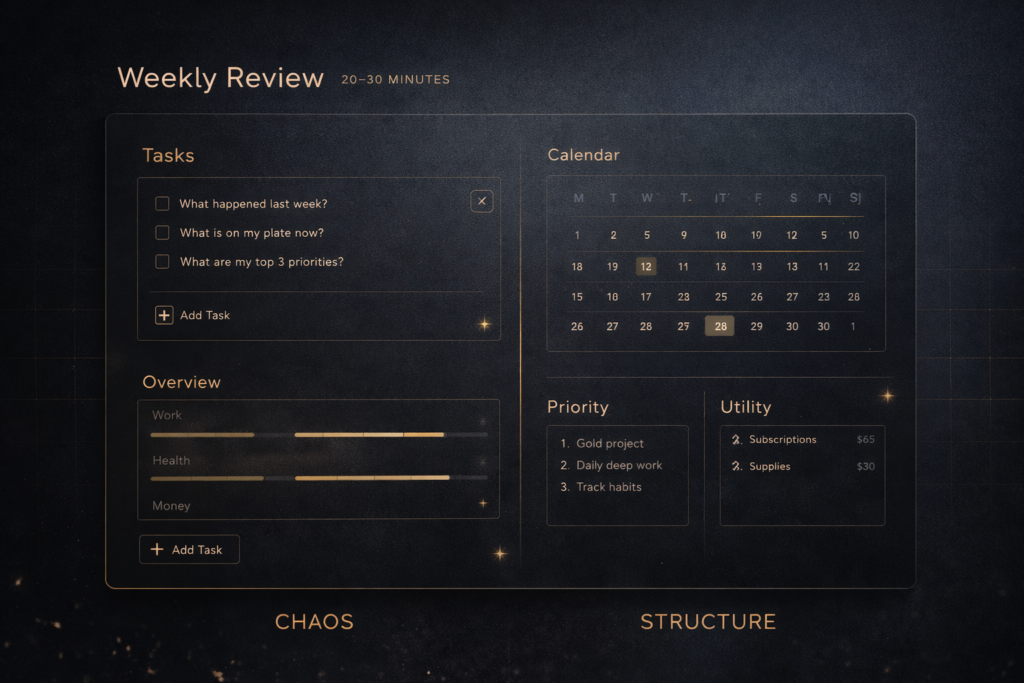
    Weekly review

    Use five questions to turn activity into feedback.

    1. What actually happened?
    2. What is on my plate now?
    3. What matters most next?
    4. What can I remove?
    5. What should I keep, adjust or stop?
    Stylised dark weekly review interface with task, calendar, priority and overview areas
    Reference illustration from the original draft. It visualises review categories only; it is not a functioning dashboard and its displayed entries are not user data.

    Use the cluster when your map needs more depth.

    These are separate reading objects, so they are presented as a compact set of linked articles—not as steps you must complete first.

    A useful system makes the better action easier to repeat—and easier to evaluate.

    The best personal systems do not demand perfect motivation. Choose one outcome, map one relationship and run one bounded experiment.

    Return to Systems & Strategy