Personal systems · Systems & Strategy · Apply
How to Build Personal Systems That Actually Work
Build for the day you actually have.
Personal systems work when they support action on ordinary days, including days with limited energy, attention or time. Trace one recurring outcome, find the structure producing it, and change one relationship you can observe for seven days.
Start with the system canvas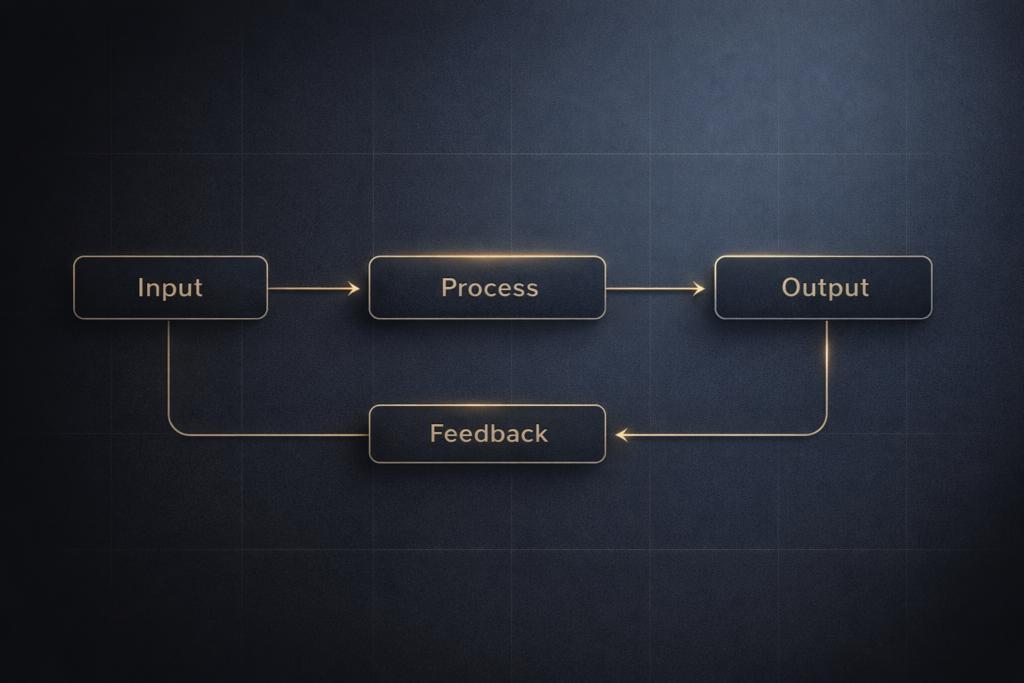
From intention to structure
When an outcome repeats, look beyond the latest event.
A missed workout, an unfinished task or an evening lost to distraction can look like a single failure. Repetition changes the question. What keeps producing this outcome? Which conditions arrive before it? What reward, delay or friction keeps the pattern in place?
This page turns the ideas in Why Systems Thinking Matters in a Complex World into a small practice. You do not need to redesign your life. You need one recurring outcome, enough evidence to describe it, and one bounded intervention.
A working definition
What personal systems actually contain
A to-do list records tasks. A routine repeats actions. Personal systems connect the conditions that feed those actions with the feedback that helps you adjust them.
- InputTime, energy, attention and resources
- ProcessCues, habits, workflows and boundaries
- OutputThe observable result the system produces
- FeedbackEvidence used to keep, adjust or stop
Diagnose before you build
Five patterns that make a system look like a personal failure.
These patterns are diagnostic prompts, not psychological diagnoses. More than one may be active at the same time.
- 01
The museum problem
The system was built for a life, workload or energy level that no longer exists.
- 02
The showcase problem
The tools and workflow look complete, but execution requires too many steps.
- 03
Willpower dependency
The desired action has no support when energy or attention is limited.
- 04
The missing trigger
Nothing reliably connects the intended action to a time, place or preceding event.
- 05
The vague inventory
Items such as “fix finances” hide several undefined decisions and next actions.

The system canvas
Trace the route from signal to review.
Move in order. Each stage changes the object you are looking at: from a felt problem to evidence, structure, action and learning.
-
STATE → EVIDENCE
Name the recurring outcome
Write what repeatedly happens without turning it into a verdict about your character. Use an observable sentence: “I begin important work after 11:00,” not “I am lazy.”
- Write
- One outcome you can observe.
- Avoid
- Identity labels and explanations you have not tested.
-
EVIDENCE → SEQUENCE
Find the pattern around it
Look at three recent occurrences. Note what happened before, during and after. Repetition matters more than a perfect explanation.
- Before
- Time, place, cue, available energy and competing demands.
- After
- Immediate relief, reward, delay or new pressure.
Need the vocabulary? See how interacting parts form a complex system.
-
SEQUENCE → STRUCTURE
Map what keeps the pattern alive
Separate parts from relationships. A phone, a deadline and tiredness are parts. “Late work increases tiredness; tiredness increases avoidance; avoidance creates later work” is a reinforcing relationship.
- What makes the unwanted action easy?
- What makes the wanted action difficult?
- Which delay hides the consequence?
- Where does the system reward the current pattern?
Deepen the map with Feedback Loops in Systems and Emergence in Complex Systems.
-
STRUCTURE → ACTION
Change one relationship
Choose an intervention small enough to test and close enough to the structure to matter. Change a cue, reduce friction, shorten a delay, add a boundary or make feedback visible.
- Trigger: what will make the first action visible at the right moment?
- Minimum version: what can still be completed on a low-energy day?
- Friction: which unnecessary step can be removed?
- Feedback: what simple signal will show whether the change helped?
Do not ask, “What is the ideal routine?” Ask, “Which relationship can I change this week?”
For the deeper principle, continue to The Hidden Logic of Complex Systems.
For a related external model of prompts and ability, see Stanford Behavior Design Lab’s Fogg Behavior Model.
-
ACTION → LEARNING
Review evidence, not motivation
After seven days, compare the outcome with your baseline. Keep the change if the relationship improved. Adjust it if the signal moved but the cost was too high. Stop it if it produced no useful change.
- Keep
- The outcome improved without unacceptable cost.
- Adjust
- The direction is useful, but the design needs refinement.
- Stop
- The intervention did not affect the relationship you mapped.
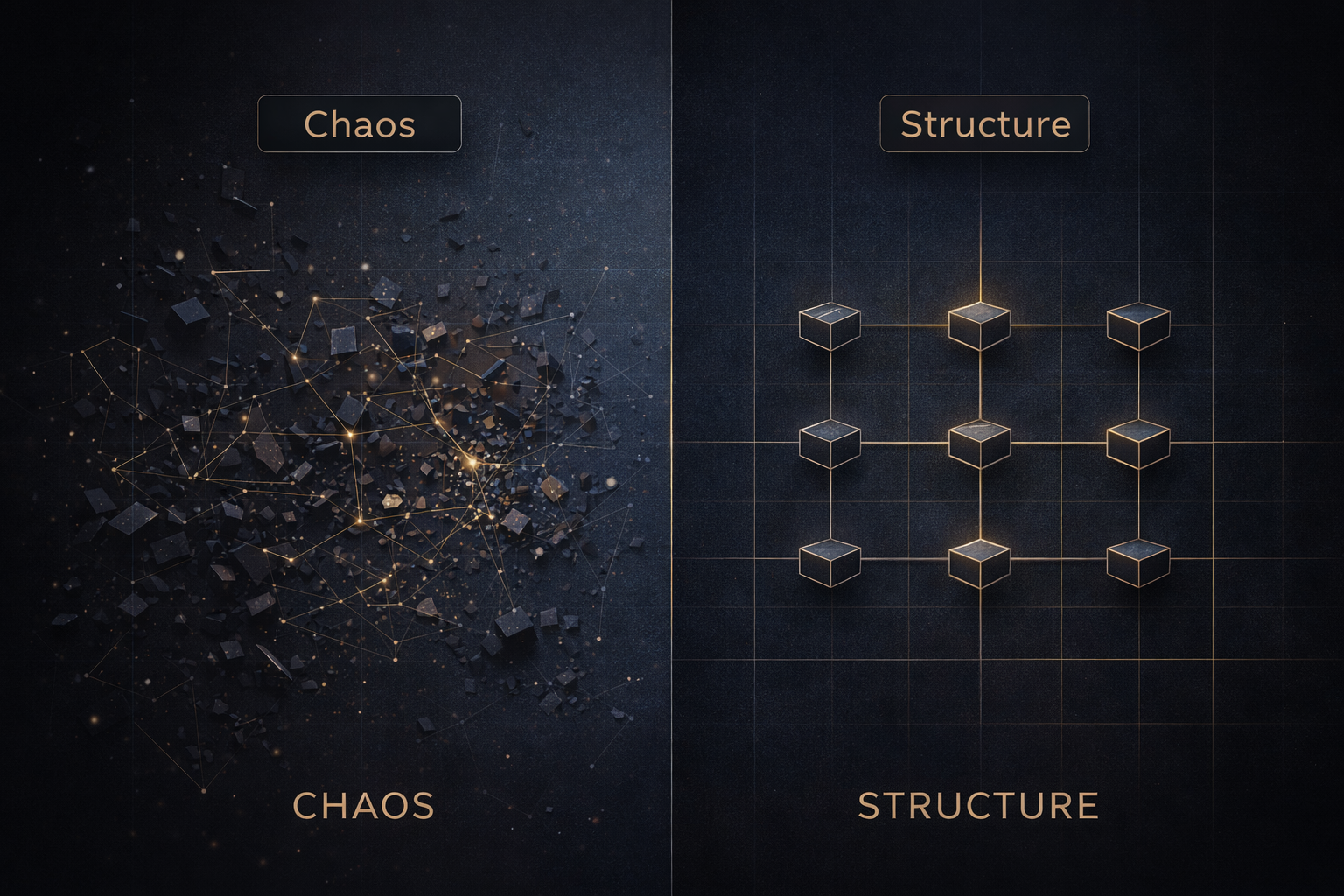
Worked example
From “I never start on time” to a testable change.
Before
A character verdict
“I need more discipline. Tomorrow I will force myself to start early.”
No evidence · no boundary · no review signal
After
A bounded intervention
“For seven days, the first work file stays open before I leave the desk. The phone charges outside the room. I record the actual start time.”
Changed cue · reduced friction · visible evidence
What changed? Not the ambition. The relationship between the evening environment, the morning cue and the first action.
Apply
Run one seven-day experiment.
Use paper, a note app or a calendar. The tool is secondary; the observation is the work.
- 01
Outcome
Write one repeated result in observable language.
- 02
Baseline
Record three recent examples or the current frequency.
- 03
Relationship
Draw one “more of this leads to more or less of that” connection.
- 04
Intervention
Change one cue, friction, delay, boundary or feedback signal.
- 05
Review
Choose in advance what will make you keep, adjust or stop it.
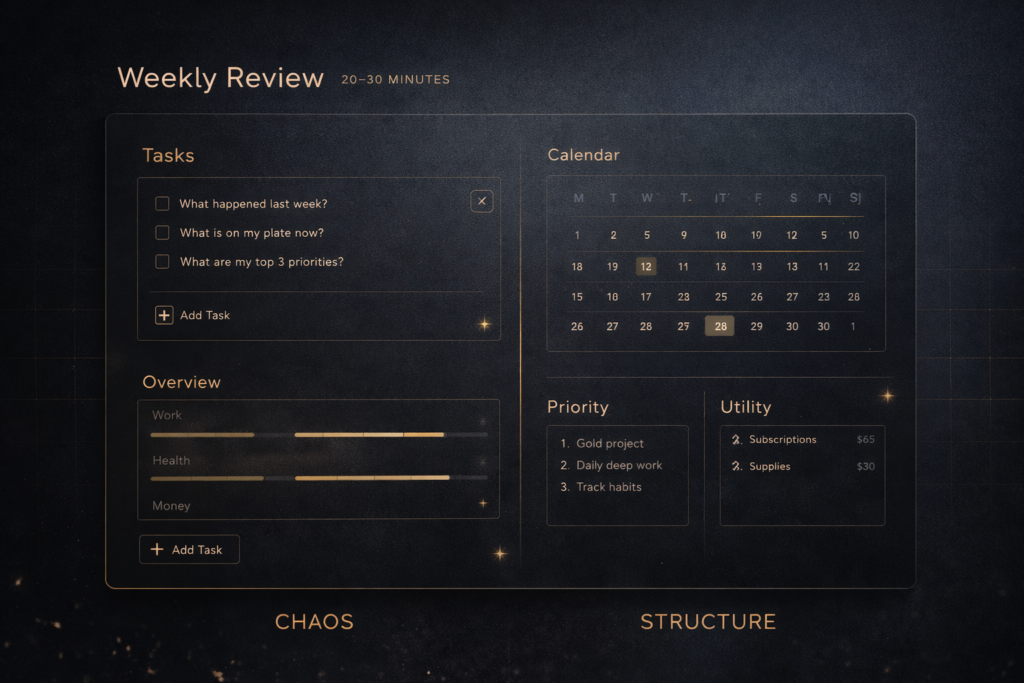
Weekly review
Use five questions to turn activity into feedback.
- What actually happened?
- What is on my plate now?
- What matters most next?
- What can I remove?
- What should I keep, adjust or stop?
Continue learning
Use the cluster when your map needs more depth.
These are separate reading objects, so they are presented as a compact set of linked articles—not as steps you must complete first.
Boundary & interaction
What Is a Complex System?
Use this when you are unsure what belongs inside your map.
Cause & feedback
Feedback Loops in Systems
Use this when a pattern appears to reinforce or correct itself.
Unexpected outcomes
Emergence in Complex Systems
Use this when no single part seems to control the result.