Kairouan and Islamic Civilization: The City That Built North Africa
- 01 · ObservationKairouan Islamic Civilization: The core claim
- 02 · ContextWhy Kairouan Islamic Civilization emerged here
- 03 · StructureWho built the machine, and who profits
- 04 · InstitutionsHow Kairouan Islamic Civilization actually worked
- 05 · NarrativeWhat the dominant story omits
- 06 · PsychologyWhy the erasure is accepted
- 07 · Systemic DynamicsWhy it does not self-correct
- 08 · PositionThe defensible claim
Kairouan and Islamic Civilization: The City That Built North Africa
How a frontier military camp became the institutional engine of an entire civilization, and why that story has been systematically compressed.
Uqba ibn Nafi
years of Maliki law
not episode
Most educated Western readers can name Carthage. They can sketch its location, recall something about Hannibal and Roman salt, and place it within a familiar story of Mediterranean rivalry.
Far fewer understand how Kairouan Islamic Civilization shaped the legal, scholarly, and urban foundations of North Africa. Kairouan Islamic Civilization produced institutions that shaped an entire region for a millennium after Carthage had been erased from the map, and it registers almost nowhere in mainstream historical education. That asymmetry is not an accident. It is the starting point for everything this article argues.
This is not a chronology. Chronologies are for encyclopedias. This is a systems investigation: how a city becomes a civilizational engine, who builds that engine, what keeps it running, and what it produces that outlasts every dynasty that touched it.
Kairouan Islamic Civilization did not emerge as a decorative chapter in medieval history. It emerged as a durable institutional system.
To understand Kairouan Islamic Civilization properly is to understand how North Africa generated institutions, not merely how it received them from elsewhere.
This is structural historical intelligence applied to civilizational analysis. If you work in policy, education, or cultural strategy, the full research archive goes deeper.
Kairouan Islamic Civilization: The Core Claim
Kairouan was not simply a city. It was a convergence machine: the point where military conquest, religious legitimacy, legal standardization, hydraulic infrastructure, and scholarly production reinforced one another into a self-sustaining civilizational system.
It did not merely survive the Arab conquest of North Africa. It institutionalized that conquest into something durable enough to outlast the conquerors themselves. That is why Kairouan Islamic Civilization must be studied as an institutional engine rather than as a medieval episode.
Why Kairouan Islamic Civilization Emerged Here, and Why Then
The year is 670 CE. The Arab general Uqba ibn Nafi is advancing into Ifriqiya, the Roman provincial designation for the territory that is now roughly Tunisia and eastern Algeria. The Mediterranean coast is dangerous: Byzantine naval power still operates from the sea, and coastal cities are vulnerable to counterattack.
The Berber population of the interior is not yet consolidated under any external authority. The strategic calculus is clear: establish a base that is defensible, central, and capable of projecting control inland without exposure to maritime assault.
Kairouan is founded inland, on the edge of the steppe, at a junction of routes connecting sub-Saharan trade networks to the Tunisian littoral and beyond. It has no natural harbor, no river, no obvious geographic gift.
What it has is position: equidistant from pressure points, removed from coastal risk, surrounded by territory that can be organized rather than merely occupied. This is a foundational lesson in how power actually works. The most consequential cities are rarely the most aesthetically endowed. They are placed at the right leverage point within a system of flows: trade, military movement, agricultural surplus, communication.
Kairouan is the answer to a geopolitical problem. That it became a cultural force of the first order is precisely what makes it worth studying.
The Mediterranean world of the seventh century is in systemic transition. Byzantine authority is contracting. Sassanid Persia has collapsed. The new Islamic caliphate is expanding not merely through military pressure but through an institutional logic that integrates conquered populations into a legal, fiscal, and religious order. North Africa is the western frontier of that expansion. Kairouan Islamic Civilization begins at exactly this pressure point between conquest and durable order.
Kairouan Islamic Civilization matters because it turned a frontier base into a self-reinforcing urban system.
Click any card to reveal deeper context
The Founding
Uqba ibn Nafi establishes Kairouan as the military and administrative base for the Arab conquest of Ifriqiya.
The inland location was deliberate: Byzantine naval power made coastal cities dangerous. Kairouan was designed for durability, not aesthetics. The name itself derives from an Arabic word for camp or caravan resting place.
↩ Click to returnAghlabid Dynasty
The Aghlabids use Kairouan to legitimize autonomous rule, commissioning the Great Mosque and hydraulic infrastructure.
Nominally vassals of Baghdad, the Aghlabids were in practice autonomous rulers who built prestige through architecture and scholarship rather than military conquest alone. Their cisterns still stand outside the city today.
↩ Click to returnSahnun and the Mudawwana
Sahnun ibn Said systematizes Maliki jurisprudence into the Mudawwana al-Kubra, the foundational legal text of the western Islamic world.
The Mudawwana is not an import. It is a North African legal product adapted to local conditions: Berber property structures, specific trade patterns, agrarian realities. It remains the dominant legal school across the Maghreb and West Africa today.
↩ Click to returnBeyond the Dynasty
The Fatimids displace the Aghlabids, but Kairouan’s legal and scholarly influence continues independently of dynastic control.
This is the critical proof of institutional depth: Kairouan’s influence persists across multiple dynasty changes. Legal traditions travel in human brains, not in palace archives. The scholars Kairouan trained dispersed the city’s civilizational logic across a continent.
↩ Click to returnThe Founding
The inland location was deliberate: Byzantine naval power made coastal cities dangerous. The name itself derives from an Arabic word for camp or caravan resting place.
Aghlabid Dynasty
Nominally vassals of Baghdad, the Aghlabids were in practice autonomous rulers who built prestige through architecture and scholarship. Their cisterns still stand today.
Sahnun and the Mudawwana
The Mudawwana is a North African legal product adapted to local conditions. It remains the dominant legal school across the Maghreb and West Africa today.
Beyond the Dynasty
Legal traditions travel in human brains, not in palace archives. The scholars Kairouan trained dispersed its civilizational logic across a continent regardless of who held political power.
Who Built the Machine, and Who Profits
Power in Kairouan is never held by a single actor. That is precisely why it lasts. The city functions through the simultaneous operation of four distinct structural actors, each with separate interests, each reinforcing the others in ways that produce systemic stability.
The Aghlabid dynasty, which consolidates control over Ifriqiya from 800 CE onward, is the most visible actor. They are nominally vassals of the Abbasid Caliphate in Baghdad but in practice autonomous rulers who use Kairouan to establish legitimacy in their own right.
They commission the expansion of the Great Mosque, fund hydraulic infrastructure, and patronize scholars whose legal rulings lend religious authority to Aghlabid governance. The dynasty profits from Kairouan’s prestige. It absorbs the cost in the form of constant negotiation with jurists who retain the power to delegitimize rulers who deviate too far from religious norms.
The jurists and scholars, centered on the Maliki tradition brought from Medina and systematized by Sahnun, constitute a second power center. They are not merely advisors. They produce binding legal opinions, train successive generations of legal scholars, and extend Kairouan’s intellectual reach across the Maghreb and into Andalusia.
They profit from state patronage and the prestige that proximity to a great mosque confers. They absorb the risk of proximity to political power, which occasionally demands they validate what they cannot justify.
The urban merchant class, less visible in the historical record but essential to the city’s material functioning, profits from stable law, predictable courts, and physical infrastructure. The Aghlabid state and the legal institutions provide exactly that.
Merchants fund mosques, scholars, and the urban fabric that makes the city operative. They absorb the costs of taxation and dynastic instability. The military and administrative apparatus maintains the physical perimeter within which civilizational production becomes possible.
No single actor can dismantle the system unilaterally, because no single actor controls all of its layers. The durability of Kairouan Islamic Civilization came from the interaction between rulers, jurists, merchants, and infrastructure. This is institutional resilience by design, even if that design is emergent rather than intentional.
Kairouan Islamic Civilization became durable because no single institution carried the city alone; the strength came from the mesh between authority, law, commerce, and urban survival.
How Kairouan Islamic Civilization Actually Worked
The Great Mosque of Kairouan is not primarily a religious building. That framing, while not inaccurate, is radically insufficient. It is a political instrument, a legal institution, an educational complex, and an urban anchor simultaneously.
At the center of Kairouan Islamic Civilization stood not one monument, but a coordinated institutional logic.
The Mosque as Power Declaration
Every expansion of the Great Mosque is a declaration of dynastic authority encoded in stone. The ruler who builds a great mosque controls the sacred geography of the city. When Aghlabid emirs commissioned successive expansions across the ninth century, they were making a claim on the right to govern, not expressing personal piety.
The Mosque as Court System
The scholars who sit in its arcades produce binding interpretations of Islamic law governing property, inheritance, marriage, commerce, and criminal procedure across Ifriqiya and, eventually, the entire Maghreb. The legal tradition that Sahnun systematizes in the ninth century is a North African product that survives to this day.
The Mosque as Knowledge Engine
The mosque generates a continuous supply of trained legal scholars, imams, administrators, and teachers who distribute the institutional logic of Kairouan across an entire region. Knowledge does not stay in the mosque. It travels through the scholars trained there, carrying legal norms and institutional frameworks into every city they subsequently inhabit.
Water as Political Statement
The Aghlabid basins, a two-basin hydraulic architecture drawing water from sources up to 36 kilometers distant, are not irrigation ditches. They produce permanence. A city that guarantees water supply in a semi-arid environment can grow, house scholars, sustain markets. The basins are the precondition for everything else. An emir who builds aqueducts demonstrates the long-term governance horizon that distinguishes a functioning state from a predatory extractive apparatus.
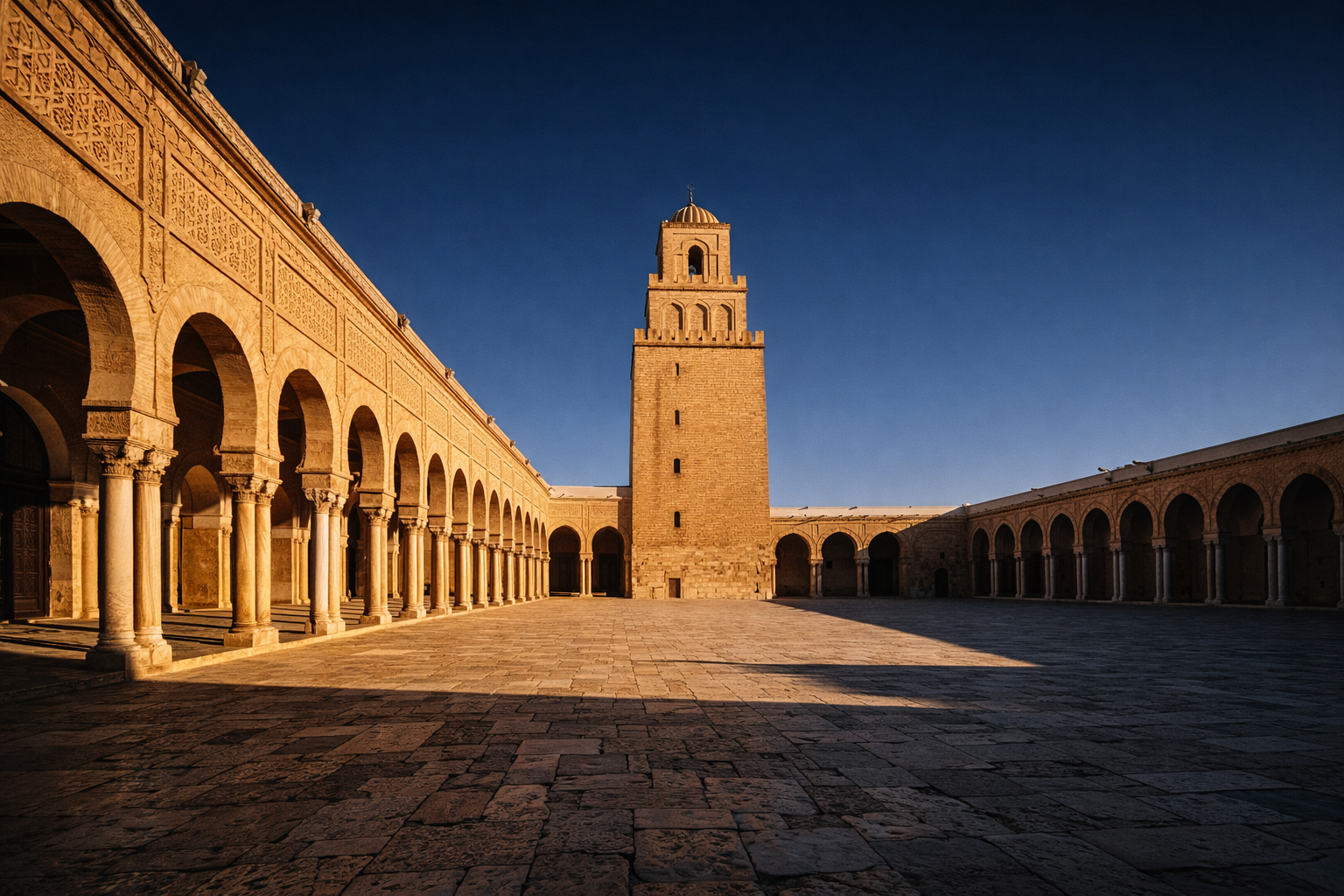

If the mosque is the hardware of Kairouan’s civilizational machine, Maliki jurisprudence is the software. The decision to adopt and then systematize the Maliki legal school is one of the most consequential institutional choices in the region’s history.
What Sahnun does is not reproduce Malik’s positions. He adapts, systematizes, and localizes them, producing a legal compendium that addresses the specific conditions of North African society: its Berber populations, its particular property structures, its trade relationships, its agrarian patterns. The Mudawwana is a North African legal product that happens to draw on Arabian sources.
Legal standardization across Ifriqiya means predictable contracts, enforceable property rights, regularized inheritance procedures. These are the conditions that make large-scale commerce possible, that make urban growth sustainable, and that make Kairouan’s influence exportable.
Wherever Maliki-trained scholars go, they carry a legal operating system that enables the same institutional conditions that produced Kairouan’s success. This is the mechanism by which a single city extends its civilizational influence across a continent without military conquest. The mosque was one of the central operating cores of Kairouan Islamic Civilization.
The enduring reach of Kairouan Islamic Civilization came from this fusion of architecture, jurisprudence, education, and urban infrastructure.
This level of structural analysis runs across the full Darja Rihla research series on Tunisia, North Africa, and Islamic civilizational history. Access the complete archive.
What the Dominant Story Omits About Kairouan Islamic Civilization
The dominant Western historical narrative about North Africa performs a specific and revealing compression. It moves from the fall of Roman Carthage in 439 CE to the Arab conquest of the seventh century in a handful of paragraphs, treats the Islamic period as a transitional phase before the arrival of the Ottomans, and then accelerates toward European colonial contact as the next moment of historical significance.
Kairouan Islamic Civilization, in this narrative structure, is an interruption rather than a protagonistic force.
What is structurally absent is the concept of North Africa as an institutional producer rather than an institutional receiver. Kairouan does not merely absorb Islamic civilization as it travels westward. It transforms it: adapts the Maliki legal school to North African conditions, produces original jurisprudence, trains scholars who reshape legal practice in Andalusia and sub-Saharan Africa, and generates an architectural tradition that becomes a template for mosques and cities across the western Islamic world.
The asymmetry is not neutral. A civilization whose institutional contributions are systematically erased from the educational record is a civilization whose contemporary descendants are implicitly denied a claim to intellectual and institutional depth.
Why do Western audiences know Carthage but not Kairouan? Because Roman and Punic history are integrated into a European civilizational self-image in which the Mediterranean is a lake the West owns. Kairouan requires a different frame entirely: one in which North Africa is a primary producer of institutional knowledge, not a secondary recipient of it. That frame is not comfortable for the institutions that built the existing curriculum, and so it does not get built.
Any serious account of North Africa that omits Kairouan Islamic Civilization is not just incomplete; it is structurally distorted.
Why the Erasure Is Accepted
The acceptance of this historical compression operates through three well-documented mechanisms. The first is the familiarity heuristic: Western audiences have been exposed to Roman and Greek history through centuries of formal education, classical literature curricula, and popular media. Carthage fits into a familiar narrative framework.
Kairouan has no equivalent cultural presence in the Western canon. No prestige television series has dramatized the Aghlabid court. No bestselling historical novel follows a Maliki jurist through the corridors of the Great Mosque. In the absence of narrative, absence becomes normal.
The second mechanism is the prestige gradient attached to certain civilizations by academic gatekeeping institutions. Medieval Islamic scholarship has been systematically underrepresented in European and American university curricula compared to Greco-Roman antiquity. This is not because of a lack of source material.
The written record from Kairouan, from Ibn Abi Zayd al-Qayrawani to Sahnun’s Mudawwana, is extensive, sophisticated, and well-preserved. It is because the selection criteria for what counts as foundational human knowledge has been shaped by institutions with specific civilizational allegiances.
The third mechanism is the most consequential for diaspora communities specifically. For Tunisians navigating the daily demands of integration in France, the Netherlands, or Germany, it is cognitively easier and socially safer to claim Roman ancestry than to assert Islamic intellectual heritage.
The Roman frame is universally recognized and politically neutral. The Islamic frame triggers a different set of associations in the European public sphere. This is not weakness. It is adaptation under pressure. But adaptation has a cost: when a community internalizes a version of its own history that begins with the stories its host society finds acceptable, it surrenders the deeper architecture of its identity.
That is one reason Kairouan Islamic Civilization remains underclaimed even by people who descend from the worlds it helped shape.
Why It Does Not Self-Correct, and Where It Breaks
The system of historical compression does not self-correct because the institutions that produce mainstream historical knowledge have no structural incentive to redistribute civilizational prestige. Prestige is a finite resource in the attention economy of historical education.
Elevating Kairouan requires displacing something else, and the constituencies that defend existing canonical content are organized, funded, and institutionally entrenched. UNESCO heritage frameworks prioritize monumentality and photographic legibility: stone columns photograph better than manuscript traditions. Tourism industries require simplification because simplification sells. Academic departments in Western universities are structured around civilizational binaries built in the nineteenth century and proven extraordinarily resistant to revision.
The concrete breaking point is digital disaggregation. The internet has already begun to disaggregate the monopoly that formal educational institutions hold over historical narrative. Platforms that produce rigorous, systems-oriented historical analysis of non-Western civilizations are accumulating audiences faster than traditional academic publishing can respond.
The reader who discovers Kairouan through a platform like Darja Rihla does not need a university course to encounter this material. They need a platform with the intellectual authority, the structural framework, and the commitment to depth that traditional media increasingly cannot provide. That disaggregation is both an opportunity and a responsibility.
Western historical education rarely presents Kairouan Islamic Civilization as a producer of institutions. That is precisely the point that must now be broken open.
The digital era gives Kairouan Islamic Civilization a new route back into public memory: not through gatekeepers first, but through strong independent knowledge platforms.
The Defensible Claim
My position is that Kairouan represents a category of historical achievement that contemporary historical education is structurally incapable of recognizing: the city as institutional producer. The dominant frameworks for understanding medieval cities in non-European contexts treat them as nodes in trade networks, as sites of religious activity, or as administrative centers for conquering powers. Kairouan is all of these things, but it is also something the frameworks struggle to articulate: a civilization-generating machine that produces legal, architectural, scholarly, and hydraulic exports that outlast the dynasty that built it by more than a millennium. The Maliki legal tradition that Sahnun systematized in ninth-century Kairouan remains the dominant legal school across North Africa and West Africa today. That is not a historical footnote. That is a civilizational outcome of the first order, and it demands a category of analysis commensurate with its scale.
Kairouan Islamic Civilization should therefore be treated as a primary case study in how institutions scale, survive, and radiate influence beyond dynastic cycles.
Who Profits, Who Absorbs the Damage, What Must Break
The stakes of this historical erasure are not academic. They are operational. A civilization whose institutional contributions are systematically excluded from mainstream historical education produces a specific political consequence: its contemporary population is denied the historical authority that comes from a demonstrated record of institutional production.
When North African societies are discussed in Western policy, media, and development discourse, they are consistently positioned as recipients of institutional models, as territories to be developed, governed, or stabilized by external frameworks. The history of Kairouan directly contradicts this positioning.
Who profits from the erasure? The institutions, academic, media, political, that derive authority from positioning Western civilization as the primary source of institutional innovation. Who absorbs the damage? Every North African and Muslim-majority society that internalizes a historical narrative in which they are perpetual latecomers to the institutions that govern modern life.
The Aghlabid cisterns built the ninth century. The Maliki legal framework built a legal system that governs over 200 million people today. These are not decorative facts. They are the evidence base for a counter-argument to a geopolitical narrative with live consequences.
Recovering Kairouan Islamic Civilization is therefore not only an act of historical clarity, but an act of civilizational repositioning.
What must be broken is the habit of treating non-Western civilizational history as supplementary material: the enriching footnote to a main text written elsewhere. Kairouan is not a footnote. It is a primary source for understanding how institutions are built, how they survive political transition, and how they extend influence beyond the power structures that originally produced them. Any serious analysis of state-building, legal institutionalization, or urban governance that ignores Kairouan is not merely incomplete. It is operating with a deliberately impoverished dataset, and the conclusions it produces will be wrong in proportion to that impoverishment. The city that built North Africa deserves to be understood at its full institutional scale. That is the only defensible position.
Structural historical intelligence applied to contemporary decisions in policy, education, and cultural strategy. If this article shifted your analytical framework, the consulting work goes deeper.
History of Tunisia: The Civilization They Forgot to Forget
The full civilizational argument: Amazigh roots, Carthage, Rome, Islam, Ottoman, diaspora. This article is one layer of that larger story.
Carthage and Hannibal
How Carthage became one of the great Mediterranean powers, and why Rome still dominates its memory a century after its destruction.
The Amazigh Roots of Tunisian Identity
Before Carthage and before empire, the deeper human foundation of Tunisia was already there, and it has never entirely disappeared.
Fez and the Architecture of Islamic Learning
How Kairouan’s institutional model traveled west and became the blueprint for the second great Islamic intellectual capital of the Maghreb.
External references: UNESCO World Heritage: Kairouan · Britannica on Kairouan