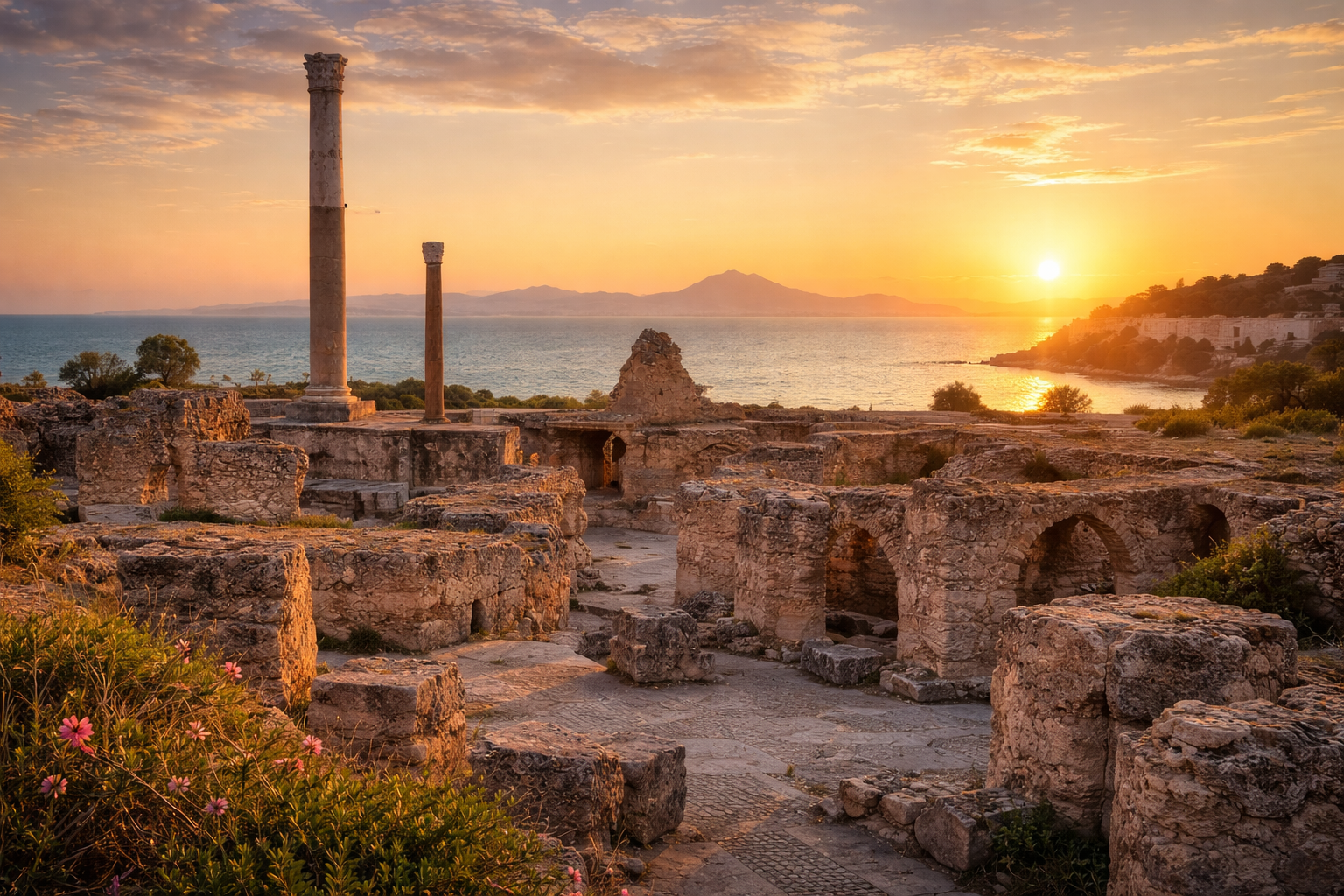
Tunisia as a compressed civilizational system
Tunisian civilization history is one of the deepest and most compressed civilizational records in the Mediterranean world. Most people encounter it through a handful of familiar images: Carthage, Roman ruins, a beach resort, or a revolution. Each image is real. None is complete.
This article is the master pillar of the Culture and Identity cluster. It connects to the supporting articles on Carthage Network Power, Kairouan and Islamic Civilization, and Dougga and the Amazigh Roots of Tunisia. Each article covers one civilizational layer in depth. This pillar reads them together as one continuous process.
- Civilizational span
- 3,000+ years
Continuous transformation across Amazigh, Punic, Roman, Islamic, Ottoman, colonial, national, and diaspora layers.
- Core centers
- Carthage, Kairouan, Tunis, Dougga
Each city stores a different layer of Tunisian civilizational memory.
- Core argument
- Not a fragment
Tunisia is not a small country with borrowed history. It is a civilization with its own operating logic.
Anchor function: Every article in the Tunisia civilization series connects back here. The supporting articles explain individual layers. This pillar explains the system that holds them together.
Tunisian civilization history begins before empire
Tunisia is not a small country with a borrowed history. It is a compressed civilizational landscape where every era left structural sediment. The mistake most narratives make is not that they remember Carthage. The mistake is that they stop there, or that they treat everything before Carthage as empty and everything after Rome as derivative.
The territory has been continuously inhabited for at least ten thousand years. Amazigh communities shaped the land through agriculture, kinship, language, trade, and territorial identity long before Phoenician ships arrived. Carthage rose on top of an existing North African world, not an empty coastline. It became one of the five great maritime powers of the ancient world. Rome destroyed it, then rebuilt the territory into one of the most productive provinces the empire ever administered. Islamic civilization turned the region into a center of theology, law, and institutional design. Ottoman governance maintained it as a Mediterranean node. France colonized it. Bourguiba modernized it. The 2011 revolution briefly electrified it.
Across all of this, geography kept generating the same civilizational logic: a Mediterranean chokepoint shaped by sea movement, interior depth, agricultural productivity, institutional absorption, and memory under pressure.
The hidden logic of Tunisian civilization history
The hidden structure is not occupation. It is metabolism. Tunisia repeatedly absorbed external systems, transformed them through local geography and social continuity, then preserved parts of them as civilizational sediment.
Tunisian civilization history becomes structurally clear only when the Amazigh, Punic, Roman, Islamic, Ottoman, colonial, national, and diaspora layers are read together instead of separately.
Land, settlement, kinship, agriculture, oral memory, language, and indigenous North African continuity.
Ports, sea lanes, chokepoints, silver, trade routes, constitutional governance, and maritime power.
Grain, cities, amphitheatres, villas, mosaics, roads, theology, taxation, and provincial administration.
Kairouan, Zaytuna, Maliki law, hydraulic engineering, scholarship, architecture, and urban continuity.
Colonial categories, tourist framing, national simplification, migration policy, and diaspora recovery.
The Amazigh layer: before empire, before alphabet, before the coast
The oldest human layer in Tunisian civilization history is Amazigh. The Amazigh are among the oldest continuous peoples of North Africa, with archaeological evidence of settlement stretching back to at least the tenth millennium BCE. Their presence predates Phoenician colonization by thousands of years.
What the Amazigh contributed was not merely ethnic presence. They contributed territorial logic. Settlement patterns, agricultural knowledge, kinship systems, oral memory, and a relationship to the land persisted through every subsequent imperial administration.
The bilingual inscriptions at Dougga demonstrate this directly: Punic and Libyco-Berber script side by side on the same monument, recording the same political authority in two languages for two populations within one administrative system.
- Territory
- Interior Highlands
Amazigh settlement patterns shaped agricultural continuity inherited by later systems.
- Language
- Libyco-Berber Script
The oldest known indigenous North African writing system preserved alongside Punic.
- Continuity
- Substrate Persistence
Amazigh kinship and territorial memory survived through Punic, Roman, Islamic, and colonial layers.
- Legacy
- Living Heritage
Amazigh identity remains visible in naming, language traces, regional identity, and memory recovery.


The layers of Tunisian civilization history across empires
ca. 10,000 BCE to 900 BCE
Amazigh foundations: settlement, agriculture, language, kinship, and territorial memory.
The Amazigh are among the oldest continuous peoples of North Africa. Their settlement patterns, agricultural knowledge, and territorial memory shaped the land that Carthage would later build on. They were not a preface to history. They were its foundation.
814 BCE to 146 BCE
Carthage: maritime-commercial republic, constitutional governance, and Mediterranean network power.
Carthage controlled trade routes from Gibraltar to the Levant and operated a constitutional republic praised by Aristotle. Rome won the wars, then burned the archive. Most of what survives about Carthage was written by its enemies.
146 BCE to 439 CE
Roman Africa: grain systems, cities, theology, mosaics, and imperial productivity.
Roman Africa supplied an estimated third of Rome’s grain and produced cities of extraordinary scale. Augustine of Hippo shaped Western Christian theology from North African soil. Tertullian coined the term Trinity while writing from Carthage. This was not a periphery. It was a center.
647 CE to 1574 CE
Islamic Ifriqiya: theology, jurisprudence, architecture, scholarship, and institutions.
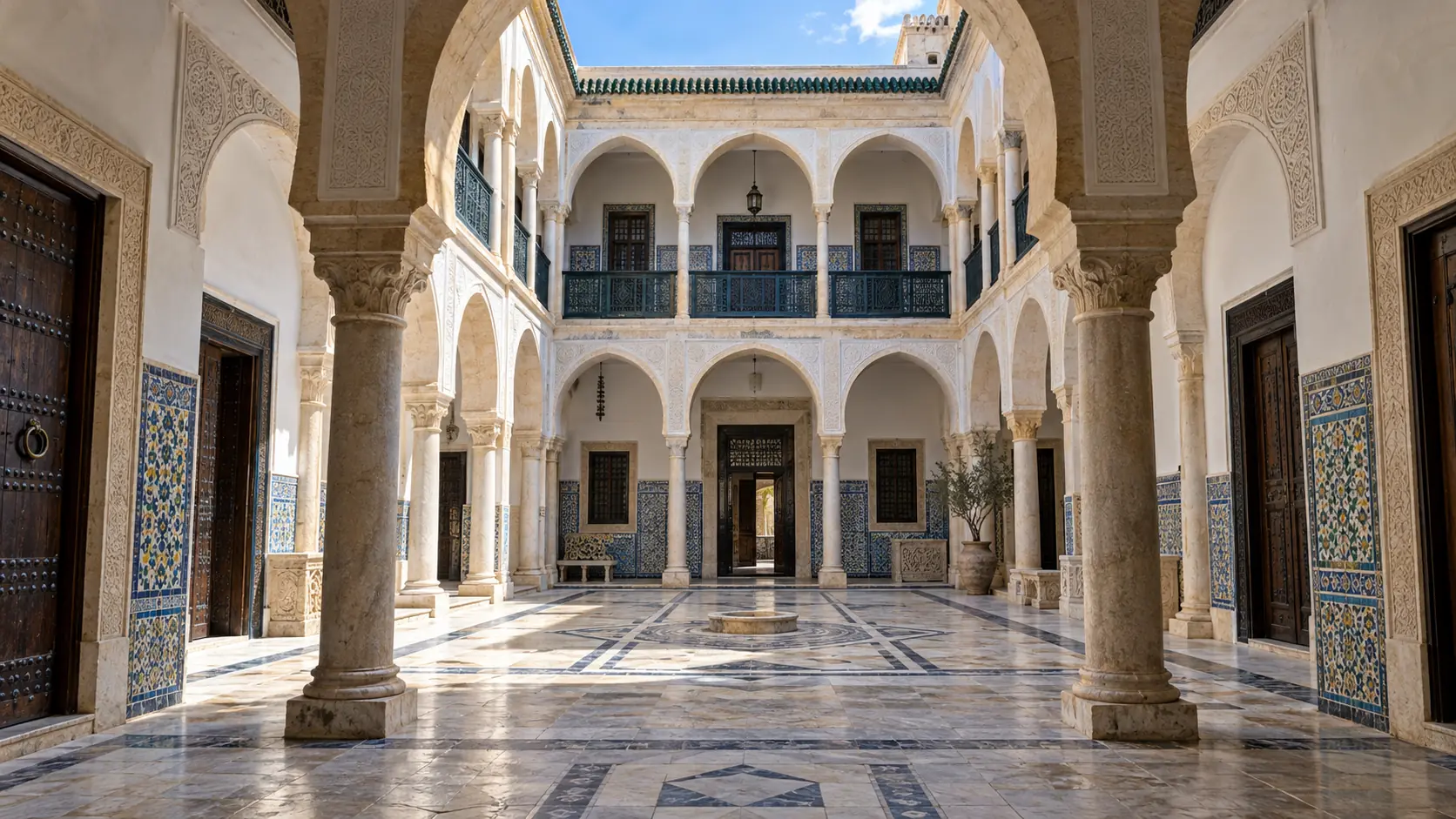
Kairouan became one of the major knowledge centers of Sunni Islam. Zaytuna operated as a center of jurisprudence, theology, grammar, and scholarship for over a thousand years. The Aghlabids built hydraulic infrastructure still visible today. The Fatimids launched their conquest of Egypt from Ifriqiya.
1574 to 1881
Ottoman Tunisia: autonomous governance, diplomacy, and constitutional experimentation.
The beys of Tunis governed with significant autonomy from Istanbul. In 1861 Tunisia adopted the Dustur, one of the earliest written constitutions in the Arab world. It established legal equality and constraints on executive authority before most of the region had begun similar reforms.
1956 to present
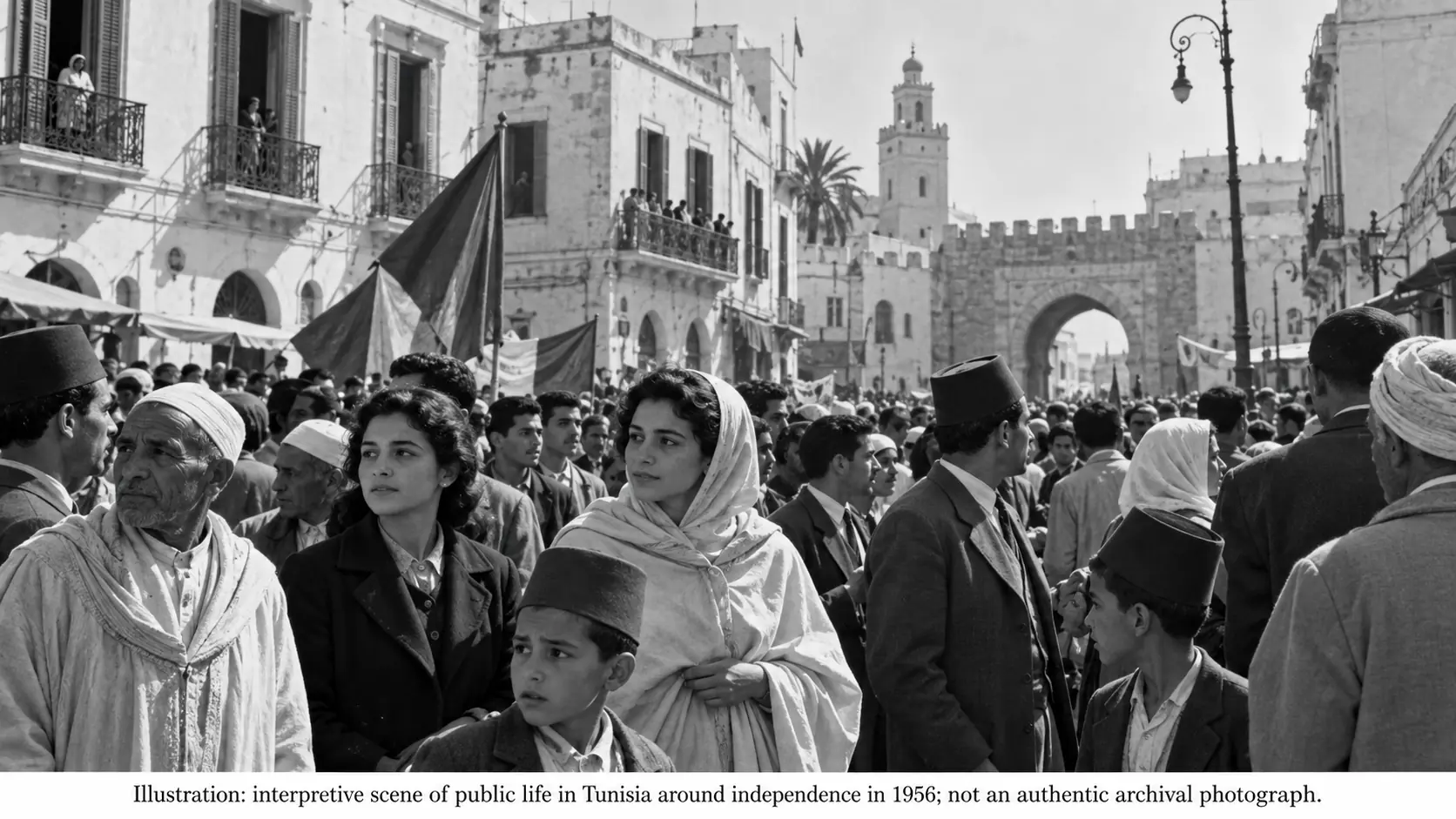
Modern Tunisia: independence, migration, revolution, and diaspora continuity.
Hundreds of thousands of Tunisians now live in France, Italy, Germany, Belgium, the Netherlands, Canada, and the Gulf states. They carry a civilizational archive across borders and through institutional systems that reduce them to integration metrics, labor statistics, or security classifications. The archive is deeper than the category.
Why Tunisia kept becoming strategically important
Tunisia is not only important because of what happened there. It is important because of where it sits. The same geography kept producing value under different systems: Amazigh settlement, Carthaginian trade, Roman grain extraction, Islamic scholarship, Ottoman diplomacy, French colonial administration, and modern diaspora movement.
The territory connects sea, interior, agriculture, ports, migration, language, and memory. This is why Tunisia repeatedly became a civilizational junction rather than a passive province.
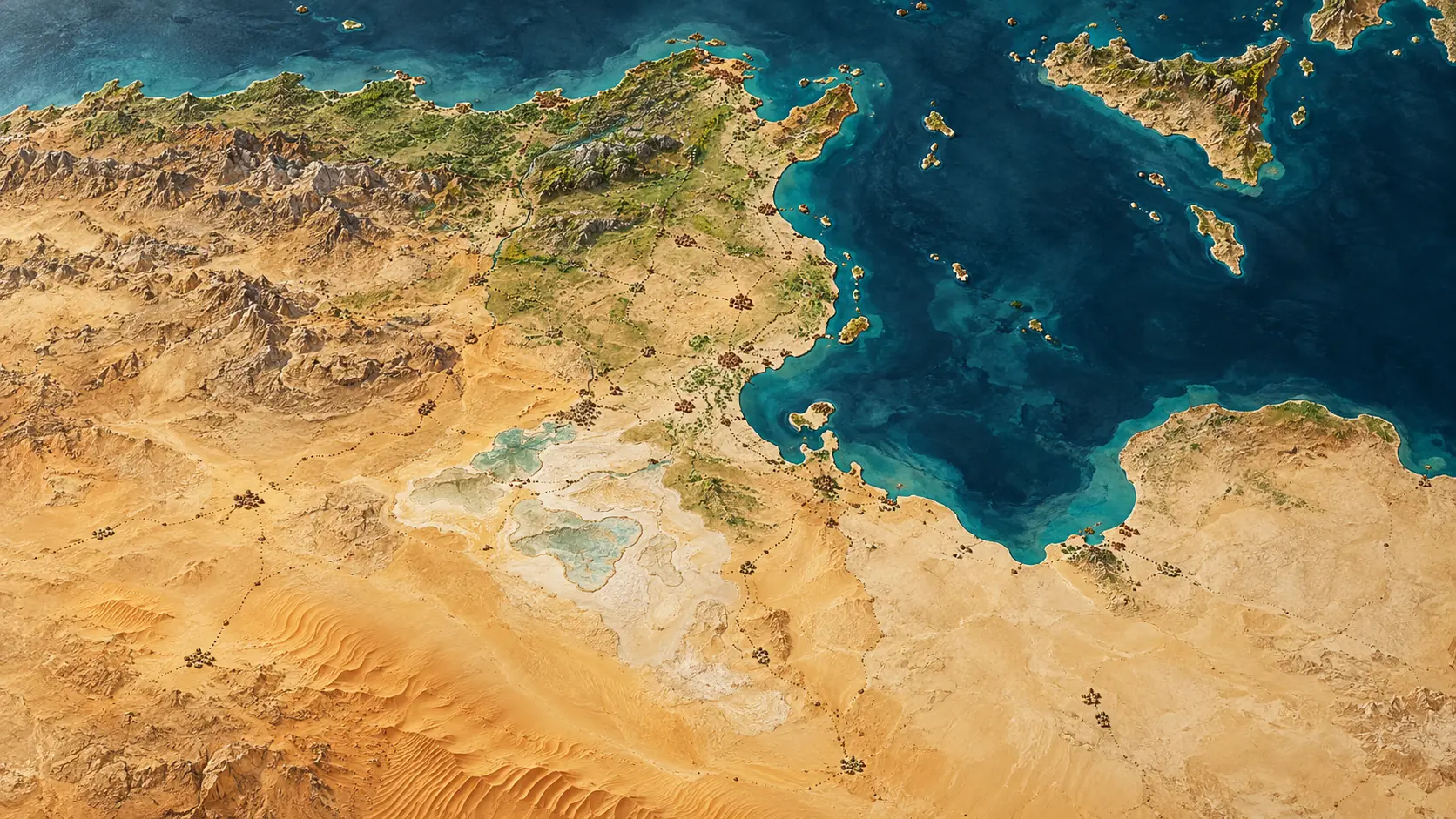
Ports, maritime routes, naval power, trade corridors, and Mediterranean chokepoints.
Agriculture, settlement continuity, tribal memory, olive systems, and land-based identity.
Law, scholarship, urban administration, mosque-universities, diplomacy, and constitutional memory.
Merchants, armies, scholars, colonizers, migrants, and diaspora networks.
How Tunisia turns pressure into continuity
The operating logic of Tunisian civilization history is not simple resistance and not simple replacement. It is civilizational metabolism: external systems arrive, collide with the local substrate, become transformed by geography, then leave usable layers inside the archive.
This flow explains why Tunisia can appear fragmented when read through empires, but coherent when read through systems. The names change. The mechanism repeats.
Amazigh settlement, agriculture, kinship, oral memory, and land-based continuity create the first operating layer.
Phoenician, Roman, Arab, Ottoman, and French systems enter through ports, trade, conquest, scholarship, administration, and migration.
Foreign systems are translated into local realities: Punic becomes North African, Roman Africa becomes productive, Islamic Ifriqiya becomes institutional.
Each era leaves infrastructure: scripts, ports, roads, law, mosques, medinas, crops, language fragments, rituals, and memory patterns.
Later systems build on older layers. Rome uses Carthaginian geography. Islamic cities inherit Roman and Amazigh space. Modern Tunisia inherits all of it.
The archive moves into families, diaspora, digital platforms, language, food, memory, and future cultural reconstruction.
Metabolism principle: Tunisia survived not by remaining unchanged, but by absorbing change without fully dissolving the substrate beneath it.
The civilizational layers as one system
A timeline shows sequence. A matrix shows function. Each layer of Tunisian civilization history did something structurally different: one rooted the land, one built networks, one extracted grain, one institutionalized knowledge, one managed diplomacy, one compressed memory, and one now carries the archive abroad.
| Layer | Core function | Infrastructure | Memory left behind |
|---|---|---|---|
| Amazigh | Substrate continuity | Settlement, kinship, land knowledge, agriculture | Territorial memory, language traces, interior identity |
| Punic and Carthaginian | Maritime network power | Ports, fleets, trade routes, chokepoints, commercial governance | Carthage, Hannibal, Mediterranean strategic imagination |
| Roman Africa | Imperial production | Roads, cities, villas, amphitheatres, grain logistics, mosaics | El Jem, Dougga, Bardo mosaics, North African theology |
| Islamic Ifriqiya | Institutional knowledge | Kairouan, Zaytuna, Maliki law, hydraulic systems, medinas | Scholarship, law, architecture, urban continuity |
| Ottoman and Husainid | Mediterranean diplomacy | Beylical administration, ports, treaties, constitutional experiments | Political autonomy, 1861 Dustur, diplomatic memory |
| French colonial | Administrative compression | Language policy, bureaucracy, rail, extraction, colonial categories | Francophone layer, social hierarchy, memory rupture |
| National and diaspora | Archive redistribution | Schools, migration, remittances, platforms, family networks | Identity reconstruction, Darija survival, digital memory |
The civilizational question is not which layer is the real Tunisia. The real Tunisia is the accumulated system formed by all layers under pressure.
Carthage Network Power: the first Mediterranean system built from Tunisian soil
Carthage was founded around 814 BCE by Phoenician settlers from Tyre. Within three centuries it had become the dominant maritime-commercial power of the western Mediterranean, controlling ports from Iberia to Sardinia, monopolizing Atlantic access through the Strait of Gibraltar, and operating a constitutional republic that Aristotle praised as one of the finest in the ancient world.
The full structural account is in Carthage Network Power. Tunisia produced one of the five great maritime civilizations identified by historian Andrew Lambert. The central argument of Tunisian civilization history is continuity through transformation rather than replacement through conquest.
At Cannae in 216 BCE Hannibal destroyed a Roman army using a double envelopment strategy still studied in military academies. His goal was not to destroy Rome directly. It was to detach Rome’s alliance network.
Ports, trade routes, chokepoints, silver, maritime logistics, mercenary systems, and commercial governance.
Land expansion, roads, manpower, taxation, citizenship integration, and imperial absorption.
Rome destroyed Carthage in 146 BCE. The city burned for seventeen days. The archive was destroyed or dispersed. But the geography remained. Chokepoints cannot be burned.
Ancient ports, modern cables, and the return of network logic
The strongest modern parallel inside Tunisian civilization history is infrastructure. Ancient power moved through harbors, grain routes, roads, taxation corridors, and manuscript networks. Modern power moves through ports, airports, data cables, logistics systems, migration routes, energy connections, and platform archives.
The technologies changed. The logic did not. Tunisia still sits where systems cross.
| Ancient mirror | Modern mirror |
|---|---|
| Ports and fleets Carthaginian harbors connected silver, timber, soldiers, merchants, and maritime intelligence across the western Mediterranean. | Ports and logistics Modern ports, shipping lanes, air routes, tourism corridors, and supply chains keep Tunisia inside Mediterranean movement systems. |
| Roads and grain Roman Africa linked inland agriculture to maritime export through roads, estates, storage, taxation, and naval transport. | Cables and data Digital systems move voice notes, payments, family memory, video calls, and identity reconstruction through invisible infrastructure. |
Why this matters
This section connects Culture and Identity to Systems and Strategy and Cybersecurity and Tech. A civilization is partly made of memory, but memory now depends on infrastructure: servers, platforms, cables, devices, archives, and access.
When Rome rebuilt on Carthaginian geography
After destroying Carthage, Rome rebuilt on the same geographic logic. Roman Africa became one of the most productive provinces in the empire. Roman Africa supplied an estimated third of Rome’s grain and produced cities such as Thysdrus, Sufetula, and Bulla Regia.
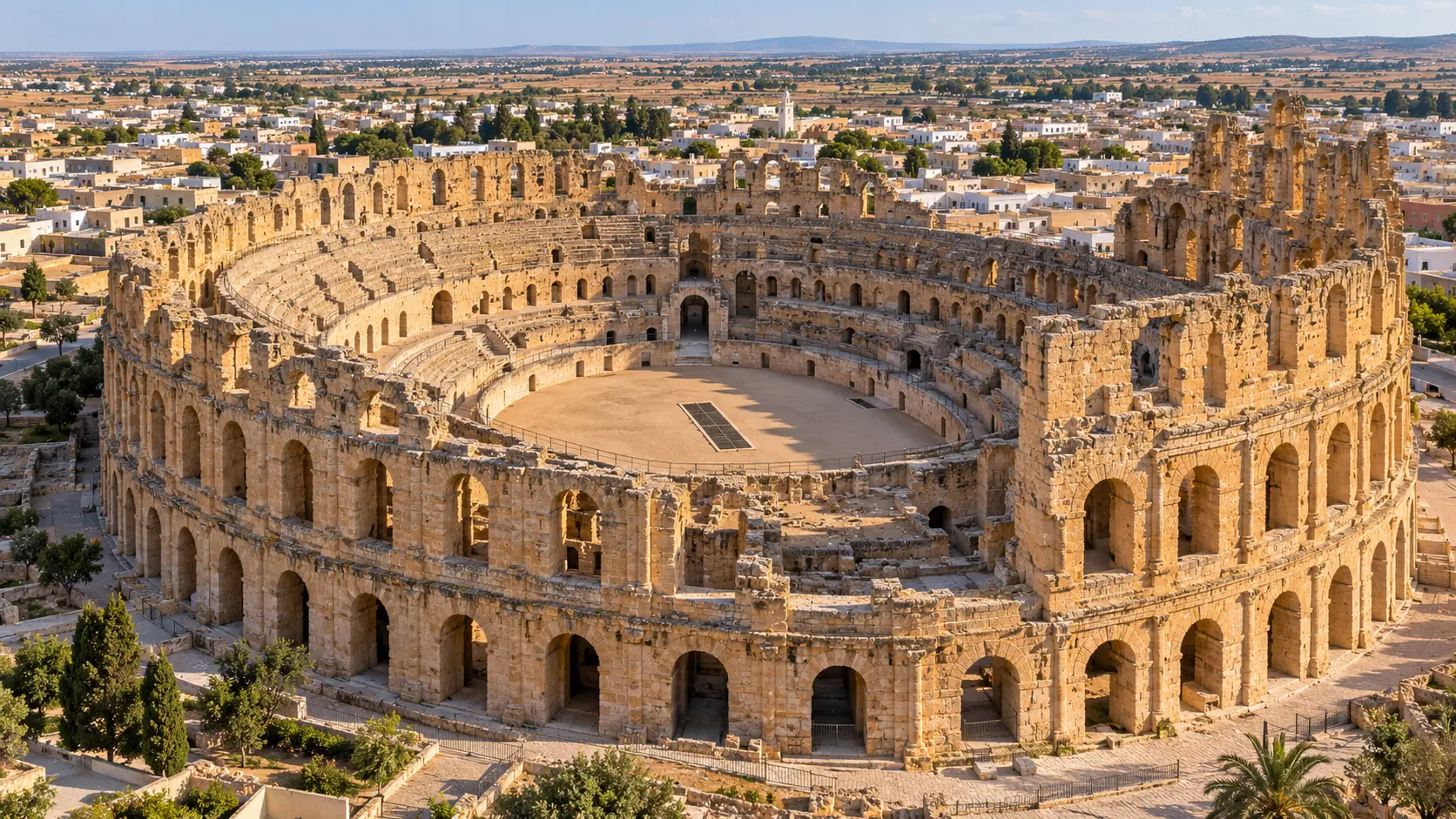
North Africa also became intellectually generative. Augustine of Hippo shaped Western Christian theology more than any single figure after Paul. Tertullian coined the term Trinity. Cyprian shaped ecclesiological thinking still visible in Catholic institutional structure.
- Agriculture Grain Empire
Roman Africa became essential to imperial food infrastructure.
- Architecture El Jem Amphitheatre
One of the largest amphitheatres in the Roman world, built from local wealth.
- Theology Augustine of Hippo
North African theology shaped Western Christianity for centuries.
- Mosaics The Bardo Collection
Tunisia preserves one of the world’s largest collections of Roman mosaics.
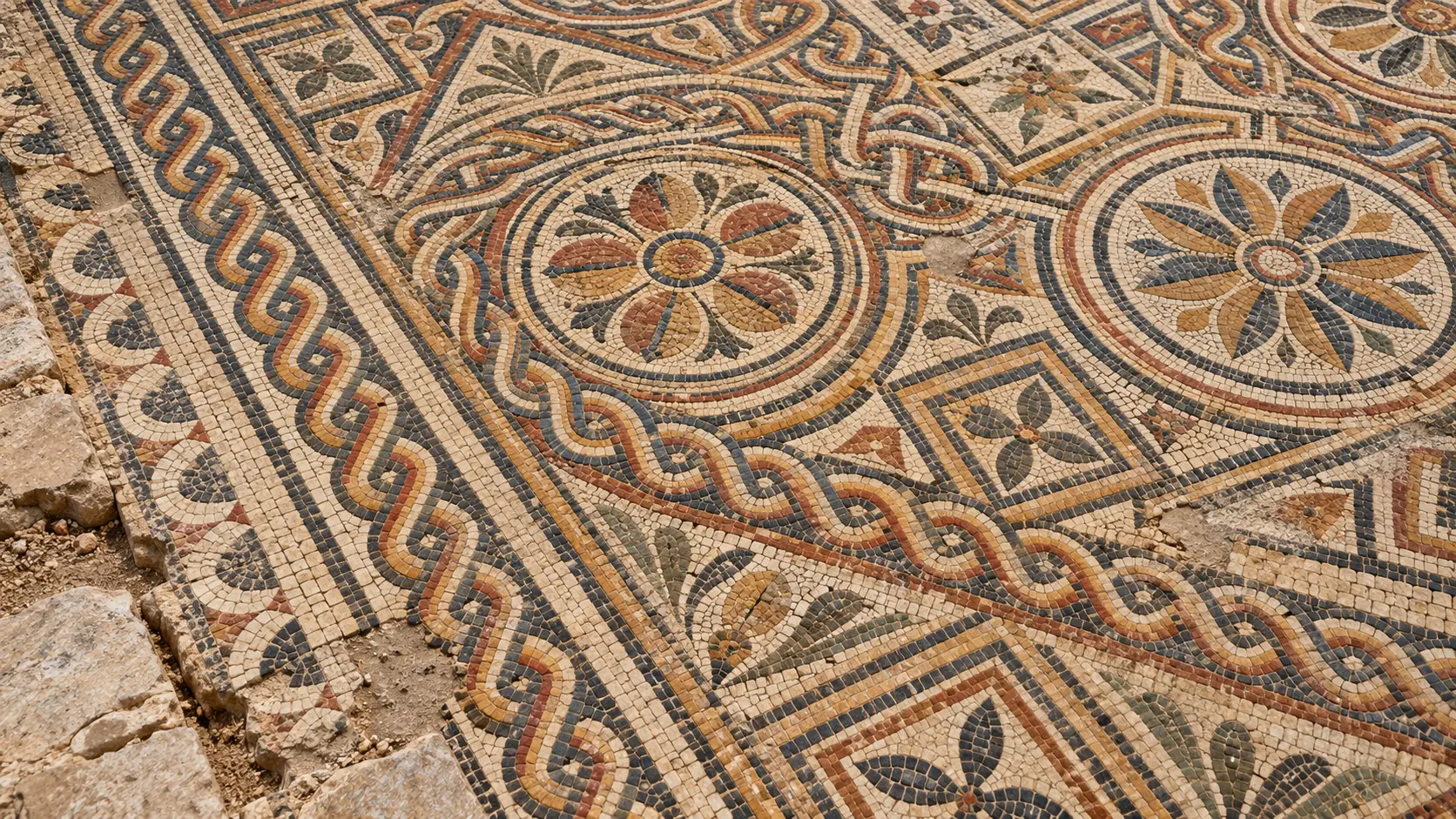
The Roman layer in Tunisian civilization history is not just ruins for tourists. It is evidence that this territory repeatedly generated civilizational output at the highest level.
The people who reveal the system
Civilizational history becomes clearer when figures are read not only as biographies, but as system signals. Each figure below represents a different layer of Tunisia’s archive: foundation myth, network warfare, theology, Islamic expansion, historical theory, nation-building, revolution, and diaspora transmission.
The foundation memory of Carthage: migration, maritime strategy, political founding, and the birth of a city that would challenge Rome.
The military expression of Carthaginian network power: not only battlefield brilliance, but an attempt to break Rome’s alliance system.
A North African intellectual whose work shaped Western Christianity and proves Roman Africa was a center of thought, not a provincial footnote.
A figure of Islamic expansion whose founding of Kairouan turned Ifriqiya into an institutional engine for law, worship, scholarship, and power.
A Tunis-born thinker whose theory of social cohesion, dynasty, and collapse belongs naturally inside a systems reading of civilization.
The modern nation-building layer: state formation, education, secular reform, postcolonial identity, and the disciplined centralization of memory.
The modern rupture point: a local act of despair becoming a regional political signal, exposing how compressed systems eventually break.
The unnamed modern figure: parents, children, workers, students, and families carrying the archive through Europe, platforms, language, and memory.
Why people accept the shortened version
People accept shortened histories because they are easier to repeat, easier to market, and easier to fit into external categories. A Tunisian can be classified as Arab, Mediterranean, African, Muslim, Francophone, migrant, or postcolonial. Each label contains truth. None captures the full archive.
Eventually people inherit the summary instead of the archive. A second-generation Tunisian in Europe may know they are Tunisian without knowing their civilizational inheritance includes constitutional republicanism, hydraulic engineering, maritime systems, theology, scholarship, and long-duration institutional continuity.
Compression risk: when people inherit only summaries, they become easier for institutions to classify and harder for themselves to fully understand.
The archive is larger than the summary
The modern image of Tunisia is often smaller than the historical reality. Tourism reduces it to beaches and ruins. Migration systems reduce it to integration categories. Colonial memory reduces it to French influence. National storytelling can reduce it to unity at the expense of older plurality.
Each summary contains a fragment of truth. The problem begins when the fragment replaces the full archive.
Beach tourism, Roman ruins, migration, revolution, French influence, and simplified identity labels.
Amazigh foundations, Carthaginian network power, Roman grain systems, Islamic institutions, Ottoman constitutionalism, colonial rupture, and diaspora memory.
Core insight: Tunisia was not made by one layer replacing another. It was made by layers accumulating, colliding, adapting, and surviving.
Kairouan: the institutional engine of Islamic Ifriqiya
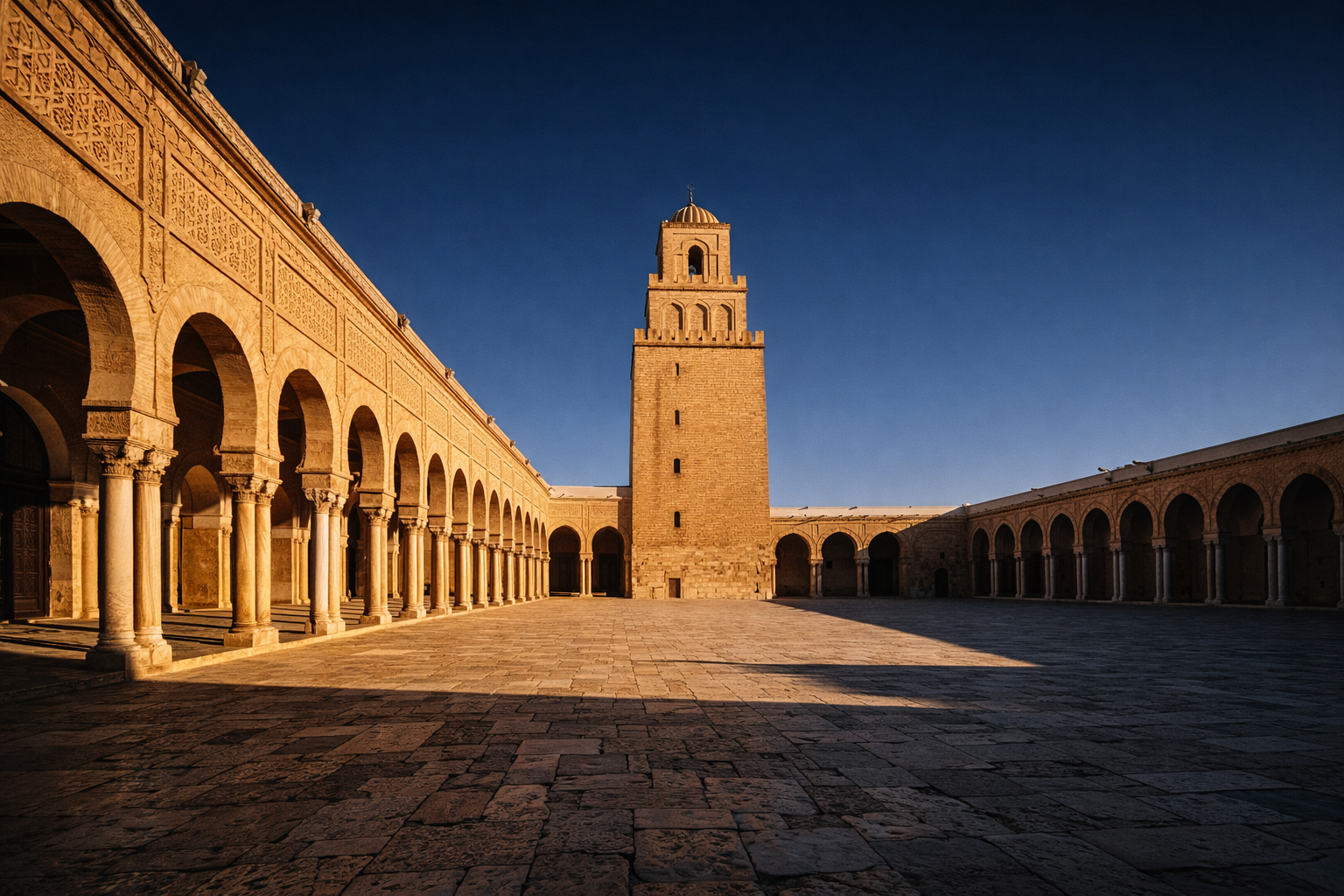
The Islamic layer in Tunisian civilization history is one of the most underread outside specialist circles. Kairouan and Islamic Civilization covers the full structural account.
Founded in 670 CE by Uqba ibn Nafi, Kairouan became one of the primary knowledge centers of Sunni Islam. The Great Mosque of Kairouan is among the oldest continuously functioning mosques in the world. Zaytuna in Tunis operated for over a thousand years as a center of jurisprudence, theology, grammar, and scholarship.
The Aghlabids built hydraulic infrastructure adapted to semi-arid North African conditions. The Fatimids used Ifriqiya as the launch platform for Cairo. The Hafsids maintained diplomatic parity with European powers for centuries.
Who benefits from a shortened Tunisia?
The shortening is not conspiracy. It is institutional optimization. Tourism rewards ruins. Schools reward simplified unity. European systems reward categories. Media rewards crisis. Academic departments reward specialization.
| Actor | Benefit | Mechanism |
|---|---|---|
| Tourism | Benefits from Roman legibility | Roman ruins are easy to package. Deeper Amazigh and Islamic layers become secondary. |
| Nation-state | Benefits from simplified unity | Plural civilizational layers complicate centralized identity narratives. |
| European systems | Benefits from categories | Diaspora populations become integration metrics, labor pools, or security classifications. |
| Academia and media | Benefit from fragmentation | Period specialization and crisis coverage fragment the continuity of the archive. |
Civilizations are not erased only by catastrophe. They are erased by accumulated simplifications.
From maritime chokepoints to modern information systems
Carthage demonstrates how power can emerge through routes instead of territory alone. Modern institutions operate through similar structures: platforms, categories, logistics, interfaces, archives, and legitimacy systems.
The Tunisian diaspora is now part of this same structural story. Diaspora Tunisians carry the archive through institutional systems that often reduce them to administrative categories.
Why this matters
This is where Culture and Identity connects to Systems and Strategy, Cybersecurity and Tech, and Philosophy and Legacy. Identity is infrastructure. Memory is infrastructure. Archives are infrastructure.
The diaspora as a living archive
The Tunisian diaspora is not a footnote to this long civilizational story. It is the latest living layer of the system. While the physical territory of Tunisia remains relatively small, the archive has become mobile. It now travels through passports, remittances, family WhatsApp groups, kitchen tables in France, Italy, Germany, Belgium, Canada, and the Gulf, and through the quiet pride of second and third generations who are slowly rediscovering what their grandparents carried but could not always name.
Every Tunisian abroad becomes an involuntary custodian of civilizational memory. They carry fragments that no museum can fully preserve: the taste of a specific olive oil cake, the rhythm of a grandmother’s prayers, the way a joke is told in Darija, the instinctive hospitality codes, and the complex navigation between Arab, Amazigh, Mediterranean, Islamic, and European identities.
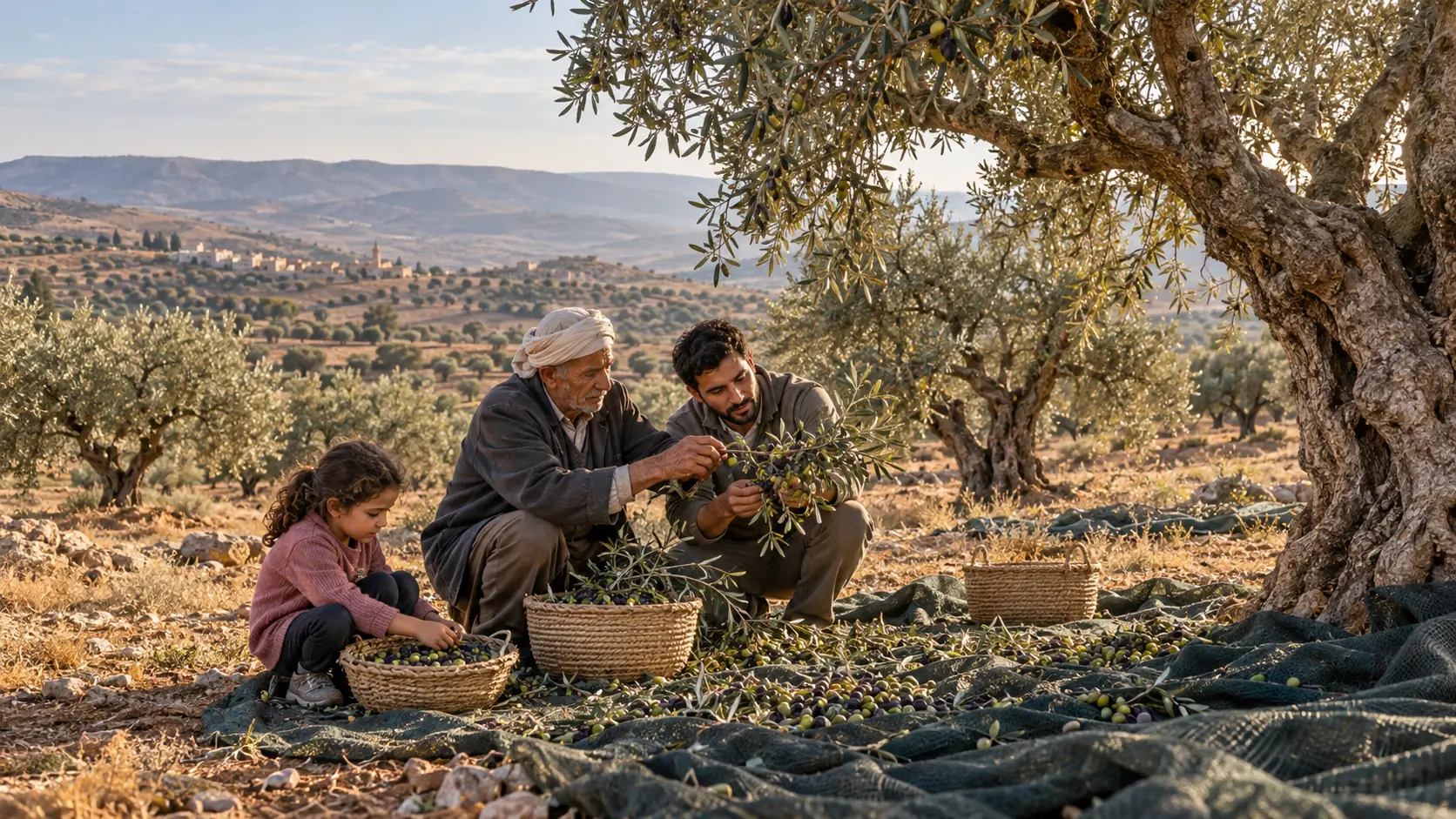
Darija shifts between Arabic roots, French loanwords, Italian expressions, Amazigh traces, and new European vocabulary.
Weddings, funerals, Ramadan gatherings, summer returns, and stories told to children who have never lived in the homeland.
Voice notes, recipe videos, family photos, football debates, songs, livestreams, and chats keep memory moving across continents.
Diaspora Tunisians carry deep civilizational memory while also simplifying themselves for bureaucracy, work, schools, and social acceptance.
The archive no longer lives only in stone, mosaics, or manuscripts. It lives in people who move through systems designed to see them as labor units, integration statistics, or security risks, while they quietly carry Carthage, Kairouan, Dougga, and the centuries of adaptation that made survival possible.
Key observation: A civilization is not only what stays in one place. It is also what travels, adapts, remembers, and finds new ways to transmit itself across borders and generations.
What continuity feels like on Tunisian soil
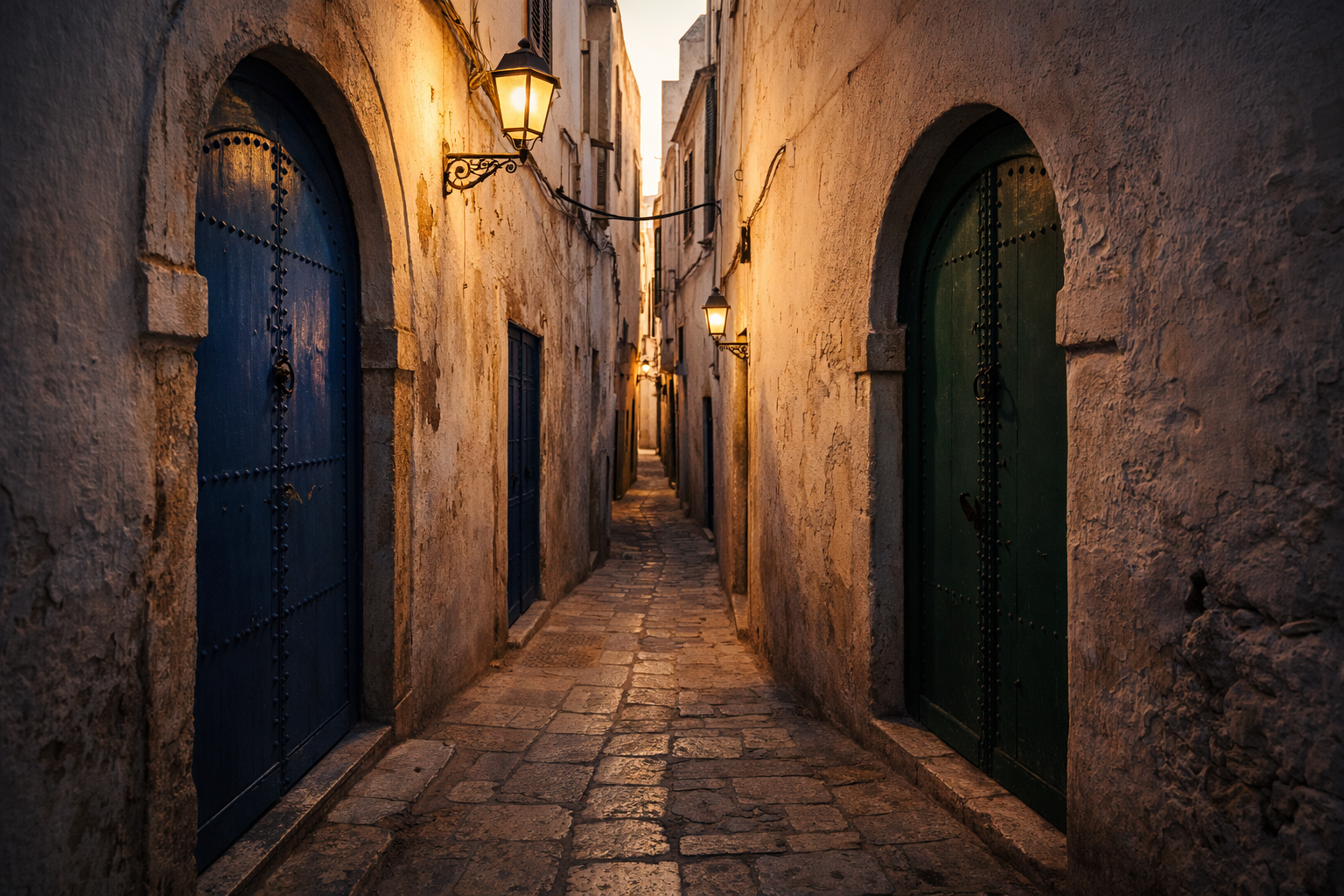
Civilizational continuity is not only visible in ruins, archives, museums, and dates. It is atmospheric. It is carried by stone heat in Dougga, sea wind near Carthage, olive trees in the interior, the geometry of old medinas, and the movement of language across generations.
In Tunisia, the ancient and the modern often occupy the same visual field. Roman roads influence modern movement. Islamic urban logic remains inside medina streets. French administrative traces sit over older city patterns. Family rituals preserve memory that written institutions often fail to transmit.
Ruins, inscriptions, amphitheatres, mosques, medinas, and walls hold memory in physical form.
Darija, adhan, Malouf, family speech, jokes, arguments, and oral memory transmit identity through rhythm.
Olive oil, harissa, bread, couscous, mint, fish, dates, and spices carry ecological and historical memory.
Summer returns, weddings, market routes, prayer routes, migration routes, and digital communication keep the archive alive.
Continuity principle: Tunisia is not only remembered through what survives in museums. It is remembered through repeated gestures, routes, tastes, words, and family systems.
What Tunisian civilization history actually reveals
Tunisian civilization history is not a collection of foreign occupations. It is a continuous process of transformation in which each layer metabolized what came before it. The Amazigh foundation shaped Carthage. Carthage shaped Roman Africa. Roman Africa shaped Islamic Ifriqiya. Geography repeatedly generated the same civilizational logic across thousands of years.
Reading Tunisian civilization history as a sequence of external impositions reproduces someone else’s summary. The archive is older, deeper, and more continuous than any single narrative frame can hold.
Civilizational pattern: systems survive when geography becomes memory, memory becomes institution, institution becomes identity, and identity becomes future infrastructure.
Continue the Tunisian civilization history cluster
Use these internal routes to read Tunisian civilization history through its main supporting layers: maritime network power, Islamic institutional depth, Amazigh foundations, and the wider Culture and Identity hub.
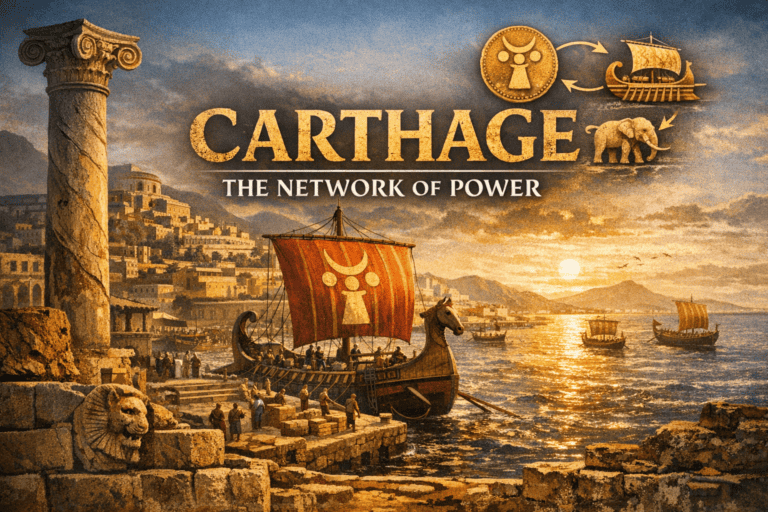
The structural account of Carthaginian maritime systems and Roman destruction.
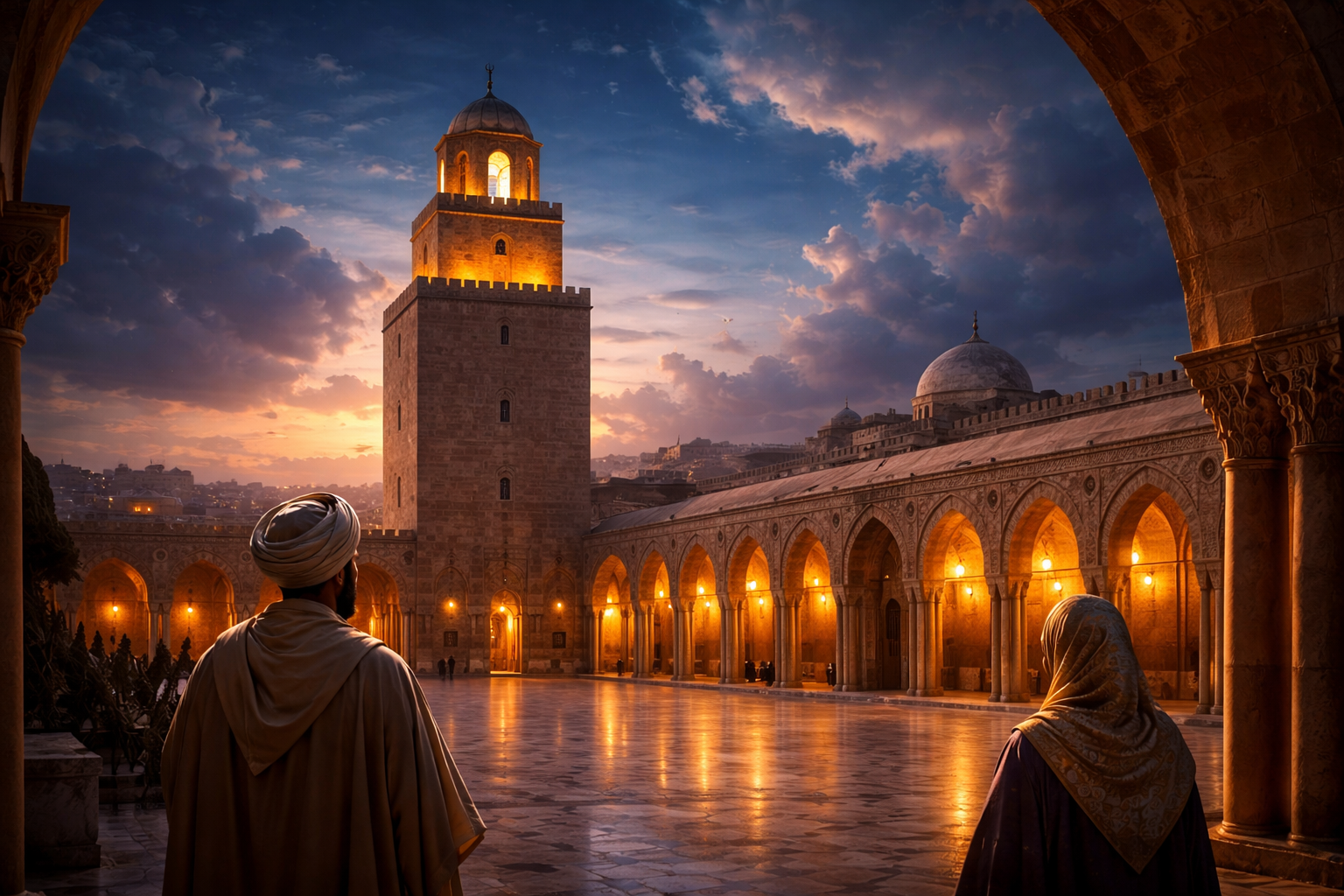
How Tunisia became an institutional engine of Islamic scholarship and law.
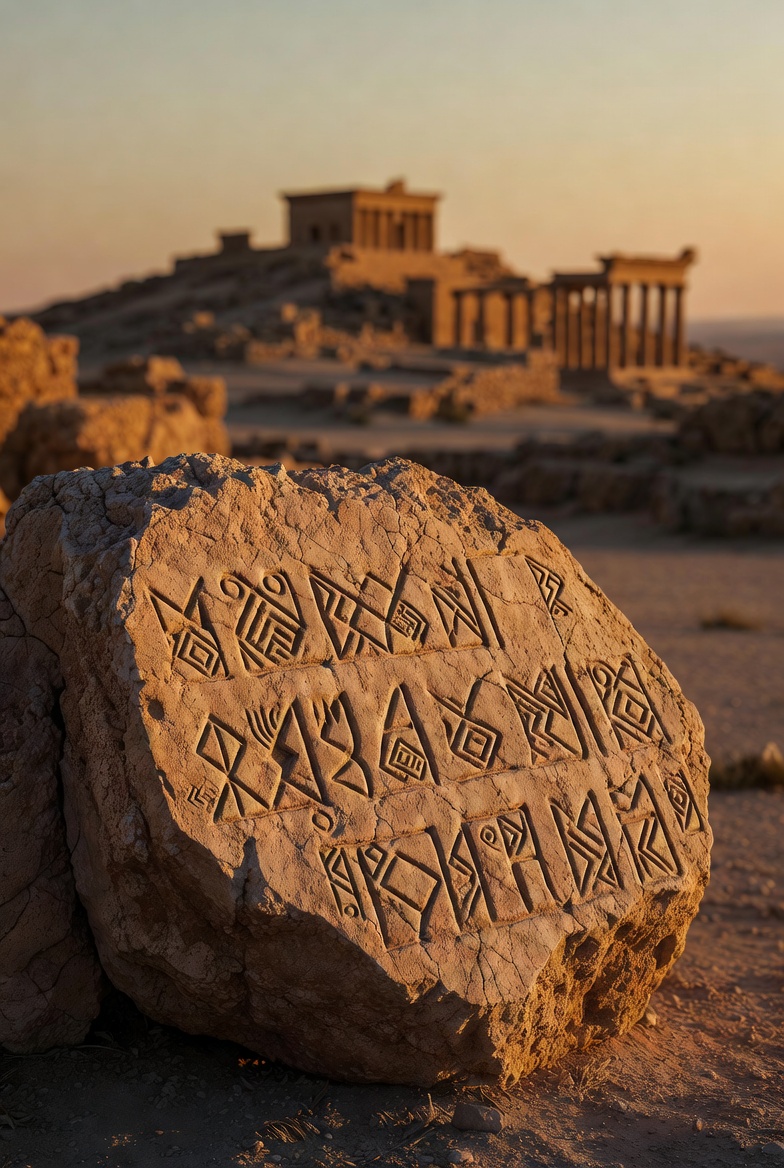
The indigenous substrate beneath later imperial layers.
The wider Darja Rihla cluster connecting civilizational identity and historical systems.
Build from the full archive
If this shifted how you think about civilization, identity, and structural history, the consulting work applies the same depth to strategy, content architecture, and platform building.
Book a Consulting SessionFuture articles opened by this pillar
A systems reading of Tunisia’s constitutional experimentation before most of the Arab world.
Food logistics, extraction, cities, taxation, and maritime dependency inside Rome.
How memory survives through migration, language, families, and digital systems.
How Roman African mosaics preserved everyday life, mythology, economy, and visual memory.
A study of Tunis as a diplomatic actor between Islamic North Africa and European maritime powers.
How agriculture turned Tunisia into infrastructure for empires from Rome to modern markets.
A bridge article connecting ancient maritime chokepoints to cables, platforms, ports, and digital infrastructure.
How Tunisian speech stores Arabic, Amazigh, French, Italian, Ottoman, and Mediterranean memory.
A systems reading of street logic, architecture, trade, worship, and family continuity inside the old city.
References and Bibliography
Institutional References
UNESCO: Archaeological Site of Carthage
Academic Bibliography
Editorial Source Note
This article currently anchors its historical claims with public institutional and reference sources. Academic works will be listed here only after their direct relevance has been verified.
Test your systems understanding
Test Your Understanding
What is the central systems claim of this article?
Why does geography matter so much in this article?
Who absorbs the cost when Tunisian history is shortened?
What structural advantage did Carthage have over Rome?
What does the article mean by calling Kairouan an institutional engine?
What does civilizational metabolism mean in this article?
Why does the infrastructure mirror section connect ancient ports to modern cables?
What does the layer matrix add that the timeline does not?