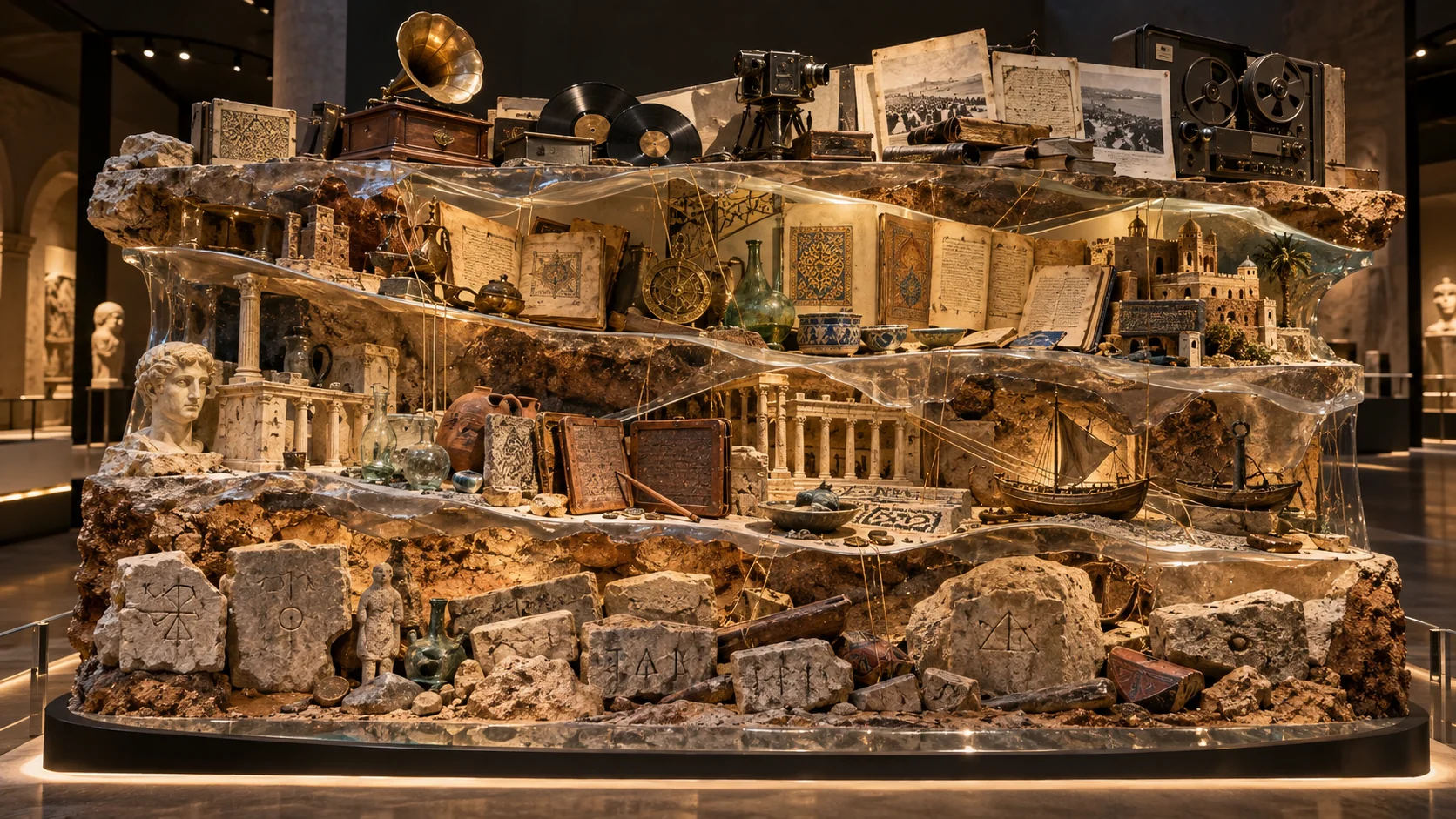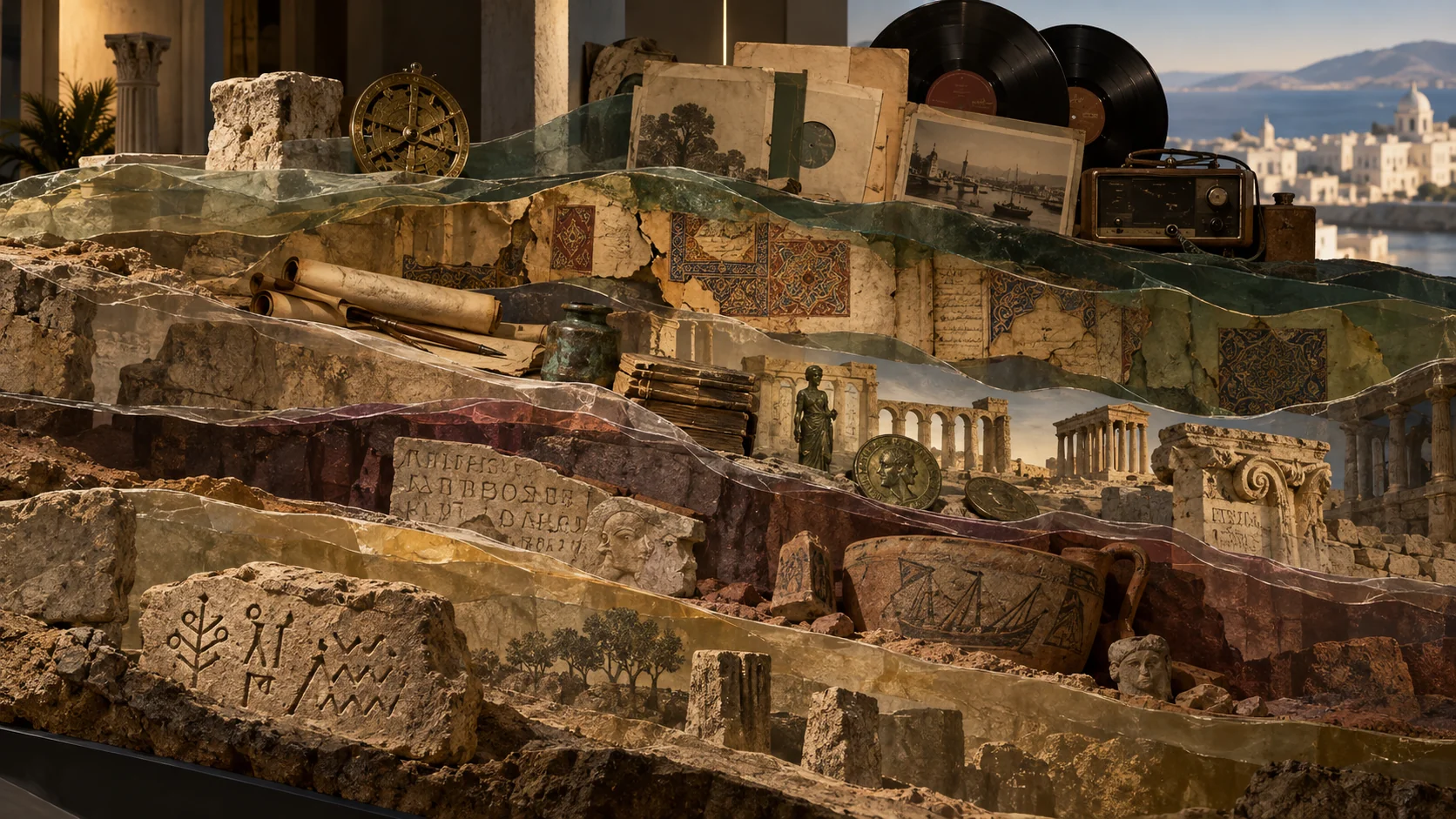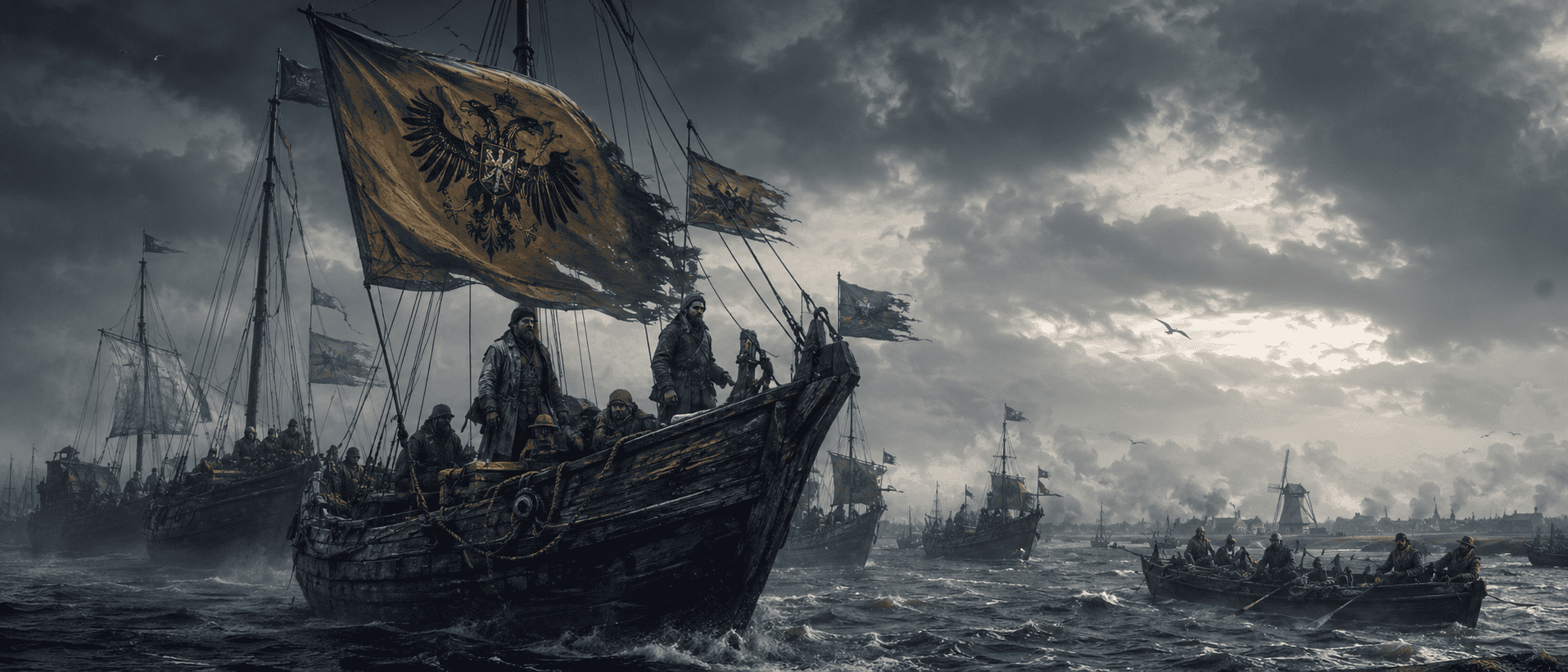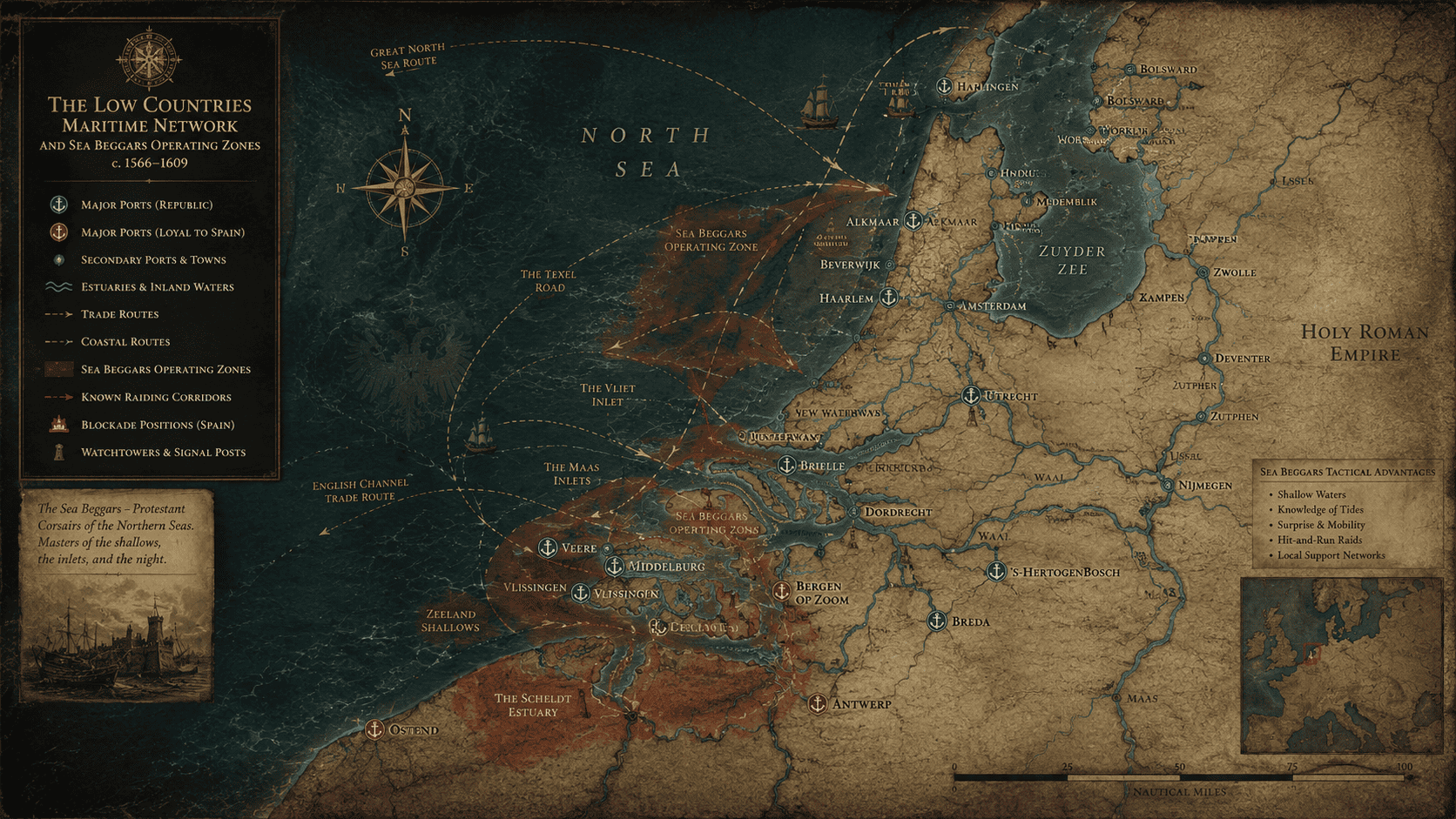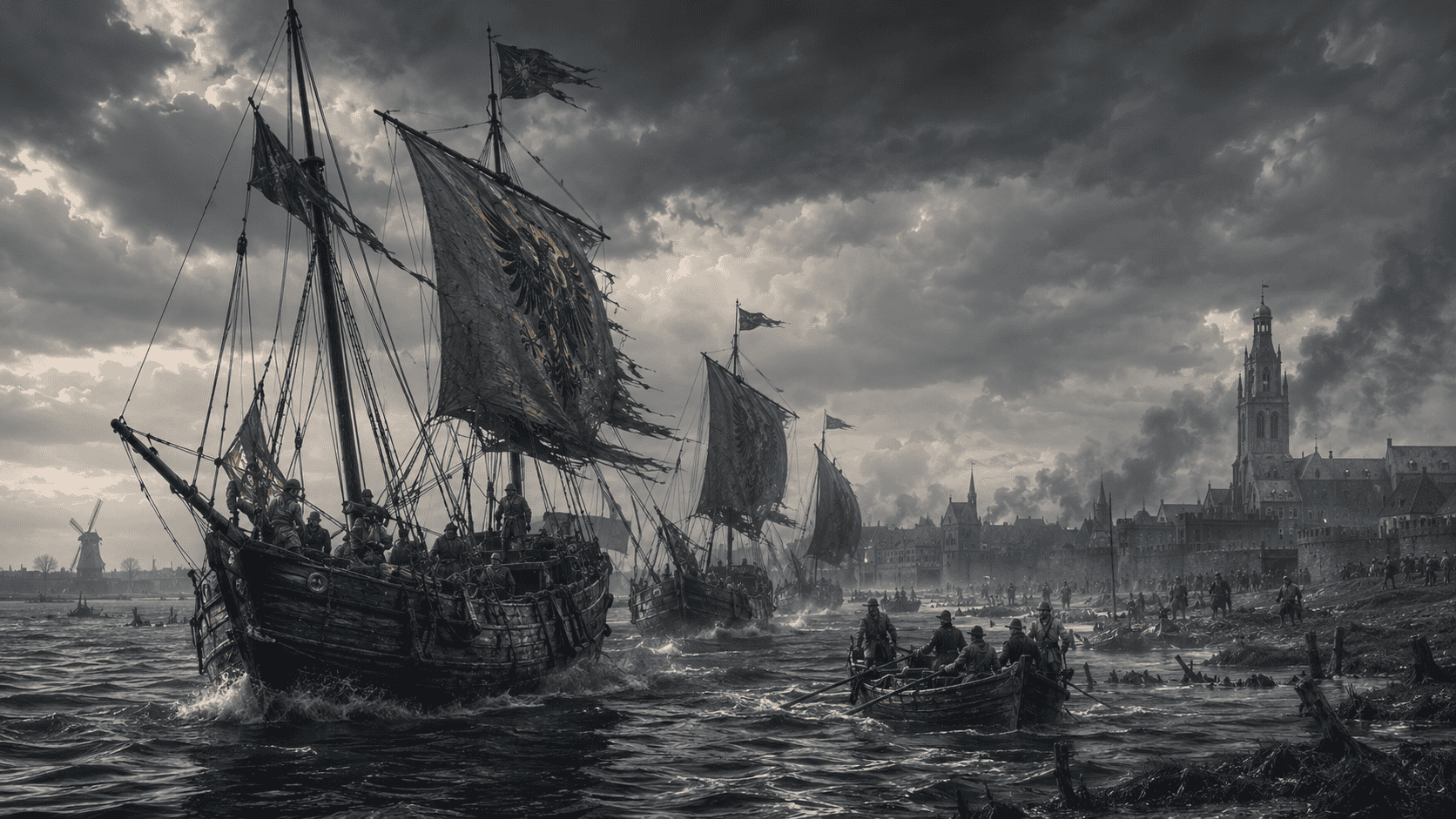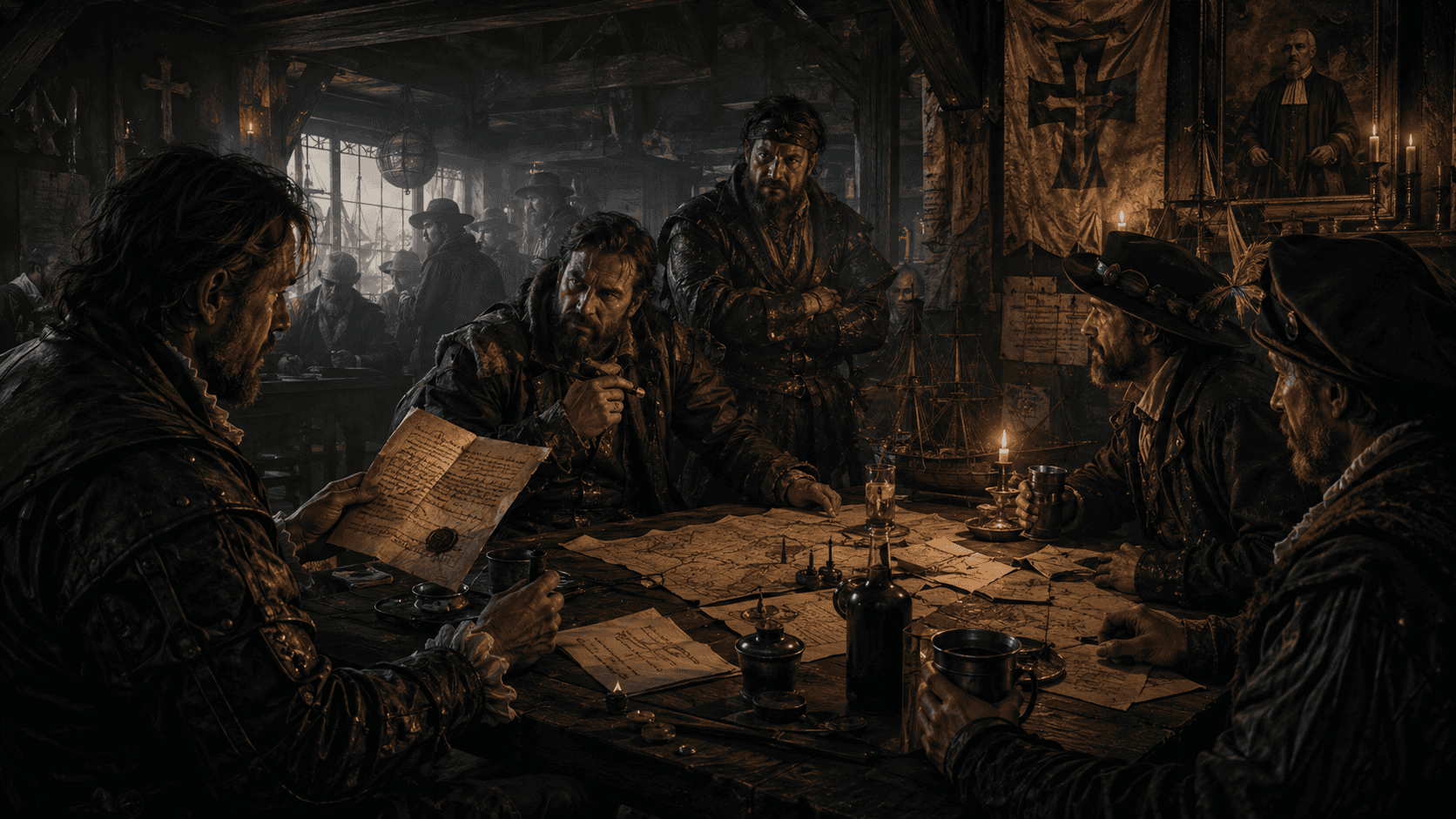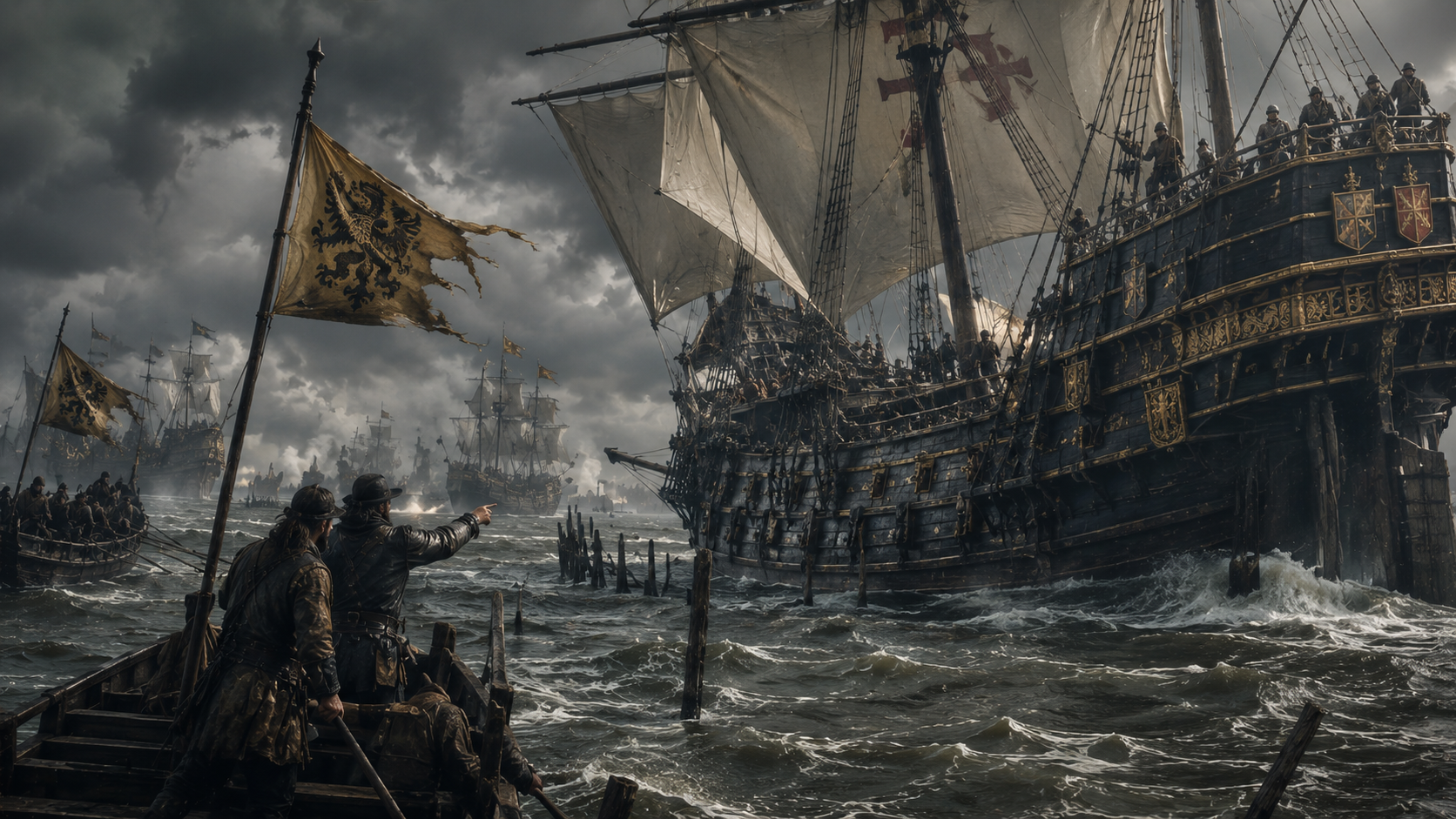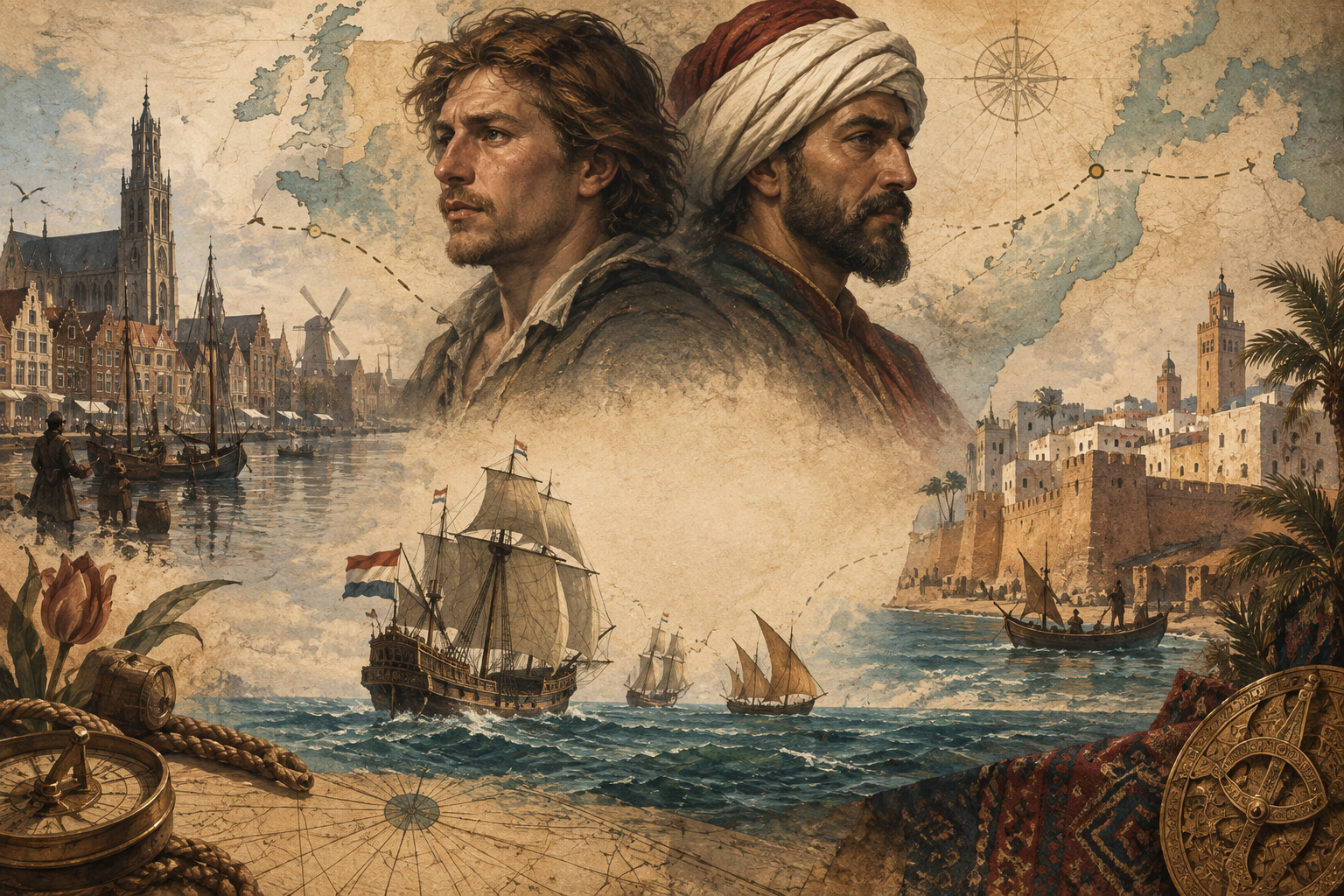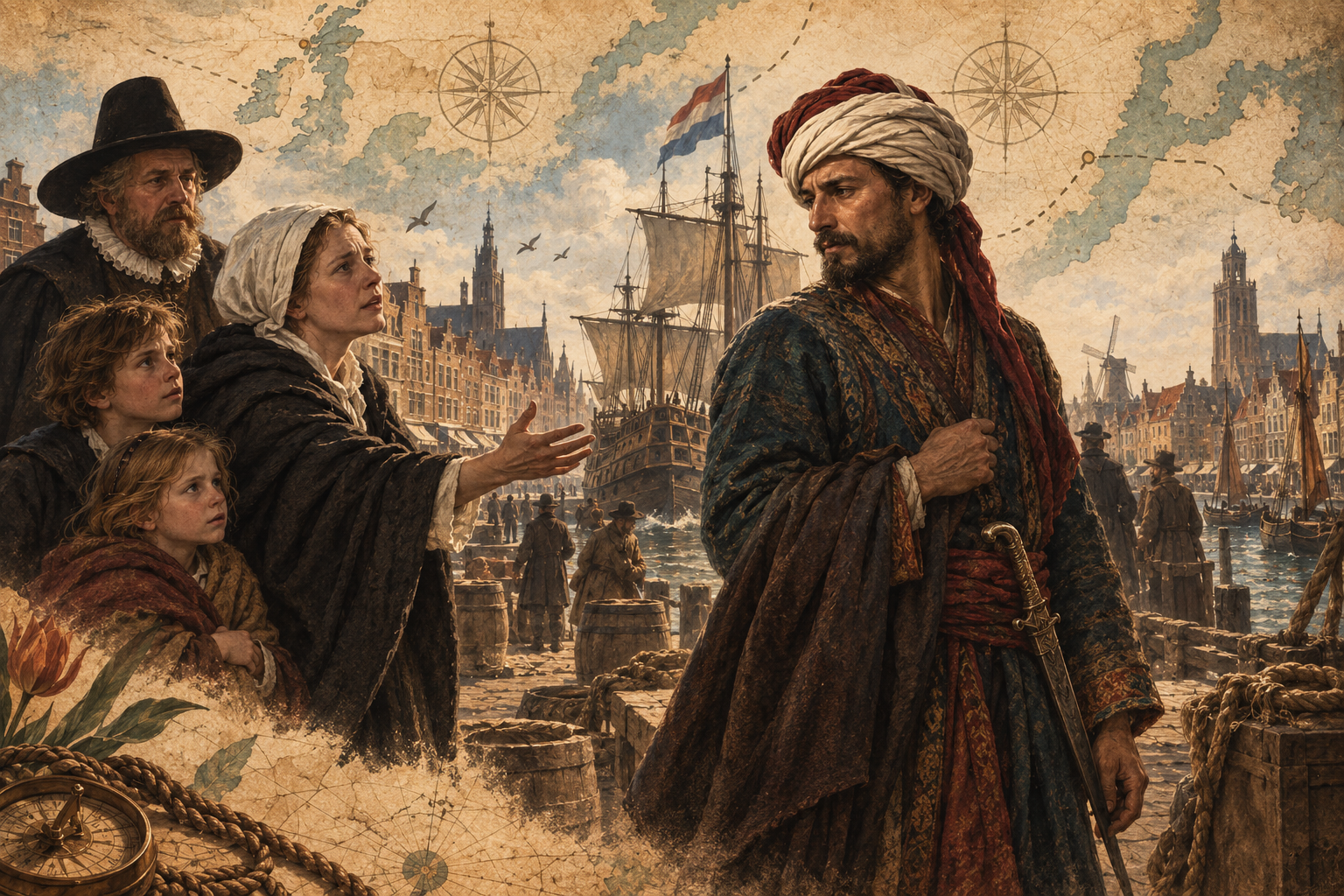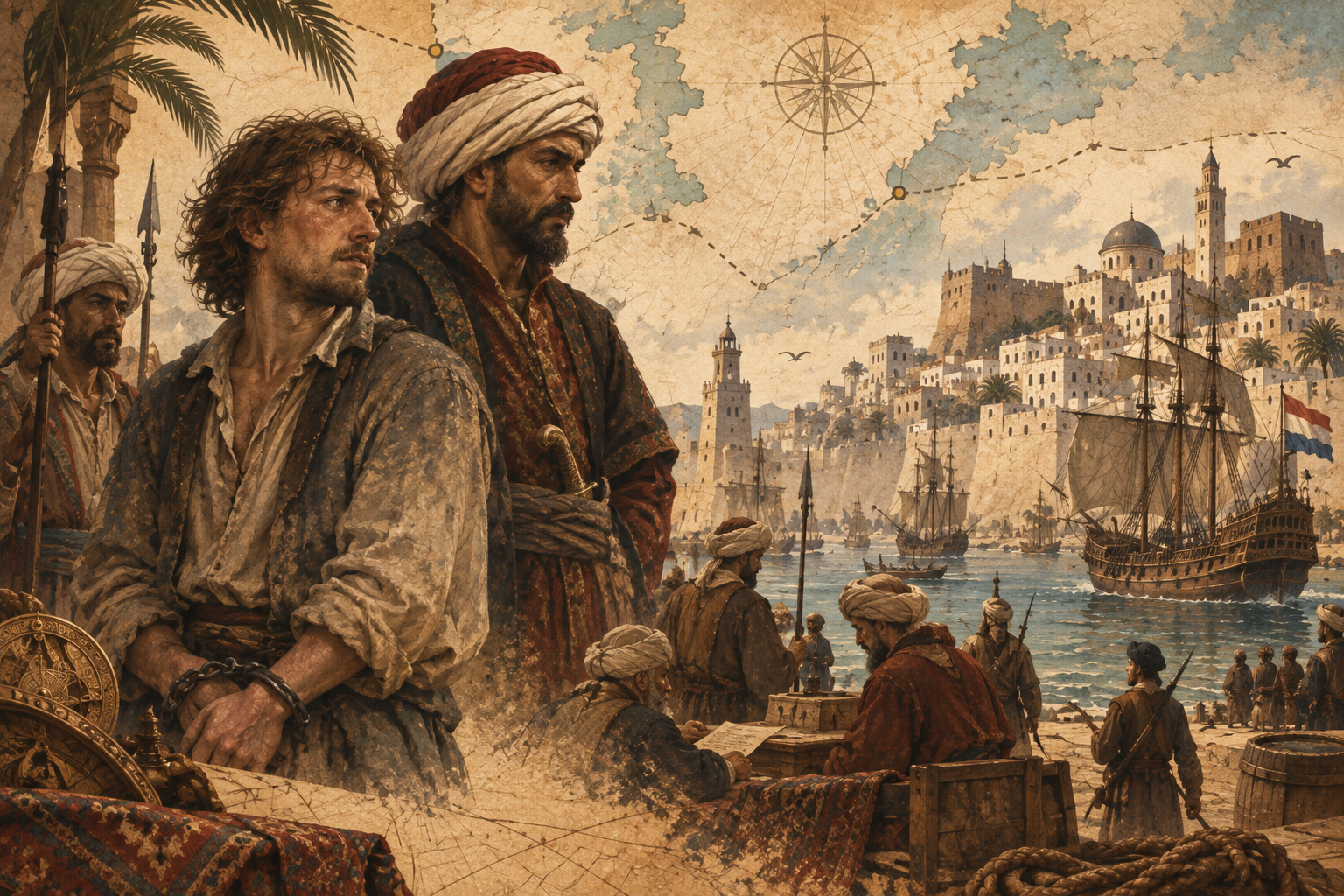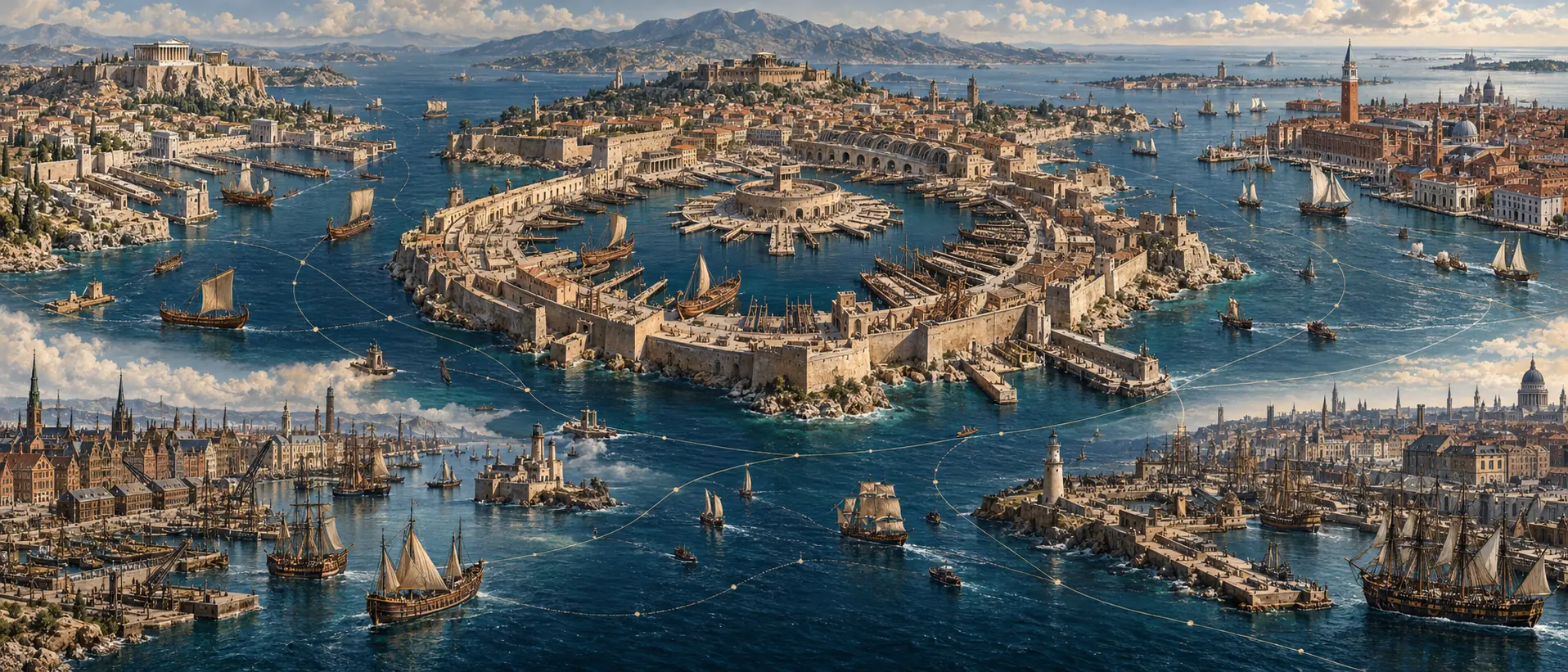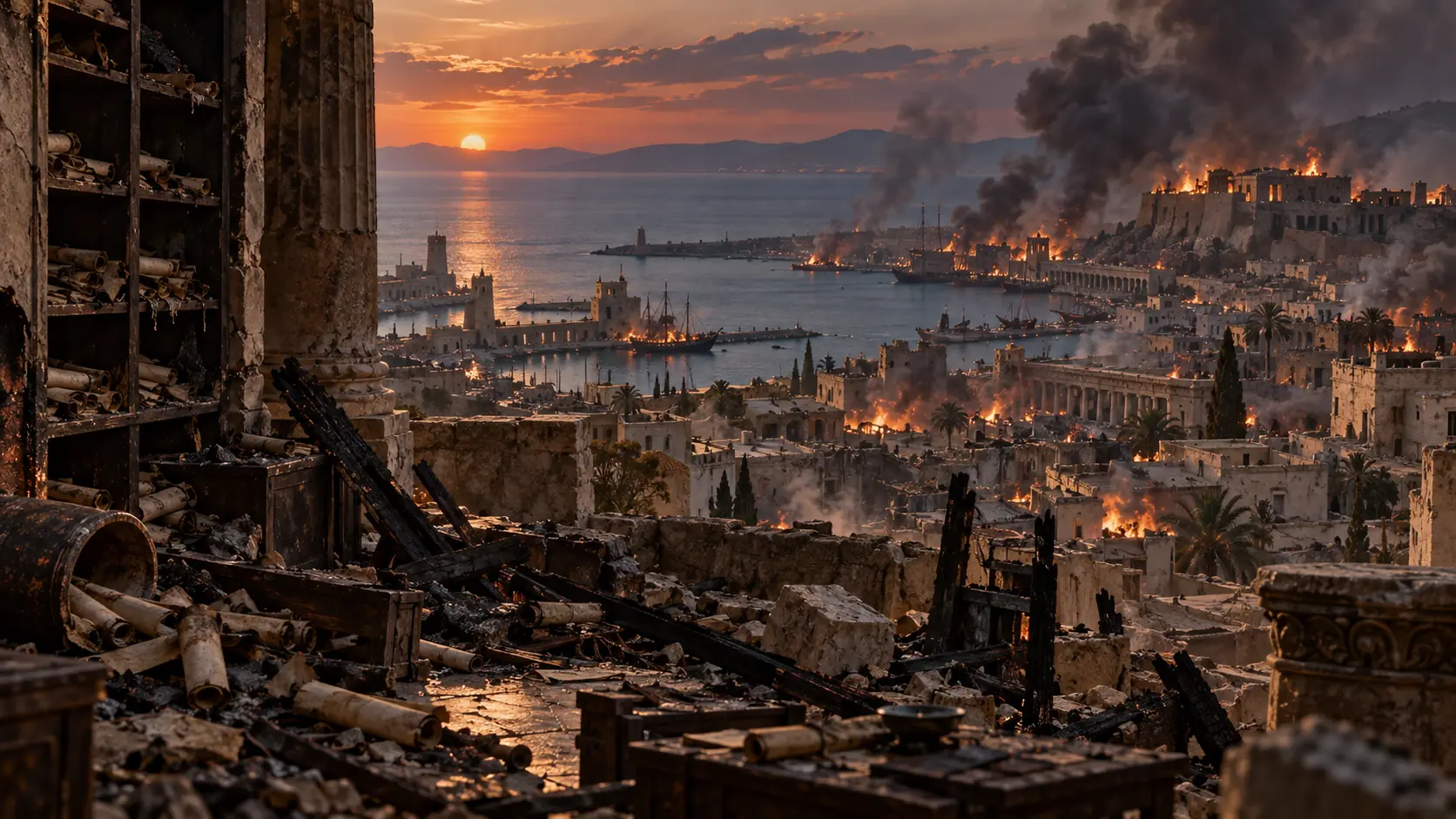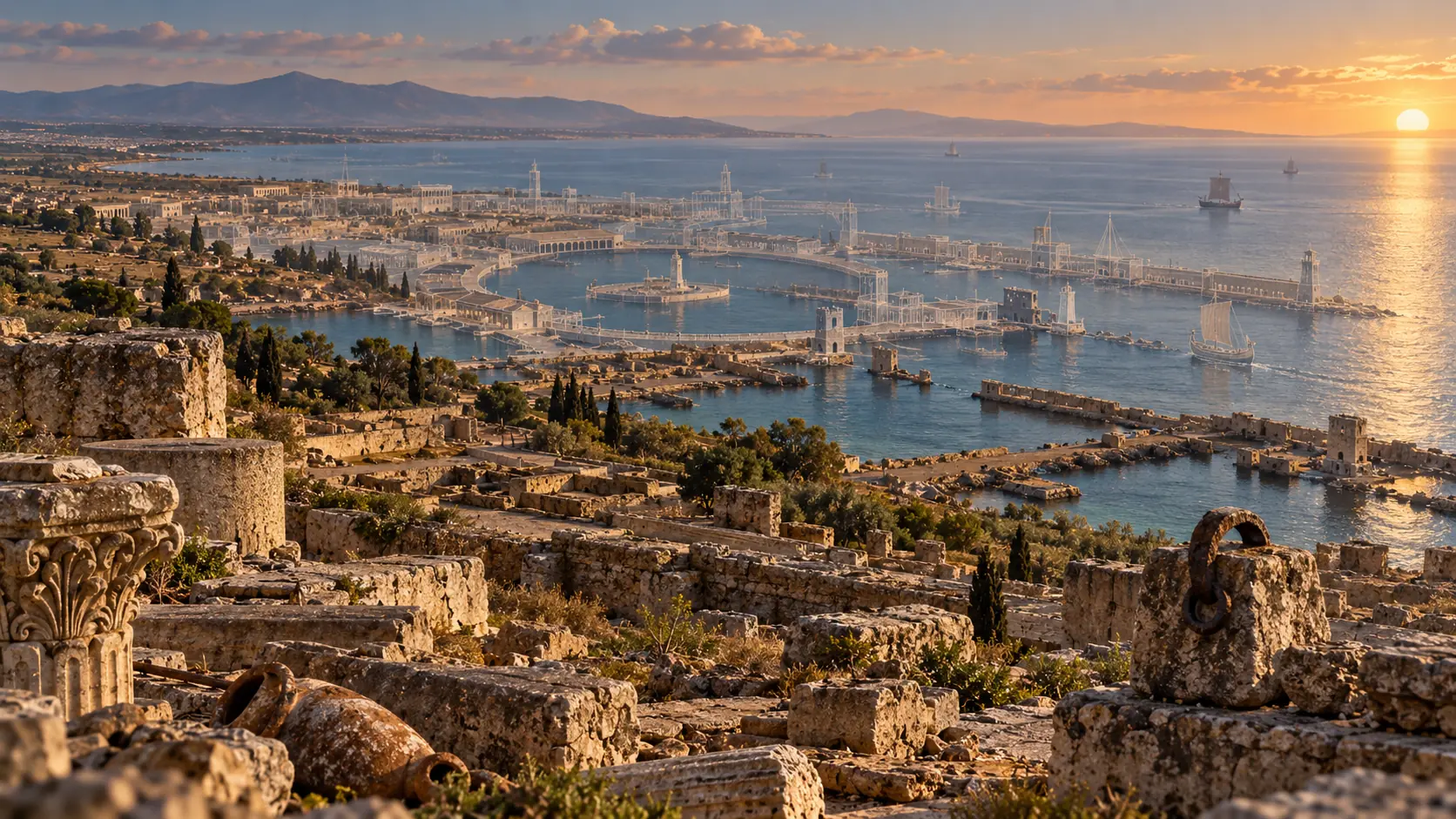
The Sea Beggars were not merely pirates or rebels. They were an adaptive maritime network that transformed decentralized naval violence into political leverage during the Dutch Revolt. Their rise shows how maritime infrastructure, ideology, commerce, and irregular warfare shaped Dutch maritime power.
Visible StoryPirates and Rebels
A simplified national memory of rough Protestant fighters resisting Spanish power.
Hidden SystemMaritime Network
A distributed structure of ships, ports, intelligence, finance, religious support, and tactical mobility.
Strategic EffectPolitical Leverage
Local maritime action could trigger wider rebellion by changing control of ports and supply lines.
Civilization PatternInfrastructure Becomes Power
Informal networks often reveal the future shape of formal institutions.
01 · Observation
The Sea Beggars Emerged from Maritime Fracture
The Sea Beggars, known in Dutch as the Watergeuzen, are often remembered through simplified national mythology: rough Protestant rebels fighting Spanish power during the Dutch Revolt. That image is powerful, but incomplete. It reduces a complex maritime system into a heroic symbol.
They operated between piracy, privateering, commerce, intelligence gathering, religious resistance, and political warfare. They were not outside the system. They emerged from the fractures inside European maritime order itself.
Core insight:
The Sea Beggars succeeded because they combined mobility, maritime knowledge, political ambiguity, and networked operations into a flexible anti-imperial system.
02 · Operating Logic
Four Forces Made the Sea Beggars Dangerous
Maritime Disruption Stack
Geography
Shallow coastal waters and fragmented shorelines favored local navigators over large imperial fleets.
Mobility
Small vessels moved quickly between ports, estuaries, river mouths, and trade corridors.
Ambiguity
Privateering licenses, exile politics, and fragmented authority created legal gray zones.
Networks
Merchants, sympathizers, financiers, sailors, and political factions formed a hidden support layer.
03 · Context
The Dutch Revolt Created Maritime Space for Irregular Warfare
In the sixteenth century, the Habsburg Empire attempted to centralize political and religious authority across the Low Countries. Tax pressure, religious repression, regional resistance, and political fragmentation created escalating instability.
On land, Spanish military power remained formidable. At sea, the situation was more fluid. Coastal cities, river systems, estuaries, fishing routes, merchant fleets, and shallow-water navigation created operational environments that conventional imperial structures struggled to fully control.
Trade routes, estuaries, and coastal infrastructure helped transform maritime insurgency into political leverage.
Maritime power rarely begins as a clean state structure. It often emerges from semi-legal networks operating in contested zones.
04 · Timeline
From Exile Network to Political Shockwave
Stage 01Imperial Pressure
Spanish authority intensifies taxation, religious enforcement, and political control.
System MeaningCrisis Creates Openings
Centralization creates resistance, displacement, and opportunities for irregular actors.
Stage 02Exile and Sea Mobility
Displaced sailors, dissidents, and privateers form mobile maritime communities.
System MeaningLoss Becomes Network
People pushed out of fixed institutions build power through movement and maritime access.
Stage 03Privateering Logic
Legal ambiguity lets maritime actors operate between rebellion, commerce, and violence.
System MeaningAmbiguity Becomes Force
When law is fragmented, flexible actors can move faster than formal institutions.
Stage 04Brielle 1572
The capture of Brielle turns maritime action into a political signal.
System MeaningLocal Action Cascades
A port seizure changes confidence, supply, legitimacy, and rebellion dynamics.
Why this matters
The Sea Beggars show how states often inherit infrastructure and tactics first developed by irregular actors operating in unstable systems.
05 · Mechanism
How Maritime Disruption Became Political Leverage
Their advantage did not come from overwhelming force. It came from system fit. They operated where imperial control was weakest: shallow waters, coastal routes, contested ports, semi-legal violence, and communities that already depended on maritime exchange.
The capture of Brielle in 1572 demonstrated how maritime disruption could trigger wider political rebellion across the Low Countries.
Political Cascade
Port seized
A local maritime strike changes who controls access, shelter, and logistics.
Signal spreads
Merchants, towns, rebels, nobles, and imperial officials reassess Spanish control.
Supply shifts
Ports and waterways alter the flow of goods, movement, and military pressure.
Authority weakens
The image of imperial inevitability breaks, making rebellion more thinkable.
Systems definition:
The Sea Beggars operated as a distributed maritime disruption network capable of converting local tactical victories into broader political destabilization.
06 · Narrative
National Myth Simplified a More Complex Reality
Later Dutch national memory often transformed the Sea Beggars into heroic freedom fighters. Elements of that narrative are true, but the reality was more ambiguous.
Maritime violence, opportunism, smuggling, private profit, religious identity, and political rebellion were deeply intertwined. The same actors could function as patriots, pirates, merchants, diplomats, and raiders depending on context.
The Sea Beggars operated between rebellion, commerce, privateering, and political warfare.
Empire saysPirates
Threatening actors outside imperial legitimacy.
Allies sayPrivateers
Useful semi-legal force against a shared enemy.
Nation saysHeroes
Founding figures in a story of liberation.
Systems viewNetwork actors
Mobile operators exploiting infrastructure gaps.
07 · Psychology
Why Maritime Rebellion Attracted Followers
Maritime systems create a different psychological environment from land empires. Sailors move between jurisdictions, cultures, languages, and legal systems. Identity becomes more fluid. Loyalty becomes more transactional.
MotivationSurvival
Displaced people needed income, protection, and new routes into security.
MotivationResistance
Religious and political pressure made anti-imperial alignment meaningful.
MotivationMobility
The sea offered escape from fixed social order and local repression.
MotivationReward
Raiding, trade, privateering, and patronage created material incentives.
Romanticizing maritime rebels hides the reality that irregular naval systems often depended on coercion, extraction, and unstable loyalties.
08 · Infrastructure
The Hidden Infrastructure Behind Maritime Power
Ships alone do not create maritime dominance. Ports, financing systems, intelligence flows, repair capacity, cartography, merchant relationships, and political protection all matter.
Large imperial fleets struggled against smaller decentralized naval actors operating in shallow coastal waters.
Hidden Support Layer
Ports
Harbors created shelter, logistics, intelligence, repair, and escape options.
Merchants
Commercial actors helped redirect trade, finance risk, and support maritime pressure.
Coastal pilots
Local navigational knowledge turned shallow waters into defensive advantage.
Religious networks
Shared identity created trust, shelter, messages, and legitimacy across distance.
Hidden system:
Maritime insurgency became a training ground for future commercial and naval infrastructure.
09 · Power Map
Who Benefited from the Sea Beggars System
Political LayerRebel Leaders
Maritime disruption stretched Spanish attention and gave rebellion a pressure tool.
Urban LayerPort Cities
Coastal communities gained bargaining power when imperial control weakened.
Economic LayerMerchants
Some merchants used instability to redirect trade and align with emerging power.
Religious LayerDissidents
Protestant resistance found protection and movement through maritime routes.
10 · Modern Parallel
From Maritime Raiders to Modern Network Actors
Today, power increasingly flows through networks rather than rigid hierarchies. Small distributed actors can exploit vulnerabilities inside larger systems. Cyber groups, digital insurgencies, decentralized information operations, and infrastructure disruptions reflect similar dynamics.
Understanding the Sea Beggars helps explain how adaptive networks challenge centralized systems across both maritime and digital environments.
11 · Synthesis
The Sea Beggars Were a Transitional Power Layer
The Sea Beggars existed at the edge of empire, legality, commerce, and rebellion. They were neither fully state actors nor simple criminals. They represented a transitional layer between fragmented maritime violence and organized Dutch naval-commercial power.
Civilizational Pattern
1. Crisis weakens authority
Centralized systems lose control at the edges.
2. Mobile actors exploit gaps
Small groups move faster than formal institutions.
3. Informal networks mature
Survival structures become operational infrastructure.
4. States institutionalize methods
What begins as irregular practice can become official power.
Modern digital systems face many of the same structural problems as historical maritime systems: dependency, interconnection, ambiguity, and asymmetric disruption.
The WordPress Security Quick Check helps identify hidden vulnerabilities before they become operational risks.
Cape Colony VOC: How a Supply Station Became Empire
The Cape Colony VOC system began as a practical answer to distance. In 1652, the Dutch East India Company established a station at the Cape of Good Hope to supply ships moving between Europe and Asia. But a supply point does not remain neutral when it requires land, labor, farms, rules, and permanent control.
6-8months per voyage10,000+nautical miles1652the year it began
Published: May 3, 202616 min read
[IMAGE: Featured image showing a dark cinematic map of the Cape of Good Hope with Dutch ships, trade routes, and a glowing supply node. Style: cinematic, archival, premium editorial. Mood: strategic, maritime, imperial. Suggested alt text: Cape Colony VOC global supply empire. Suggested search terms: Cape of Good Hope Dutch East India Company ships map.]
The Problem of Distance
The Dutch maritime world operated across vast distances. Ships moving between Europe and Asia faced a structural problem: time, scarcity, disease, repair, food, water, and exposure to unpredictable seas.
A voyage could last six to eight months. Crews needed food, drinkable water, repairs, discipline, and enough physical health to survive the route. Food spoiled. Water turned dangerous. Scurvy weakened sailors and threatened the operational life of the ship.
Even in flexible systems like Jan Janszoon and the maritime networks around Salé and the Dutch maritime world, mobility had limits. Ships could move, but they could not sustain themselves indefinitely.
Key Takeaway
The Cape turned distance from a random danger into a managed logistical problem.
The Cape Was Not Empty Space
The Cape was not an empty platform waiting for European organization. It was inhabited, crossed, used, and understood by communities whose relationship to land, water, cattle, movement, and seasonality did not fit the VOC map of control.
That matters because infrastructure is never just technical. When one system defines a place as a supply zone, it changes what other people are allowed to do inside that space.
The Cape Colony story therefore begins with two realities at once: the logistical needs of a maritime company and the lived presence of people already occupying the land that would become part of the supply machine.
The Cape Colony VOC Solution
In 1652, the Dutch East India Company established a permanent station at the Cape of Good Hope under Jan van Riebeeck. Officially, it was a refreshment station for ships traveling between Europe and Asia.
Structurally, it was something larger: a fixed node inside a global commercial machine. The Cape Colony VOC system helped turn the ocean route into a managed route.
The VOC did not need the Cape because it wanted another symbolic possession on the map. It needed the Cape because a global route is only as strong as the points that keep it alive.
A fixed node allowed ships to refresh, repair, reorganize, and continue. It transformed the route from a dangerous crossing into a repeatable system. Repeatability was the real value.
The VOC was not simply a merchant firm with ships. It acted like a company-state: a commercial institution with military power, administrative authority, contracts, land claims, and a worldview that treated trade discipline as an ordering force.
That commercial worldview is explored further in The VOC Was a Belief System Before It Was a Company. The Cape settlement makes that logic visible because it shows how business incentives could become law, settlement, and control.
From Network to Infrastructure
Earlier Dutch systems, including Salé’s maritime networks, relied on flexibility, movement, negotiation, and opportunistic force.
The Cape changed the logic. It introduced permanence. Instead of only moving through the world, the Dutch began anchoring themselves inside it.
That is why the Cape Colony VOC system matters. It shows how trade can become territory when a commercial route needs reliable support.
Key Takeaway
The Cape Colony VOC system represents the shift from trade networks to territorial infrastructure.
Food Became Territory
The Cape began as a place where ships could take in food and water, but food production quickly required land, labor, storage, roads, rules, and settlement. A logistical answer became a territorial system.
Once the supply station depended on farms and permanent production, the station could no longer remain a simple stopover. The supply machine needed a surrounding zone it could control.
Food was not a detail in the background. It was the mechanism through which maritime trade became land control.
The Free Burgher Feedback Loop
The VOC could not run the supply machine through ships alone. It needed producers on land, which meant settlers, farms, contracts, incentives, and enforcement. Free burghers were released from direct company service and pushed into agricultural production.
That created a feedback loop: ships needed food, farms needed land, land required control, and control encouraged further settlement. Each solution increased the scale of the original system.
System Loop
Supply demand created settlement. Settlement required land. Land control created conflict. Conflict justified stronger control. Stronger control made the supply system more permanent.
Khoikhoi Relations and the Cost of Infrastructure
For the Khoikhoi, VOC infrastructure was not an abstract improvement in maritime efficiency. It was experienced as progressive displacement through pressure on land, water, cattle, movement, and labor.
The more reliable the Cape became for ships, the more disruptive it became for people who already inhabited the supply zone. Infrastructure concentrated value for the VOC while narrowing the space available to existing communities.
The efficiency of the supply machine and the cost paid by those who inhabited the supply zone are not separate stories. They are the same story.
[IMAGE: Supporting visual showing four stacked layers labeled narrative, infrastructure, control, and legacy around the Cape Colony. Style: dark editorial diagram with muted gold accents. Mood: analytical, historical, systems-focused. Suggested alt text: Cape Colony VOC 4 layer empire framework. Suggested search terms: VOC Cape Colony map Dutch empire supply route.]
The Cape as a Control Layer
The Cape became more than a stop. It became a control layer between oceanic movement and territorial administration.
That control layer linked ships, farms, labor, contracts, security, and settlement into one system. The more the node mattered, the more the surrounding region had to be shaped around it.
This is why the Cape works as a historical example of Feedback Loops in Systems. One practical need produced a chain of consequences that reinforced itself over time.
The Boer Expansion System
Dutch settlers, later known as Boers, extended beyond the initial station. Agriculture was not just survival. It became a mechanism of territorial claim.
Land, production, labor, and settlement formed a self-reinforcing system. What began as logistics created social and political consequences that lasted far beyond the VOC itself.
The Boer expansion system shows how a company solution could outgrow the company. The structure remained even when the original administrative logic changed.
A Contrast in Civilizational Systems
Unlike the organic development explored in the history of Tunisia, the Cape Colony VOC system was engineered from the start.
Tunisia’s identity grew through layered civilizational inheritance. The Cape settlement was designed around efficiency, route security, and imperial logistics.
One system accumulated meaning through time. The other began as a logistical design and then produced meaning, hierarchy, and conflict through control.
From Carthage to the VOC
The Cape belongs to a wider maritime pattern. Ancient Carthage also built power through routes, ports, ships, and commercial nodes rather than through a simple land empire.
The VOC did not invent maritime network power. It inherited an older logic and industrialized it through company administration, accounting, ships, and fortified supply points.
Empire Needs Narrative Control
Infrastructure alone does not explain empire. Empire also needs a story that makes its control appear necessary, rational, moral, or inevitable.
The Cape could be described as a refreshment station, but that description hid the larger transformation. A supply station became a settlement. A settlement became a claim. A claim became a structure of rule.
The logic behind the Cape did not disappear. It evolved.
Today, infrastructure is no longer only ports, farms, warehouses, and ships. It is also identity systems, authentication layers, databases, platforms, and digital access control.
The same structural question remains: who controls the node, who depends on it, and who pays the cost when that node becomes essential?
This is why the history of infrastructure also belongs near modern cybersecurity. The wider digital version of this pattern appears in How Cybersecurity Shapes the Modern World.
What the Cape Colony Actually Teaches
The Cape Colony VOC system teaches that infrastructure is never only technical. It creates dependency, authority, visibility, exclusion, and memory.
A complex system is not defined only by its parts, but by the relationships that keep those parts reinforcing each other. That is why this story also belongs beside What Is a Complex System?.
The Cape was not important because it was isolated. It was important because it connected ships, people, land, food, disease, trade, violence, and long-term identity into one operating structure.
Key Takeaway
The Cape Colony VOC system shows how a practical support node can become a durable structure of power.
Why This Matters
Why This Matters
The Cape Colony VOC system reveals a durable pattern: control follows infrastructure. That pattern still defines power in culture, trade, technology, and cybersecurity.
If you want to apply the infrastructure lens to modern digital systems, continue through the WordPress Security Quick Check. If you want to stay within the historical and cultural route, return to Culture & Identity.
Tyrian Purple Meninx: 7 Ways Luxury Built Maritime Power in Ancient Djerba
Tyrian purple Meninx is not only a story about dye. It is a story about how luxury became infrastructure.
On the island of Djerba, the ancient city of Meninx turned marine biology into elite status,
elite status into maritime trade, and maritime trade into durable political power.
Published: April 27, 202624 min read
Ports Are Not Always Built by Necessity
Most people think ports are built for necessity. Grain feeds cities. Water sustains life.
Armies require harbors. Empires need naval bases. This is true, but incomplete.
Some ports were not built primarily for survival. They were built because prestige created demand,
and demand created routes.
Tyrian purple Meninx became powerful because it transformed a rare marine resource into elite political symbolism across the Mediterranean.
That sounds less serious only if prestige is misunderstood. In the ancient world, prestige was not vanity.
Prestige was political technology. It organized hierarchy, legitimized rule, and made power visible
to everyone who saw it.
A ruler who could display rare goods was not simply rich. He appeared elevated above ordinary men.
Luxury was never just consumption. It was architecture.
This is why Meninx matters. The ancient city on Djerba became one of the Mediterranean’s important
maritime centers because it supplied one of the most politically valuable luxury goods in the ancient world:
Tyrian purple dye.
Purple was not fashion. It was authority made visible.
Darja Rihla · Hidden Mediterranean Infrastructure
To wear purple was to announce rank. It marked emperors, governors, aristocrats, priests,
and the highest levels of political society. It transformed cloth into hierarchy.
Meninx was not simply producing color. It was producing visible legitimacy. It was exporting status.
Key Takeaway
Meninx did not become powerful because it made something beautiful.
It became powerful because it supplied a material that helped ancient elites display authority.
Before Meninx, Before Empire
To understand Meninx, you must begin before Meninx. This is where weak history often fails.
Many historical narratives begin where ruins become visible. Roman columns survive,
so people assume history starts with Rome. Written records feel safer, so the story begins
with conquerors, administrators, and imperial inscriptions.
That creates false beginnings.
Djerba mattered long before Rome, long before Carthage, and long before Phoenician merchants named routes.
Its importance began with geography.
Protected coastlines, fish-rich waters, cultivable land, maritime visibility,
and survivable water systems made permanence possible. These were not decorative advantages.
They were the foundations of settlement.
Repeated Selection
A place becomes historically important when different communities keep choosing it across time
because its geography solves practical problems better than surrounding alternatives.
This matters because too much Mediterranean history begins only when outsiders arrive.
Phoenicians did not create Djerba. Carthage did not create Djerba. Rome did not create Djerba.
They entered an already functioning human landscape.
Civilization rarely arrives from outside fully formed. More often, it accumulates.
For the deeper historical foundation of this island logic, read
History of Tunisia.
The Sea Before the State
Before Rome was a superpower, before Carthage dominated western trade,
the Mediterranean already operated like a living machine.
The sea was not empty water between civilizations. It was the civilization.
Movement shaped power more than borders did. A city that could move goods, information,
sailors, and trust across water could become powerful without controlling vast inland territory.
This is where the Phoenicians become essential. They were not empire builders in the Roman sense.
They did not think first in terms of conquered land. They thought like sailors.
Their power came from ships, ports, routes, and trust systems that made long-distance trade repeatable.
Tyre, Sidon, Utica, Gades, and eventually Carthage were not isolated cities.
They were nodes in a distributed maritime operating system.
Djerba fit perfectly into that logic.
Its protected coasts offered stopping points. Its position between eastern and western Mediterranean zones
made it useful. Its existing settlement systems made continuity possible.
The island was not glorious in the way imperial capitals were glorious. It was reliable.
Reliability matters more than beauty in maritime history. Sailors do not ask whether a coast is poetic.
They ask whether movement can be trusted there.
That is why Djerba entered the Mediterranean machine. Not as a capital, but as a node.
Carthage inherited Phoenician network logic and hardened it into empire.
Carthage was not only a city. It was a distributed operating system.
Its real power lived in circulation: Sicily, Sardinia, Ibiza, Utica,
North African coastlines, and strategic maritime nodes like Djerba.
Carthage did not rule the sea by owning everything. It ruled by making movement depend on it.
This is the difference between possession and power. Possession says: this territory is mine.
Power says: your movement must pass through my system.
Djerba mattered because it sat near movement between western Mediterranean trade zones,
Sicily, Tripolitania, and North African coastal routes.
That created three imperial advantages: observation, interruption, and taxation.
Observation means you see movement. Interruption means you can stop movement.
Taxation means you convert movement into durable power.
Meninx likely began as a Punic trading settlement before Roman monumental expansion made it archaeologically louder.
Rome did not invent Meninx. It inherited a working machine.
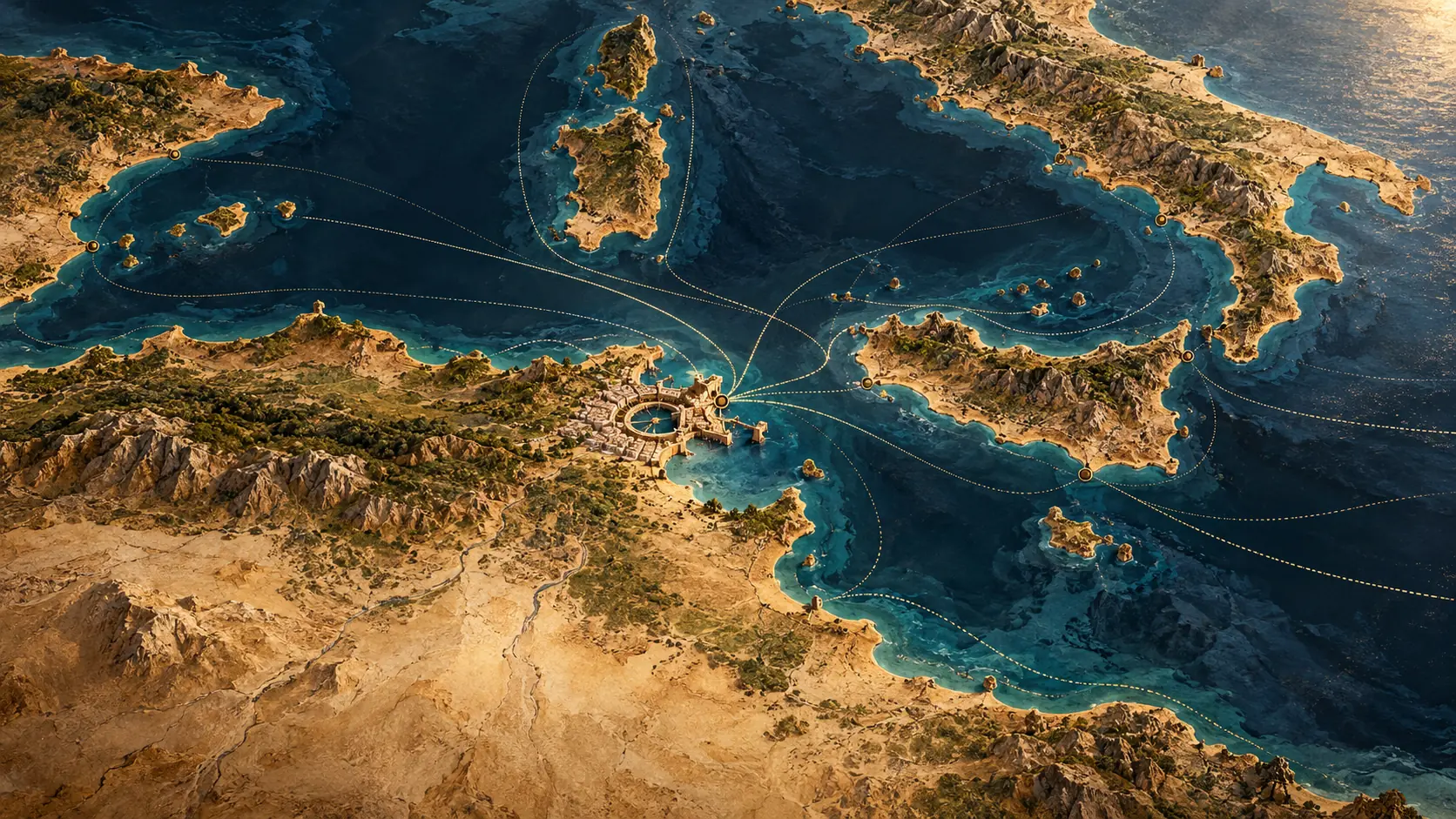
The Trade Routes That Carried Tyrian Purple from Meninx
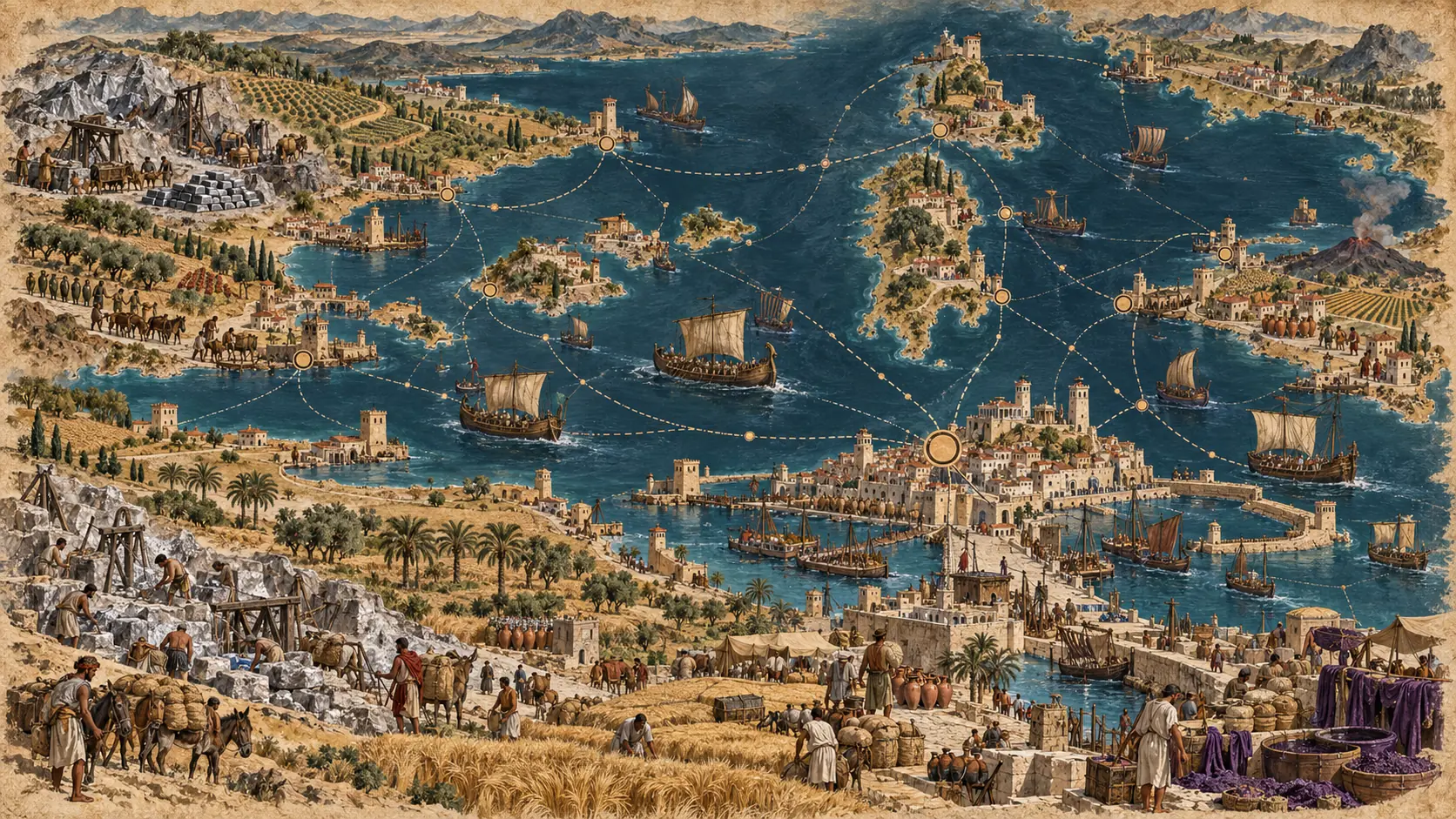
Tyrian purple from Meninx did not move randomly across the sea. It followed the logic of Mediterranean routes:
short coastal movements, trusted island stops, protected harbors, and commercial corridors already used for
olive oil, grain, ceramics, salted fish, textiles, and elite goods.
From Djerba, ships could move northwest toward Carthage and the Tunisian coast,
connecting Meninx to one of the most important commercial command points in the western Mediterranean.
From there, purple goods could continue toward Sicily, Sardinia, and the Italian peninsula.
Another route connected Meninx eastward toward Tripolitania and the wider North African coast.
This mattered because the coast was not an empty edge of empire. It was a chain of ports,
anchorages, markets, and storage points that allowed goods to move in stages.
Luxury Route Map
Meninx→Carthage→Sicily→Rome+Tripolitania=status moving through sea power
Route logic: the dye was local, but the demand was imperial.
Meninx mattered because it connected North African production to elite Mediterranean consumption.
The final elite buyer did not need to know the labor of the murex worker,
the smell of the dye vats, or the difficulty of the harbor. They only saw the cloth.
But behind that cloth stood a maritime system.
The Snail That Funded Hierarchy
The product that made Meninx extraordinary came from something almost absurdly small:
the murex sea snail.
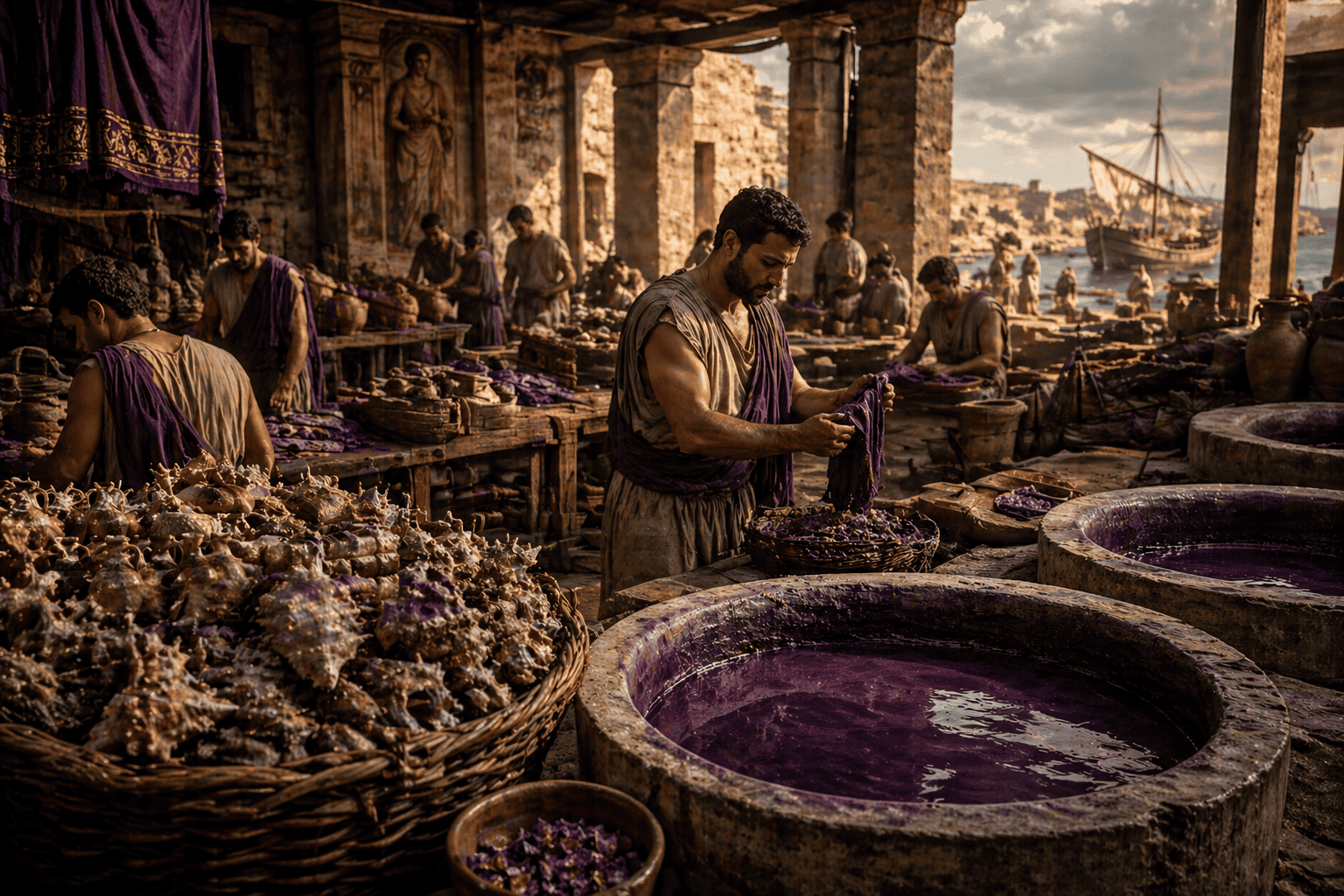
Thousands of murex shells were required to produce even a small amount of Tyrian purple dye.
The process was slow, violent, and unpleasant.
Thousands of murex shells were required to produce Tyrian purple,
transforming marine biology into elite political symbolism.
It was not artisanal elegance. It was chemical brutality.
Purple mattered because it was hard to make, expensive to buy, and instantly recognizable.
It turned cloth into a social border.
The Production Chain Behind the Prestige
Luxury becomes politically powerful when it hides labor behind elegance.
The purple border on a garment looked effortless, but every visible thread depended on an invisible chain of work.
First came coastal extraction. Workers had to collect shellfish in large quantities.
This required knowledge of tides, rocks, coastal pools, and fishing grounds.
Second came biological processing. The valuable material came from a small internal gland.
The work was repetitive, unpleasant, and probably socially low status compared with the rank of those who eventually wore the finished dye.
Third came chemical transformation. The dye precursor had to be fermented and exposed through controlled processes.
Purple was beautiful at the end because it was ugly at the beginning.
From Shell to Sovereignty
1. Murex Collection
Coastal labor turns local marine ecology into raw material.
2. Dye Processing
Fermentation and controlled production transform biology into value.
3. Textile Circulation
Cloth moves through merchants, ships, warehouses, and taxation points.
4. Elite Display
Status becomes visible on bodies, courts, temples, and imperial ceremonies.
This is why purple is a perfect Darja Rihla object. It is beautiful on the surface,
but structural underneath.
Tyrian Purple Meninx and the Political Economy of Status
Tyrian purple Meninx matters because it names the intersection between material production and political symbolism.
The importance of Tyrian purple Meninx was never only economic. It was political, because purple functioned as visible legitimacy for emperors, governors, and aristocratic elites.
Meninx was not simply a production site. It was a conversion point.
It converted marine extraction into elite consumption, elite consumption into long-distance maritime demand,
and maritime demand into port infrastructure.
A luxury object does not remain symbolic by itself. It requires a system behind it:
extraction, labor, storage, transport, merchants, taxation, security, and repeatable demand.
Status always hides infrastructure.
Build Authority on Secure Infrastructure
Meninx shows that visible authority depends on hidden systems. Your website works the same way:
trust, security, performance, and structure decide whether your platform can carry real value.
A luxury economy cannot survive on desire alone. Desire creates demand,
but administration makes demand repeatable.
Meninx needed more than shells and ships. It needed predictable systems for storage,
accounting, security, labor, and movement.
The Hidden Infrastructure of Status
Elite View
Purple means rank, beauty, privilege, and social distance.
Port View
Purple means labor, storage, ships, taxes, customs, and repeatable routes.
Luxury is never only symbolic. It becomes powerful when symbols require infrastructure.
Why Tyrian Purple Meninx Still Matters
Meninx was never truly about color. It was about hierarchy.
It transformed a coastal island into a strategic machine because elites across the Mediterranean
were willing to pay for visible legitimacy.
That demand created routes. Routes created taxation. Taxation created urban permanence.
Urban permanence created imperial relevance.
This is why Tyrian purple Meninx remains one of the clearest examples of how luxury goods can create real geopolitical infrastructure.
That is why purple built ports.
Why This Matters
Meninx changes how we read Mediterranean history. It shows that North Africa was not a passive edge of empire,
but an operational zone where geography, luxury, trade, taxation, and political legitimacy converged.
Sources & Further Reading
Pliny the Elder, Natural History
David Mattingly, Tripolitania
Hédi Dridi, Carthage and the Punic World
University of Munich archaeological research on Meninx, Djerba
Studies on Roman North African trade, purple dye production, and murex shell deposits
Culture & Identity · Maritime Borderlands · History of the Dutch Empire
The Sea Beggars: Dutch Private Violence Before the VOC
The Sea Beggars were not simply pirates, and they were not yet a modern navy. They were something more important: an early Dutch machine for converting private violence into political power. Before the VOC formalized commercial empire, the Sea Beggars showed how maritime opportunism, legal ambiguity, and territorial seizure could harden rebellion into state formation.
Published: April 23, 202615 min read
Contents
Reading Path
1. The Sea Beggars in the Dutch Maritime Borderlands
2. From Murad Reis to the Sea Beggars
3. Letters of Marque and Licensed Violence
4. Brielle, 1572: When Rebellion Became Territory
5. The Dark Side of the Myth
6. From Sea Beggars to the VOC
7. Why This Matters for Dutch Power
The Sea Beggars in the Dutch Maritime Borderlands
The Sea Beggars (Watergeuzen) belonged to the violent edge of the Dutch Revolt. They were Calvinist rebels, exiles, opportunistic captains, smugglers, privateers, and maritime raiders operating against Spanish Habsburg rule during the late sixteenth century.
They were not a formal state navy. They were not simply criminal pirates either. They lived in the gray zone between rebellion and legitimacy.
That gray zone is exactly where Dutch power begins to harden.
This article is not about pirate folklore. It is about the architecture of power: how the Dutch revolt learned to use privately organized violence as a strategic instrument before formal institutions fully existed.
Key Takeaway
The Sea Beggars matter because they show how rebellion became infrastructure—how irregular maritime violence turned into territorial and political leverage.
From Murad Reis to the Sea Beggars
In Jan Janszoon / Murad Reis, we see the mobile operator: a Dutch sailor moving through the Mediterranean world of corsairs, conversion, privateering, and legal ambiguity.
In Salé and the Dutch Maritime World, we see the transnational system: a corsair republic where maritime violence, commerce, diplomacy, and exile networks fused into a functioning political order.
The Sea Beggars are the next step.
They bring that same maritime logic back inside Dutch state formation itself.
Murad Reis shows the operator.
Salé shows the system.
The Sea Beggars show the mutation:
private violence becomes proto-state violence.
Darja Rihla cluster logic
This is the bridge between corsair opportunism and later institutional empire.
Letters of Marque and Licensed Violence
William of Orange lacked the money and institutional capacity to build a full conventional navy. Spain had imperial resources the rebels could not directly match.
The answer was asymmetry.
Through letters of marque, private ships could attack enemy commerce under political authorization. Violence did not disappear. It was reclassified.
The ship could remain the same.
The crew could remain the same.
What changed was legitimacy.
A pirate with paper becomes a privateer.
This allowed the Dutch revolt to weaponize commercial incentives. Crews could raid shipping, attack Catholic targets, disrupt supply lines, and keep part of the profit.
War financed itself through maritime extraction.
Alternative Perspective
The difference between pirate and patriot is often not morality, but authorization. Successful violence gets renamed.
Brielle, 1572: When Rebellion Became Territory
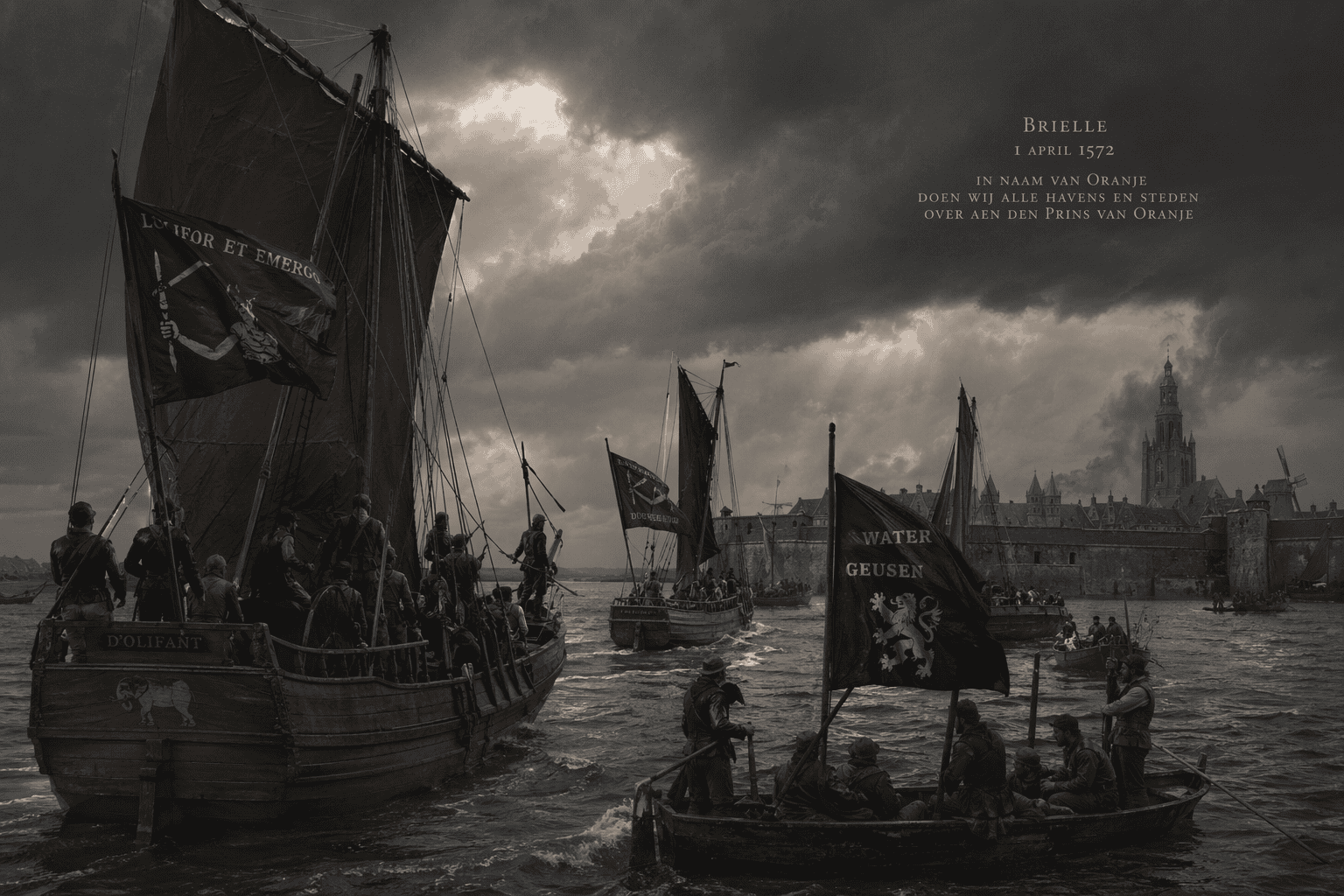
On April 1, 1572, the Sea Beggars captured Brielle (Den Briel).
This was not simply a port seizure. It was the conversion point.
Before Brielle, the Sea Beggars were mobile raiders.
After Brielle, they became politically transformative.
Once a port was held, private violence stopped being only fluid and maritime. It became territorial.
Territory created:
taxation, legitimacy, recruitment, alliances, administration, and momentum.
floating violence became territorial leverage.
Darja Rihla reading of Brielle
Without land, rebellion remains disruption.
With land, it becomes governance.
The capture of Brielle marked the moment when Sea Beggar privateering became territorial political power.
Why This Matters
States do not always begin by monopolizing violence. Sometimes they begin by absorbing, licensing, and redirecting violence that already exists in private hands.
The Dark Side of the Myth
Dutch national memory often upgrades the Sea Beggars into heroic founders.
That is selective memory.
They were also brutal.
They looted monasteries, attacked clergy, raided civilians, and committed anti-Catholic violence. The killings associated with the Martyrs of Gorcum show how difficult it was for William of Orange to fully control the forces he relied on.
Private violence is efficient. It is rarely obedient.
Important
The Sea Beggars helped build Dutch rebel power, but they were not clean heroes. They were politically useful because they were violent, mobile, and only partially governable.
From Sea Beggars to the VOC
The deepest legacy of the Sea Beggars was not one battle.
It was an operating model:
private actor + commercial incentive + political objective
This formula later appears in more formal form through the VOC and WIC.
The Dutch East India Company did not invent outsourced force. It inherited a world already trained to think that coercion could be delegated, profit could be harnessed, and legality could be wrapped around extraction.
The Sea Beggars were the prototype.
The VOC became the machine.
That is why this post must come before the VOC article in the cluster.
The Sea Beggars explain the mutation.
The VOC explains the scale.
Continue the Sequence
Before the Dutch empire became corporate, it learned how to organize force through maritime intermediaries.
Next comes the formalization of that logic.
Most people learn Dutch history through trade, tolerance, finance, and the Golden Age.
But before Amsterdam finance and before the VOC, there was already a deeper Dutch lesson being learned:
power scales fastest when violence, commerce, and legitimacy can be made to work together.
The Sea Beggars expose that early laboratory.
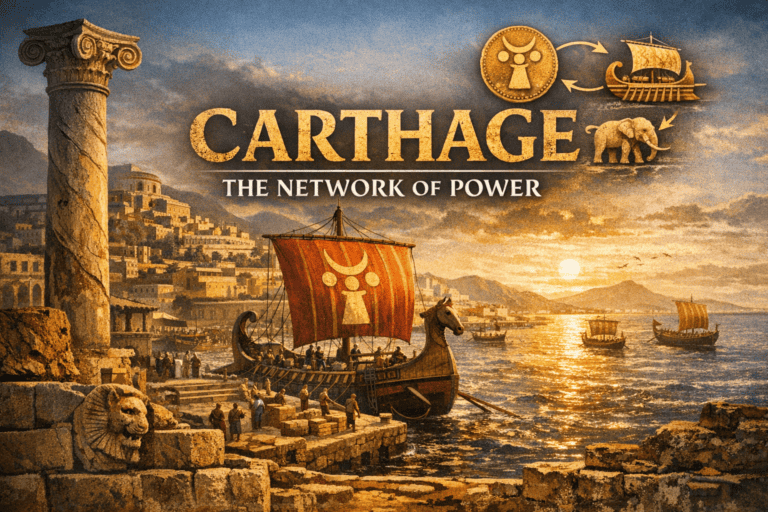
Read together with Carthage Network Power, another pattern appears: maritime systems often build power before ideology names it. Sea routes, chokepoints, mobility, and logistics matter more than national myths.
Read together with Human Error in Cybersecurity, the same structural logic appears again: power often comes from exploiting dependency rather than direct confrontation.
This is why the Sea Beggars belong inside Darja Rihla. They are not a side story. They are one of the earliest laboratories of Dutch organized power.
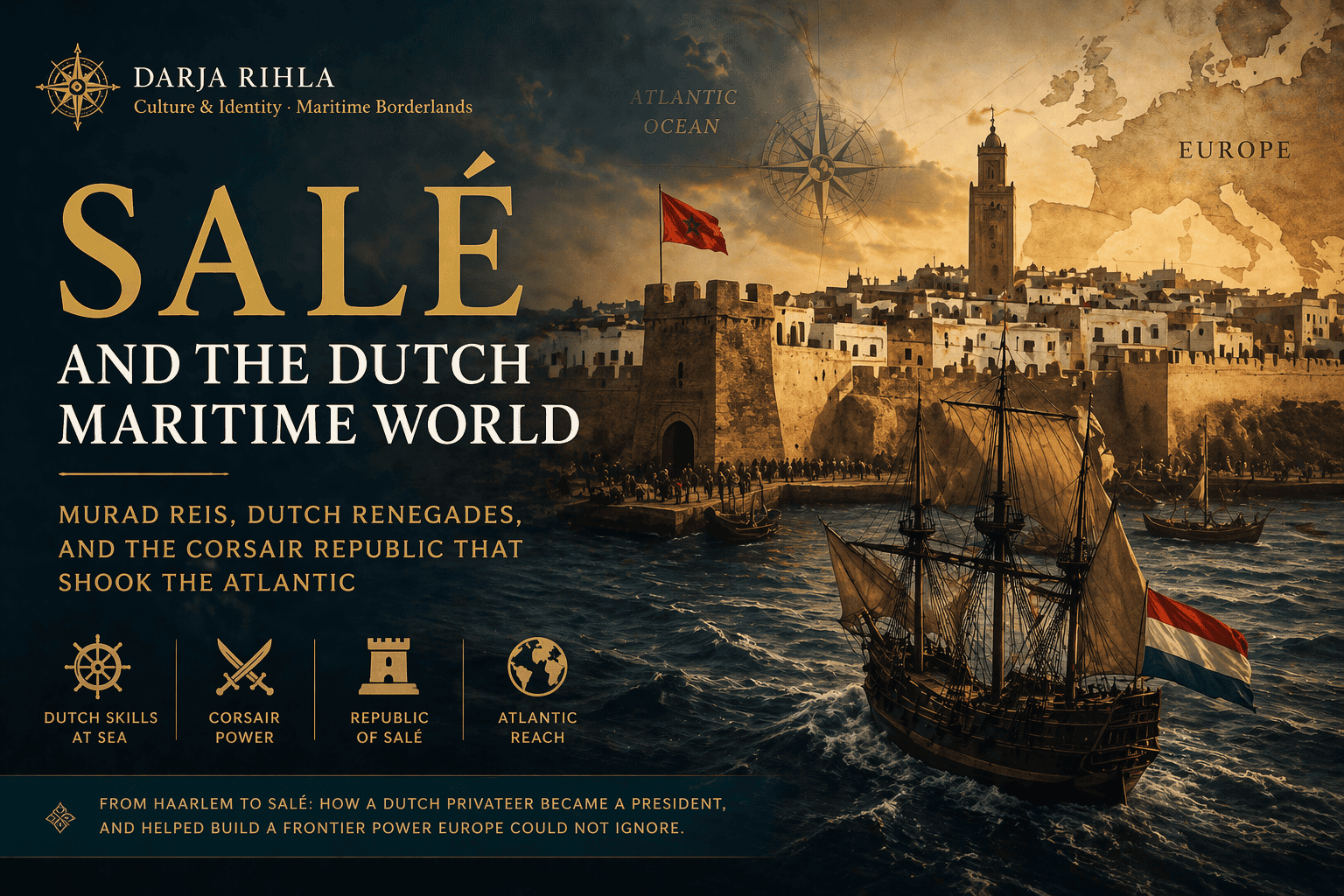
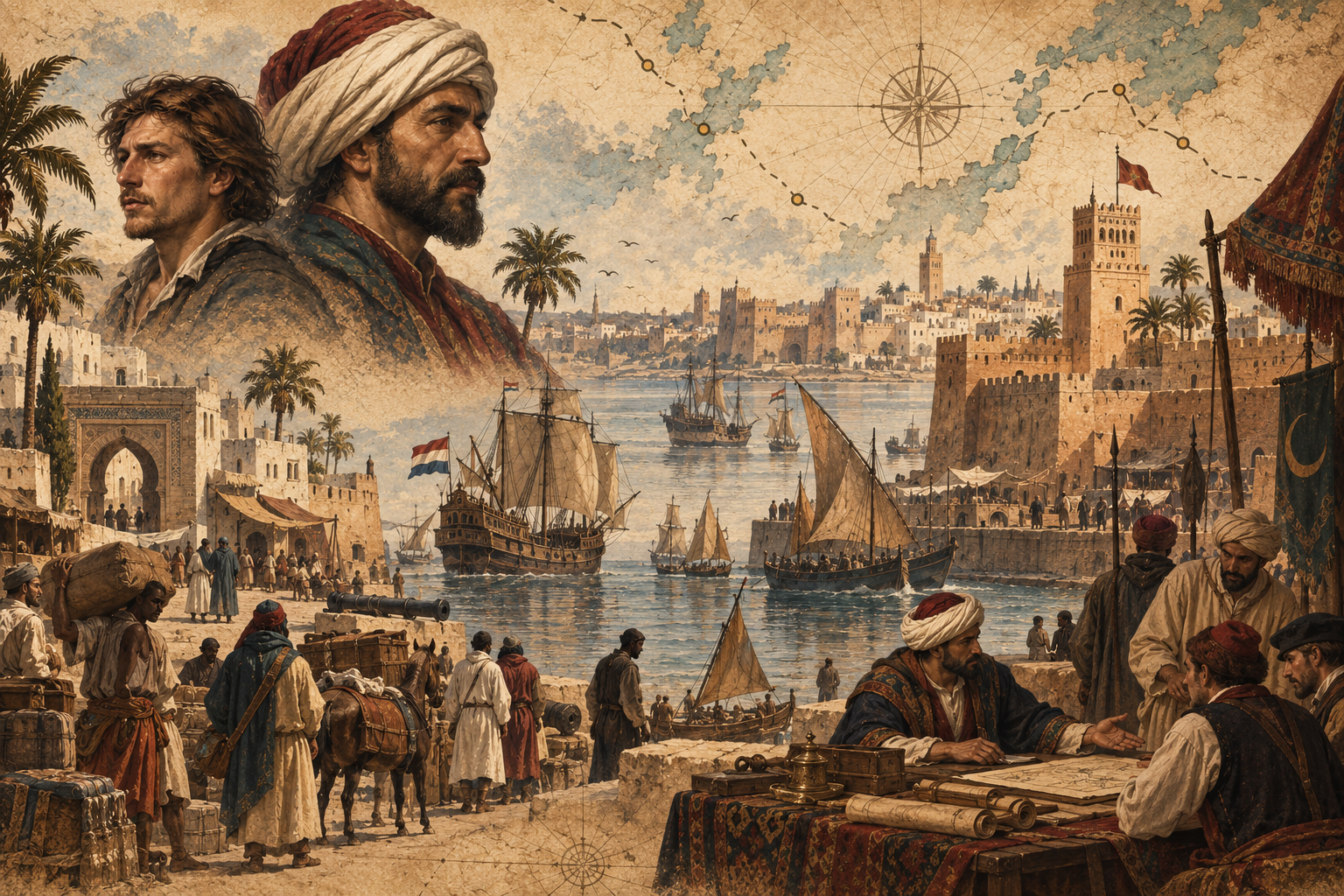
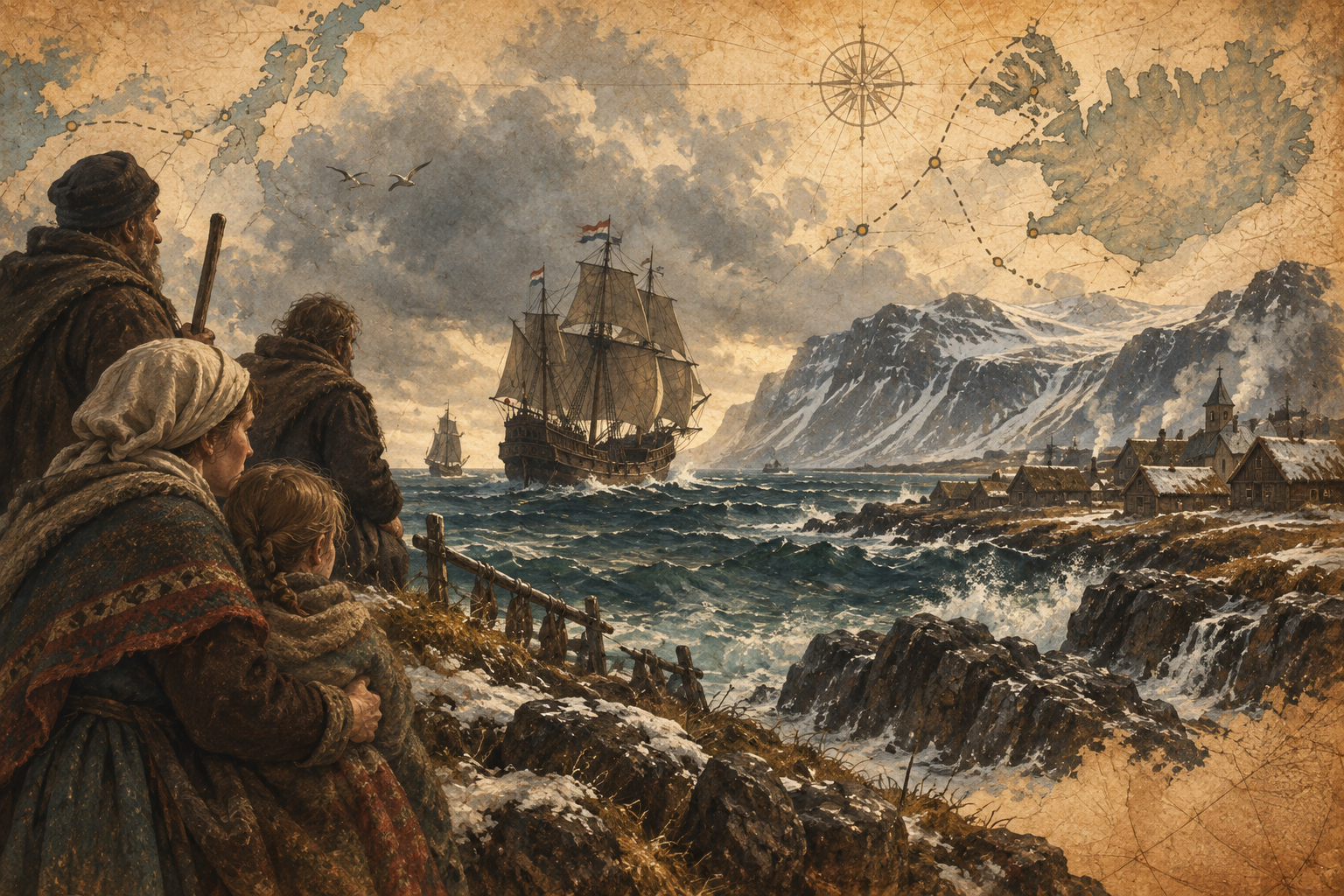
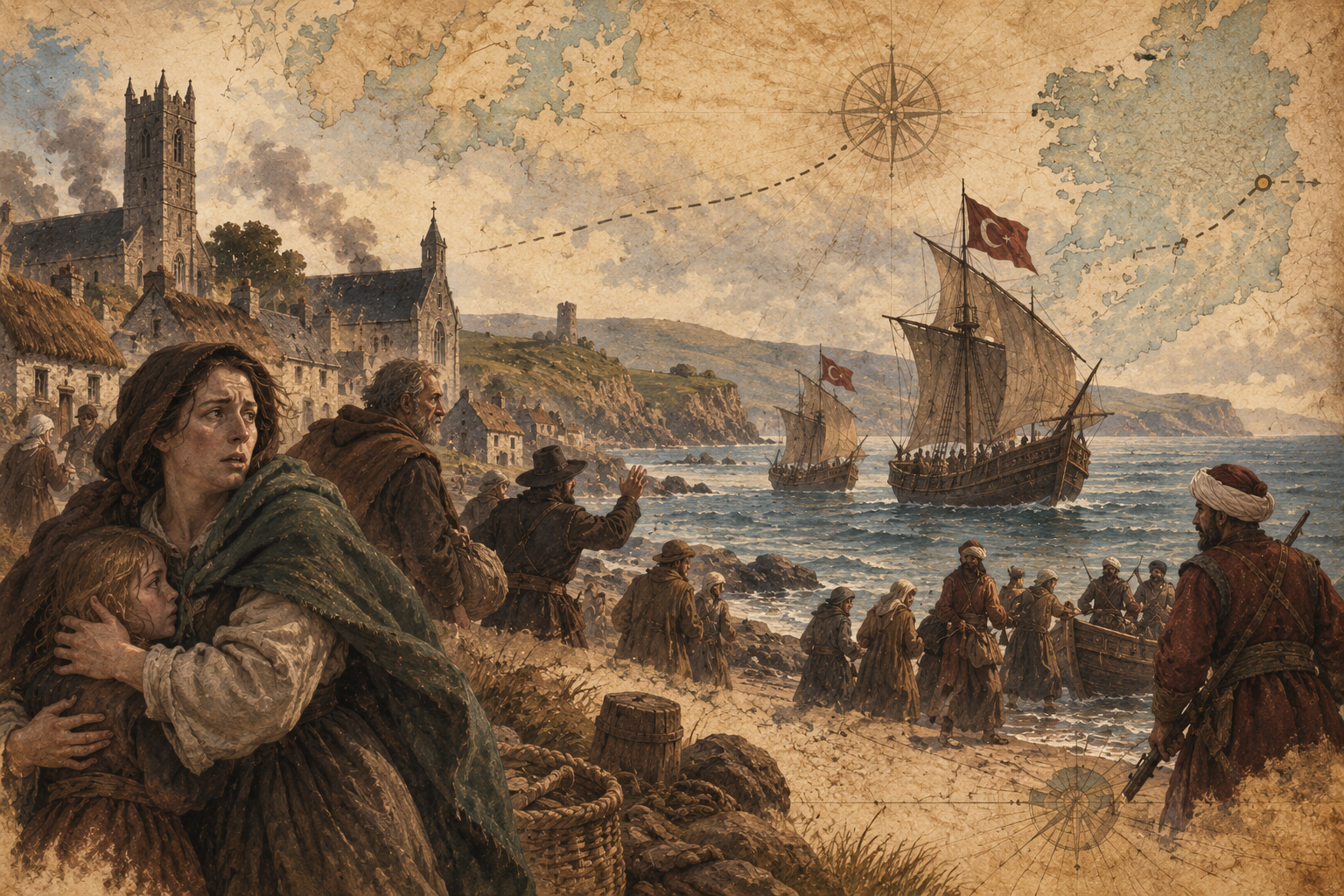
In 1627, a fleet out of Salé raided Iceland and took hundreds of captives. In 1631, the same network struck Baltimore in Ireland. The man behind these operations was born Jan Janszoon, in Haarlem. He died as Murad Reis, president of a corsair republic on the Atlantic coast of Morocco. This is the story of how Dutch maritime logic built a frontier power that Europe could not ignore.
SaléMurad ReisCorsair RepublicDutch Maritime History
This is not a pirate curiosity piece. It is a systems-history essay on how privateering, ship knowledge, flexible identity, and pragmatic diplomacy became a portable Dutch maritime operating system, one that functioned far outside the Republic’s legal borders, and reshaped the balance of Atlantic power in the process.
HaarlemOrigin point
SaléFrontier republic
PrivateeringPortable logic
DiplomacyTrade over purity
Murad ReisHuman bridge
Maritime Frontier MapA visual shorthand for how Dutch skills, port logic, and opportunistic maritime systems moved into North African space and returned as part of a larger borderlands story.
The Republic of Salé, a corsair state on the Atlantic coast of Morocco, has more to do with the history of the Netherlands than geography suggests. In the early seventeenth century, this frontier republic became a striking extension of Dutch maritime culture: a place where privateering logic, technical knowledge, flexible identity, and pragmatic diplomacy operated outside the formal borders of the Dutch Republic. The consequences reached as far as Iceland, Ireland, and the Canary Islands.
Timeline
Key events in the Salé corridor
The connection between the Dutch Republic and the Republic of Salé was not a single moment. It was a sequence of overlapping events spanning decades, driven by war, opportunity, conversion, and the portable logic of maritime violence.
c. 1580sSea Beggars normalize maritime revolt
Dutch rebels use privateer fleets against Spain. Decentralized naval violence becomes a legitimate political and economic tool. The mindset that will later travel to North Africa takes shape in the waters of Zeeland and Holland.
c. 1600Simon de Danser upgrades the Barbary fleet
The Flemish-born sailor introduces northern European square-rigged ship designs to Algiers. For the first time, Barbary corsairs can operate beyond the Mediterranean, into the Atlantic. This single technical transfer reshapes the balance of maritime power across the region.
c. 1618Jan Janszoon is captured and enters Barbary service
A Dutch privateer from Haarlem, operating under letters of marque against Spain, is captured by corsairs. Rather than languishing in captivity, he converts to Islam, takes the name Murad Reis, and begins his rise through the power networks of Algiers and eventually Salé.
1619-1627The Bou Regreg Republic takes shape
At the mouth of the Bou Regreg river, across from Rabat, a semi-autonomous corsair republic consolidates. Salé governs its own port, sets its own tariffs, manages its own fleet, and runs its own foreign negotiations. Murad Reis rises to become one of its most prominent captains.
1627The Iceland raid
Ships under Murad Reis’s command raid the coast of Iceland, one of the most distant corsair operations in Atlantic history. Hundreds of Icelanders are taken captive and brought back to North Africa. The raid demonstrates that Dutch-upgraded corsair fleets can project force anywhere in the Atlantic.
1627The Veere episode
Storm damage forces Murad into the Dutch port of Veere in Zeeland. He encounters his Dutch wife and children. The Republic is willing to tolerate his return. He chooses to leave. He chooses Salé. This is not simply an emotional moment. It is a sovereignty decision: the frontier offers him power, autonomy, and maritime command that the increasingly institutional Dutch Republic no longer can.
1631The sack of Baltimore
Corsairs from Salé’s network strike Baltimore in County Cork, Ireland. Over a hundred English settlers are taken captive. The raid shocks the English-speaking world and forces European governments to reckon with the reach of Barbary maritime power.
The Dutch Republic negotiates treaties with Moroccan rulers to protect Dutch shipping, while Dutch renegades continue to serve in the very corsair fleets threatening other European powers. Spain remains the shared enemy, creating room for selective cooperation and deliberate ambiguity.
1641Murad Reis becomes president of Salé
Murad reaches the peak of his political career, governing the republic itself. A man born in Haarlem now runs a North African maritime state, negotiates with European consuls, and controls one of the most active corsair fleets in the Atlantic.
c. 1641Murad Reis dies in Salé
He never returns to the Netherlands. His life arc, from Haarlem privateer to Barbary captain to republic president, becomes the clearest single illustration of Dutch maritime logic operating outside Dutch borders.
The renegade network
The men who carried Dutch maritime knowledge south
Murad Reis was not an isolated adventurer. He was part of a broader class of Dutch and northern European maritime renegades who exported ship knowledge, operational tactics, and the privateer mindset to North Africa. These men did not arrive as passive defectors. They arrived as technical specialists whose skills transformed the corsair fleets from Mediterranean galley operations into Atlantic-capable naval forces.
⚓
Jan Janszoon van Haarlem / Murad Reis the Younger
c. 1570 – c. 1641 · Haarlem to Salé
Born in Haarlem around 1570, Janszoon began as a Dutch privateer during the Eighty Years’ War, operating under letters of marque against Spanish shipping. Captured by Barbary corsairs around 1618, he converted to Islam and took the name Murad Reis. He rose through the power structures of Algiers and later Salé, becoming one of the most feared corsair captains in the Atlantic.
His operational range was extraordinary. The 1627 Iceland raid and the network behind the 1631 Baltimore attack were not acts of random piracy. They were organized military-commercial operations run on profit logic, using ships and techniques that owed a direct debt to Dutch naval practice. At the peak of his career, he served as president of the Republic of Salé, governing a North African maritime state while negotiating directly with European diplomats.
The Veere episode remains the most psychologically revealing moment of his life. Forced into a Dutch port by storm damage, he encountered the wife and children he had left behind. He could have stayed. He chose to leave. Salé offered him something Haarlem no longer could: command, frontier mobility, and a sovereignty that the increasingly institutional Dutch Republic had begun to foreclose for men like him.
PrivateerConvertFleet commanderPresident of SaléIceland 1627
⛵
Simon de Danser / Zymen Dansen
c. 1579 – c. 1611 · Dordrecht to Algiers
Born in Dordrecht (some sources say Vlissingen), Simon de Danser was arguably the single most consequential figure in the technical transformation of Barbary naval power. Before his arrival in Algiers around 1600, corsair fleets relied primarily on oar-driven galleys: effective in the Mediterranean but incapable of sustained Atlantic operations.
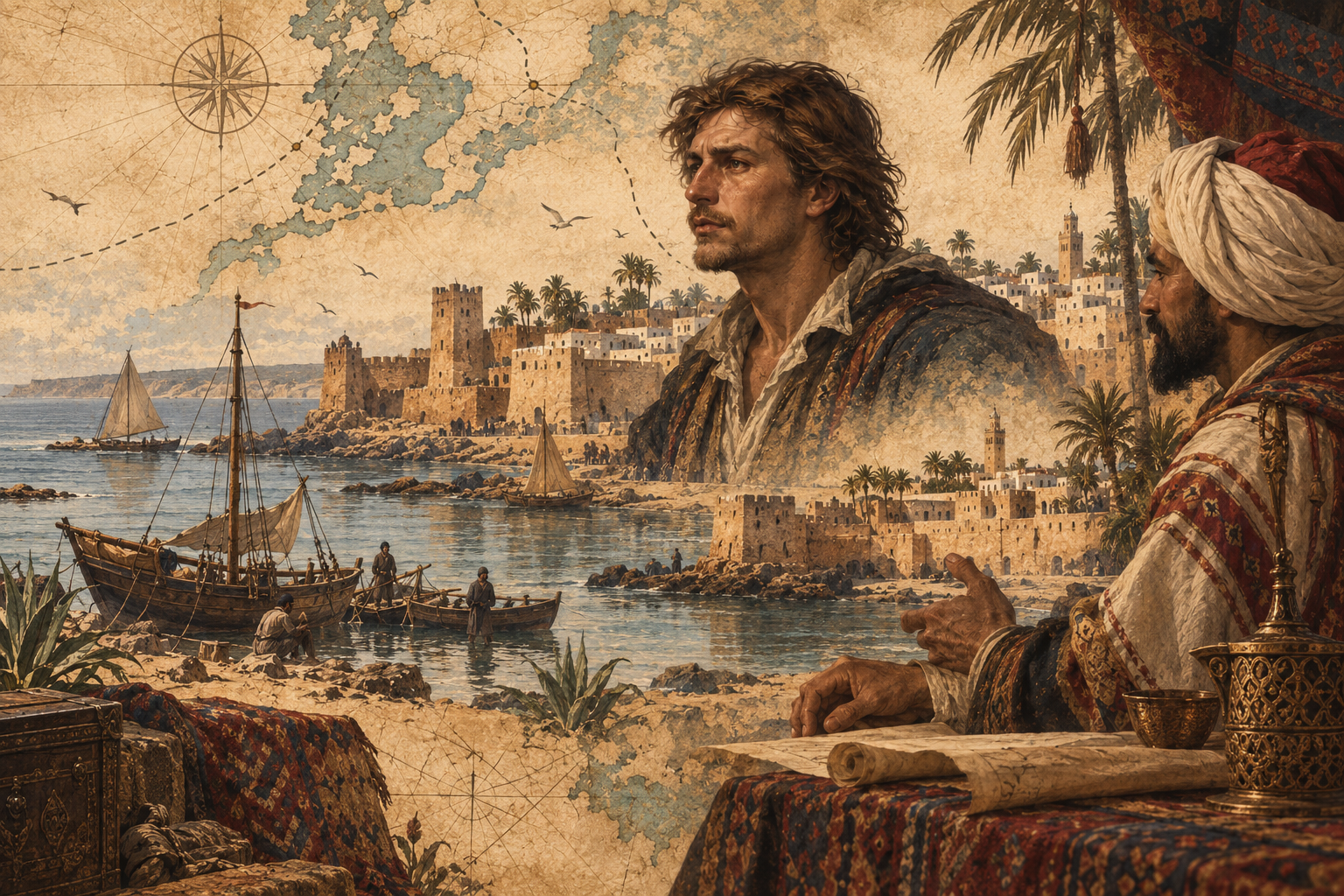
De Danser introduced round-hulled, square-rigged sailing ships to the Barbary fleet. This was not a cosmetic upgrade. It was a fundamental shift in operational capability. After this transfer, Barbary corsairs could handle Atlantic swells, carry larger crews, mount heavier armament, and operate far from home port for months at a time. The raids on Iceland, Ireland, and England that would follow in the 1620s and 1630s were made possible by this single knowledge transfer.
He was eventually killed in Tunis around 1611, possibly betrayed during a diplomatic negotiation. But the technical revolution he enabled outlived him by decades. Every corsair ship that raided the Atlantic after 1600 was, in some structural sense, a product of his intervention.
Ship engineerGalley to sail transitionAlgiers fleet architectKilled in Tunis c. 1611
🗡
Claes Gerritszoon Compaen
1587 – 1660 · Oostzaan to the Atlantic and back
Claes Compaen was born in Oostzaan, North Holland. He began as a privateer, then crossed the line into unauthorized corsair activity, operating across the Atlantic from the Caribbean to the Barbary Coast. His career illustrates the thin and often invisible boundary between state-sanctioned privateering and freelance maritime violence.
At the height of his operations, Compaen was one of the most wanted maritime figures in Europe. He attacked ships of multiple nations, built alliances across jurisdictional lines, and demonstrated that the Dutch privateer skillset could function autonomously anywhere there was open water and commercial shipping to intercept.
Unlike Murad Reis, Compaen eventually returned to the Netherlands. He negotiated a pardon, retired to the countryside, and died in Oostzaan in 1660. His case proves that the renegade network was not a one-way street: some men returned, bringing back knowledge of Barbary operational methods and Atlantic route intelligence.
Privateer turned corsairAtlantic scalePardonedReturned to Oostzaan
🌙
Ivan Dirkie de Veenboer / Soliman Reis
Active early 17th century · Netherlands to Algiers
Less documented than Murad Reis or De Danser, but no less significant in the network. De Veenboer, known as Soliman Reis after his conversion, operated as a corsair captain out of Algiers. He represented the second tier of Dutch renegades: men who were not famous enough to generate diplomatic incidents, but whose skills and knowledge were essential to the daily functioning of Barbary corsair operations.
His career reinforces the central argument: the Dutch maritime world did not export one exceptional individual. It exported a class of technically skilled, jurisdictionally flexible, economically motivated maritime professionals who could operate in any port system that offered them ships, revenue, and political cover.
How Dutch ship knowledge changed Barbary corsair power
The parallel is instructive. The Dutch fluyt was optimized for scalable, efficient trade: maximum cargo, minimum crew. The corsair hybrid vessels emerging from De Danser’s technical transfer were optimized for scalable raiding: maximum range, maximum prize potential. Different goals, same underlying logic: use ship design as a force multiplier for economic extraction from the sea.
This was not cultural influence. It was a direct technology transfer that changed the military balance across the Atlantic. Before it, European Atlantic shipping faced local piracy. After it, European Atlantic shipping faced a coordinated, state-backed raiding system capable of striking from Morocco to Iceland.
Core mechanism
The Dutch exported a maritime operating system. When that system entered the frontier conditions of the Republic of Salé, it did not disappear. It adapted, and it made Salé capable of projecting force across the entire Atlantic.
Geopolitical consequence
What the Republic of Salé did to Europe
The Republic of Salé was not exotic background. It was part of a real maritime power contest that shaped European shipping, diplomacy, and finance. Barbary corsair activity, amplified by Dutch ship technology, created a persistent disruption system across Atlantic and Mediterranean trade routes. European states paid tribute, ransomed captives, and adjusted naval deployments to manage the threat.
The Dutch position was uniquely contradictory. The Republic was simultaneously threatened by corsair activity against its own merchant fleet and pragmatically aligned with Morocco against their shared enemy, Spain. Dutch diplomats negotiated treaties with Moroccan rulers to protect Dutch shipping, while Dutch renegades were building the very corsair capability that threatened other European powers. This was not hypocrisy. It was the logic of a commercial republic that prioritized trade routes over moral consistency.
The financial consequences ran deeper still. Corsair risk accelerated the development of marine insurance markets, influenced shipping route calculations, and contributed to the development of convoy systems. The Barbary threat was one of the pressures that pushed European maritime commerce toward greater institutionalization. The same institutionalization that would eventually produce the VOC.
Identity arbitrage
The sovereignty of choosing Salé
The standard telling of Murad Reis treats him as an exotic curiosity: the Dutchman who became a Barbary pirate. That framing misses the point. Murad’s trajectory was not an aberration. It was an expression of a logic already embedded in Dutch maritime culture: jurisdictional flexibility, opportunistic alliance, and the willingness to move between political systems when the economics demanded it.
In the Republic, he would have been a retired privateer: tolerated, maybe pardoned, certainly diminished. In Salé, he was a president, a fleet commander, a man who could negotiate directly with European consuls and Moroccan power brokers. The frontier gave him a sovereignty that the homeland could not.
This is identity as strategy. Not as folklore.
Systems escalation
From frontier corsairs to the corporate empire
Salé matters most when placed inside the longer arc of Dutch maritime power. The usual story moves from the Sea Beggars to the VOC in one clean leap: revolt, independence, corporate expansion, global empire. But that arc skips the intermediate phase: the frontier phase, where Dutch maritime skills operated outside formal state control, in spaces that were legally ambiguous, politically opportunistic, and economically driven by personal initiative.
The actual sequence is more revealing. Sea Beggars normalized decentralized maritime violence. Privateering formalized it. The renegade network exported it to North Africa. Salé showed it could function as a self-sustaining system. And the VOC institutionalized the same underlying logic into a corporate structure backed by state charter and investor capital.
Phase 1
Frontier
Sea Beggars, privateers, renegades. Decentralized, personal, jurisdictionally flexible. Skills and violence moving freely across borders.
Phase 2
Frontier Republic
The Republic of Salé. A port-based system running on raiding revenue, political cover, and imported Dutch maritime knowledge. Self-sustaining but not yet institutional.
Phase 3
Corporate Empire
The VOC. Same underlying logic: maritime violence, port extraction, trade monopoly. Scaled through corporate structure, state charter, and finance capital.
Structural echo
Salé, Carthage, and the pattern of maritime network power
Carthage was an ancient network power: a sea-focused commercial republic that prioritized port control, maritime revenue, flexible diplomacy, and distributed agency over territorial consolidation. It did not seek to conquer land empires. It sought to control the nodes: the harbors, the chokepoints, the routes.
The Republic of Salé was a frontier echo of the same logic. A port-based republic prioritizing maritime mobility, raiding revenue, and pragmatic political alliances over territorial depth. The Dutch Republic itself was another instance: a commercial maritime state that built power through trade, shipping, and port-based finance rather than continental conquest.
The pattern is structural, not accidental. Wherever maritime conditions dominate, wherever the sea matters more than the land, you find the same logic recurring: distributed agency, flexible identity, port-based revenue, and the prioritization of mobility over territory. Carthage, Salé, the Dutch Republic, and eventually the VOC are all nodes in the same long history of maritime network power.
Civilizational takeaway
The Republic of Salé is not a footnote in Dutch history. It is a missing chapter: the frontier phase where Dutch maritime skills proved they could function outside any single political system. That proof is what makes the VOC legible not as a uniquely Dutch invention, but as the institutional capture of a maritime logic that was already, by then, genuinely portable.
Tunisian civilization history is one of the deepest and most compressed civilizational records in the Mediterranean world. Most people encounter it through a handful of familiar images: Carthage, Roman ruins, a beach resort, or a revolution. Each image is real. None is complete.
Continuous transformation across Amazigh, Punic, Roman, Islamic, Ottoman, colonial, national, and diaspora layers.
Core centersCarthage, Kairouan, Tunis, Dougga
Each city stores a different layer of Tunisian civilizational memory.
Core argumentNot a fragment
Tunisia is not a small country with borrowed history. It is a civilization with its own operating logic.
Anchor function: Every article in the Tunisia civilization series connects back here. The supporting articles explain individual layers. This pillar explains the system that holds them together.
01 · Observation
Tunisian civilization history begins before empire
Tunisia is not a small country with a borrowed history. It is a compressed civilizational landscape where every era left structural sediment. The mistake most narratives make is not that they remember Carthage. The mistake is that they stop there, or that they treat everything before Carthage as empty and everything after Rome as derivative.
The territory has been continuously inhabited for at least ten thousand years. Amazigh communities shaped the land through agriculture, kinship, language, trade, and territorial identity long before Phoenician ships arrived. Carthage rose on top of an existing North African world, not an empty coastline. It became one of the five great maritime powers of the ancient world. Rome destroyed it, then rebuilt the territory into one of the most productive provinces the empire ever administered. Islamic civilization turned the region into a center of theology, law, and institutional design. Ottoman governance maintained it as a Mediterranean node. France colonized it. Bourguiba modernized it. The 2011 revolution briefly electrified it.
Across all of this, geography kept generating the same civilizational logic: a Mediterranean chokepoint shaped by sea movement, interior depth, agricultural productivity, institutional absorption, and memory under pressure.
02 · Operating Logic
The hidden logic of Tunisian civilization history
The hidden structure is not occupation. It is metabolism. Tunisia repeatedly absorbed external systems, transformed them through local geography and social continuity, then preserved parts of them as civilizational sediment.
Tunisian civilization history becomes structurally clear only when the Amazigh, Punic, Roman, Islamic, Ottoman, colonial, national, and diaspora layers are read together instead of separately.
Amazigh substrate
Land, settlement, kinship, agriculture, oral memory, language, and indigenous North African continuity.
Colonial categories, tourist framing, national simplification, migration policy, and diaspora recovery.
03 · Context
The Amazigh layer: before empire, before alphabet, before the coast
The oldest human layer in Tunisian civilization history is Amazigh. The Amazigh are among the oldest continuous peoples of North Africa, with archaeological evidence of settlement stretching back to at least the tenth millennium BCE. Their presence predates Phoenician colonization by thousands of years.
What the Amazigh contributed was not merely ethnic presence. They contributed territorial logic. Settlement patterns, agricultural knowledge, kinship systems, oral memory, and a relationship to the land persisted through every subsequent imperial administration.
The bilingual inscriptions at Dougga demonstrate this directly: Punic and Libyco-Berber script side by side on the same monument, recording the same political authority in two languages for two populations within one administrative system.
TerritoryInterior Highlands
Amazigh settlement patterns shaped agricultural continuity inherited by later systems.
LanguageLibyco-Berber Script
The oldest known indigenous North African writing system preserved alongside Punic.
ContinuitySubstrate Persistence
Amazigh kinship and territorial memory survived through Punic, Roman, Islamic, and colonial layers.
LegacyLiving Heritage
Amazigh identity remains visible in naming, language traces, regional identity, and memory recovery.
Tunisian civilization history at the Mausoleum of Dougga: two civilizations on one monument.Dougga Capitol: Rome built on what Carthage built on what the Amazigh shaped.
04 · Timeline
The layers of Tunisian civilization history across empires
ca. 10,000 BCE to 900 BCE
Amazigh foundations: settlement, agriculture, language, kinship, and territorial memory.
The Amazigh are among the oldest continuous peoples of North Africa. Their settlement patterns, agricultural knowledge, and territorial memory shaped the land that Carthage would later build on. They were not a preface to history. They were its foundation.
814 BCE to 146 BCE
Carthage: maritime-commercial republic, constitutional governance, and Mediterranean network power.
Carthage controlled trade routes from Gibraltar to the Levant and operated a constitutional republic praised by Aristotle. Rome won the wars, then burned the archive. Most of what survives about Carthage was written by its enemies.
146 BCE to 439 CE
Roman Africa: grain systems, cities, theology, mosaics, and imperial productivity.
Roman Africa supplied an estimated third of Rome’s grain and produced cities of extraordinary scale. Augustine of Hippo shaped Western Christian theology from North African soil. Tertullian coined the term Trinity while writing from Carthage. This was not a periphery. It was a center.
647 CE to 1574 CE
Islamic Ifriqiya: theology, jurisprudence, architecture, scholarship, and institutions.
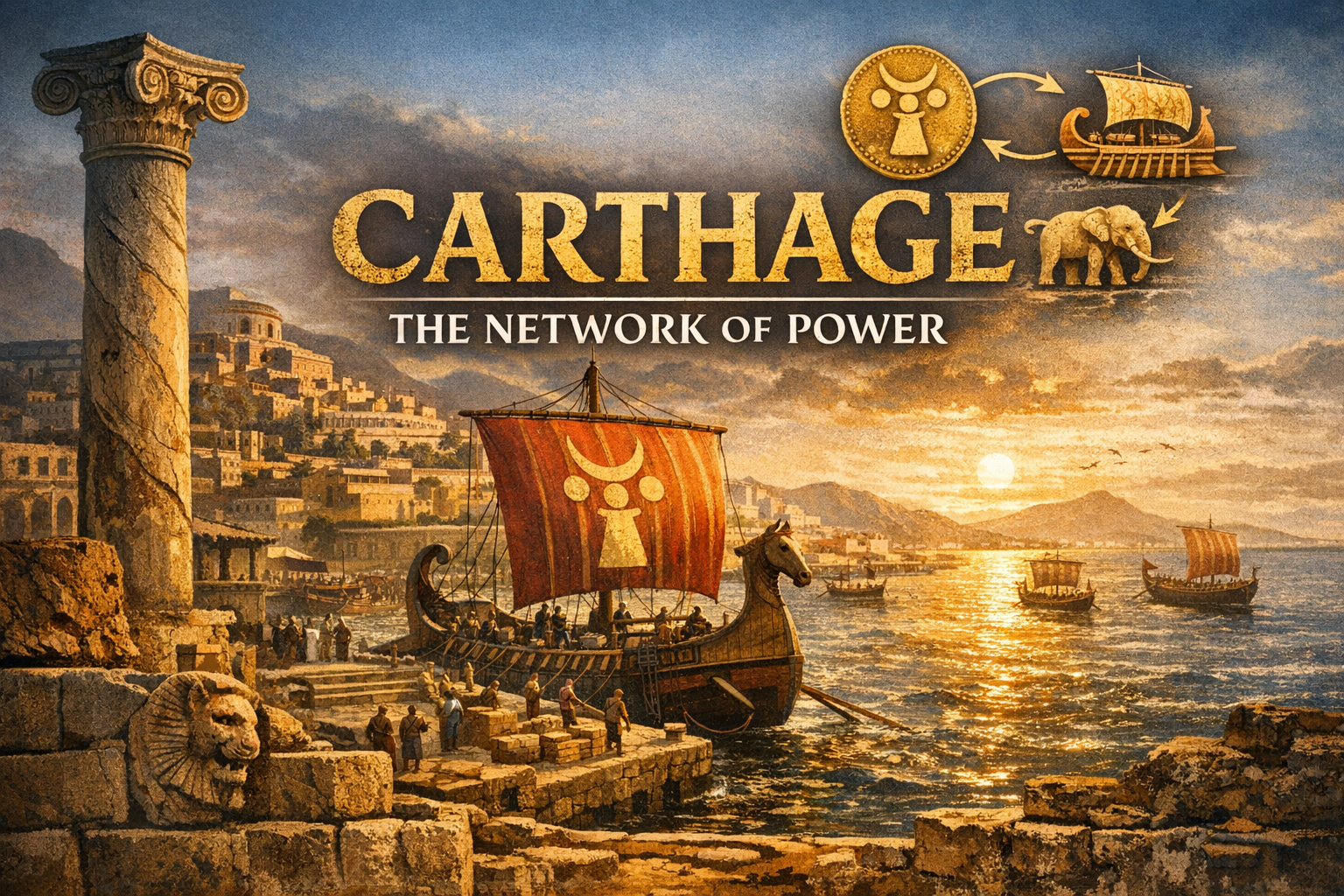
Kairouan became one of the major knowledge centers of Sunni Islam. Zaytuna operated as a center of jurisprudence, theology, grammar, and scholarship for over a thousand years. The Aghlabids built hydraulic infrastructure still visible today. The Fatimids launched their conquest of Egypt from Ifriqiya.
1574 to 1881
Ottoman Tunisia: autonomous governance, diplomacy, and constitutional experimentation.
The beys of Tunis governed with significant autonomy from Istanbul. In 1861 Tunisia adopted the Dustur, one of the earliest written constitutions in the Arab world. It established legal equality and constraints on executive authority before most of the region had begun similar reforms.
1956 to present
Modern Tunisia: independence, migration, revolution, and diaspora continuity.
Hundreds of thousands of Tunisians now live in France, Italy, Germany, Belgium, the Netherlands, Canada, and the Gulf states. They carry a civilizational archive across borders and through institutional systems that reduce them to integration metrics, labor statistics, or security classifications. The archive is deeper than the category.
04A · Geography System
Why Tunisia kept becoming strategically important
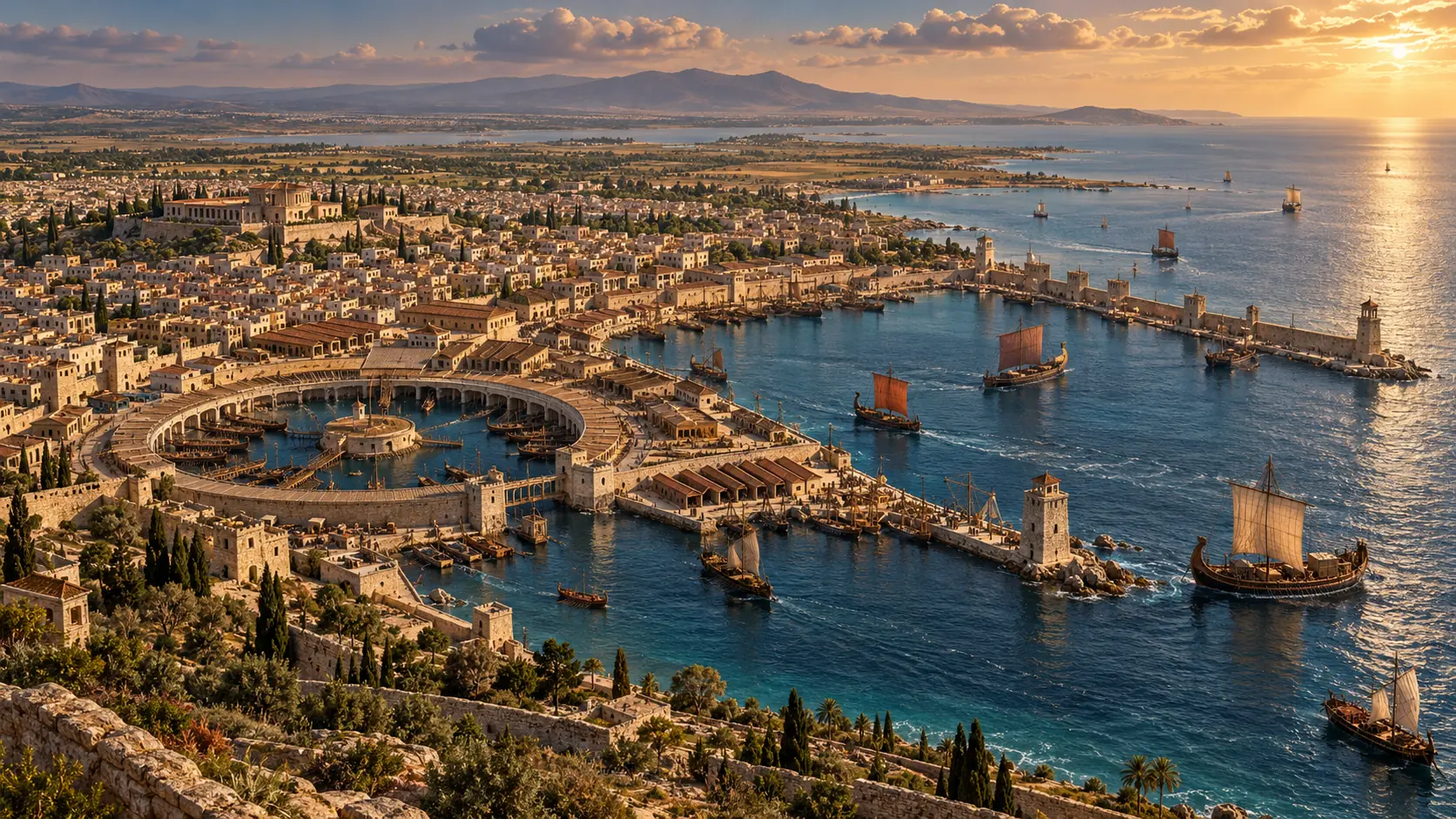
Tunisia is not only important because of what happened there. It is important because of where it sits. The same geography kept producing value under different systems: Amazigh settlement, Carthaginian trade, Roman grain extraction, Islamic scholarship, Ottoman diplomacy, French colonial administration, and modern diaspora movement.
The territory connects sea, interior, agriculture, ports, migration, language, and memory. This is why Tunisia repeatedly became a civilizational junction rather than a passive province.
Sea access
Ports, maritime routes, naval power, trade corridors, and Mediterranean chokepoints.
Interior depth
Agriculture, settlement continuity, tribal memory, olive systems, and land-based identity.
Institutional production
Law, scholarship, urban administration, mosque-universities, diplomacy, and constitutional memory.
Movement
Merchants, armies, scholars, colonizers, migrants, and diaspora networks.
04B · Civilizational Metabolism Flow
How Tunisia turns pressure into continuity
The operating logic of Tunisian civilization history is not simple resistance and not simple replacement. It is civilizational metabolism: external systems arrive, collide with the local substrate, become transformed by geography, then leave usable layers inside the archive.
This flow explains why Tunisia can appear fragmented when read through empires, but coherent when read through systems. The names change. The mechanism repeats.
1. Substrate
Amazigh settlement, agriculture, kinship, oral memory, and land-based continuity create the first operating layer.
↓
2. Contact
Phoenician, Roman, Arab, Ottoman, and French systems enter through ports, trade, conquest, scholarship, administration, and migration.
↓
3. Translation
Foreign systems are translated into local realities: Punic becomes North African, Roman Africa becomes productive, Islamic Ifriqiya becomes institutional.
↓
4. Sediment
Each era leaves infrastructure: scripts, ports, roads, law, mosques, medinas, crops, language fragments, rituals, and memory patterns.
↓
5. Reuse
Later systems build on older layers. Rome uses Carthaginian geography. Islamic cities inherit Roman and Amazigh space. Modern Tunisia inherits all of it.
↓
6. Transmission
The archive moves into families, diaspora, digital platforms, language, food, memory, and future cultural reconstruction.
Metabolism principle: Tunisia survived not by remaining unchanged, but by absorbing change without fully dissolving the substrate beneath it.
04C · Layer Matrix
The civilizational layers as one system
A timeline shows sequence. A matrix shows function. Each layer of Tunisian civilization history did something structurally different: one rooted the land, one built networks, one extracted grain, one institutionalized knowledge, one managed diplomacy, one compressed memory, and one now carries the archive abroad.
Layer
Core function
Infrastructure
Memory left behind
Amazigh
Substrate continuity
Settlement, kinship, land knowledge, agriculture
Territorial memory, language traces, interior identity
Political autonomy, 1861 Dustur, diplomatic memory
French colonial
Administrative compression
Language policy, bureaucracy, rail, extraction, colonial categories
Francophone layer, social hierarchy, memory rupture
National and diaspora
Archive redistribution
Schools, migration, remittances, platforms, family networks
Identity reconstruction, Darija survival, digital memory
The civilizational question is not which layer is the real Tunisia. The real Tunisia is the accumulated system formed by all layers under pressure.
05 · Mechanism
Carthage Network Power: the first Mediterranean system built from Tunisian soil
Carthage was founded around 814 BCE by Phoenician settlers from Tyre. Within three centuries it had become the dominant maritime-commercial power of the western Mediterranean, controlling ports from Iberia to Sardinia, monopolizing Atlantic access through the Strait of Gibraltar, and operating a constitutional republic that Aristotle praised as one of the finest in the ancient world.
The full structural account is in Carthage Network Power. Tunisia produced one of the five great maritime civilizations identified by historian Andrew Lambert. The central argument of Tunisian civilization history is continuity through transformation rather than replacement through conquest.
Hannibal Barca
At Cannae in 216 BCE Hannibal destroyed a Roman army using a double envelopment strategy still studied in military academies. His goal was not to destroy Rome directly. It was to detach Rome’s alliance network.
Land expansion, roads, manpower, taxation, citizenship integration, and imperial absorption.
Rome destroyed Carthage in 146 BCE. The city burned for seventeen days. The archive was destroyed or dispersed. But the geography remained. Chokepoints cannot be burned.
05A · Infrastructure Mirror
Ancient ports, modern cables, and the return of network logic
The strongest modern parallel inside Tunisian civilization history is infrastructure. Ancient power moved through harbors, grain routes, roads, taxation corridors, and manuscript networks. Modern power moves through ports, airports, data cables, logistics systems, migration routes, energy connections, and platform archives.
The technologies changed. The logic did not. Tunisia still sits where systems cross.
Ancient mirrorPorts and fleets
Carthaginian harbors connected silver, timber, soldiers, merchants, and maritime intelligence across the western Mediterranean.
Modern mirrorPorts and logistics
Modern ports, shipping lanes, air routes, tourism corridors, and supply chains keep Tunisia inside Mediterranean movement systems.
Ancient mirrorRoads and grain
Roman Africa linked inland agriculture to maritime export through roads, estates, storage, taxation, and naval transport.
Modern mirrorCables and data
Digital systems move voice notes, payments, family memory, video calls, and identity reconstruction through invisible infrastructure.
Why this matters
This section connects Culture and Identity to Systems and Strategy and Cybersecurity and Tech. A civilization is partly made of memory, but memory now depends on infrastructure: servers, platforms, cables, devices, archives, and access.
06 · Narrative
When Rome rebuilt on Carthaginian geography
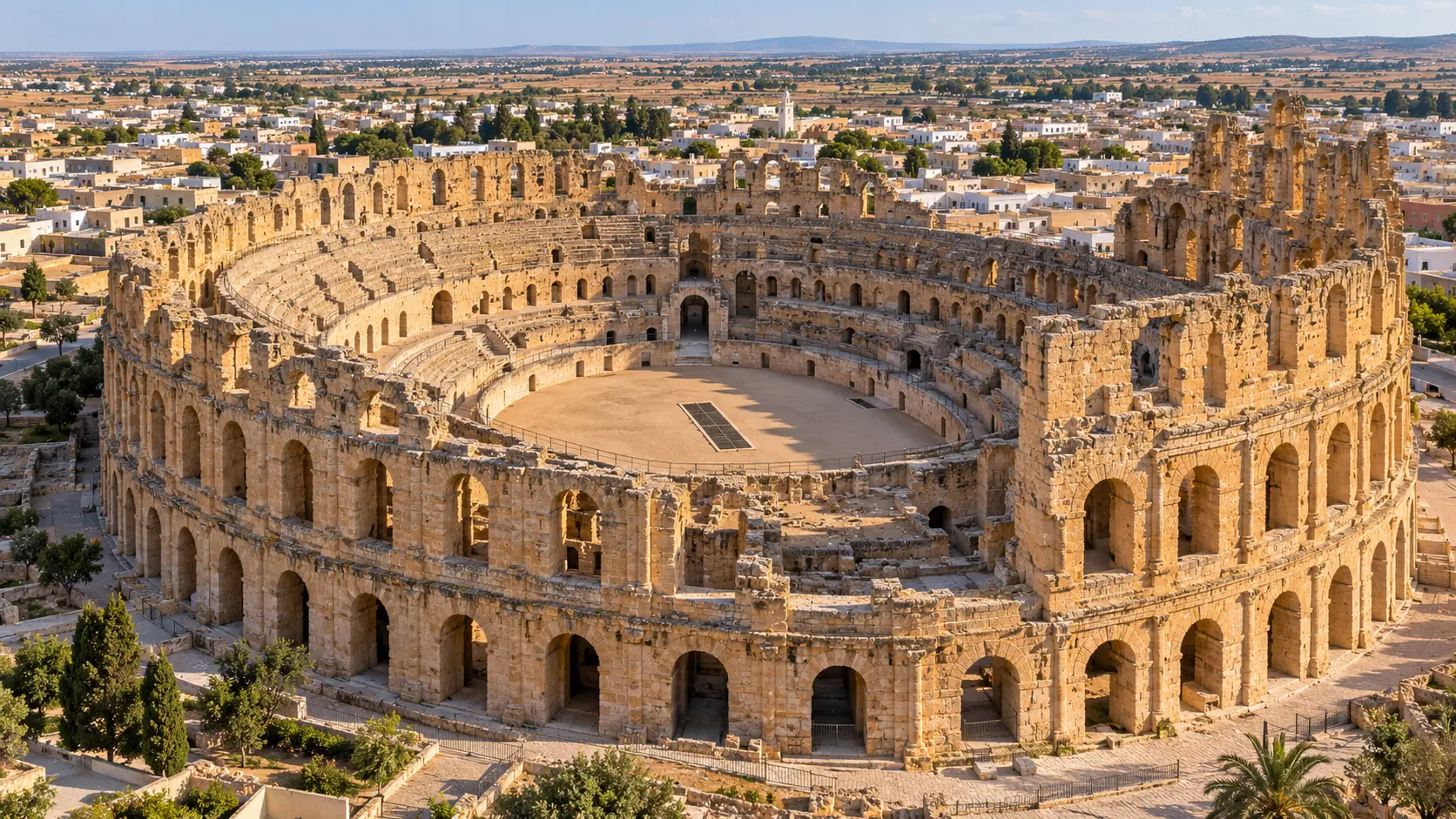
After destroying Carthage, Rome rebuilt on the same geographic logic. Roman Africa became one of the most productive provinces in the empire. Roman Africa supplied an estimated third of Rome’s grain and produced cities such as Thysdrus, Sufetula, and Bulla Regia.
North Africa also became intellectually generative. Augustine of Hippo shaped Western Christian theology more than any single figure after Paul. Tertullian coined the term Trinity. Cyprian shaped ecclesiological thinking still visible in Catholic institutional structure.
AgricultureGrain Empire
Roman Africa became essential to imperial food infrastructure.
ArchitectureEl Jem Amphitheatre
One of the largest amphitheatres in the Roman world, built from local wealth.
TheologyAugustine of Hippo
North African theology shaped Western Christianity for centuries.
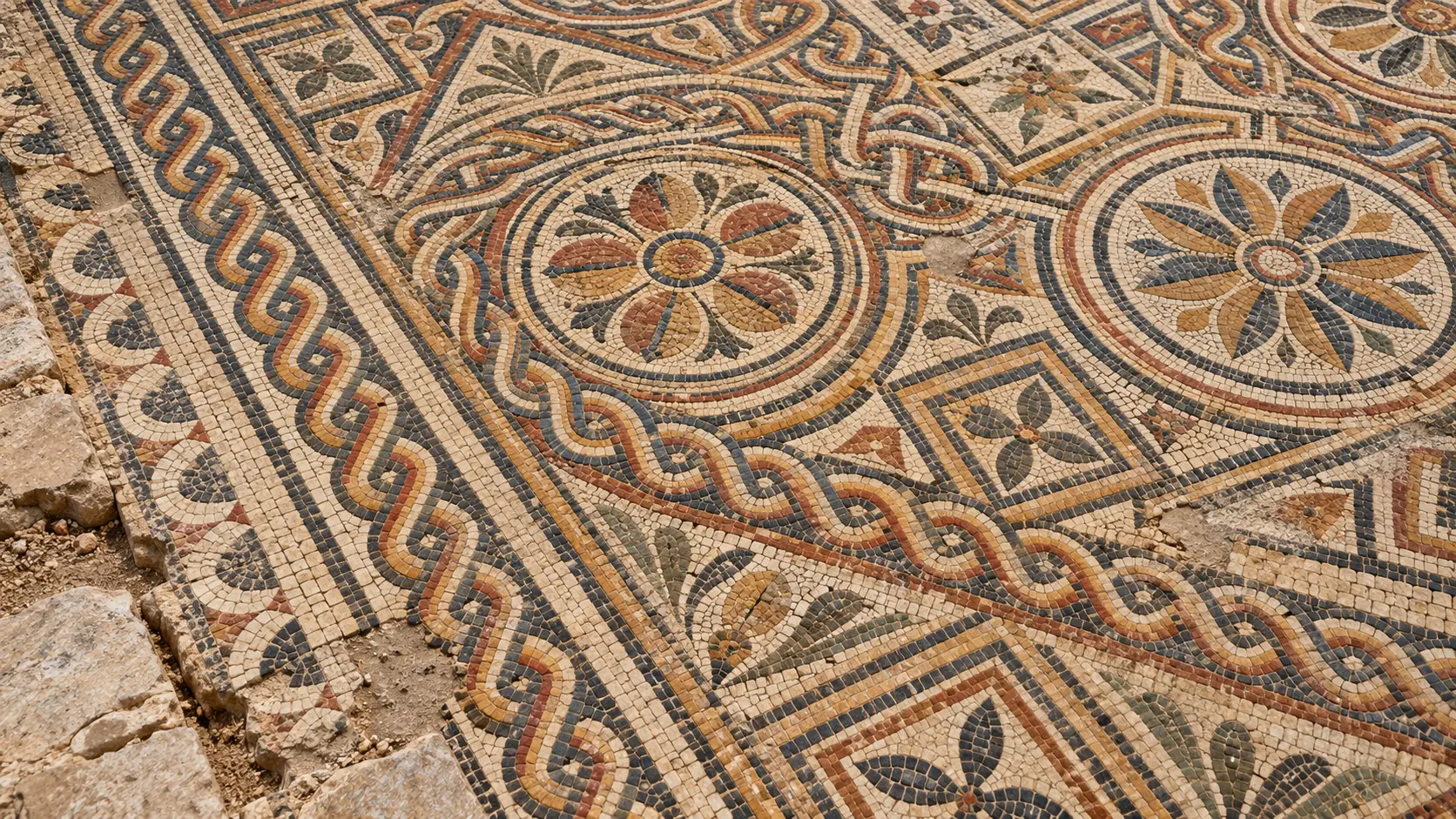
MosaicsThe Bardo Collection
Tunisia preserves one of the world’s largest collections of Roman mosaics.
The Roman layer in Tunisian civilization history is not just ruins for tourists. It is evidence that this territory repeatedly generated civilizational output at the highest level.
06A · Civilizational Figures
The people who reveal the system
Civilizational history becomes clearer when figures are read not only as biographies, but as system signals. Each figure below represents a different layer of Tunisia’s archive: foundation myth, network warfare, theology, Islamic expansion, historical theory, nation-building, revolution, and diaspora transmission.
Elissa or Dido
The foundation memory of Carthage: migration, maritime strategy, political founding, and the birth of a city that would challenge Rome.
Hannibal Barca
The military expression of Carthaginian network power: not only battlefield brilliance, but an attempt to break Rome’s alliance system.
Augustine of Hippo
A North African intellectual whose work shaped Western Christianity and proves Roman Africa was a center of thought, not a provincial footnote.
Uqba ibn Nafi
A figure of Islamic expansion whose founding of Kairouan turned Ifriqiya into an institutional engine for law, worship, scholarship, and power.
Ibn Khaldun
A Tunis-born thinker whose theory of social cohesion, dynasty, and collapse belongs naturally inside a systems reading of civilization.
Habib Bourguiba
The modern nation-building layer: state formation, education, secular reform, postcolonial identity, and the disciplined centralization of memory.
Mohamed Bouazizi
The modern rupture point: a local act of despair becoming a regional political signal, exposing how compressed systems eventually break.
The diaspora carrier
The unnamed modern figure: parents, children, workers, students, and families carrying the archive through Europe, platforms, language, and memory.
07 · Psychology
Why people accept the shortened version
People accept shortened histories because they are easier to repeat, easier to market, and easier to fit into external categories. A Tunisian can be classified as Arab, Mediterranean, African, Muslim, Francophone, migrant, or postcolonial. Each label contains truth. None captures the full archive.
Eventually people inherit the summary instead of the archive. A second-generation Tunisian in Europe may know they are Tunisian without knowing their civilizational inheritance includes constitutional republicanism, hydraulic engineering, maritime systems, theology, scholarship, and long-duration institutional continuity.
Compression risk: when people inherit only summaries, they become easier for institutions to classify and harder for themselves to fully understand.
07A · Archive vs Summary
The archive is larger than the summary
The modern image of Tunisia is often smaller than the historical reality. Tourism reduces it to beaches and ruins. Migration systems reduce it to integration categories. Colonial memory reduces it to French influence. National storytelling can reduce it to unity at the expense of older plurality.
Each summary contains a fragment of truth. The problem begins when the fragment replaces the full archive.
The SummarySmall Tunisia
Beach tourism, Roman ruins, migration, revolution, French influence, and simplified identity labels.
The ArchiveDeep Tunisia
Amazigh foundations, Carthaginian network power, Roman grain systems, Islamic institutions, Ottoman constitutionalism, colonial rupture, and diaspora memory.
Core insight: Tunisia was not made by one layer replacing another. It was made by layers accumulating, colliding, adapting, and surviving.
08 · Infrastructure
Kairouan: the institutional engine of Islamic Ifriqiya
The Islamic layer in Tunisian civilization history is one of the most underread outside specialist circles. Kairouan and Islamic Civilization covers the full structural account.
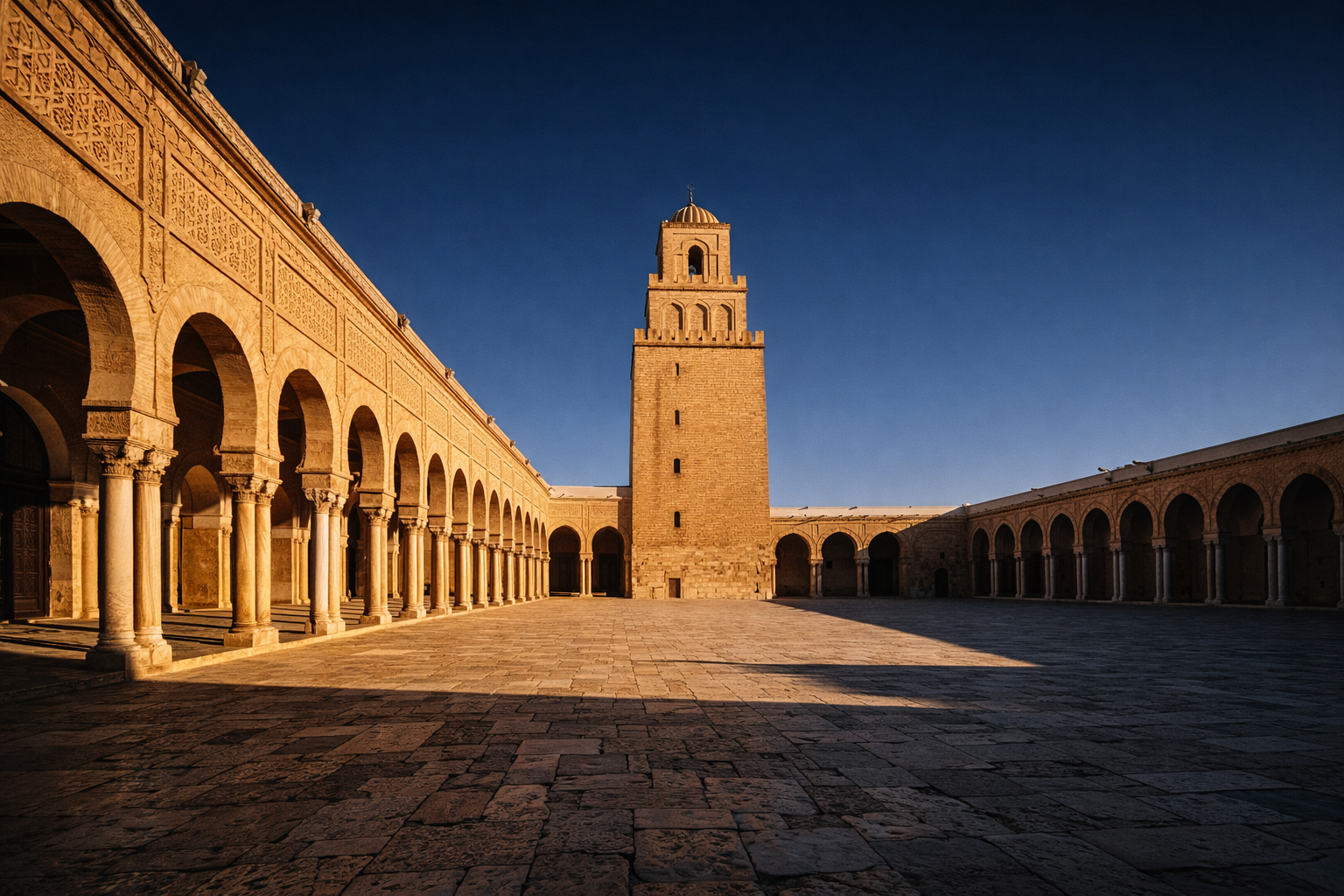
Founded in 670 CE by Uqba ibn Nafi, Kairouan became one of the primary knowledge centers of Sunni Islam. The Great Mosque of Kairouan is among the oldest continuously functioning mosques in the world. Zaytuna in Tunis operated for over a thousand years as a center of jurisprudence, theology, grammar, and scholarship.
The Aghlabids built hydraulic infrastructure adapted to semi-arid North African conditions. The Fatimids used Ifriqiya as the launch platform for Cairo. The Hafsids maintained diplomatic parity with European powers for centuries.
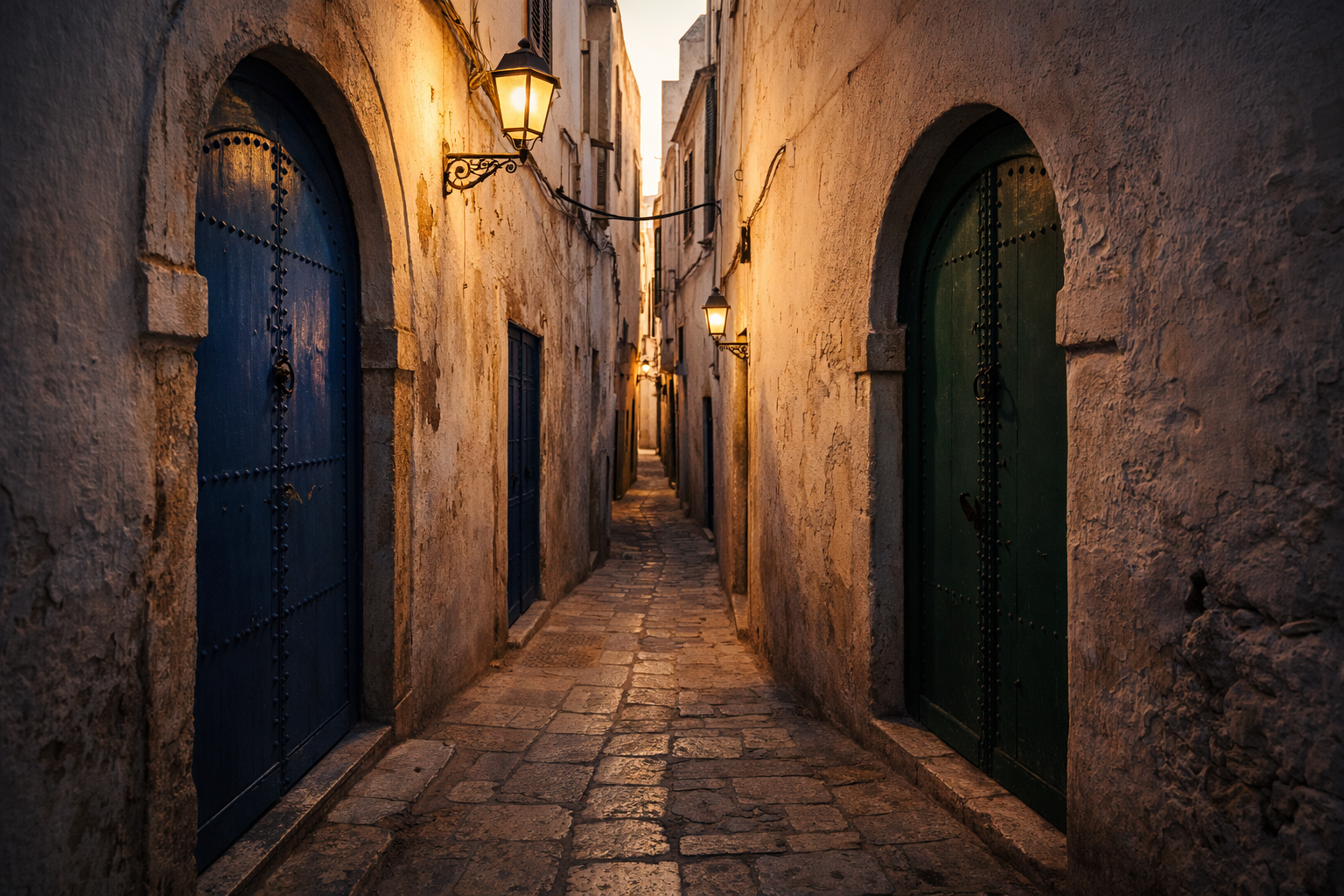
Kairouan in Tunisian civilization history: one of the oldest Islamic cities and institutional centers in the world.The Medina of Tunis: a living archive of civilizational continuity.
09 · Power Map
Who benefits from a shortened Tunisia?
The shortening is not conspiracy. It is institutional optimization. Tourism rewards ruins. Schools reward simplified unity. European systems reward categories. Media rewards crisis. Academic departments reward specialization.
TourismBenefits from Roman legibility
Roman ruins are easy to package. Deeper Amazigh and Islamic layers become secondary.
Diaspora populations become integration metrics, labor pools, or security classifications.
Academia and mediaBenefit from fragmentation
Period specialization and crisis coverage fragment the continuity of the archive.
Civilizations are not erased only by catastrophe. They are erased by accumulated simplifications.
10 · Modern Parallel
From maritime chokepoints to modern information systems
Carthage demonstrates how power can emerge through routes instead of territory alone. Modern institutions operate through similar structures: platforms, categories, logistics, interfaces, archives, and legitimacy systems.
The Tunisian diaspora is now part of this same structural story. Diaspora Tunisians carry the archive through institutional systems that often reduce them to administrative categories.
Why this matters
This is where Culture and Identity connects to Systems and Strategy, Cybersecurity and Tech, and Philosophy and Legacy. Identity is infrastructure. Memory is infrastructure. Archives are infrastructure.
10A · Diaspora Archive
The diaspora as a living archive
The Tunisian diaspora is not a footnote to this long civilizational story. It is the latest living layer of the system. While the physical territory of Tunisia remains relatively small, the archive has become mobile. It now travels through passports, remittances, family WhatsApp groups, kitchen tables in France, Italy, Germany, Belgium, Canada, and the Gulf, and through the quiet pride of second and third generations who are slowly rediscovering what their grandparents carried but could not always name.
Every Tunisian abroad becomes an involuntary custodian of civilizational memory. They carry fragments that no museum can fully preserve: the taste of a specific olive oil cake, the rhythm of a grandmother’s prayers, the way a joke is told in Darija, the instinctive hospitality codes, and the complex navigation between Arab, Amazigh, Mediterranean, Islamic, and European identities.
LanguageLiving Code-Switching
Darija shifts between Arabic roots, French loanwords, Italian expressions, Amazigh traces, and new European vocabulary.
FamilyTransmission System
Weddings, funerals, Ramadan gatherings, summer returns, and stories told to children who have never lived in the homeland.
Digital LayerPortable Memory Network
Voice notes, recipe videos, family photos, football debates, songs, livestreams, and chats keep memory moving across continents.
Identity TensionThe Double Archive
Diaspora Tunisians carry deep civilizational memory while also simplifying themselves for bureaucracy, work, schools, and social acceptance.
The archive no longer lives only in stone, mosaics, or manuscripts. It lives in people who move through systems designed to see them as labor units, integration statistics, or security risks, while they quietly carry Carthage, Kairouan, Dougga, and the centuries of adaptation that made survival possible.
Key observation: A civilization is not only what stays in one place. It is also what travels, adapts, remembers, and finds new ways to transmit itself across borders and generations.
10B · Atmospheric Continuity
What continuity feels like on Tunisian soil
Civilizational continuity is not only visible in ruins, archives, museums, and dates. It is atmospheric. It is carried by stone heat in Dougga, sea wind near Carthage, olive trees in the interior, the geometry of old medinas, and the movement of language across generations.
In Tunisia, the ancient and the modern often occupy the same visual field. Roman roads influence modern movement. Islamic urban logic remains inside medina streets. French administrative traces sit over older city patterns. Family rituals preserve memory that written institutions often fail to transmit.
Stone
Ruins, inscriptions, amphitheatres, mosques, medinas, and walls hold memory in physical form.
Sound
Darija, adhan, Malouf, family speech, jokes, arguments, and oral memory transmit identity through rhythm.
Taste
Olive oil, harissa, bread, couscous, mint, fish, dates, and spices carry ecological and historical memory.
Movement
Summer returns, weddings, market routes, prayer routes, migration routes, and digital communication keep the archive alive.
Continuity principle: Tunisia is not only remembered through what survives in museums. It is remembered through repeated gestures, routes, tastes, words, and family systems.
11 · Synthesis
What Tunisian civilization history actually reveals
Tunisian civilization history is not a collection of foreign occupations. It is a continuous process of transformation in which each layer metabolized what came before it. The Amazigh foundation shaped Carthage. Carthage shaped Roman Africa. Roman Africa shaped Islamic Ifriqiya. Geography repeatedly generated the same civilizational logic across thousands of years.
Reading Tunisian civilization history as a sequence of external impositions reproduces someone else’s summary. The archive is older, deeper, and more continuous than any single narrative frame can hold.
Civilizational pattern: systems survive when geography becomes memory, memory becomes institution, institution becomes identity, and identity becomes future infrastructure.
12 · Related Reading
Continue the Tunisian civilization history cluster
Use these internal routes to read Tunisian civilization history through its main supporting layers: maritime network power, Islamic institutional depth, Amazigh foundations, and the wider Culture and Identity hub.
If this shifted how you think about civilization, identity, and structural history, the consulting work applies the same depth to strategy, content architecture, and platform building.
This article currently anchors its historical claims with public institutional and reference sources. Academic works will be listed here only after their direct relevance has been verified.
16 · Knowledge Check
Test your systems understanding
Knowledge Check
Test Your Understanding
What is the central systems claim of this article?
Why does geography matter so much in this article?
Who absorbs the cost when Tunisian history is shortened?
What structural advantage did Carthage have over Rome?
What does the article mean by calling Kairouan an institutional engine?
What does civilizational metabolism mean in this article?
Why does the infrastructure mirror section connect ancient ports to modern cables?
What does the layer matrix add that the timeline does not?
Jan Janszoon Murad Reis as a hinge figure between Dutch privateering, North African corsair systems, captive economies, and the Atlantic world, from Haarlem to the Bou Regreg and on toward Brooklyn
ThemeMaritime History · Systems · IdentityPeriodca. 1570–1641RegionNetherlands · North Africa · AtlanticReading Time25 min read
Featured visual: Jan Janszoon Murad Reis as a maritime hinge figure between the Dutch Republic, North Africa, and the Atlantic world.
I. Jan Janszoon Murad Reis as a System Map
Jan Janszoon Murad Reis is best read not merely as a biography, but as a system map. Some lives are stories of character. Others are routes through wider forces: war, trade, law, religion, geography, and the institutions that move people through time. Jan Janszoon of Haarlem belongs to the second category. Under one name he was a Dutch privateer. Under another he became Murad Reis, operating from the Bou Regreg in a corsair order that reached Ireland, Iceland, and the Atlantic edge of Europe. His son later established himself in what became New York. His name would eventually touch land in Brooklyn.
That is not simply the path of an exceptional man. It is the path of a system that could absorb people, repurpose them, and transmit their consequences into the next generation. This essay reads that system. It begins with water.
II. Water as a Governing Principle
The Netherlands is not just a country with water. It is a country shaped by water. Early Dutch political logic was deeply tied to water management. Water boards existed from the medieval period onward as functional institutions built around dikes, drainage, shared risk, and collective maintenance.
That same logic later reappears in Dutch maritime capitalism. The sea is water, water is risk, risk becomes governance. Joint-stock ventures, maritime licenses, and pooled capital all reflect the same structural instinct: distribute danger, formalize responsibility, and turn instability into organized advantage.
This matters because the Dutch Republic was not simply a trading state. It was a trading state at war. And war at sea required legal instruments, private investors, and tolerated violence. That brings us to the letter of marque.
III. The Letter of Marque as an API Key
The difference between a privateer and a pirate is, in essence, a piece of paper. A privateer held a letter of marque, a state document granting legal permission to attack designated enemy shipping and bring captured goods before a prize court. Pirates had no such legal shield. The distinction was fundamental in law and unstable in practice.
System Analysis
The letter of marque as licensed violence
Think of the letter of marque as an early modern API key: a token that authorizes violence under state logic while outsourcing risk to private actors. The state does not have to bear the full cost of a permanent fleet. Investors finance ships and crews. The law provides a framework. Violence is privatized but not fully informal.
The system had three layers: (1) the license layer, state permission; (2) the legal layer, prize adjudication; (3) the investment layer, merchants, rederies, and local maritime networks funding the enterprise for profit.
Jan Janszoon began his career inside exactly that system. Around 1600, he sailed as a Dutch privateer in the context of the Eighty Years’ War. In 1618, he was captured off Lanzarote by Algerian corsairs. That moment is the hinge point of his life: the transfer from one licensed violence system into another.
“The line between privateer and pirate was legally crucial and practically unstable. A man could be legitimate one season and outlawed the next.”
Early modern maritime pattern
This is also why Janszoon should not be presented as an isolated anomaly. European converts and maritime renegades already formed a recognizable infrastructure inside North African corsair systems. He did not invent the route. He entered it.
IV. Algiers: the First System
After his capture in 1618, Janszoon was taken to Algiers. His conversion to Islam, whether strategic, pressured, sincere, or some combination of all three, gave him entry into a new system of protection, advancement, and operational legitimacy. He took the name Murad Reis.
Algiers was one of the major corsair centers of the Mediterranean. It sat at the intersection of raiding, slavery, ransom, and diplomacy. But it also had constraints. Treaties with European powers could limit who might be legally targeted, which made the city less ideal for captains seeking broader operational freedom. That helps explain why Murad’s center of gravity shifted westward toward Salé.
V. The Republic of Salé: a System of Its Own
Salé, more accurately the urban-political complex around Salé and Rabat at the mouth of the Bou Regreg, was not simply a pirate harbor. It was a governance structure, an economic engine, and a maritime power center built under conditions of migration, fragmentation, and opportunity.
The Morisco foundation story
The roots of Salé’s rise lie in Iberian expulsion. Morisco refugees displaced from Spain in the early seventeenth century brought money, maritime skills, grievances, networks, and strategic knowledge. Their arrival helped transform the Bou Regreg zone into an Atlantic corsair environment capable of competing far beyond Morocco’s shoreline.
Salé worked because violence, governance, and logistics were joined. The fleet did not exist outside administration. It financed and was shaped by it.
Political structure and internal tension
Salé’s political order was unstable but real. Urban factions, especially Hornacheros and later-arriving Andalusian Moriscos, struggled over representation, revenue, and control. Internal conflict did not weaken the analytical value of Salé as a system. It strengthens it. The republic was not chaos. It was contested order.
Moroccan instability as enabling condition
Early seventeenth-century Morocco was politically fragmented. The weakening of central authority after the death of Ahmad al-Mansur created a landscape where strong local actors could establish semi-autonomous zones of power. Salé’s rise should therefore be read not as a deviation from order, but as one of the forms order took when central sovereignty fractured.
VI. Murad Reis as Admiral: the Operational System
One of the most important documented moments in Murad’s career occurs in 1622, not in Veere, but in Salé. That year the Dutch ambassador Albert Ruyl arrived to negotiate the release of Dutch captives, explicitly expecting Murad’s help. Murad did assist, and dozens of Dutch prisoners were freed or delivered within days. This is crucial because it shows Murad as more than a raider. He functioned inside a triangle of violence, diplomacy, and brokerage.
In August 1624, Murad was appointed admiral of the Salé fleet under Moroccan authority. His crews were multinational, and his strength lay not in theatrical brutality but in calculation: distance, vulnerability, timing, and the conversion of movement into value.
Operational Logic
The corsair as risk manager
A successful corsair captain was fundamentally a manager of risk. Profit depended on four variables: how vulnerable a target was, how likely resistance would be, how marketable the outcome was, and whether the home port could absorb the mission politically and logistically.
This is why Murad Reis remains analytically useful. His operations reveal maritime violence as managed process, not random chaos.
The Veere episode: identity as diplomatic leverage
The famous Dutch-family confrontation belongs in November 1623, not 1622. In that month Murad entered Veere to take on provisions. His wife and children traveled from Haarlem to plead with him to return. He refused and sailed away again. This is one of the strongest identity scenes in the entire story because it is not mythic. It is bureaucratic, familial, legal, and emotionally concrete all at once.
For Dutch authorities, renegades posed a problem: useful, dangerous, embarrassing, and difficult to classify. For Murad, multiple identities created room to maneuver. That is why this scene matters. It shows the collapse of neat categories more clearly than any abstract statement could.
VII. The Atlas of Violence: Iceland, Lundy, Baltimore
The reach of the Salé corsairs is easy to exaggerate and unnecessary to sensationalize. The real story is already strong enough. Their power extended beyond the Mediterranean into Atlantic Europe, and that alone was strategically shocking.
Iceland 1627: the Tyrkjaránið
In 1627, the raids on Iceland resulted in roughly 400 captives and roughly 30 deaths. A portion of those seized were sold into slavery in North Africa, and only a minority were later redeemed. These figures are far more defensible than the inflated ranges often repeated in loose popular accounts.
The Iceland case matters because of distance. It proves that corsair capacity could travel far beyond where many northern Europeans imagined North African maritime power could reach.
Lundy: a disputed claim, not a slogan
Lundy is one of the places where Darja Rihla-style source criticism matters. The familiar phrase that Murad “held Lundy for five years” is attractive, but too clean. It is safer and more historically serious to describe Lundy as a temporary or periodic corsair base, with the popular claim of a continuous five-year occupation treated as disputed rather than settled fact.
That does not weaken the argument. It improves it. The real question becomes: what did sovereignty, possession, or occupation even mean in a maritime world of fragmented authority?
Baltimore 1631: extraction, not chaos
On 20 June 1631, Baltimore in County Cork was attacked in one of the best-documented Atlantic corsair operations of the century. The strongest evidence supports 107 captives reaching Algiers.
Step 1: information as weapon. Local knowledge mattered. Pilots and informants reduced uncertainty and made precision possible.
Step 2: violence as logistics. The operation was planned, timed, and executed as an extraction rather than a battlefield confrontation.
Step 3: conversion into value. The captives entered a system in which human beings became saleable labor, ransom assets, and bargaining leverage.
The popular claim that “only English settlers were taken while the Irish were spared” should be treated cautiously. It may align with some later interpretive logic, but it should not be presented as a hard fact.
“Baltimore was not a burst of chaos. It was an extraction operation performed by a system that could turn people into marketable value.”
Analytical core of the 1631 raid
VIII. The Captive Economy: How Human Life Became Value
To understand the world in which Murad Reis operated, captivity has to be treated as infrastructure rather than anecdote. Captives were not incidental byproducts of raids. They were central outputs.
Scale without false precision
Large estimates about the total number of European captives in North Africa exist, but they are methodologically contested. For a pillar article, the stronger move is not to perform certainty. It is to state clearly that this was a long-running and substantial system whose scale has been debated, politicized, and sometimes abused in later discourse.
Three forms of value
A captive had at least three possible kinds of value: ransom value, if family or institutions could pay; labor value, if the captive could be used productively; and conversion value, if integration into the system became possible. This final category is what makes Murad’s story so analytically rich: the system could reproduce itself by absorbing some of the people it captured.
Ransom diplomacy
European states responded by negotiating, paying, or fighting. Over time, even states that initially resisted systemic ransom arrangements moved toward more institutionalized responses. That adaptation matters. It shows that the captive economy did not merely confront states from the outside. It altered how states behaved.
The strongest formulation is not “an exact total number,” but this: a large, durable, and politically contested system that converted human lives into labor, money, leverage, and sometimes new loyalties.
IX. Identity as a Functional System
It is tempting to frame Janszoon’s conversion as pure drama: the Dutchman who became Muslim, the Christian who became “Turk,” the privateer who became corsair. But analytically, this is too thin. In the early modern Mediterranean and Atlantic, conversion, renaming, and loyalty shifts often functioned less as moral melodrama and more as role transitions within larger systems.
The renegade as infrastructure
Renegades were not only religious defectors. They were translators, informants, navigators, brokers, and sometimes diplomats. Their value lay in their ability to cross boundaries that other actors could not. Murad Reis fits this perfectly. His identity did not merely change. It became operational.
That is why this story works so well for Darja Rihla’s identity-and-systems framework. Identity here is not decorative biography. It is a trust boundary under pressure.
The archival problem
Much of what we know about corsairs and renegades is fragmentary. Men who moved between systems had obvious incentives to conceal routes, relationships, and records. North African archival survival for this period is also uneven. This is not a weakness in the essay. It is part of the argument. The silence in the archive tells us something about how the system functioned.
The final documented phase
By late 1640, Murad appears in a documented diplomatic context as governor of El-Oualidia, and there is evidence of a meeting with his daughter Lysbeth. That alone is enough to complicate the lazy trope of a simple tragic ending. We know less than later narrative comfort would like us to know, and that makes caution stronger than mythmaking.
X. The Hidden New Yorker: Anthony van Salee
One of the most remarkable afterlives of Janszoon’s story lies not in the Mediterranean but in North America. His son Anthony Janszoon van Salee established himself in New Netherland and became associated with early landholding in what later became Brooklyn.
Who was Anthony?
Anthony emerged from a family world already shaped by movement, hybridity, and legal-cultural boundary crossing. In New Netherland he became a notable figure in colonial society. For the pillar article, the most important thing is not to overstate everything at once, but to hold onto one firm bridge: early documentation places him clearly inside the development of colonial landholding and social life in the New Amsterdam orbit.
Anthony as systems mirror
Anthony’s life shows that the line from Bou Regreg to Brooklyn is not poetic exaggeration. It can be traced through records, deeds, and institutional memory. That makes him ideal material for a dedicated supporting article.
Genealogical Discipline
One hard bridge is stronger than ten loose claims
For the pillar, it is better to anchor Anthony through a small number of strong documents than to overload the page with every later famous descendant claim at once.
XI. The Dutch-Moroccan Diplomatic Axis
The story of Jan Janszoon does not exist in a diplomatic vacuum. The Dutch Republic and Morocco had a meaningful relationship in the early seventeenth century, shaped in part by their shared hostility toward Spain. The treaty of 1610 provided an important legal and political background for later movements of trade, captives, and maritime actors.
This connection was not purely commercial. It had intellectual and diplomatic dimensions as well. Moroccan envoys, Dutch officials, and Leiden Oriental scholarship all moved within the same broader geopolitical moment. Murad Reis operated in that space rather than outside it. He was not simply a destroyer of systems. He was also a participant in multiple overlapping systems.
XII. Timeline of the System
Chronological System Map · Jan Janszoon / Murad Reis
13th c.
Water boards. Early Dutch governance develops around shared water management, risk, and maintenance.
1568–1648
Eighty Years’ War. The Dutch state forms under prolonged conflict. Privateering functions as licensed violence.
ca. 1570
Birth of Jan Janszoon in Haarlem.
ca. 1600
Begins as privateer. Janszoon operates inside Dutch maritime war logic.
1609–1614
Morisco expulsions from Spain. Displaced populations help build the Bou Regreg corsair environment.
1610
Dutch-Moroccan treaty. A key diplomatic background condition.
1618
Captured off Lanzarote. Janszoon enters the North African corsair system.
1622
Salé / Albert Ruyl. Murad assists in the release or delivery of Dutch captives during embassy activity.
Nov. 1623
Veere. Murad enters Veere for provisions. His family arrives from Haarlem to plead with him to return. He refuses and sails again.
Aug. 1624
Admiral of Salé. Murad is formally elevated inside a politically unstable but strategically important system.
1626
Contact with Dutch coast. This shows that his ties to the Republic were never fully severed.
1627
Iceland. Around 30 dead, around 400 captives. A northern proof of corsair reach.
1627–1632
Lundy. Best framed as disputed, temporary, or periodic use as base rather than a cleanly settled long occupation.
1630
Anthony leaves for New Netherland. The North American branch of the story begins.
20 June 1631
Baltimore. The operation leads to 107 captives reaching Algiers.
1640
El-Oualidia. Murad appears as governor in a diplomatic setting and is seen again by his daughter.
XIII. The Netherlands as Mirror
Jan Janszoon’s life is not just an adventure story. It is a mirror for the Dutch Republic itself: a small state shaped by water, war, commerce, and legal innovation, willing to outsource violence while still trying to regulate it.
The power of this story lies in its structure. It reveals how licenses, ports, captives, diplomacy, and identity intersected. That is why Jan Janszoon Murad Reis matters. Not because he makes history colorful, but because he makes systems visible.
“He did not fall out of Dutch history. He exposed how much of Dutch history had always depended on unstable boundaries.”
Closing reflection
This pillar should function as the center of a broader topic cluster. The goal is not to force every detail into one page, but to create a durable authority structure.
SystemsThe Letter of Marque Explained
What licensed violence looked like in the Dutch maritime world.
EconomyThe Captive Economy
How ransom, labor, slavery, and diplomacy formed one system.
Port LogicSalé as a Harbor Machine
Bou Regreg, sandbanks, revenue, and strategic maritime geography.
Case StudyBaltimore 1631
Pilots, timing, extraction, and the procedural evidence of the raid.
IdentityRenegades as Infrastructure
Conversion, multilingualism, brokerage, and trust boundaries.
New YorkAnthony van Salee and Brooklyn
One hard documentary bridge from North Africa to early America.
GeographyLundy and Maritime Sovereignty
What temporary control meant in a world of fragmented authority.
GovernanceThe Netherlands as Water State
From water boards to maritime risk logic.
XV. Bibliography and Source Notes
This bibliography is structured for pillar use first and cluster expansion second. For the strongest live version, keep archive-near and academic sources as the backbone, and use public summaries only as supporting entry points.
Kairouan and Islamic Civilization: The City That Built North Africa
How a frontier military camp became the institutional engine of an entire civilization, and why that story has been systematically compressed.
Deep-Dive · Kairouan Islamic Civilization · History of Tunisia · 14 min read
Founded670 CE Uqba ibn Nafi
Influence radius1,400+ years of Maliki law
Core argumentInstitution not episode
Most educated Western readers can name Carthage. They can sketch its location, recall something about Hannibal and Roman salt, and place it within a familiar story of Mediterranean rivalry.
Far fewer understand how Kairouan Islamic Civilization shaped the legal, scholarly, and urban foundations of North Africa. Kairouan Islamic Civilization produced institutions that shaped an entire region for a millennium after Carthage had been erased from the map, and it registers almost nowhere in mainstream historical education. That asymmetry is not an accident. It is the starting point for everything this article argues.
This is not a chronology. Chronologies are for encyclopedias. This is a systems investigation: how a city becomes a civilizational engine, who builds that engine, what keeps it running, and what it produces that outlasts every dynasty that touched it.
Kairouan Islamic Civilization did not emerge as a decorative chapter in medieval history. It emerged as a durable institutional system.
To understand Kairouan Islamic Civilization properly is to understand how North Africa generated institutions, not merely how it received them from elsewhere.
Connected to the Master Pillar
To understand Kairouan in isolation is to miss the broader argument developed in our master pillar on Tunisia’s layered civilizational history. Kairouan is one institutional layer in a much longer continuum stretching from Amazigh roots and Carthage through Islamic scholarship to modern diasporic identity. Read both together.
Darja Rihla Premium
This is structural historical intelligence applied to civilizational analysis. If you work in policy, education, or cultural strategy, the full research archive goes deeper.
Kairouan was not simply a city. It was a convergence machine: the point where military conquest, religious legitimacy, legal standardization, hydraulic infrastructure, and scholarly production reinforced one another into a self-sustaining civilizational system.
It did not merely survive the Arab conquest of North Africa. It institutionalized that conquest into something durable enough to outlast the conquerors themselves. That is why Kairouan Islamic Civilization must be studied as an institutional engine rather than as a medieval episode.
Context
Why Kairouan Islamic Civilization Emerged Here, and Why Then
The year is 670 CE. The Arab general Uqba ibn Nafi is advancing into Ifriqiya, the Roman provincial designation for the territory that is now roughly Tunisia and eastern Algeria. The Mediterranean coast is dangerous: Byzantine naval power still operates from the sea, and coastal cities are vulnerable to counterattack.
The Berber population of the interior is not yet consolidated under any external authority. The strategic calculus is clear: establish a base that is defensible, central, and capable of projecting control inland without exposure to maritime assault.
Kairouan is founded inland, on the edge of the steppe, at a junction of routes connecting sub-Saharan trade networks to the Tunisian littoral and beyond. It has no natural harbor, no river, no obvious geographic gift.
What it has is position: equidistant from pressure points, removed from coastal risk, surrounded by territory that can be organized rather than merely occupied. This is a foundational lesson in how power actually works. The most consequential cities are rarely the most aesthetically endowed. They are placed at the right leverage point within a system of flows: trade, military movement, agricultural surplus, communication.
Kairouan is the answer to a geopolitical problem. That it became a cultural force of the first order is precisely what makes it worth studying.
The Mediterranean world of the seventh century is in systemic transition. Byzantine authority is contracting. Sassanid Persia has collapsed. The new Islamic caliphate is expanding not merely through military pressure but through an institutional logic that integrates conquered populations into a legal, fiscal, and religious order. North Africa is the western frontier of that expansion. Kairouan Islamic Civilization begins at exactly this pressure point between conquest and durable order.
The Institutional Engine of Kairouan Islamic Civilization
Kairouan Islamic Civilization lasted because its core systems reinforced each other. The mosque generated legitimacy, law stabilized society, water enabled permanence, scholarship exported norms, and all of it scaled into regional authority.
Kairouan Islamic Civilization matters because it turned a frontier base into a self-reinforcing urban system.
Click any card to reveal deeper context
670 CE
The Founding
Uqba ibn Nafi establishes Kairouan as the military and administrative base for the Arab conquest of Ifriqiya.
Deeper Context
The inland location was deliberate: Byzantine naval power made coastal cities dangerous. Kairouan was designed for durability, not aesthetics. The name itself derives from an Arabic word for camp or caravan resting place.
↩ Click to return
800 – 909 CE
Aghlabid Dynasty
The Aghlabids use Kairouan to legitimize autonomous rule, commissioning the Great Mosque and hydraulic infrastructure.
Deeper Context
Nominally vassals of Baghdad, the Aghlabids were in practice autonomous rulers who built prestige through architecture and scholarship rather than military conquest alone. Their cisterns still stand outside the city today.
↩ Click to return
9th century
Sahnun and the Mudawwana
Sahnun ibn Said systematizes Maliki jurisprudence into the Mudawwana al-Kubra, the foundational legal text of the western Islamic world.
Deeper Context
The Mudawwana is not an import. It is a North African legal product adapted to local conditions: Berber property structures, specific trade patterns, agrarian realities. It remains the dominant legal school across the Maghreb and West Africa today.
↩ Click to return
Post-909 CE
Beyond the Dynasty
The Fatimids displace the Aghlabids, but Kairouan’s legal and scholarly influence continues independently of dynastic control.
Deeper Context
This is the critical proof of institutional depth: Kairouan’s influence persists across multiple dynasty changes. Legal traditions travel in human brains, not in palace archives. The scholars Kairouan trained dispersed the city’s civilizational logic across a continent.
↩ Click to return
670 CE
The Founding
▼
Uqba ibn Nafi establishes Kairouan as the military and administrative base for the Arab conquest of Ifriqiya.
Deeper Context
The inland location was deliberate: Byzantine naval power made coastal cities dangerous. The name itself derives from an Arabic word for camp or caravan resting place.
800 – 909 CE
Aghlabid Dynasty
▼
The Aghlabids use Kairouan to legitimize autonomous rule, commissioning the Great Mosque and hydraulic infrastructure.
Deeper Context
Nominally vassals of Baghdad, the Aghlabids were in practice autonomous rulers who built prestige through architecture and scholarship. Their cisterns still stand today.
9th century
Sahnun and the Mudawwana
▼
Sahnun systematizes Maliki jurisprudence into the Mudawwana al-Kubra, the foundational legal text of the western Islamic world.
Deeper Context
The Mudawwana is a North African legal product adapted to local conditions. It remains the dominant legal school across the Maghreb and West Africa today.
Post-909 CE
Beyond the Dynasty
▼
The Fatimids displace the Aghlabids, but Kairouan’s legal and scholarly influence continues independently of dynastic control.
Deeper Context
Legal traditions travel in human brains, not in palace archives. The scholars Kairouan trained dispersed its civilizational logic across a continent regardless of who held political power.
Structure
Who Built the Machine, and Who Profits
Power in Kairouan is never held by a single actor. That is precisely why it lasts. The city functions through the simultaneous operation of four distinct structural actors, each with separate interests, each reinforcing the others in ways that produce systemic stability.
The Aghlabid dynasty, which consolidates control over Ifriqiya from 800 CE onward, is the most visible actor. They are nominally vassals of the Abbasid Caliphate in Baghdad but in practice autonomous rulers who use Kairouan to establish legitimacy in their own right.
They commission the expansion of the Great Mosque, fund hydraulic infrastructure, and patronize scholars whose legal rulings lend religious authority to Aghlabid governance. The dynasty profits from Kairouan’s prestige. It absorbs the cost in the form of constant negotiation with jurists who retain the power to delegitimize rulers who deviate too far from religious norms.
The jurists and scholars, centered on the Maliki tradition brought from Medina and systematized by Sahnun, constitute a second power center. They are not merely advisors. They produce binding legal opinions, train successive generations of legal scholars, and extend Kairouan’s intellectual reach across the Maghreb and into Andalusia.
They profit from state patronage and the prestige that proximity to a great mosque confers. They absorb the risk of proximity to political power, which occasionally demands they validate what they cannot justify.
The urban merchant class, less visible in the historical record but essential to the city’s material functioning, profits from stable law, predictable courts, and physical infrastructure. The Aghlabid state and the legal institutions provide exactly that.
Merchants fund mosques, scholars, and the urban fabric that makes the city operative. They absorb the costs of taxation and dynastic instability. The military and administrative apparatus maintains the physical perimeter within which civilizational production becomes possible.
No single actor can dismantle the system unilaterally, because no single actor controls all of its layers. The durability of Kairouan Islamic Civilization came from the interaction between rulers, jurists, merchants, and infrastructure. This is institutional resilience by design, even if that design is emergent rather than intentional.
Kairouan Islamic Civilization became durable because no single institution carried the city alone; the strength came from the mesh between authority, law, commerce, and urban survival.
How does power become city? How does religion become institution? How does infrastructure become legitimacy? Kairouan answers all three questions simultaneously.
Mechanism
How Kairouan Islamic Civilization Actually Worked
The Great Mosque of Kairouan is not primarily a religious building. That framing, while not inaccurate, is radically insufficient. It is a political instrument, a legal institution, an educational complex, and an urban anchor simultaneously.
At the center of Kairouan Islamic Civilization stood not one monument, but a coordinated institutional logic.
Political instrument
The Mosque as Power Declaration
Every expansion of the Great Mosque is a declaration of dynastic authority encoded in stone. The ruler who builds a great mosque controls the sacred geography of the city. When Aghlabid emirs commissioned successive expansions across the ninth century, they were making a claim on the right to govern, not expressing personal piety.
Legal institution
The Mosque as Court System
The scholars who sit in its arcades produce binding interpretations of Islamic law governing property, inheritance, marriage, commerce, and criminal procedure across Ifriqiya and, eventually, the entire Maghreb. The legal tradition that Sahnun systematizes in the ninth century is a North African product that survives to this day.
Educational complex
The Mosque as Knowledge Engine
The mosque generates a continuous supply of trained legal scholars, imams, administrators, and teachers who distribute the institutional logic of Kairouan across an entire region. Knowledge does not stay in the mosque. It travels through the scholars trained there, carrying legal norms and institutional frameworks into every city they subsequently inhabit.
Hydraulic resilience
Water as Political Statement
The Aghlabid basins, a two-basin hydraulic architecture drawing water from sources up to 36 kilometers distant, are not irrigation ditches. They produce permanence. A city that guarantees water supply in a semi-arid environment can grow, house scholars, sustain markets. The basins are the precondition for everything else. An emir who builds aqueducts demonstrates the long-term governance horizon that distinguishes a functioning state from a predatory extractive apparatus.
Click to enlarge
Political Infrastructure
The Great Mosque of Kairouan: state power encoded in stone
Click to enlarge
Hydraulic Power
The Aghlabid basins: water as civilizational infrastructure
If the mosque is the hardware of Kairouan’s civilizational machine, Maliki jurisprudence is the software. The decision to adopt and then systematize the Maliki legal school is one of the most consequential institutional choices in the region’s history.
What Sahnun does is not reproduce Malik’s positions. He adapts, systematizes, and localizes them, producing a legal compendium that addresses the specific conditions of North African society: its Berber populations, its particular property structures, its trade relationships, its agrarian patterns. The Mudawwana is a North African legal product that happens to draw on Arabian sources.
Legal standardization across Ifriqiya means predictable contracts, enforceable property rights, regularized inheritance procedures. These are the conditions that make large-scale commerce possible, that make urban growth sustainable, and that make Kairouan’s influence exportable.
Wherever Maliki-trained scholars go, they carry a legal operating system that enables the same institutional conditions that produced Kairouan’s success. This is the mechanism by which a single city extends its civilizational influence across a continent without military conquest. The mosque was one of the central operating cores of Kairouan Islamic Civilization.
The enduring reach of Kairouan Islamic Civilization came from this fusion of architecture, jurisprudence, education, and urban infrastructure.
Darja Rihla Archive
This level of structural analysis runs across the full Darja Rihla research series on Tunisia, North Africa, and Islamic civilizational history. Access the complete archive.
What the Dominant Story Omits About Kairouan Islamic Civilization
The dominant Western historical narrative about North Africa performs a specific and revealing compression. It moves from the fall of Roman Carthage in 439 CE to the Arab conquest of the seventh century in a handful of paragraphs, treats the Islamic period as a transitional phase before the arrival of the Ottomans, and then accelerates toward European colonial contact as the next moment of historical significance.
Kairouan Islamic Civilization, in this narrative structure, is an interruption rather than a protagonistic force.
What is structurally absent is the concept of North Africa as an institutional producer rather than an institutional receiver. Kairouan does not merely absorb Islamic civilization as it travels westward. It transforms it: adapts the Maliki legal school to North African conditions, produces original jurisprudence, trains scholars who reshape legal practice in Andalusia and sub-Saharan Africa, and generates an architectural tradition that becomes a template for mosques and cities across the western Islamic world.
The asymmetry is not neutral. A civilization whose institutional contributions are systematically erased from the educational record is a civilization whose contemporary descendants are implicitly denied a claim to intellectual and institutional depth.
Why do Western audiences know Carthage but not Kairouan? Because Roman and Punic history are integrated into a European civilizational self-image in which the Mediterranean is a lake the West owns. Kairouan requires a different frame entirely: one in which North Africa is a primary producer of institutional knowledge, not a secondary recipient of it. That frame is not comfortable for the institutions that built the existing curriculum, and so it does not get built.
Any serious account of North Africa that omits Kairouan Islamic Civilization is not just incomplete; it is structurally distorted.
Psychology
Why the Erasure Is Accepted
The acceptance of this historical compression operates through three well-documented mechanisms. The first is the familiarity heuristic: Western audiences have been exposed to Roman and Greek history through centuries of formal education, classical literature curricula, and popular media. Carthage fits into a familiar narrative framework.
Kairouan has no equivalent cultural presence in the Western canon. No prestige television series has dramatized the Aghlabid court. No bestselling historical novel follows a Maliki jurist through the corridors of the Great Mosque. In the absence of narrative, absence becomes normal.
The second mechanism is the prestige gradient attached to certain civilizations by academic gatekeeping institutions. Medieval Islamic scholarship has been systematically underrepresented in European and American university curricula compared to Greco-Roman antiquity. This is not because of a lack of source material.
The written record from Kairouan, from Ibn Abi Zayd al-Qayrawani to Sahnun’s Mudawwana, is extensive, sophisticated, and well-preserved. It is because the selection criteria for what counts as foundational human knowledge has been shaped by institutions with specific civilizational allegiances.
The third mechanism is the most consequential for diaspora communities specifically. For Tunisians navigating the daily demands of integration in France, the Netherlands, or Germany, it is cognitively easier and socially safer to claim Roman ancestry than to assert Islamic intellectual heritage.
The Roman frame is universally recognized and politically neutral. The Islamic frame triggers a different set of associations in the European public sphere. This is not weakness. It is adaptation under pressure. But adaptation has a cost: when a community internalizes a version of its own history that begins with the stories its host society finds acceptable, it surrenders the deeper architecture of its identity.
That is one reason Kairouan Islamic Civilization remains underclaimed even by people who descend from the worlds it helped shape.
Systemic Dynamics
Why It Does Not Self-Correct, and Where It Breaks
The system of historical compression does not self-correct because the institutions that produce mainstream historical knowledge have no structural incentive to redistribute civilizational prestige. Prestige is a finite resource in the attention economy of historical education.
Elevating Kairouan requires displacing something else, and the constituencies that defend existing canonical content are organized, funded, and institutionally entrenched. UNESCO heritage frameworks prioritize monumentality and photographic legibility: stone columns photograph better than manuscript traditions. Tourism industries require simplification because simplification sells. Academic departments in Western universities are structured around civilizational binaries built in the nineteenth century and proven extraordinarily resistant to revision.
The concrete breaking point is digital disaggregation. The internet has already begun to disaggregate the monopoly that formal educational institutions hold over historical narrative. Platforms that produce rigorous, systems-oriented historical analysis of non-Western civilizations are accumulating audiences faster than traditional academic publishing can respond.
The reader who discovers Kairouan through a platform like Darja Rihla does not need a university course to encounter this material. They need a platform with the intellectual authority, the structural framework, and the commitment to depth that traditional media increasingly cannot provide. That disaggregation is both an opportunity and a responsibility.
Western historical education rarely presents Kairouan Islamic Civilization as a producer of institutions. That is precisely the point that must now be broken open.
The digital era gives Kairouan Islamic Civilization a new route back into public memory: not through gatekeepers first, but through strong independent knowledge platforms.
Reflection & Position
The Defensible Claim
My position is that Kairouan represents a category of historical achievement that contemporary historical education is structurally incapable of recognizing: the city as institutional producer. The dominant frameworks for understanding medieval cities in non-European contexts treat them as nodes in trade networks, as sites of religious activity, or as administrative centers for conquering powers. Kairouan is all of these things, but it is also something the frameworks struggle to articulate: a civilization-generating machine that produces legal, architectural, scholarly, and hydraulic exports that outlast the dynasty that built it by more than a millennium. The Maliki legal tradition that Sahnun systematized in ninth-century Kairouan remains the dominant legal school across North Africa and West Africa today. That is not a historical footnote. That is a civilizational outcome of the first order, and it demands a category of analysis commensurate with its scale.
Kairouan Islamic Civilization should therefore be treated as a primary case study in how institutions scale, survive, and radiate influence beyond dynastic cycles.
Conflict & Consequence
Who Profits, Who Absorbs the Damage, What Must Break
The stakes of this historical erasure are not academic. They are operational. A civilization whose institutional contributions are systematically excluded from mainstream historical education produces a specific political consequence: its contemporary population is denied the historical authority that comes from a demonstrated record of institutional production.
When North African societies are discussed in Western policy, media, and development discourse, they are consistently positioned as recipients of institutional models, as territories to be developed, governed, or stabilized by external frameworks. The history of Kairouan directly contradicts this positioning.
Who profits from the erasure? The institutions, academic, media, political, that derive authority from positioning Western civilization as the primary source of institutional innovation. Who absorbs the damage? Every North African and Muslim-majority society that internalizes a historical narrative in which they are perpetual latecomers to the institutions that govern modern life.
The Aghlabid cisterns built the ninth century. The Maliki legal framework built a legal system that governs over 200 million people today. These are not decorative facts. They are the evidence base for a counter-argument to a geopolitical narrative with live consequences.
Recovering Kairouan Islamic Civilization is therefore not only an act of historical clarity, but an act of civilizational repositioning.
What must be broken is the habit of treating non-Western civilizational history as supplementary material: the enriching footnote to a main text written elsewhere. Kairouan is not a footnote. It is a primary source for understanding how institutions are built, how they survive political transition, and how they extend influence beyond the power structures that originally produced them. Any serious analysis of state-building, legal institutionalization, or urban governance that ignores Kairouan is not merely incomplete. It is operating with a deliberately impoverished dataset, and the conclusions it produces will be wrong in proportion to that impoverishment. The city that built North Africa deserves to be understood at its full institutional scale. That is the only defensible position.
Darja Rihla Consulting
Structural historical intelligence applied to contemporary decisions in policy, education, and cultural strategy. If this article shifted your analytical framework, the consulting work goes deeper.
Carthage Network Power built the first maritime republic in the ancient western world. This is the full structural account of how it worked, who carried it, and why Rome chose total destruction over negotiation.
Deep-Dive · Carthage Network Power · Tunisia Civilization Series · 20 min read
Founded814 BCEQart-Hadast · The New City
Destroyed146 BCERome’s total answer
Core ArgumentSystemnot just city, not just war
Carthage Network Power was not a conventional empire. It was one of the earliest, most sophisticated demonstrations in human history of what power looks like when it flows through routes rather than roads, through ports rather than provinces, through commercial coordination rather than territorial absorption. Most people receive Carthage through Rome. That is already the distortion. By the time Rome defined the terms of the story, it had already burned the archive that could have contested them. Understanding Carthage Network Power means reading against the grain of everything Rome wanted us to believe.
This article belongs with the Tunisia civilization pillar and the Kairouan deep dive. Tunisia’s history is not a sequence of disconnected episodes. It is a layered civilizational process. Carthage Network Power is its oldest imperial layer. Without understanding how Carthage Network Power organized trade, law, infrastructure, colonization, and alliance systems, the later story of Tunisia remains structurally incomplete.
This is structural historical intelligence applied to civilizational analysis. If you work in education, strategy, content architecture, or identity, the consulting framework goes deeper.
Carthage Network Power Built Something Rome Could Not Absorb
Carthage Network Power was not simply a city-state that grew powerful and then lost a war. It was a maritime-commercial republic built on chokepoint control, port infrastructure, trade flow management, legal coordination, and elite political accountability. Rome did not merely defeat a rival city. It eliminated a system that embodied a structurally different answer to the problem of how power should be organized in the ancient world.
That distinction matters because military defeat and systemic deletion are not the same thing. A city can lose a war and still remain part of the civilizational record. Carthage Network Power had to be physically burned, institutionally erased, textually redefined in the vocabulary of its conqueror, and its archive distributed or destroyed so that no future generation could read it in its own terms. That scale of destruction tells you what Rome believed it had confronted.
QART-HADAST
The New City · Founded 814 BCE · Destroyed 146 BCE · Never fully forgotten
02 · Context
Carthage Network Power Began with Strategic Geography, Not Accident
Look at a map of the Mediterranean. Find the narrowest point between its eastern and western halves: the strait between modern Tunisia and Sicily, barely 140 kilometers at its widest. Every ship, every merchant, every military commander moving goods or armies between the Levant and the Atlantic had to pass through or around that strait. Carthage Network Power sat on the African side, on a triangular peninsula in the Gulf of Tunis, with a high defensive hill, a natural harbor, and fertile agricultural land at its back.
The Phoenicians who sent their settlers there in the ninth century BCE were not romantic wanderers. They were merchants with extraordinary geographic intelligence who had already built more than three hundred trading colonies across the Mediterranean coast from Lebanon to Spain. They understood chokepoints. Whoever controls the movement of goods controls the price of everything. The location they chose for Qart-Hadast, the New City, placed Carthage Network Power at the most significant commercial chokepoint in the ancient western world.
By 650 BCE, Carthage Network Power had grown beyond its Phoenician origins. It controlled ports in Sardinia, Corsica, western Sicily, and along the North African coast. Its dual harbor, a rectangular commercial port and a circular military harbor capable of housing 220 warships, was among the most sophisticated pieces of infrastructure in the ancient world. Merchants built houses six stories high above the port. The warehouses held silver from Iberian mines, grain from North African fields, purple dye from coastal mollusks, ivory from sub-Saharan Africa, tin from Britain. Hanno the Navigator sailed down the West African coast around 500 BCE, possibly reaching modern Cameroon. His brother Himilco navigated the European Atlantic coast as far as Britain. Carthage Network Power was the first civilization to systematically probe the Atlantic in both directions.
The New City begins as a Phoenician foundation and quickly develops into a western Mediterranean power center defined by geography before ideology.
Deeper Context
The name means New City. Carthage Network Power’s significance was geographic first: positioned to mediate movement between multiple basins of trade and war. Aristotle would later praise its constitution as one of the finest in the world.
↩ Click to return
6th BCE onward
Independence
Carthage Network Power breaks from Tyrian oversight and begins its own colonial expansion, building a system spanning Iberia, North Africa, Sicily, and the Atlantic.
Deeper Context
When Tyre fell to Babylon, Carthage Network Power stopped paying tribute and began building its own empire. Unlike Tyre, it also had fertile agricultural land behind it, making it self-sufficient in a way that pure trading cities rarely were.
↩ Click to return
3rd century BCE
Barcid Intensification
The Barcid family pushes Carthage Network Power to its highest military intensity in direct confrontation with the expanding Roman Republic.
Deeper Context
Hamilcar and Hannibal did not invent Carthage Network Power. They inherited an existing maritime-commercial machine and attempted to convert its strengths into a strategic answer to Roman territorial expansion. The attempt came terrifyingly close to succeeding.
↩ Click to return
146 BCE
Total Deletion
Rome burns Carthage Network Power’s city for seventeen days, sells the survivors into slavery, and destroys or disperses its entire civilizational archive.
Deeper Context
What Rome preserved was what it found useful: Mago’s agricultural treatise, because it made the province of Africa profitable to administer. What it burned was what might allow Carthage Network Power to remain intelligible on its own terms.
↩ Click to return
814 BCE
Qart-Hadast
▼
The New City begins as a Phoenician foundation and quickly becomes a western Mediterranean power center.
Deeper Context
Aristotle would later praise Carthage Network Power’s constitution as one of the finest in the world. Geography before ideology was its founding logic.
6th BCE
Independence
▼
Carthage Network Power breaks from Tyre and builds its own empire from Iberia to North Africa.
Deeper Context
Unlike pure trading cities, Carthage Network Power had fertile land behind it, making it self-sufficient in a way that allowed long-term structural independence.
3rd c. BCE
Barcid Intensification
▼
The Barcid family pushes Carthage Network Power to its highest military intensity against Rome.
Deeper Context
Hamilcar and Hannibal inherited an existing maritime-commercial machine and tried to weaponize it against Roman expansion. It almost worked.
146 BCE
Total Deletion
▼
Rome burns Carthage Network Power’s city for seventeen days and destroys its entire archive.
Deeper Context
Rome preserved what was economically useful. What it burned was what might allow Carthage Network Power to be understood on its own terms.
03 · The People
The Barcids: The Family Who Carried Carthage Network Power to Its Breaking Point
History remembers systems through the people who embodied them. Carthage Network Power’s final and most consequential chapter is inseparable from one family. Barca in Punic means lightning, or thunderbolt. It was the cognomen that Hamilcar earned on the battlefield in Sicily, for the ferocity and speed of his attacks. It became his dynasty’s name. And that name became the most dangerous thing Rome had ever encountered, because it carried the full weight of Carthage Network Power’s unfinished strategic project.
Hamilcar Barca
c. 275 BCE – 228 BCE · The Thunderbolt
General · Statesman · Father
Hamilcar entered history in 247 BCE, the same year his son Hannibal was born, when he took command of the Carthaginian forces in Sicily during the final desperate years of the First Punic War. Rome and Carthage had been grinding each other down for seventeen years. Carthage Network Power had lost its naval advantage. What Hamilcar received was a small mercenary force, no money to expand it, no authority to negotiate peace, and instructions that amounted to: hold what you can.
He did something remarkable. Without the resources to win, he refused to lose. For six years he conducted a guerrilla campaign from the mountain of Eryx in western Sicily, keeping his army intact, raiding the Roman coast of Italy, maintaining pressure with a force that Rome could never quite eliminate. His soldiers were Iberians, Gauls, Libyans, Greeks, Numidians. He held them together through personal force and a military skill that his enemies, including the Romans who eventually defeated Carthage Network Power, continued to acknowledge for centuries afterward.
When the peace treaty came in 241 BCE, Hamilcar did not negotiate it. He was not given the authority. The Carthaginian senate accepted humiliating terms. He sailed back undefeated in the field and spent the rest of his life believing that what Carthage Network Power had lost was not a war but a political failure. After suppressing the catastrophic mercenary revolt of 241 to 238 BCE, he convinced the government to fund a new imperial project in Iberia. The silver mines of Spain could replace revenues lost from Sicily and Sardinia. And his sons could be trained in the field, where military understanding is formed through lived experience, not theory. He died in battle in 228 BCE, drowning in a river while covering his army’s retreat from an Iberian ambush. Hannibal was nineteen. The boy who had sworn at nine years old never to be a friend of Rome inherited an army, a cause, and a grief that would animate the next three decades of Mediterranean history.
Hannibal Barca
247 BCE – 183 BCE · The System Disruptor
General · Strategist · Exile
The most famous story of Hannibal’s childhood is also the most revealing. He was nine years old when his father prepared to depart for the Spanish campaign. He begged to come along. Hamilcar agreed on one condition. He brought the boy to the Temple of Melqart in Carthage, the Phoenician god of journeys and the sea, and made Hannibal place his hands on the altar and swear, before the gods, that he would never be a friend of Rome. The oath was not religious theater. It was a political education compressed into a single act.
What followed was the most comprehensive military education in the ancient world. Hannibal spent his adolescence and early twenties in the Spanish campaigns alongside Hamilcar and then his brother-in-law Hasdrubal. He learned to command multilingual armies of Iberians, Numidians, Gauls, and Libyans who had nothing in common except their commander. He learned the languages those soldiers spoke. He received a formal philosophical education in Greek alongside his military training. He read history, strategy, and philosophy in Greek. He was capable of diplomatic correspondence at the highest level and of administrative governance across occupied territory that even hostile Roman historians later acknowledged as disciplined.
When Hasdrubal was assassinated in 221 BCE, the army chose Hannibal, twenty-six years old, as commander in chief. Within three years he launched one of the most audacious strategic operations in recorded history: crossing the Alps in late autumn with 60,000 infantry, 12,000 cavalry, and 37 war elephants. He lost more than half his men to cold, altitude, and hostile mountain tribes. He also, within weeks of descending into Italy, began defeating Roman armies. Trebia in 218 BCE. Lake Trasimene in 217 BCE, where he ambushed a Roman army of 30,000 men in morning fog along a lakeshore and killed most of them before they understood what was happening. And then Cannae in 216 BCE, where he encircled and destroyed a Roman force of perhaps 80,000 men in a single afternoon using a double envelopment that military academies still teach as the foundational text of tactical encirclement.
Hannibal’s strategy was never to destroy Rome physically. It was to detach Rome’s Italian allies by demonstrating Roman vulnerability, forcing Rome into a negotiated settlement that would rebalance Mediterranean power. This is a network strategy applied to a military context: target the relationship structure, not the physical center. Rome refused to negotiate. It mobilized. It raised new armies faster than Hannibal could destroy them. And because Rome had made its Italian allies stakeholders in the Roman system through progressive grants of rights and citizenship, those allies held. Carthage Network Power’s client cities, bound only by tribute agreements, stayed neutral or calculated survival differently. That asymmetry in alliance loyalty, not Hannibal’s tactical genius, determined the outcome.
He died in Libyssa, modern Turkey, approximately 183 BCE, sixty-four years old. When he understood the Romans had surrounded the fortress where he was staying, he drank the poison he had carried for this eventuality. His reported last words: let us relieve the Romans of their anxiety, since they find it impossible to wait for an old man’s death. It was, even in its ending, the remark of a man who had never stopped contesting the terms of his existence.
Hamilcar’s sons were not born into comfort. They were born into a project. The family name meant lightning. The oath was sworn at nine years old, both hands on an altar in Carthage, before a god who witnessed journeys into the unknown.
04 · Structure
Carthage Network Power Was a Network, Not a Territorial Empire
The easiest way to misread Carthage Network Power is to force it into Roman categories. Rome scaled through land conquest, road systems, military incorporation, and the progressive integration of conquered peoples into a territorial imperial machine. Carthage Network Power functioned on an entirely different logic. Its strength lay in maritime coordination, selective port control, strategic colonies, elite commercial management, and the taxation of flows between key nodes rather than the taxation of fixed populations on fixed land.
This architecture made Carthage Network Power extraordinarily effective and simultaneously structurally vulnerable under prolonged existential war. A network empire can move wealth and influence with great efficiency. But its cohesion under total military pressure differs fundamentally from that of a territorial state that binds populations through citizenship, military service, and layered institutional incorporation. Carthage Network Power excelled at extraction, mediation, and maritime leverage. Rome excelled at absorbing catastrophic defeat, mobilizing manpower generationally, and regenerating force across a deep territorial base.
What Aristotle Actually Said About Carthage Network Power
Aristotle, writing in the fourth century BCE, described the Carthage Network Power constitution as one of the finest in the known world. He called it a mixed constitution combining elements of monarchy, aristocracy, and democracy in a balance that produced admirable stability. Two suffetes elected annually held executive and judicial power but not military command. A council of elders held deliberative authority on policy. A tribunal of 104 judges, appointed for life, held generals accountable for their military conduct, with punishments ranging from fines to crucifixion. A popular assembly held final authority when the suffetes and senate disagreed. The system distributed power across four distinct institutions, each capable of checking the others. Aristotle noted that Carthage Network Power had never experienced a significant tyranny. This is separation of powers, with independent judicial accountability for military commanders, more than two thousand years before Montesquieu formalized the concept in Western political theory.
05 · Carthage as Colonizer
Carthage Network Power Was Itself a Colonial Empire Before Rome Arrived
This is the angle almost no mainstream article addresses directly: Carthage Network Power was not only a civilization that was destroyed by Rome in 146 BCE. Before that, Carthage Network Power was itself one of the most active colonial powers of the ancient world, building a network of subject cities, tribute-paying allies, and directly controlled outposts that stretched from the Atlantic coast of Morocco to the western tip of Sicily.
The Carthaginian colonial model was inherited from the Phoenicians but then transformed. Phoenician colonies were largely autonomous, expected only to send occasional tribute to their mother city. When Carthage Network Power emerged as an independent power in the sixth century BCE, it changed the structure fundamentally. Carthage Network Power appointed its own magistrates to rule the towns it controlled. It extracted systematic tribute in silver, grain, and military manpower. It imposed commercial treaties that required allied cities to trade through Carthaginian ports and under Carthaginian terms. It closed the Strait of Gibraltar to Greek shipping entirely at certain periods, asserting a monopoly on Atlantic access that would not be challenged again at that scale until the Portuguese in the fifteenth century.
Mediterranean Basin
The Port Network
Carthage Network Power directly controlled or extracted tribute from ports across Sardinia, Corsica, western Sicily, the Balearic Islands, the North African coast from modern Libya to Morocco, and large sections of the Iberian Peninsula including the silver-rich territories around modern Cartagena, which the Barcids literally named New Carthage.
Atlantic Exploration
Beyond the Pillars
Hanno the Navigator sailed down the West African coast around 500 BCE, possibly reaching modern Cameroon. His brother Himilco navigated the European Atlantic coast as far as Britain. Carthage Network Power was the first civilization to systematically explore both directions of the Atlantic, and their logs are almost entirely lost.
Colonial Model
Extraction, Not Integration
Unlike Rome, which eventually offered citizenship and status to allied peoples, Carthage Network Power extracted tribute without offering political inclusion. Allied cities remained economically bound but politically excluded. This produced revenue but not loyalty, which proved fatal when existential pressure arrived.
Cultural Approach
Hybridization
Carthage Network Power had no ethnic restrictions on intermarriage or political advancement. The Barcid generals were themselves products of this hybridization, commanding armies of a dozen nationalities in multiple languages. Cosmopolitan before the word existed.
The Iberian silver mines were Carthage Network Power’s greatest colonial asset and its most consequential strategic vulnerability. When Hamilcar and then Hannibal built their Iberian empire, they financed it with silver revenues that allowed them to maintain professional armies independent of Carthaginian senate approval. This created the Barcid dynasty’s extraordinary operational freedom. It also made Iberia the strategic center of the entire Carthaginian system, which is why Scipio’s campaign to take Iberia was the decisive act that made Zama possible. Remove the silver, remove the army, end the war. Rome understood the logic perfectly.
06 · Seapower Model
Carthage Network Power and the Five Seapowers: Why Tunisia Built the First
In 2019, historian Andrew Lambert published the defining structural analysis of why Carthage Network Power matters beyond its conflict with Rome. Lambert identified five and only five civilizations that built a seapower identity: a state where maritime commerce, inclusive governance, network thinking, and a conscious orientation toward the sea became the foundation of national power rather than an auxiliary to it. Those five are Athens, Carthage, Venice, the Dutch Republic, and Britain. Together, Lambert argues, these five states did more to advance trade, knowledge, and political inclusion than all the continental empires of their respective eras combined. Tunisia produced one of the five, the first to operate at true western Mediterranean imperial scale with Carthage Network Power, the one that established the template the next four iterations would refine over two thousand years.
Athens · 5th-4th c. BCE
The Prototype
Athens established that maritime states require political inclusion to mobilize full human and fiscal capacity. The trireme required democratic tax policy. Democracy, trade, and empire became self-reinforcing. Carthage Network Power inherited and institutionalized this at larger scale and longer duration.
Carthage · 814-146 BCE · Tunisia
The Network Empire
The largest maritime trade system of the ancient western world. A constitutional republic praised by Aristotle. No ethnic restrictions on political advancement. Destroyed precisely because it worked as an alternative model. First of the five seapowers, foundational to the lineage.
Venice · 10th-18th c.
The Refined Successor
Venice fixed Carthage Network Power’s fatal vulnerability: alliance loyalty. Where Carthage Network Power extracted tribute, Venice built a merchant aristocracy with shared stakes. It maintained genuinely elected leadership and built institutional memory to survive dynasty changes. Lasted 1,100 years.
Dutch Republic · 1581-1795
The Commercial Peak
Small territory, outsized global reach. The VOC as a state-backed network empire. No ethnic restrictions. Inclusive merchant oligarchy. What Carthage Network Power built at Mediterranean scale, the Dutch built at global scale, formalized through corporate structure and insurance markets.
07 · The Dutch Parallel
What the VOC Inherited from Carthage Network Power, and What Every Modern Empire Built on the Same Logic
The parallel between Carthage Network Power and the Dutch Republic is not poetic coincidence. It is structural. Both were small territories with no natural imperial advantage in land or population. Both built power through network control: ports, routes, commodities, and the financial instruments that made long-distance trade viable. Both operated merchant-oligarchic republics more politically inclusive than their continental rivals. Both were eventually overwhelmed by larger territorial powers, but not before leaving institutional DNA that their successors used for centuries.
Carthage Network Power · 5th-3rd c. BCE
The Original Network Model
Controlled Mediterranean trade through port monopolies, convoy systems, and treaty-based exclusions of rivals from key shipping lanes. Silver from Iberia, grain from North Africa, purple dye from coastal mollusks.
Colonial administration through appointed magistrates. Tributaries, not citizens. Enormous wealth. Shallow loyalty. No political integration of subject populations. The model generated revenue without solidarity.
Dutch VOC · 17th-18th c.
The Refined Global Version
Controlled Asian trade through port monopolies, convoy systems, and treaty-based exclusions of rivals from key maritime routes. Spices from Indonesia, silk from China, silver from Japan.
Colonial administration through company-appointed governors. Tributaries and trade partners, not citizens. Institutionally more resilient than Carthage Network Power through the joint-stock company, insurance markets, and distributed share ownership.
The specific thing the Dutch learned, through Venice’s institutional correction of Carthage Network Power’s fatal flaw, was how to convert passive subject populations into active investors in the imperial project through share ownership. Carthage Network Power had wealthy merchants who funded wars through private means. The Dutch had a nation that owned its own empire as shareholders. The loyalty differential this produced was precisely what Carthage Network Power lacked when Rome’s pressure became existential.
Every great maritime commercial empire that came after Carthage Network Power can be read as an attempt to rebuild the same model with one critical correction: how do you make the people who live inside your system want to protect it when an existential rival arrives?
Modern Echoes: Singapore, Dollar Dominance, and the Continuing Lineage
The Carthaginian model did not end with the Dutch Republic. Britain at its commercial peak operated through port network control and treaty-based commercial exclusions, a direct structural echo of Carthage Network Power’s chokepoint logic. The East India Company was a joint-stock colonial administration that governed territories through tributary extraction without citizenship extension, precisely Carthage Network Power’s model applied to India and Southeast Asia. American hegemony after 1945 operated a version of this logic through dollar dominance, military basing rights, and the control of international financial institutions, which are ports of a different kind: chokepoints in the flow of capital rather than ships. Singapore today, the only twenty-first century city-state with genuine global commercial significance, derives its power from its position on one of the world’s most important maritime chokepoints rather than from territorial mass. Tunisia produced the founding instance of this lineage in 814 BCE, and the lineage is still operational in 2026.
When a civilization grows rich enough, it begins to tell itself in stone.
Darja Rihla · so do I.
08 · Psychology
Why Carthage Network Power Disappeared from the Constitutional History Canon
The Roman victory over Carthage Network Power was not only military. It was psychological and linguistic. Once Rome defines Carthage as treacherous, decadent, alien, and ultimately disposable, that framing can travel centuries beyond the war itself. The phrase Punica fides, Punic faith, became embedded in Latin as a synonym for treachery and betrayal. Every institution that trained its intellectuals in Latin, which includes the foundation of Western law, theology, and medieval scholarship, trained them in a language that had made Carthaginian identity itself a synonym for moral failure. This was not accident. It was the information operation that completed the military one.
Modern audiences accept that deletion for several compounding reasons. First, Roman history sits near the center of mainstream Western education, so anything outside its narrative orbit tends to appear secondary or marginal. Second, Carthage Network Power is easier to consume as spectacle than as system. Hannibal and elephants are dramatic. Trade architecture, port networks, and comparative constitutional models require a more demanding kind of historical imagination. Third, many descendants of the regions shaped by Carthage Network Power have inherited later identity frameworks that do not always make Punic continuity feel immediately available as a living claim. And fourth: Western civilization narrates itself as Greek in philosophy, Roman in law, Christian in ethics. Carthage Network Power fits none of these genealogies. It is Semitic in language, African in geography, mercantile in ethos, and Phoenician in origin. Rehabilitating it as a constitutional innovator and seapower pioneer would require acknowledging that the origin story of Western civilization contains a deliberate deletion of one of its most significant alternatives.
09 · Systemic Dynamics
Why Carthage Network Power Lost: Alliance Architecture, Not Military Failure
Carthage Network Power did not lose because it lacked intelligence or courage. It lost because the type of system it had built was less resilient under protracted existential war than the Roman system it confronted. Rome could repeatedly absorb defeat and regenerate manpower from a broad territorial-social base. Carthage Network Power had immense wealth and strategic sophistication, but its dependence on maritime leverage, hired military capacity, and looser alliance structures created limits under sustained total pressure.
The structural vulnerability was alliance architecture. Carthage Network Power extracted tribute from its allied cities rather than integrating them into the Carthaginian system. Rome’s allies received rights, status, and eventually citizenship. Carthage Network Power’s client cities paid tribute. When Roman pressure became existential, Roman allies held. Carthage Network Power’s clients calculated survival and chose neutrality or defection.
The concrete breaking point that most analyses miss: the moment Rome targeted Carthage Network Power’s network nodes through political maneuver rather than military force. When Rome seized Sardinia in 238 BCE while Carthage Network Power suppressed its mercenary revolt, it removed a critical network node at no military cost. Remove enough nodes and the network loses the revenue streams that pay the mercenaries, the trade flows that fund the harbor, and the chokepoints that give the center its power. The Barcids understood this. The Italian campaign was an attempt to apply the same logic in reverse: detach Rome’s Italian allies, and Rome becomes strategically unsustainable. It almost worked.
10 · Position
The Defensible Claim About Carthage Network Power
My Position · Darja Rihla
The destruction of Carthage Network Power was not simply the fall of a rival city. It was the suppression of an alternative civilizational model, rooted in routes rather than roads, exchange rather than territorial absorption, and strategic chokepoints rather than territorial depth. The fact that later powers rebuilt aspects of this model under different names, in Venice, in Amsterdam, in London, in Singapore, only strengthens the case. Carthage Network Power was not an anomaly. It was an early form of a recurring pattern in history. Tunisia produced the founding instance. The deletion was as complete as organized violence can make it. And the geography remained, shaping every subsequent civilization that tried to control it, because chokepoints cannot be burned.
146 BCE
Seventeen days of fire. The archive burned with it. What survived was only what Rome found useful to keep.
11 · Conflict & Consequence
Carthage Network Power Lost the War but the Model Won the World
What survives after a civilizational deletion is rarely enough to speak in its own voice. That is the deepest damage Rome inflicted on Carthage Network Power. The city can be excavated. Harbors can be mapped. Coins, inscriptions, fragments, and hostile accounts can be studied. But a society whose archive is burned loses something more than data. It loses narrative sovereignty.
The structural consequence for North Africa is continuous and ongoing. The Amazigh, Tunisian, Algerian, and Moroccan populations whose deep civilizational roots connect to the Punic world have moved through the Roman, Byzantine, Arab, Ottoman, French colonial, and postcolonial periods without access to an indigenous civilizational archive in their own tradition. The narrative of Carthage Network Power that exists is Roman. The archaeology of Carthage Network Power is interpreted through European academic institutions with their own genealogical investments in the Roman tradition.
What Rome could not burn was the geography. The geography kept generating the same civilizational logic: a place at the chokepoint of the Mediterranean, shaped by the sea, built on movement, inhabited by people who had always understood that the real wealth was not in the land but in the flow. That is what Tunisia produced. Not just a city. Not just a dynasty of generals. A theory of power, a constitutional system, a network model, and a seapower identity that the world would not see matched until Venice rebuilt it a thousand years later on a different coastline. The lineage from Carthage Network Power to Venice to the Dutch Republic to modern Singapore is not a metaphor. It is a continuous structural pattern in how small states located at geographic leverage points have repeatedly organized themselves into civilizational forces disproportionate to their physical size.
What must be broken is the habit of reading Carthage Network Power only through Roman victory. Carthage Network Power deserves to be studied as a system in its own right: maritime, commercial, constitutional, networked, cosmopolitan, and strategically original. That is the only scale at which its destruction becomes fully intelligible, and the only scale at which Tunisia’s deeper civilizational history can be read honestly. Rome won the war. The seapower model won the world. Tunisia built it first. No archive fire can permanently erase an idea whose geography survives.
Darja Rihla Consulting
If this shifted how you think about power, history, and civilizational systems, the consulting work applies the same structural depth to strategy, identity, research, and platform building.
Dougga Tifinagh Tunisia: The Hidden Amazigh Script of Tunisia
How Dougga, Tifinagh, Tamazight and Numidian inscriptions reveal the buried Amazigh operating system beneath Tunisian identity, Darija and public memory.
Deep-Dive · Dougga Tifinagh Tunisia · History of Tunisia · 16 min read
Core siteDougga Numidian-Punic bilingual key
Core scriptTifinagh from Libyco-Berber to Neo-form
Core argumentAbsorption not simple erasure
Dougga Tifinagh Tunisia is not just an archaeological subject. It is one of the clearest ways to see the hidden Amazigh layer beneath Tunisian identity, Darija, script history and state narrative.
Most people are taught Tunisia in disconnected fragments. Carthage appears first. Rome enters next. Then Islam, Ottoman rule, French colonialism and the modern republic. What gets flattened is the deeper layer that was already there before all of them and that never fully disappeared after them.
This article argues that Tunisia’s Amazigh foundation was not destroyed in a total sense. It was compressed, absorbed, renamed and pushed out of official visibility. Tamazight lost domains. Tifinagh lost public legitimacy. But the layer itself remained active in speech, place names, memory and civilizational structure.
That is why Dougga Tifinagh Tunisia matters. Dougga is not only a ruin. Tifinagh is not only a symbol. Together they expose a much larger truth about how Tunisia carries an older North African identity under later political narratives.
The bilingual Numidian-Punic inscription at Dougga remains one of the clearest physical bridges between ancient Libyco-Berber writing and the deeper Amazigh layer of Tunisia.
Dougga Tifinagh Tunisia and the Hidden Amazigh Layer
Tunisia is usually presented as overwhelmingly Arab-Muslim in official framing, yet large parts of what makes Tunisia distinct inside the Arab world point back to a deeper Amazigh substrate. That substrate appears in local memory, southern speech communities, place names, fragments of vocabulary, and in the older script history of the region.
Tamazight in Tunisia survives in fragmented southern pockets rather than as a state-recognized national layer. Tifinagh survives mostly as a symbolic script rather than a normalized public writing system. And yet traces of the older layer remain everywhere once you know how to read them.
The strongest way to say it is simple: Tunisia did not lose its Amazigh base. It lost the official grammar for naming that base in the present.
Context
Why This Layer Matters for Tunisia
Amazigh populations predate every later imperial layer on the land that became modern Tunisia. The real historical sequence is not Arab identity first with a small indigenous footnote underneath. It is the reverse: a North African Amazigh base first, then later Punic, Roman, Islamic, Ottoman, French and national overlays.
The state narrative simplifies that complexity because states prefer clean identity stories. Clean stories are easier to teach, easier to administer, and easier to weaponize in nation-building. But Tunisia’s actual social and historical structure is layered, not pure.
That is why Dougga Tifinagh Tunisia is bigger than script history. It is a key to understanding how a society can be officially narrated one way while continuing to carry a different, older structure beneath the surface.
A civilizational map of Tunisia linking Dougga, Carthage, Kairouan, Matmata and Djerba as layers inside one longer North African historical system.
Structure
Tamazight, Tifinagh and the Hierarchy of Visibility
In Tunisia, Tamazight and Tifinagh do not sit inside the state as ordinary national layers. They exist closer to the edge: in villages, activist circles, symbolic banners, memory fragments and occasional acts of cultural assertion. Arabic dominates the official layer. French retains prestige in many institutional and economic domains. Tifinagh is largely excluded from both.
Suppressed visibilityTifinagh heritage yes, rights no
The result is not total disappearance. It is selective compression. Tamazight loses domains, but Amazigh residue remains inside Tunisian Darija and local culture. Tifinagh loses public normalization, but stays alive as symbol, memory and visual claim.
Tamazight in Tunisia is not best understood as simply dying. It is better understood as losing domains while leaving behind lexical, cultural and structural traces inside the dominant language itself. The buried layer continues to operate even when the state refuses to name it clearly.
What could stand in stone at Dougga still cannot fully stand on the street in Matmata.
Mechanism
How Absorption Replaced Erasure
The easy story says a people were conquered, their language faded, and a new identity replaced the old one. That is too crude to explain Tunisia. What happened is more intelligent and more unsettling.
First, Arabization and later state centralization rewarded Arabic in religion, school, law and administration. Then families shifted toward the language of mobility. Public domains narrowed for Tamazight. Once that happened, the older language no longer needed to remain visibly dominant in order to keep shaping daily life. It moved under the surface.
That is why the best description is not extinction, but absorption. Amazigh words, sounds, local naming patterns, social memory and script history continue to exist, even where active public recognition is weak.
Tifinagh followed a similar pattern. In Tunisia it survives mostly as a symbol rather than as a fully normalized civic script. In Morocco, by contrast, Neo-Tifinagh was absorbed into state infrastructure. Both cases preserve Arabic prestige, but through different methods: controlled inclusion in one case, managed absence in the other.
That is the deeper mechanism beneath Dougga Tifinagh Tunisia: not a simple war between one identity and another, but a long contest over which layer may appear as modern, official and public.
A visual comparison between Phoenician, ancient Libyco-Berber and modern Neo-Tifinagh helps show continuity, adaptation and selective borrowing rather than simplistic replacement.
The famous bilingual inscription from the Ateban mausoleum at Dougga is one of the clearest physical demonstrations of layered identity in ancient North Africa. Punic and Libyco-Berber appear side by side. That matters because it shows a Numidian elite working through hybrid legitimacy rather than pure cultural surrender.
Dougga proves that a local North African layer did not vanish simply because a prestige language was present. It adapted, coexisted and remained visible. The bilingual inscription became crucial for decipherment, but its meaning is larger than epigraphy.
It shows that the territory of modern Tunisia once displayed multiple identity layers openly in public monument form. That makes the modern narrowing of public script visibility even more striking.
The ruins of Dougga and the inscriptional memory tied to them form one of the strongest visual arguments for Tunisia’s buried Amazigh foundation.
There is also a harder angle here. Dougga is safe because it is ancient. It can be curated, visited, aestheticized and absorbed into heritage discourse. But once the older layer tries to return as a living public sign, it becomes sensitive. That is why the pharmacy-sign story in Matmata matters so much. The same script family that is acceptable in archaeology becomes risky in daily life.
Numidian Corpus
Beyond Dougga: The Wider Numidian Inscription World
Dougga was not an isolated exception. It was the clearest and most famous node in a broader Numidian inscription world. Across the wider region, especially in eastern Algeria and northern Tunisia, Libyco-Berber inscriptions appear on funerary stelae, monuments and selected bilingual texts. Most are short. Many follow repetitive lineage formulas. But that itself is revealing.
It shows that Libyco-Berber was not just decorative or ceremonial. It had routine commemorative use in naming, kinship and memory. In other words, it belonged to a functioning epigraphic system, not a single spectacular artifact.
Once you include the wider corpus, Dougga stops looking like a miracle and starts looking like the best-preserved summit of a larger Numidian script ecology. That changes the whole argument. The hidden Amazigh layer of Tunisia is not built on one stone alone. Dougga is simply the stone that makes the broader system hardest to ignore.
The wider Numidian corpus matters because it blocks the lazy response that Dougga was only an isolated elite anomaly. It was not. It was the clearest surviving window into a much broader world of script, lineage, legitimacy and North African continuity.
That is also why Dougga Tifinagh Tunisia should be understood as a cluster idea, not a single site idea. Dougga is the entry point. The wider inscription world is the proof of system.
Reflection & Position
The Defensible Conclusion
My position is that Dougga, Tifinagh and the wider Numidian inscription world reveal something far more consequential than script history. They reveal that Tunisia has always been civilizationally layered, and that the older Amazigh layer was never fully erased. It was absorbed, pushed downward, and made less visible by later prestige systems. What survives today in Darija, in southern memory, in place names and in script-symbol politics is not a minor residual curiosity. It is evidence of a buried foundation that still shapes the country.
The strongest conclusion is not that Tunisia must choose between Arab and Amazigh. It is that Tunisia makes far more sense once you stop pretending those layers were ever neatly separable. The official narrative flattened the archive. The archive itself did not disappear.
Dougga at sunset works as civilizational memory in visual form: a site where Amazigh, Punic and Roman layers remain present even after the official story has narrowed.
Dougga Tifinagh Tunisia matters because it forces a harder reading of Tunisia itself. The country did not become what it is by replacing one layer cleanly with another. It became what it is through selective absorption, hierarchy, memory and compression. Dougga preserves the stone proof. Tifinagh preserves the visual memory. Darija preserves the hidden operating system. That is the real story.
Darja Rihla Consulting
Structural historical intelligence applied to identity, culture and strategy. If this article changed your framework, the deeper consulting and archive work goes further.
To provide the best experiences, we use technologies like cookies to store and/or access device information. Consenting to these technologies will allow us to process data such as browsing behavior or unique IDs on this site. Not consenting or withdrawing consent, may adversely affect certain features and functions.
Functional
Always active
The technical storage or access is strictly necessary for the legitimate purpose of enabling the use of a specific service explicitly requested by the subscriber or user, or for the sole purpose of carrying out the transmission of a communication over an electronic communications network.
Preferences
The technical storage or access is necessary for the legitimate purpose of storing preferences that are not requested by the subscriber or user.
Statistics
The technical storage or access that is used exclusively for statistical purposes.The technical storage or access that is used exclusively for anonymous statistical purposes. Without a subpoena, voluntary compliance on the part of your Internet Service Provider, or additional records from a third party, information stored or retrieved for this purpose alone cannot usually be used to identify you.
Marketing
The technical storage or access is required to create user profiles to send advertising, or to track the user on a website or across several websites for similar marketing purposes.