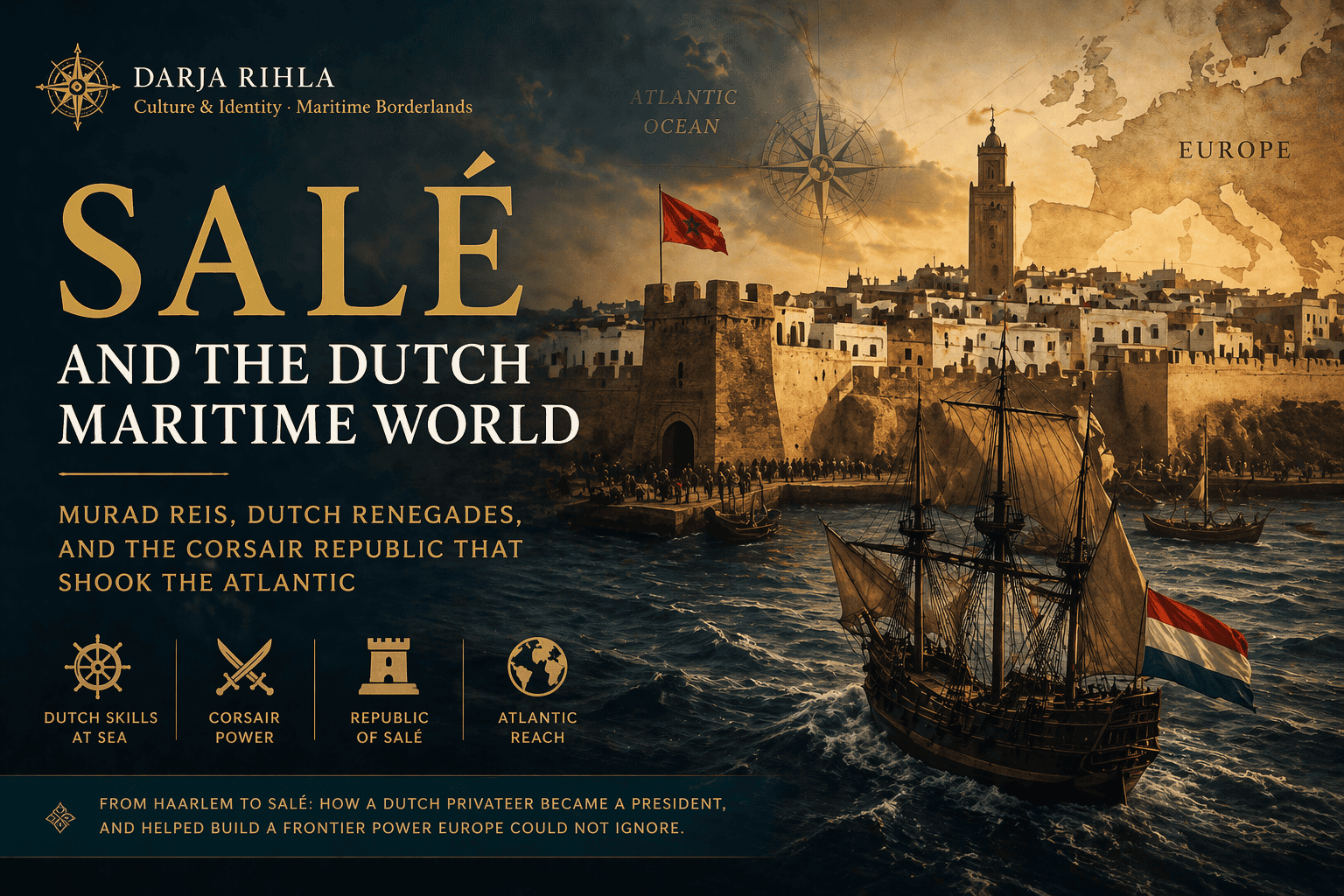
Salé and the Dutch Maritime World
In 1627, a fleet out of Salé raided Iceland and took hundreds of captives. In 1631, the same network struck Baltimore in Ireland. The man behind these operations was born Jan Janszoon, in Haarlem. He died as Murad Reis, president of a corsair republic on the Atlantic coast of Morocco. This is the story of how Dutch maritime logic built a frontier power that Europe could not ignore.
This is not a pirate curiosity piece. It is a systems-history essay on how privateering, ship knowledge, flexible identity, and pragmatic diplomacy became a portable Dutch maritime operating system, one that functioned far outside the Republic’s legal borders, and reshaped the balance of Atlantic power in the process.
The Republic of Salé, a corsair state on the Atlantic coast of Morocco, has more to do with the history of the Netherlands than geography suggests. In the early seventeenth century, this frontier republic became a striking extension of Dutch maritime culture: a place where privateering logic, technical knowledge, flexible identity, and pragmatic diplomacy operated outside the formal borders of the Dutch Republic. The consequences reached as far as Iceland, Ireland, and the Canary Islands.
Key events in the Salé corridor
The connection between the Dutch Republic and the Republic of Salé was not a single moment. It was a sequence of overlapping events spanning decades, driven by war, opportunity, conversion, and the portable logic of maritime violence.
Dutch rebels use privateer fleets against Spain. Decentralized naval violence becomes a legitimate political and economic tool. The mindset that will later travel to North Africa takes shape in the waters of Zeeland and Holland.
The Flemish-born sailor introduces northern European square-rigged ship designs to Algiers. For the first time, Barbary corsairs can operate beyond the Mediterranean, into the Atlantic. This single technical transfer reshapes the balance of maritime power across the region.
A Dutch privateer from Haarlem, operating under letters of marque against Spain, is captured by corsairs. Rather than languishing in captivity, he converts to Islam, takes the name Murad Reis, and begins his rise through the power networks of Algiers and eventually Salé.
At the mouth of the Bou Regreg river, across from Rabat, a semi-autonomous corsair republic consolidates. Salé governs its own port, sets its own tariffs, manages its own fleet, and runs its own foreign negotiations. Murad Reis rises to become one of its most prominent captains.
Ships under Murad Reis’s command raid the coast of Iceland, one of the most distant corsair operations in Atlantic history. Hundreds of Icelanders are taken captive and brought back to North Africa. The raid demonstrates that Dutch-upgraded corsair fleets can project force anywhere in the Atlantic.
Storm damage forces Murad into the Dutch port of Veere in Zeeland. He encounters his Dutch wife and children. The Republic is willing to tolerate his return. He chooses to leave. He chooses Salé. This is not simply an emotional moment. It is a sovereignty decision: the frontier offers him power, autonomy, and maritime command that the increasingly institutional Dutch Republic no longer can.
Corsairs from Salé’s network strike Baltimore in County Cork, Ireland. Over a hundred English settlers are taken captive. The raid shocks the English-speaking world and forces European governments to reckon with the reach of Barbary maritime power.
The Dutch Republic negotiates treaties with Moroccan rulers to protect Dutch shipping, while Dutch renegades continue to serve in the very corsair fleets threatening other European powers. Spain remains the shared enemy, creating room for selective cooperation and deliberate ambiguity.
Murad reaches the peak of his political career, governing the republic itself. A man born in Haarlem now runs a North African maritime state, negotiates with European consuls, and controls one of the most active corsair fleets in the Atlantic.
He never returns to the Netherlands. His life arc, from Haarlem privateer to Barbary captain to republic president, becomes the clearest single illustration of Dutch maritime logic operating outside Dutch borders.
The men who carried Dutch maritime knowledge south
Murad Reis was not an isolated adventurer. He was part of a broader class of Dutch and northern European maritime renegades who exported ship knowledge, operational tactics, and the privateer mindset to North Africa. These men did not arrive as passive defectors. They arrived as technical specialists whose skills transformed the corsair fleets from Mediterranean galley operations into Atlantic-capable naval forces.
Born in Haarlem around 1570, Janszoon began as a Dutch privateer during the Eighty Years’ War, operating under letters of marque against Spanish shipping. Captured by Barbary corsairs around 1618, he converted to Islam and took the name Murad Reis. He rose through the power structures of Algiers and later Salé, becoming one of the most feared corsair captains in the Atlantic.
His operational range was extraordinary. The 1627 Iceland raid and the network behind the 1631 Baltimore attack were not acts of random piracy. They were organized military-commercial operations run on profit logic, using ships and techniques that owed a direct debt to Dutch naval practice. At the peak of his career, he served as president of the Republic of Salé, governing a North African maritime state while negotiating directly with European diplomats.
The Veere episode remains the most psychologically revealing moment of his life. Forced into a Dutch port by storm damage, he encountered the wife and children he had left behind. He could have stayed. He chose to leave. Salé offered him something Haarlem no longer could: command, frontier mobility, and a sovereignty that the increasingly institutional Dutch Republic had begun to foreclose for men like him.
Born in Dordrecht (some sources say Vlissingen), Simon de Danser was arguably the single most consequential figure in the technical transformation of Barbary naval power. Before his arrival in Algiers around 1600, corsair fleets relied primarily on oar-driven galleys: effective in the Mediterranean but incapable of sustained Atlantic operations.
De Danser introduced round-hulled, square-rigged sailing ships to the Barbary fleet. This was not a cosmetic upgrade. It was a fundamental shift in operational capability. After this transfer, Barbary corsairs could handle Atlantic swells, carry larger crews, mount heavier armament, and operate far from home port for months at a time. The raids on Iceland, Ireland, and England that would follow in the 1620s and 1630s were made possible by this single knowledge transfer.
He was eventually killed in Tunis around 1611, possibly betrayed during a diplomatic negotiation. But the technical revolution he enabled outlived him by decades. Every corsair ship that raided the Atlantic after 1600 was, in some structural sense, a product of his intervention.
Claes Compaen was born in Oostzaan, North Holland. He began as a privateer, then crossed the line into unauthorized corsair activity, operating across the Atlantic from the Caribbean to the Barbary Coast. His career illustrates the thin and often invisible boundary between state-sanctioned privateering and freelance maritime violence.
At the height of his operations, Compaen was one of the most wanted maritime figures in Europe. He attacked ships of multiple nations, built alliances across jurisdictional lines, and demonstrated that the Dutch privateer skillset could function autonomously anywhere there was open water and commercial shipping to intercept.
Unlike Murad Reis, Compaen eventually returned to the Netherlands. He negotiated a pardon, retired to the countryside, and died in Oostzaan in 1660. His case proves that the renegade network was not a one-way street: some men returned, bringing back knowledge of Barbary operational methods and Atlantic route intelligence.
Less documented than Murad Reis or De Danser, but no less significant in the network. De Veenboer, known as Soliman Reis after his conversion, operated as a corsair captain out of Algiers. He represented the second tier of Dutch renegades: men who were not famous enough to generate diplomatic incidents, but whose skills and knowledge were essential to the daily functioning of Barbary corsair operations.
His career reinforces the central argument: the Dutch maritime world did not export one exceptional individual. It exported a class of technically skilled, jurisdictionally flexible, economically motivated maritime professionals who could operate in any port system that offered them ships, revenue, and political cover.
How Dutch ship knowledge changed Barbary corsair power
The parallel is instructive. The Dutch fluyt was optimized for scalable, efficient trade: maximum cargo, minimum crew. The corsair hybrid vessels emerging from De Danser’s technical transfer were optimized for scalable raiding: maximum range, maximum prize potential. Different goals, same underlying logic: use ship design as a force multiplier for economic extraction from the sea.
This was not cultural influence. It was a direct technology transfer that changed the military balance across the Atlantic. Before it, European Atlantic shipping faced local piracy. After it, European Atlantic shipping faced a coordinated, state-backed raiding system capable of striking from Morocco to Iceland.
The Dutch exported a maritime operating system. When that system entered the frontier conditions of the Republic of Salé, it did not disappear. It adapted, and it made Salé capable of projecting force across the entire Atlantic.
What the Republic of Salé did to Europe
The Republic of Salé was not exotic background. It was part of a real maritime power contest that shaped European shipping, diplomacy, and finance. Barbary corsair activity, amplified by Dutch ship technology, created a persistent disruption system across Atlantic and Mediterranean trade routes. European states paid tribute, ransomed captives, and adjusted naval deployments to manage the threat.
The Dutch position was uniquely contradictory. The Republic was simultaneously threatened by corsair activity against its own merchant fleet and pragmatically aligned with Morocco against their shared enemy, Spain. Dutch diplomats negotiated treaties with Moroccan rulers to protect Dutch shipping, while Dutch renegades were building the very corsair capability that threatened other European powers. This was not hypocrisy. It was the logic of a commercial republic that prioritized trade routes over moral consistency.
The financial consequences ran deeper still. Corsair risk accelerated the development of marine insurance markets, influenced shipping route calculations, and contributed to the development of convoy systems. The Barbary threat was one of the pressures that pushed European maritime commerce toward greater institutionalization. The same institutionalization that would eventually produce the VOC.
The sovereignty of choosing Salé
The standard telling of Murad Reis treats him as an exotic curiosity: the Dutchman who became a Barbary pirate. That framing misses the point. Murad’s trajectory was not an aberration. It was an expression of a logic already embedded in Dutch maritime culture: jurisdictional flexibility, opportunistic alliance, and the willingness to move between political systems when the economics demanded it.
In the Republic, he would have been a retired privateer: tolerated, maybe pardoned, certainly diminished. In Salé, he was a president, a fleet commander, a man who could negotiate directly with European consuls and Moroccan power brokers. The frontier gave him a sovereignty that the homeland could not.
This is identity as strategy. Not as folklore.
From frontier corsairs to the corporate empire
Salé matters most when placed inside the longer arc of Dutch maritime power. The usual story moves from the Sea Beggars to the VOC in one clean leap: revolt, independence, corporate expansion, global empire. But that arc skips the intermediate phase: the frontier phase, where Dutch maritime skills operated outside formal state control, in spaces that were legally ambiguous, politically opportunistic, and economically driven by personal initiative.
The actual sequence is more revealing. Sea Beggars normalized decentralized maritime violence. Privateering formalized it. The renegade network exported it to North Africa. Salé showed it could function as a self-sustaining system. And the VOC institutionalized the same underlying logic into a corporate structure backed by state charter and investor capital.
Frontier
Sea Beggars, privateers, renegades. Decentralized, personal, jurisdictionally flexible. Skills and violence moving freely across borders.
Frontier Republic
The Republic of Salé. A port-based system running on raiding revenue, political cover, and imported Dutch maritime knowledge. Self-sustaining but not yet institutional.
Corporate Empire
The VOC. Same underlying logic: maritime violence, port extraction, trade monopoly. Scaled through corporate structure, state charter, and finance capital.
Salé, Carthage, and the pattern of maritime network power
Carthage was an ancient network power: a sea-focused commercial republic that prioritized port control, maritime revenue, flexible diplomacy, and distributed agency over territorial consolidation. It did not seek to conquer land empires. It sought to control the nodes: the harbors, the chokepoints, the routes.
The Republic of Salé was a frontier echo of the same logic. A port-based republic prioritizing maritime mobility, raiding revenue, and pragmatic political alliances over territorial depth. The Dutch Republic itself was another instance: a commercial maritime state that built power through trade, shipping, and port-based finance rather than continental conquest.
The pattern is structural, not accidental. Wherever maritime conditions dominate, wherever the sea matters more than the land, you find the same logic recurring: distributed agency, flexible identity, port-based revenue, and the prioritization of mobility over territory. Carthage, Salé, the Dutch Republic, and eventually the VOC are all nodes in the same long history of maritime network power.
The Republic of Salé is not a footnote in Dutch history. It is a missing chapter: the frontier phase where Dutch maritime skills proved they could function outside any single political system. That proof is what makes the VOC legible not as a uniquely Dutch invention, but as the institutional capture of a maritime logic that was already, by then, genuinely portable.
Read this as part of the wider maritime sequence
Jan Janszoon / Murad Reis
The individual frontier story that opens the Dutch-North African maritime lane.
Bridge essayCarthage Network Power
The deeper model of maritime network logic that later frontier republics and commercial systems would echo.
Theme hubCulture & Identity
Return to the wider archive map and follow the next expansion of the cluster.