Culture & Identity Maritime Borderlands Pillar Essay
From Haarlem to Salé, Oualidia and New Netherland
The documented trail of one man across two worlds
How Jan Janszoon Murad Reis, a Haarlem-born mariner, moved through Dutch warfare, North African corsair governance, conversion, captivity, diplomacy and the Atlantic world, leaving a documentary trail from the Dutch Republic to Algiers, Salé, Iceland, Ireland, Oualidia and New Netherland.
The Voyage Line
Follow the documentary route
A geographical spine, not another table of contents: each stop marks a change in jurisdiction, evidence or operational reach.
- OriginHaarlem
- 1623Veere
- 1618+Algiers
- 1620sSalé
- 1627Grindavík
- 1631Baltimore
- 1640/41Oualidia
- LegacyNew Netherland
Choose a route
Six high-level stops keep the page scannable. Use the slide-out Contents tool for the full chapter list.
A stricter reconstruction of Jan Janszoon Murad Reis
The foundation of this reconstruction is intentionally stricter than the popular Murad Reis story. It does not assume that every repeated detail is true simply because it appears in later biographies. Claims such as a precisely documented capture near Lanzarote, continuous five-year rule over Lundy, the title “president of Salé”, or a certain death in Salé around 1641 require stronger evidence than is presently available. The documentary trail instead shows something more complicated and ultimately more interesting: Jan Janszoon did not simply disappear from Dutch history when he became Murad Reis. He remained connected to Dutch families, ports, ambassadors and political interests while simultaneously occupying positions inside North African maritime systems.
That is the central question of this article.
Not simply: how did a Dutch sailor become a Muslim corsair?
But:
How could one person remain operationally meaningful inside several political, religious and legal systems that were sometimes allies, sometimes competitors and sometimes enemies?
Act I · Before The Legend
Veere, November 1623
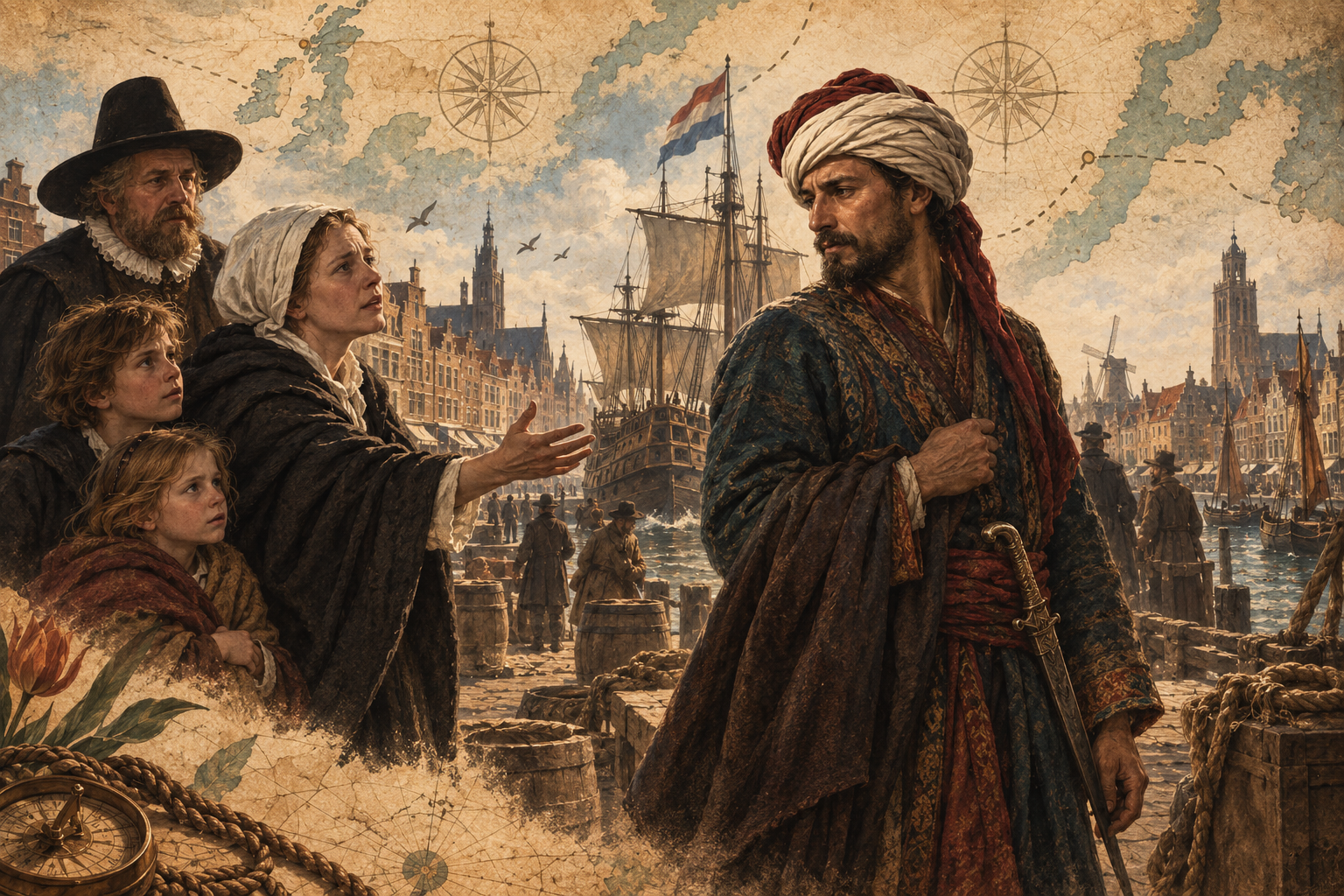
In November 1623, a vessel commanded by Moerad Rais entered the Zeeland port of Veere.
News of his arrival reached Haarlem.
His wife and children travelled south to Zeeland and attempted to persuade him to abandon his new life, return to his family and return to Christianity.
He did not.
This moment deserves to stand at the beginning of the story because it contains almost every major theme that would later define Murad Reis: family, religion, law, nationality, mobility, reputation, maritime power and the instability of political categories.
Read the full historical, systems & cybersecurity analysis
The man aboard the vessel could still be recognized as Jan Janszoon by the people who had known him in the Netherlands. He had not become culturally invisible simply because he had changed religion, name, political connections and professional environment. To his Dutch relatives, he remained husband and father. To his crew, he was Murad Reis. To authorities, he belonged to the troublesome category of the “renegade”, the contemporary European term often applied to Christians who had converted to Islam. To North African maritime society, he was no longer simply an immigrant from Haarlem. He had accumulated expertise, reputation and authority.
One individual was therefore being processed by several identity systems simultaneously.
That is what makes Veere far more interesting than a dramatic “pirate comes home” anecdote.
Maartje van Gelder’s research into Dutch converts operating in North Africa shows that converted corsairs could maintain contact with their original societies after conversion. They might preserve commercial links, family connections and political usefulness while becoming integrated into Muslim political and maritime networks. Her larger argument is that these figures should not simply be imagined as people trapped between mutually exclusive Christian and Muslim civilizations. They often operated across a continuum connecting the Dutch Republic with the Islamic Mediterranean.
The Veere incident also reveals a deeper problem of jurisdiction.
What exactly was Murad when he entered a Dutch harbor?
Was he an enemy?
A Dutch subject who had abandoned his faith?
A foreign officer?
A private maritime entrepreneur?
A diplomatically useful intermediary?
The answer could change depending on which institution was asking the question.
Dutch authorities struggled more generally with converted compatriots arriving in Dutch ports. Van Gelder shows that the States General debated how they should be treated. The problem was not theoretical. Converts arrived in Dutch territory, sometimes aboard armed vessels and sometimes carrying prizes captured at sea. Authorities could condemn them ideologically while simultaneously being constrained by treaties, trade interests and practical political realities.
This exposes a distinction that will return throughout Murad’s career:
identity is not the same thing as authorization.
Knowing who someone is does not automatically determine what that person is allowed to do.
Modern cybersecurity expresses this through identity and access management. A system may successfully authenticate a user without automatically granting that user every privilege. Identity answers one question. Authorization answers another. Trust adds a third.
Murad’s world operated without databases, cryptographic tokens or central identity providers, but the underlying governance problem already existed.
Who is this man?
Who recognizes him?
Whose authority does he possess?
Which jurisdiction applies?
Which actions will be tolerated?
Which old relationships remain valid?
The answers were negotiated through names, documents, reputation, family networks, diplomatic recognition and political usefulness.
Veere therefore represents more than a homecoming that failed.
It is the first visible trust boundary in the story.
Murad had crossed political and religious boundaries without destroying every relationship that existed on the other side.
That is precisely why the scene matters.
The traditional narrative asks why he refused to return.
The systems question is more revealing:
How could someone who had crossed so many boundaries still remain recognizable, negotiable and useful to the society he had left?
Act II · Licensed Violence
Privateering Before Murad Reis
Jan Janszoon entered a maritime world in which the line separating public warfare from private violence was already unstable.
The Dutch Republic itself had been shaped by maritime conflict.
During the revolt against Habsburg rule, the Sea Beggars demonstrated how armed maritime actors could move between rebellion, raiding, political legitimacy and emerging state power. Their history matters here because it prevents a simplistic contrast between supposedly orderly European naval warfare and supposedly chaotic North African corsairing.
Early modern states did not always possess the centralized monopoly on violence that modern readers associate with sovereign government.
Political authorities could delegate violence.
Read the full historical, systems & cybersecurity analysis
A privateer received authorization from a recognized political authority to attack specified enemies. The private actor might provide the ship, crew, capital, weapons and operational expertise. The state or sovereign provided something else: legal authority.
That distinction created an institutional framework around violence.
Captured vessels could become prizes.
Prize courts or comparable authorities could determine whether a seizure was legally valid.
Investors could finance voyages.
Crews could divide proceeds.
Governments could increase maritime pressure on enemies without directly financing every vessel.
Privateering therefore transformed violence into a partially outsourced system.
The state did not need to own every ship in order to project maritime force.
This is one reason the comparison between a letter of marque and an API key is useful, provided it remains explicitly an analogy rather than a claim of legal equivalence.
An API credential can give an external actor limited permission to perform operations within a system.
The important concept is scope.
An API key does not normally grant unlimited authority. It authorizes specific interactions.
A privateering commission functioned differently in law and technology, but it dealt with a structurally similar governance problem: how can a central authority permit an external actor to exercise a capability without directly executing every action itself?
And like modern authorization systems, privateering generated edge cases.
What happens when an operator exceeds the scope of authorization?
What happens when a commission expires?
What happens when one jurisdiction recognizes authorization and another rejects it?
What happens when the supposedly authorized actor targets a neutral party?
A vessel could therefore be a legitimate privateer from one political perspective and a pirate from another.
There was no universally accepted authorization authority covering the entire maritime world.
This is essential for understanding the category “corsair”.
North African corsair systems operated within their own political, legal and diplomatic arrangements. Ships could operate under recognized authorities, treaties could regulate relations between polities, and captive-taking could form part of warfare and maritime economies. European governments might classify the same actions differently depending on treaty relationships, war status and jurisdiction.
Corsair therefore cannot simply be translated as pirate.
Piracy described violence treated as illegitimate by relevant authorities.
Privateering and corsairing could possess forms of authorization.
But that authorization remained contested.
Van Gelder explicitly notes that the line between corsairing and piracy was frequently blurred in practice. The identity of ships, passengers, goods and crews could be disputed, and political agreements were not always consistently observed.
This creates an important connection with modern cyber conflict.
A state today may formally condemn cybercrime while tolerating, protecting or indirectly benefiting from technically independent operators who target foreign adversaries. The relationship between state and operator can range from command to sponsorship, permissive tolerance, intelligence sharing or simple refusal to prosecute.
The comparison does not make historical corsairs “hackers”.
It reveals the persistence of a governance pattern.
Political systems repeatedly seek ways to gain capability while externalizing some combination of cost, attribution and operational risk.
The Dutch Sea Beggars provide one route into that history.
Privateers provide another.
North African corsairs provide another.
Later chartered corporations such as the VOC would push delegated authority much further, combining commerce, diplomacy, territorial control and coercive power on an extraordinary scale.
Murad Reis moved through this environment before modern categories of state, corporation, military and criminal actor became as sharply separated as they appear today.
His world therefore forces a more difficult question than “pirate or privateer?”
The better question is:
Who possessed the authority to classify violence, and who possessed enough power to make that classification matter?
Educational layer · click any card
Privateer, pirate, corsair, renegade
Four labels that are often treated as synonyms, even though they describe different relationships between violence, authorization and identity.
Act III · Crossing Systems
Algiers and the making of Jan Janszoon Murad Reis
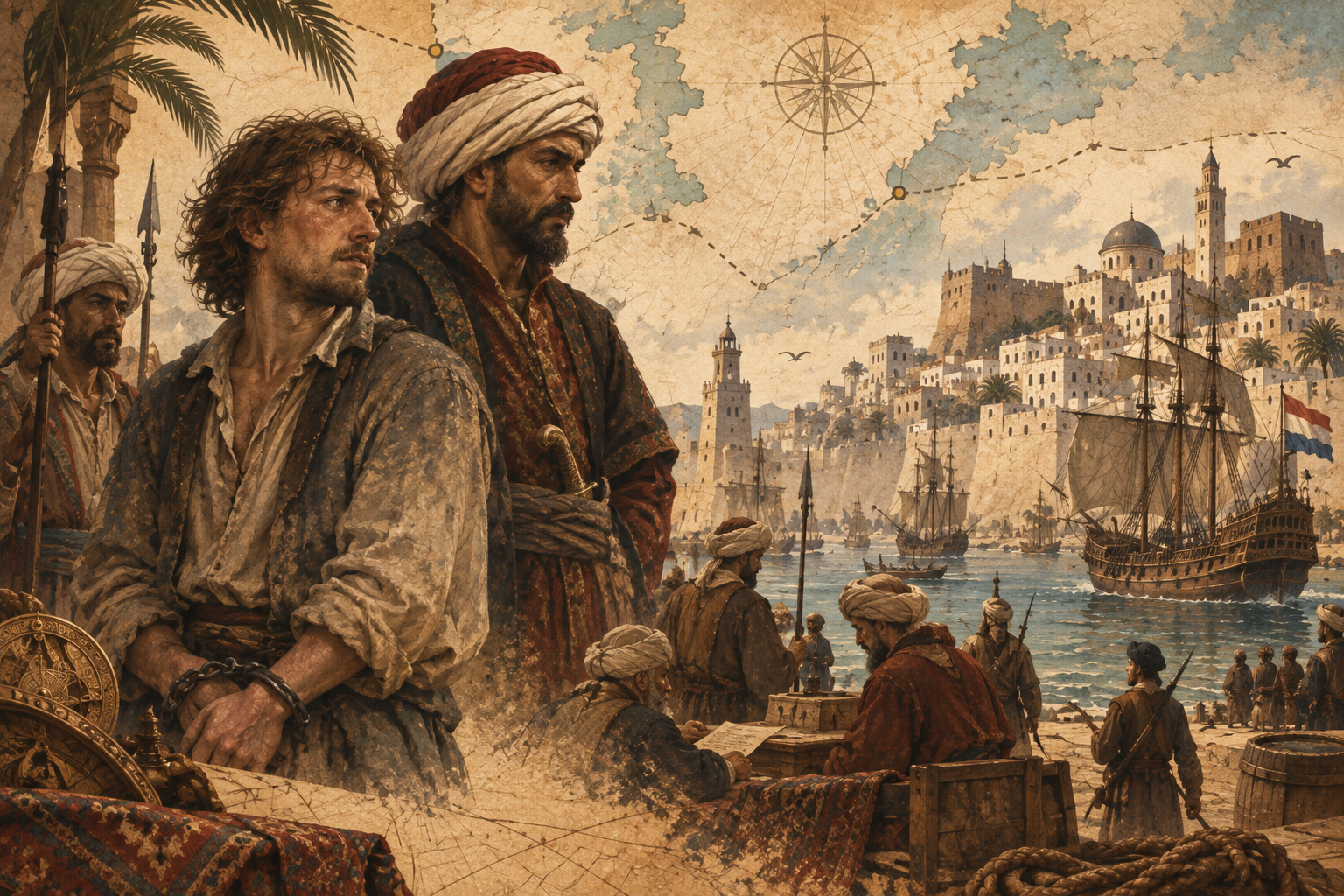
By 1618 Jan Janszoon was operating within the North African corsair world.
Van Gelder identifies him as the successor to Soliman Rais, another Dutch-born convert who had become prominent among the corsairs of Algiers. Janszoon took command of Soliman’s fleet and subsequently operated as Murad Reis. Later in 1618 he moved west toward Salé.
This is the documentary core.
A widely repeated narrative describes Janszoon being captured by North African corsairs near Lanzarote and subsequently converting to Islam. That specific capture scene should not be treated with the same confidence as the later documentary evidence unless a strong contemporary source is produced.
The conversion itself is established.
Read the full historical, systems & cybersecurity analysis
Its motive is not.
That distinction matters.
Popular history tends to demand psychological certainty.
Was he forced?
Was he opportunistic?
Was he sincerely convinced?
Was conversion a survival strategy?
Did he seek political advancement?
Did his religious convictions genuinely change?
The surviving record does not provide access to a private internal monologue capable of settling those questions.
Van Gelder’s broader discussion of conversion is useful precisely because she rejects simple binaries. Conversion could involve religious belief, social integration, political opportunity, marriage, patronage and economic advancement. Coercion itself was not limited to immediate physical violence. Social, fiscal, political and economic pressures could influence choices. Converts might receive new clothing, new names and entry into new networks while continuing to maintain older connections.
The correct historical discipline is therefore to distinguish what happened from why it happened.
Jan Janszoon became Muslim.
He became known as Murad Reis.
He entered North African political and maritime structures.
His precise inner motive remains uncertain.
This uncertainty does not weaken the story.
It improves it.
Because once conversion is removed from the role of exotic plot twist, a larger transformation becomes visible.
Religious identity in the early modern Mediterranean affected far more than private spirituality.
It interacted with marriage, law, taxation, patronage, professional opportunity, political legitimacy and social networks.
Changing religion could therefore alter the institutional environments through which a person was able to move.
Murad did not merely acquire a different label.
He entered a different trust architecture.
Yet his earlier identity was not deleted.
That is one of the most important findings in Van Gelder’s research. Converts frequently maintained or reconstructed links with their societies of origin. New names could even preserve elements of past professions or ethnic origins. Commercial connections, correspondence and relationships with Christian relatives could survive conversion.
In modern systems language, this resembles a multi-domain identity.
A person may possess one legal identity, several professional identities, family relationships, organizational memberships and credentials recognized by different institutions.
No single attribute necessarily explains the entire person.
Murad was Dutch-born.
Muslim.
Corsair.
Mariner.
Broker.
Later admiral.
Later governor.
Father.
Contact point for Dutch diplomats.
None of these identities automatically erased the others.
This is where popular narratives about “betrayal” become analytically inadequate.
They assume political and cultural identities are mutually exclusive containers.
Murad’s career suggests something less comfortable.
Individuals can remain attached to multiple systems at once.
The border may not run between two civilizations.
The border can run through the actor.
And that actor may become valuable precisely because he understands both sides.
This is also the foundation of the cybersecurity comparison with identity federation.
Modern federated identity allows one domain to accept certain identity assertions generated elsewhere. The systems do not merge completely. They establish limited trust relationships.
Murad himself was obviously not a technological identity provider.
But his political function increasingly resembled a human interoperability layer.
Dutch authorities could not simply command the institutions of Salé.
Salé did not belong to the Dutch state.
Yet Murad possessed access, recognition and credibility inside systems Dutch officials needed to reach.
His ambiguity became useful.
That is the deeper lesson of Act III.
Murad’s transformation did not remove him from one system and install him neatly inside another.
It increased the number of systems through which he could operate.
Act IV · The Bou Regreg
Salé Was A Contested System, Not A Pirate Caricature
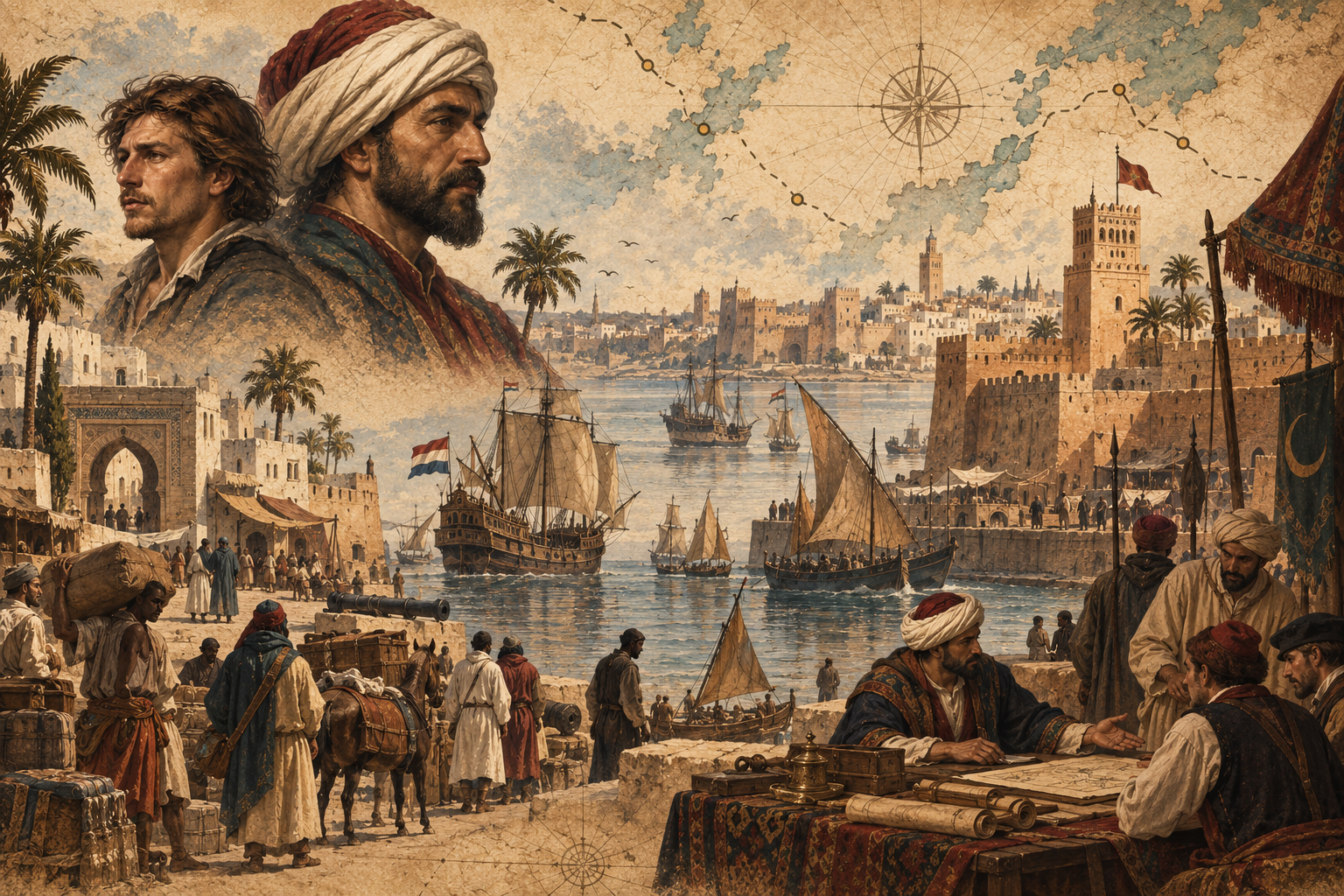
The phrase “Republic of Salé” is memorable.
It is also dangerous when used without explanation.
It can produce an image of one unified pirate city independently governed by corsairs.
The political reality around the mouth of the Bou Regreg was considerably more complicated.
The area involved several communities and centers of power.
Read the full historical, systems & cybersecurity analysis
Hornacheros, Muslims expelled from Hornachos in Spain, formed an important organized community around the Kasbah. Other Andalusian Moriscos arrived under different circumstances. Old Salé, across the river, possessed its own population, institutions and political actors.
These communities did not automatically behave as a single refugee bloc.
They possessed different economic resources, migration histories, political interests and relationships with local Moroccan power.
That created competition.
Who controlled customs revenue?
Who determined political representation?
Who financed the fleet?
Who received shares from maritime activity?
Who controlled the harbor?
Who maintained defensive infrastructure?
Who negotiated with external powers?
Those questions reveal why reducing Salé to a pirate hideout destroys most of the historically interesting material.
Repeated maritime operations require organization.
Ships require maintenance.
Crews require provisioning.
Ports require administration.
Political factions require negotiation.
Revenue requires distribution.
Foreign governments require diplomatic interfaces.
Captives require systems of custody, sale, ransom or exchange.
Violence itself becomes embedded in bureaucracy.
This does not make the system benign.
It makes the violence more intelligible.
A criminalized or predatory economy can be institutionally organized.
Order and legality are not the same variable.
That distinction is central to understanding Salé.
The weakening of Moroccan central authority after the death of Ahmad al-Mansur created opportunities for local actors to gain greater autonomy. But fragmented sovereignty does not mean absence of governance.
When central control weakens, governance can reappear at lower levels.
Local elites establish rules.
Commercial interests create institutions.
Military capability produces bargaining power.
Factional conflict generates new political settlements.
Revenue distribution becomes political structure.
This is precisely why Salé is such a useful systems case.
Consider the system as a flow.
Inputs include ships, sailors, capital, maritime knowledge, weapons, migration, intelligence and political protection.
Operational processes include navigation, raiding, commerce, diplomacy, captive-taking, maintenance and negotiation.
Outputs include revenue, political authority, ransom opportunities, captured goods and increased military capability.
But those outputs feed back into the system.
Successful maritime activity can attract more sailors and investment.
More revenue can strengthen port infrastructure.
Greater wealth can intensify disputes over control.
More successful raiding can provoke stronger European naval responses.
Internal factional rivalry can weaken collective capacity.
Treaties can redirect violence from one category of target toward another.
This is a classic feedback architecture.
Success does not simply create more success.
It also changes the environment in which future operations occur.
That makes Salé relevant to Darja Rihla’s wider systems analysis.
Systems survive not because every participant agrees but because recurring transactions require enough structure to continue.
The same principle appears in modern illicit digital markets.
Cybercriminal ecosystems can develop specialization, reputation mechanisms, infrastructure providers, access brokers, marketplaces, dispute procedures and payment systems.
That comparison must remain bounded.
A seventeenth-century corsair polity is not a ransomware forum.
But both reveal the same failure in simplistic thinking:
illegal or contested activity does not imply organizational chaos.
In fact, repeated exploitation often requires stable internal rules.
The deeper problem is therefore not whether Salé was orderly.
The question is what kind of order it produced.
A political system can be highly organized while producing suffering outside its protected membership.
A market can efficiently allocate resources while those resources originate in coercion.
A bureaucracy can increase operational capacity without increasing justice.
That is why the romantic phrase “pirate republic” should never be allowed to do the analytical work.
The stronger description is:
a fragmented maritime governance system operating under contested sovereignty, sustained through commerce, coercion, migration, maritime expertise and negotiated political authority.
Murad Reis became important because he was able to operate inside precisely this kind of system.
Act V · Broker And Admiral
Ruyl, Veere And The Dutch Connection
The year 1622 reveals a side of Murad Reis that pirate biography often pushes to the margins.
Dutch ambassador Albert Ruyl travelled to Salé seeking the release of Dutch captives.
Murad became involved.
His assistance was not incidental.
It showed that the same person associated with maritime raiding could function as an intermediary in negotiations intended to reverse some of the consequences of that maritime violence.
Read the full historical, systems & cybersecurity analysis
That apparent contradiction disappears when viewed as a system.
Murad possessed access.
He understood local political structures.
He possessed maritime authority.
He understood Dutch society and language.
He could communicate across religious and political boundaries.
He could reach actors a foreign ambassador might struggle to reach directly.
This made him valuable.
Van Gelder’s research demonstrates that Dutch converts could act as informants, intermediaries and sometimes effectively informal diplomats. Murad became one of the clearest examples. His position eventually approached that of a Dutch representative without him simply becoming a Dutch official again.
In August 1624 Mulay Zaydan appointed Murad admiral of the Salé fleet.
This matters because his authority was no longer simply personal reputation.
He possessed formal status within Moroccan political structures.
At roughly the same time, Dutch authorities continued to treat him as someone through whom Dutch interests could be advanced.
That gives Murad two overlapping forms of legitimacy.
One came from the political structure in which he operated.
The other came from the confidence foreign actors placed in his usefulness.
Formal authority and operational trust were not identical.
That distinction is extremely relevant to modern systems.
Organizations routinely depend on entities they do not own.
Cloud providers.
Certificate authorities.
Payment processors.
Identity providers.
Managed service providers.
Software supply chains.
External consultants.
Business partners.
A company may not control any of these parties directly, yet its own operations can depend on them.
The relevant security problem is third-party trust.
Murad occupied a historical version of that dependency problem.
The Dutch Republic did not own Salé.
It did not directly command Murad.
It could not simply impose its administrative system on every local institution.
Yet Dutch interests could depend on his ability to operate within those institutions.
He became a bridge.
That bridge increased capability.
It also created dependency.
This is the part of the story that most strongly resembles cybersecurity trust architecture.
An intermediary can solve an interoperability problem.
But every intermediary introduces another failure mode.
What happens if the intermediary changes allegiance?
What happens if political authority behind him collapses?
What happens if other actors stop trusting him?
What happens when he disappears?
What happens when knowledge about how to navigate the other system exists mainly inside one person?
The Dutch relationship with Murad therefore resembles a human single point of failure.
The comparison becomes even more interesting because trust did not need to equal moral approval.
The Dutch could object to conversion.
They could object to corsair activity.
They could still conclude that Murad was useful and sufficiently reliable for specific tasks.
Modern security architecture operates on the same principle.
Trust should be scoped.
An organization does not need to believe a third party is universally benevolent.
It needs confidence that the third party will perform a specified function under specified conditions.
This is the historical significance of Murad’s broker role.
His life demonstrates that cross-border political systems already depended on trust relationships extending beyond direct sovereign control.
Ships connected ports.
Treaties connected governments.
Merchants connected markets.
Captives connected families to diplomatic machinery.
And intermediaries connected institutions that could not communicate effectively on their own.
Murad was not merely travelling between systems.
For a period, he became part of the infrastructure connecting them.
New educational layer · the trust mirror
A seventeenth-century trust stack
The comparison is structural, not technological. It shows why Jan Janszoon Murad Reis is useful for understanding governance across domains.
- IdentityName, language, religion, origin, reputation
- AuthorizationCommission, office, patronage, treaty status
- InterfaceBroker, envoy, captain, merchant network
- InfrastructurePorts, ships, records, ransom systems
- EvidenceLetters, resolutions, deeds, surviving archives
- IdentityAccount, credential, device, claims, context
- AuthorizationScopes, roles, permissions, policy
- InterfaceIdentity provider, vendor, API, broker
- InfrastructureNetworks, cloud, endpoints, supply chain
- EvidenceLogs, provenance, telemetry, forensic artifacts
Identity is not trust. Authorization is not ownership. A treaty is not enforcement. A border is not control. A missing record is not proof.
Act VI · Atlantic Reach
Iceland, Lundy And Baltimore
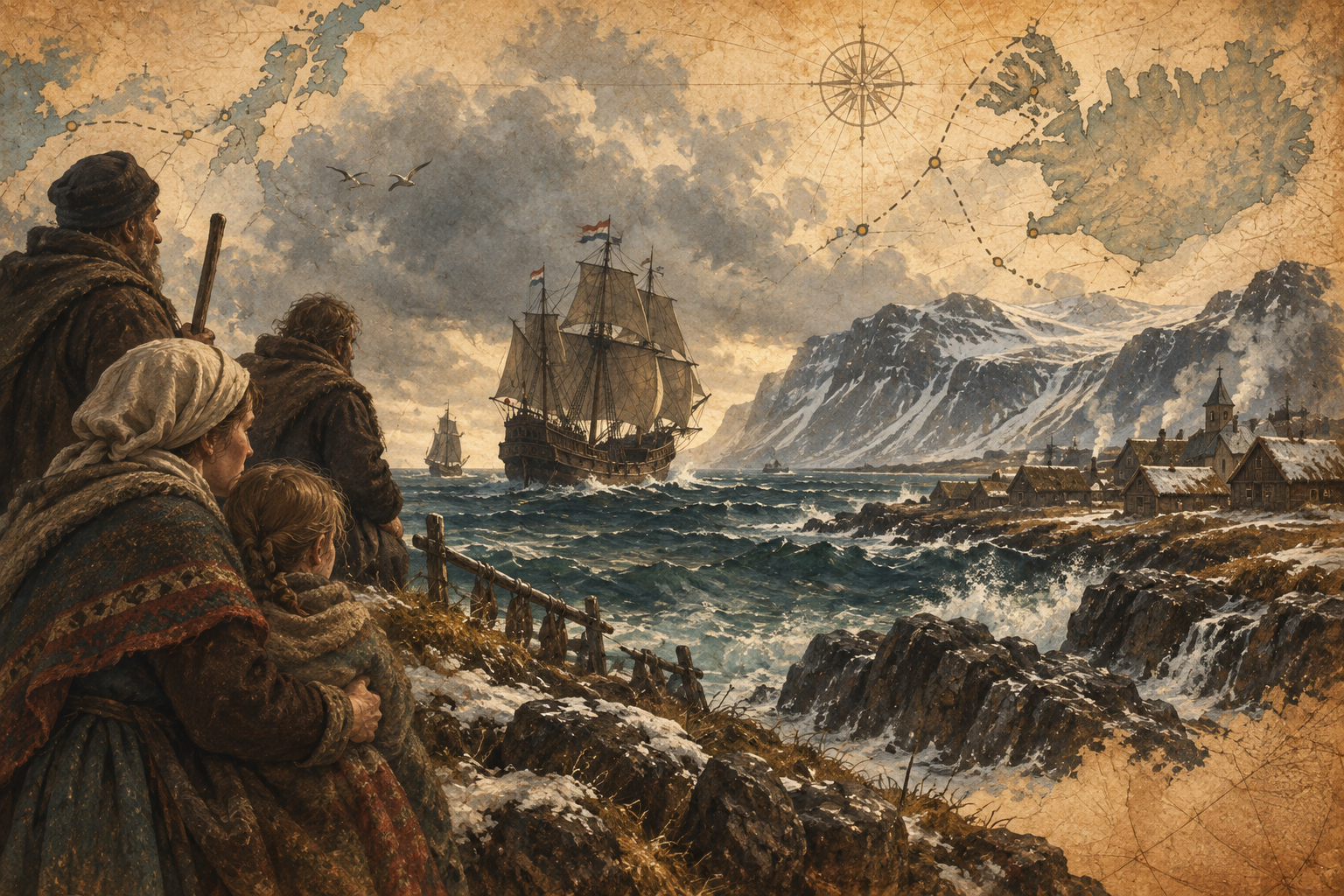
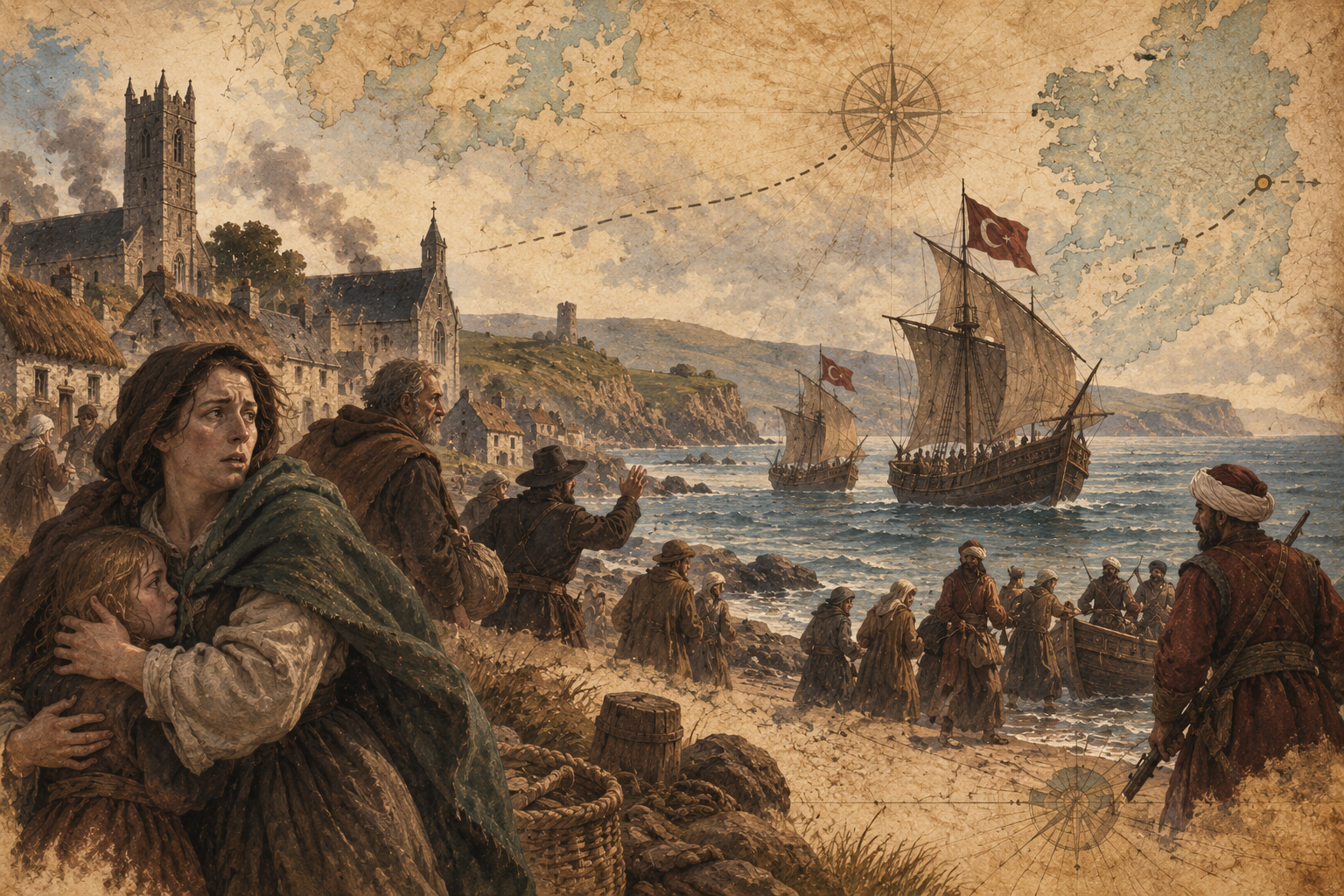
The Atlantic raids associated with Murad Reis are usually treated as the most spectacular section of his career.
They should instead be read as demonstrations of operational reach.
The first principle is attribution discipline.
In 1627 North African corsair expeditions reached Iceland.
The famous total of roughly four hundred captives belongs to the combined Icelandic raids, not simply to Murad Reis.
Read the full historical, systems & cybersecurity analysis
Murad led the Salé expedition associated with Grindavík.
Other attacks, including devastating operations in the East Fjords and Westman Islands, were carried out by an Algerian expedition.
The distinction matters.
It is tempting to attach the largest available number to the most famous commander.
That is precisely how historical exaggeration develops.
A better methodology resembles cyber threat intelligence.
Participation in one component of a campaign does not justify attributing the entire campaign to one actor.
Separate operation from campaign.
Separate commander from ecosystem.
Separate confirmed presence from assumed responsibility.
That principle strengthens rather than diminishes the historical reach of the story.
Even the firmly attributable expedition demonstrates the extraordinary geographical radius available to Salé corsairs.
North African maritime operations were not confined to short Mediterranean journeys.
They could penetrate deep into Atlantic waters.
That has important implications for security.
Defending a coastline is not the same thing as claiming sovereignty over it.
European states controlled territory politically while possessing incomplete operational coverage.
Thousands of kilometers of coast, islands, fishing settlements and shipping routes could not be continuously observed.
That creates an attack surface.
The term comes from cybersecurity, but the structural concept is older.
Every exposed route, harbor, settlement or poorly defended island creates another potential point of access.
Lundy demonstrates this problem particularly clearly.
Murad and his crew are associated with the island in 1627, while later Salé Rovers used Lundy intermittently for years.
The National Trust describes intermittent use, not a securely documented continuous five-year Murad occupation. (National Trust)
This correction creates a better analytical question.
What does sovereignty mean if a government claims territory but cannot continuously control who uses it?
Ownership is not enforcement.
A modern organization can own a network and still fail to monitor it.
A government can claim an island and still lack persistent maritime visibility around it.
Operational control requires observability, response capacity and presence.
Lundy therefore represents an early-modern version of a familiar security gap:
claimed control exceeded actual defensive coverage.
Baltimore in Ireland, attacked on 20 June 1631, exposes another mechanism.
Successful extraction operations require more than aggression.
They require target selection.
Navigation.
Timing.
Intelligence.
Knowledge of local vulnerabilities.
Sufficient manpower.
Custody of captives.
A route away from pursuing forces.
A destination where captured people or goods can enter another economic system.
This turns a raid into a process.
Reconnaissance.
Approach.
Access.
Action.
Extraction.
Monetization or political use.
That sequence resembles the logic of a modern attack chain without implying that seventeenth-century corsairs were somehow proto-hackers.
The useful insight is methodological.
Complex attacks are rarely singular moments.
The visible breach is only one stage.
Preparation comes before it.
Monetization comes after it.
Infrastructure makes both possible.
This is why Baltimore should not simply be narrated as horror arriving unexpectedly from the sea.
The analytical task is to identify the infrastructure that made such operations repeatable.
Ships.
Navigational knowledge.
Crews.
Markets.
Intelligence.
Ports.
Political protection.
Captive-processing systems.
Without those components, violence remains episodic.
With them, violence becomes scalable.
And once violence becomes scalable, defenders must reorganize.
That produces the next system in the story.
Act VII · Human Infrastructure
The Captive Economy
Captivity was not merely an accidental consequence of corsairing.
Humans themselves could become central outputs of maritime operations.
This must be stated clearly because reducing corsair raids to adventurous naval history distorts the economic structure that supported them.
Captives could enter several pathways.
Some possessed ransom value.
Read the full institutional analysis of captivity and response
Families, religious institutions, diplomats or states might raise money for release.
Others could be sold.
Some entered coerced labor.
Others could be incorporated into households or institutions.
Some converted, changed status or developed entirely new lives within North African societies.
These outcomes should not be collapsed into a single price model.
A ransom captive is not economically identical to someone sold for labor.
A converted former captive is not simply a commodity category.
Status could change over time.
People moved through institutions.
And because the evidence is incomplete, historians should resist creating false numerical precision around the total number of Europeans held in North Africa across long periods.
The mechanism is more important than sensational totals.
A successful raid could generate human captives.
Captives created economic value and diplomatic pressure.
Diplomatic pressure generated negotiations, ransom institutions, consular activity and sometimes military responses.
Those responses changed the environment in which future corsair operations occurred.
That is a feedback loop.
Predation creates defense.
Defense changes predation.
The cycle might look like this:
successful raids increase revenue.
Greater revenue supports maritime capacity.
Increased activity creates greater political pressure on targeted states.
States strengthen naval patrols, treaties or ransom institutions.
Corsairs adapt target selection or geography.
New targets create new diplomatic relationships.
Those relationships redistribute risk again.
Murad’s own diplomatic role shows how uneven that protection could become.
By helping Dutch diplomats secure the release of Dutch captives and by operating as an intermediary for Dutch interests, he contributed to mechanisms that could make nationality politically relevant to survival.
Security was not universally distributed.
Treaty status mattered.
Political relationships mattered.
Nationality mattered.
Access to intermediaries mattered.
That is another point of contact with modern cybersecurity.
Security resources are rarely distributed evenly.
Privileged accounts receive stronger controls.
High-value systems receive continuous monitoring.
Major clients may receive dedicated incident response.
Critical infrastructure receives regulatory attention.
Less visible users or systems may receive weaker protection.
The result is a layered security environment.
Protection follows perceived value, political importance and institutional membership.
Early modern captivity operated through vastly different moral and technological systems, but it also reveals the unequal distribution of protection.
A captive whose government had diplomatic access possessed different possibilities from someone whose community lacked those connections.
This makes captivity more than a story about victims and raiders.
It becomes a story about institutional response.
European states developed bureaucratic mechanisms because captivity forced them to.
Diplomacy became part of security.
Redemption became organized.
Information about missing sailors had to move between ports and governments.
Payments had to be arranged.
Treaties had to define categories of protected shipping.
Navies had to decide when coercion was cheaper or more effective than negotiation.
The captive economy therefore influenced state behavior.
It did not sit outside European political development.
It helped shape it.
This matters for Darja Rihla because it demonstrates a recurring systems truth.
A threat does not merely damage an existing system.
Persistent threats cause systems to evolve.
Cybercrime today produces cyber-insurance, incident-response firms, security operations centers, regulatory frameworks and threat-intelligence markets.
Maritime captivity produced different institutions appropriate to its era.
The pattern is not technological.
It is structural.
Threat creates response.
Response creates cost.
Cost creates specialization.
Specialization becomes infrastructure.
The violence at the center of the system must never be romanticized.
But neither should it be described as chaos.
The uncomfortable truth is the opposite.
Captivity became powerful precisely because enough infrastructure existed to turn human seizure into repeatable political and economic outcomes.
Act VIII · Identity Under Pressure
Renegades As Infrastructure
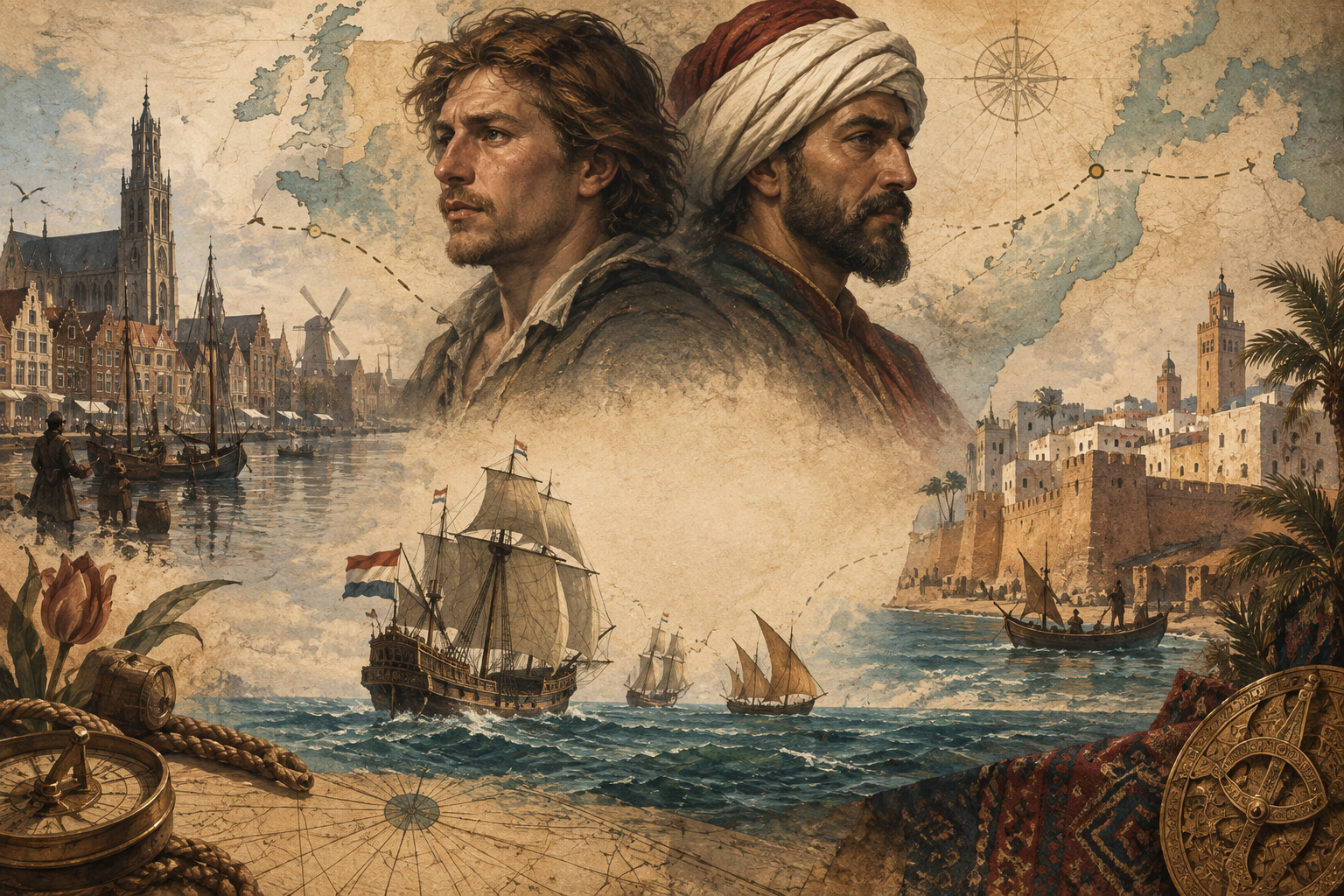
Calling Jan Janszoon a renegade describes how many Europeans perceived conversion.
It does not fully describe how he functioned.
Converted mariners could become translators, navigators, informants, brokers and political intermediaries.
They understood multiple environments because they had lived inside more than one.
Their identities could therefore become operational assets.
Explore identity governance, boundary actors and archival uncertainty
Van Gelder’s central contribution is to challenge the idea that these converts should automatically be understood as marginal people suspended between a Christian past and Muslim present.
Her evidence suggests something more fluid.
Dutch converts could become deeply integrated into Muslim societies while continuing to maintain relationships with the Dutch Republic.
They belonged to overlapping networks rather than disappearing completely from one before entering another.
This makes Murad particularly valuable for understanding identity as infrastructure.
Identity is often described as something internal.
Who are you?
But institutions deal with a different problem.
Who do we believe you are?
What evidence supports that belief?
Which of your attributes matter here?
Which privileges follow from them?
Under what conditions should those privileges continue?
That is identity governance.
Modern cybersecurity formalizes these questions.
Identity.
Authentication.
Authorization.
Privilege.
Federation.
Context.
Reputation.
Murad’s environment possessed historical equivalents without digital machinery.
Language could authenticate cultural familiarity.
Family relationships could establish provenance.
Reputation could function as a trust signal.
Political titles established authority.
Personal letters established relationships.
Treaties defined categories.
Ships and crews demonstrated actual power.
Repeated successful interactions produced reputation.
No single authority controlled the entire identity system.
This makes Murad’s position resemble federated identity more than centralized identity.
Different political domains recognized different attributes.
Dutch officials did not need to regard him as an ordinary Dutch citizen in order to trust his ability to negotiate.
Moroccan authorities did not need to erase his Dutch origins in order to give him authority.
His usefulness emerged from context.
This is also why simplistic questions about loyalty struggle to explain him.
Was he Dutch?
Yes, by origin and continuing relationships.
Was he Muslim?
Yes.
Was he integrated into North African political structures?
Yes.
Did he interact with Dutch institutions?
Yes.
These facts do not need to be forced into one exclusive category.
Murad’s identity was layered.
And the layering itself created capability.
The same characteristic creates risk.
A person who moves between systems can become a translator.
Or a spy.
A negotiator.
Or a smuggler.
A broker.
Or a double agent.
The interface position is powerful because it carries information across boundaries.
Security systems therefore pay special attention to boundary actors.
Administrators.
Third-party vendors.
Identity providers.
Translators.
Consultants.
Supply-chain operators.
Service accounts.
All of them can possess access across multiple domains.
Murad’s historical position was obviously different, but structurally he occupied that kind of privileged boundary.
This also explains the archival problem.
People who operated in legally ambiguous maritime environments sometimes had incentives not to preserve evidence.
Van Gelder notes that surviving North African archival material is uneven and that corsair activity itself could generate deliberate documentary obscurity. The Dutch corsair Claes Compaen even boasted of destroying captured shipping records. Questions of ship ownership, passenger identity and legal status could remain contested.
That creates an epistemological rule Darja Rihla should make explicit:
missing evidence is not permission to invent continuity.
Historical reconstruction should therefore use confidence levels.
Documented.
Probable.
Possible.
Disputed.
Unsupported.
This is the same discipline required in digital forensics and threat intelligence.
A log shows what was observed.
An analyst interprets it.
A hypothesis connects evidence.
Confidence describes uncertainty.
None of these are identical.
Murad Reis therefore becomes more than a historical figure.
His documentary trail becomes a lesson in evidence governance.
The archive has a trust boundary too.
Act IX · Last Strong Documentary Phase
Oualidia, 1640/41
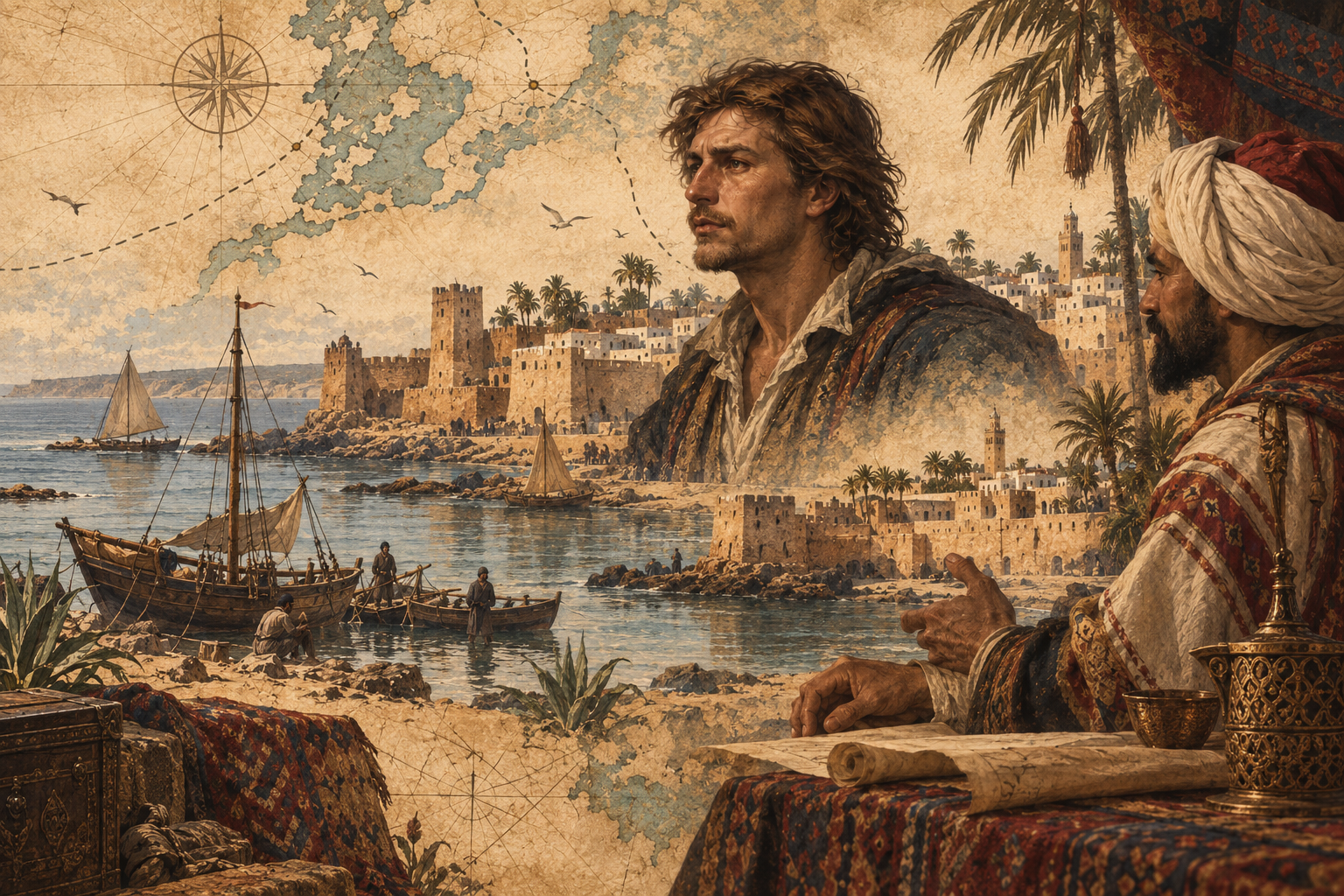
By 1640 Murad’s career had moved beyond the image of the wandering corsair captain.
He appears as governor of al-Walidiya, modern Oualidia, a fortified Atlantic port south of Salé.
This is one of the most important corrections to popular versions of the story.
The later Murad should not simply be described as “president of Salé”.
The documentary evidence points instead toward his governorship at Oualidia.
Open the evidence discipline behind the unresolved ending
That change matters because titles create models of political structure.
Calling him president suggests a particular constitutional arrangement.
Calling him governor reflects a documented role within Moroccan authority.
Historical precision matters most when one word silently changes how readers imagine the entire system.
Oualidia also reveals how thoroughly Murad had become institutionally embedded.
The trajectory was no longer:
Dutch sailor becomes pirate.
It had become:
Dutch-born mariner enters North African corsair networks, gains maritime command, acts as diplomatic intermediary, receives formal authority and eventually governs a strategically significant harbor.
That is social mobility across systems on an extraordinary scale.
Yet the strongest scene in this final documentary phase is not political.
It is familial.
Murad’s Haarlem-born daughter Lijsbeth travelled with a Dutch diplomatic mission and met her father.
She stayed with him for a period.
He subsequently returned to his post.
The symmetry with Veere is remarkable.
In 1623, members of his Dutch family travelled to him and tried to pull him back toward Haarlem.
Around 1640/41, another member of that family crossed toward the world Murad had built for himself.
Veere and Oualidia therefore operate as narrative mirrors.
At Veere:
family crosses the boundary to ask Murad to return.
At Oualidia:
family crosses the boundary and one daughter remains.
No fictional embellishment is required.
The documented structure is already powerful.
And then the archive becomes quiet.
This is where historical discipline matters most.
Popular biography dislikes an unresolved ending.
It wants a final year.
A deathbed.
A grave.
A place.
An age.
A conclusion.
But the responsible formulation is simpler.
The strongest documentary trail fades after this phase.
That means Murad’s date and place of death should remain uncertain unless stronger evidence emerges.
This distinction has an unusually useful cybersecurity parallel.
In digital forensics, “last observed” is not the same as “ceased to exist”.
If an endpoint disappears from telemetry at 14:32, the evidence demonstrates absence from observation after 14:32.
It does not automatically prove destruction at 14:32.
If a threat actor stops appearing in available logs, disappearance from evidence is not identical to disappearance from reality.
Murad should therefore be treated in the same epistemic way.
Oualidia is the last strong observed phase.
Not necessarily the end of his life.
That gives the article a more rigorous ending than invented certainty ever could.
It also illustrates a principle Darja Rihla can carry into future historical and cybersecurity work:
The edge of evidence must remain visible.
Do not extend the map simply because the blank space feels uncomfortable.
Act X · What Crossed The Atlantic
Anthony Van Salee And New Netherland
Murad Reis eventually disappears from the surviving documentary trail.
His family does not.
One of the strongest transatlantic bridges leads through his son Anthony Jansen van Salee.
Anthony established himself in New Netherland and became a significant landholder around New Amsterdam.
A surviving property deed provides the kind of evidence this article should prioritize.
Read the full historical, systems & cybersecurity analysis
The Center for Brooklyn History preserves documentation concerning Anthony Jansen van Salee and a one-hundred-morgen land grant near Coney Island. The surviving record creates a hard archival connection between this family and the development of colonial New Netherland. (Center for Brooklyn History finding aid)
This is far more valuable than a collection of internet genealogies claiming that Murad Reis was the ancestor of various famous modern Americans.
Those claims may be worth investigating individually.
They should not be allowed to substitute for documented history.
The methodological rule should be explicit:
one hard bridge is stronger than ten loose genealogical claims.
Anthony matters because his record demonstrates continuity.
The geography of the family had already become extraordinary.
Haarlem.
Mediterranean waters.
Algiers.
Salé.
The Atlantic.
Morocco.
New Netherland.
The family history therefore becomes a map of early modern mobility.
But this should not be interpreted as a romantic story about cosmopolitan freedom.
Every one of those regions was embedded in systems of war, colonialism, trade, religious conflict, slavery, migration and territorial expansion.
New Netherland itself was a colonial project.
The Atlantic connection therefore extends Murad’s story into another system of power rather than providing a neutral epilogue.
Anthony allows us to ask a different question:
What survives when the original actor disappears?
Not necessarily ideology.
Not necessarily political title.
Not even reputation.
What can survive is documentation.
Property.
Family.
Names.
Legal claims.
Institutional records.
Those records can then become evidence centuries later.
This is why Anthony belongs not only in Culture & Identity but also in Philosophy & Legacy.
Legacy is not merely fame.
It is persistence through systems.
A person may disappear while administrative consequences continue.
A land deed survives because an institution had reason to preserve it.
A diplomatic letter survives because governments needed records.
A court record survives because law generates documentation.
An archive is therefore not a neutral mirror of everything that happened.
It is the fossil record of what institutions considered worth recording and what material happened to survive.
That produces another Darja Rihla insight.
Power determines not only what people can do.
Power influences what becomes visible to future historians.
A governor generates records differently from an enslaved captive.
A landowner generates documentation differently from an anonymous sailor.
A diplomat leaves traces because bureaucracy preserves correspondence.
The archive therefore contains structural bias.
Evidence discipline requires recognizing it.
Anthony’s deed is powerful evidence precisely because its institutional provenance is strong.
But the existence of that record should never imply that similarly detailed records survive for everyone who travelled through the same world.
This is the difference between genealogy as storytelling and archival reconstruction as method.
The first seeks continuity.
The second asks how continuity can actually be demonstrated.
Act XI · Diplomatic Systems
The Dutch-Moroccan Axis
Murad Reis cannot be understood as an isolated anomaly.
His career became possible partly because the Dutch Republic and Morocco were already connected through diplomacy, commerce and shared geopolitical interests.
The relationship was not simply “Christian Europe versus Muslim North Africa”.
That civilizational frame hides the political reality.
The Dutch Republic was fighting Habsburg Spain.
Read the full historical, systems & cybersecurity analysis
Moroccan rulers had their own conflicts and interests regarding Spain.
Shared strategic hostility created opportunities for cooperation that crossed religious boundaries.
Commerce added another incentive.
The Dutch did not require ideological sameness in order to trade or negotiate.
States rarely do.
Interests create interfaces.
A Dutch-Moroccan treaty concluded in 1610 provided a formal background for commercial and diplomatic interaction.
The Nationaal Archief preserves the treaty record, making this more than retrospective interpretation. (Nationaal Archief)
Treaties are important.
But treaties are not self-executing.
This distinction is essential.
A written agreement can define rights.
It cannot automatically ensure compliance in every port, ship, faction and political crisis.
Van Gelder’s research repeatedly demonstrates the difficulties that followed from fragmented authority and inconsistent observance of treaties across North African maritime systems.
This creates a useful systems stack.
Treaty:
formal protocol.
Diplomacy:
negotiation layer.
Merchants:
transaction layer.
Ports and ships:
physical infrastructure.
Political authorities:
authorization layer.
Intermediaries such as Murad:
interoperability layer.
This is where the comparison with cybersecurity becomes particularly precise.
A security policy does not equal technical enforcement.
A company may declare that only approved devices may access a service.
If the infrastructure does not actually verify devices, the policy remains aspirational.
A treaty can likewise define acceptable conduct while local actors still behave differently.
Formal rules require mechanisms capable of turning rules into behavior.
That means monitoring.
Enforcement.
Reputation.
Negotiation.
Sanctions.
Intermediaries.
In early modern diplomacy, the distance between capitals and ports made those mechanisms difficult.
Information travelled slowly.
Political authority was fragmented.
Captains could operate far from central decision-makers.
Local rulers had their own incentives.
This increased the value of people who could translate formal agreements into actual outcomes.
Murad was one such person.
His position therefore demonstrates a transition from personal trust toward institutional trust.
Small systems can operate through direct relationships.
I trust you because I know you.
Larger systems cannot scale entirely through personal familiarity.
They require documents.
Titles.
Procedures.
Treaties.
Records.
Standardized authority.
But formal institutions never eliminate personal trust completely.
They sit on top of it.
The Dutch-Moroccan system shows both layers operating simultaneously.
The treaty created an institutional baseline.
Murad helped make that baseline operational in specific situations.
This is the historical foundation for a much larger Darja Rihla theme:
How Empires Scale Trust.
Empires, corporations and states cannot grow indefinitely through face-to-face relationships.
They create trust technologies.
Writing.
Currency.
Contracts.
Law.
Passports.
Charters.
Registries.
Accounting.
Standardized weights.
Later, digital credentials.
Today, cryptographic certificates.
All solve versions of the same problem.
How can strangers coordinate at scale without personally knowing one another?
Murad belongs at an earlier boundary of that history.
He remained powerful because institutions were not yet sufficient to make personal intermediaries obsolete.
His career therefore exposes the gap between written sovereignty and operational reality.
Act XII · What The Story Reveals
Why Jan Janszoon Murad Reis still matters
Jan Janszoon Murad Reis matters because one life makes multiple systems visible at once.
Dutch history often celebrates maritime expansion, legal innovation, global trade and naval power.
Those achievements were real.
So were privateering, coercion, slavery, colonial violence and delegated warfare.
North African history is often reduced in European narratives to Barbary piracy and captive-taking.
Those phenomena were real.
So were diplomacy, administration, commercial networks, taxation, political negotiation and institutional complexity.
The purpose of comparing them is not to declare them morally equivalent.
It is to remove the false assumption that they existed as sealed civilizations occasionally colliding across an empty sea.
They were already connected.
Read the full historical, systems & cybersecurity analysis
Ships connected them.
Captives connected them.
Treaties connected them.
Families connected them.
Renegades connected them.
Commerce connected them.
Diplomats connected them.
Violence connected them.
Jan Janszoon did not fall out of Dutch history when he became Murad Reis.
His Dutch connections remained operational.
That is perhaps the central correction this article makes to the popular legend.
The dramatic version says:
a Dutchman became a Muslim pirate.
The historical version says:
a Dutch-born maritime actor entered another religious and political environment, rose through corsair institutions, retained relationships with Dutch society, acted as an intermediary between competing political systems, participated in Atlantic raiding, acquired formal authority in Morocco and remained connected to a family whose documentary trail eventually crossed the Atlantic again.
The second version is less simple.
It is also far more interesting.
It reveals why binary identities often fail as historical explanations.
Christian or Muslim.
Dutch or Moroccan.
Pirate or admiral.
Traitor or diplomat.
European or African.
Those labels can describe important dimensions of reality.
They become misleading when they are treated as mutually exclusive total identities.
Murad’s life functioned through overlap.
His power came partly from overlap.
His danger came partly from overlap.
His usefulness came partly from overlap.
That is why the cybersecurity comparisons in this article are more than decorative metaphors.
Cybersecurity studies boundary management.
Who belongs inside a system?
Who is external?
Which external actors may be trusted?
Which credentials are recognized?
How much access should an intermediary receive?
How do we monitor delegated capability?
How do we attribute hostile activity?
How do we prove what actually happened?
How do we manage dependencies we do not control?
Murad’s historical environment asked equivalent governance questions using ships, letters, treaties, reputations and human intermediaries instead of networks and cryptographic identities.
The technology changed.
The systems problem survived.
This is also where the archival method becomes part of the story itself.
Murad Reis has attracted legend because his life crosses so many culturally charged boundaries.
That makes him especially vulnerable to retrospective simplification.
A spectacular capture story gets repeated.
A political title becomes more precise every time someone retells it.
An uncertain death becomes a specific year and place.
Hundreds of captives from several operations become attributed to one commander.
Intermittent use of an island becomes continuous occupation.
Genealogical possibilities become celebrity ancestry.
Eventually repetition imitates evidence.
Darja Rihla should resist that process.
The correction is not to strip the story of wonder.
It is to relocate the wonder.
The real story does not need inflation.
A man born in Haarlem became Murad Reis.
He operated in Algiers.
He became important at Salé.
Dutch diplomats sought his assistance.
His family found him again in Dutch ports.
Moroccan authority appointed him admiral.
His operations reached the Atlantic fringe of Europe.
He later became governor at Oualidia.
His daughter crossed into his world.
His son left a documentary trail in New Netherland.
And after 1640/41 the father himself gradually disappears from the evidence.
That is extraordinary enough.
The archive should be allowed to end where the archive ends.
Evidence checkpoint
What we know — and what remains open
- Veere family contact in November 1623.
- Murad’s role as intermediary and admiral in the 1620s.
- Participation in the Salé expedition associated with Grindavík in 1627.
- Oualidia governorship and the Lijsbeth encounter around 1640/41.
- Anthony van Salee’s documentary bridge into New Netherland.
- The precise circumstances of Janszoon’s initial capture.
- The inner motive for conversion.
- A continuous five-year Murad occupation of Lundy.
- The hard title “president of Salé”.
- An exact death year and place after the Oualidia phase.
Evidence layer
Timeline of the record
The timeline keeps Jan Janszoon Murad Reis tied to what is actually observable in the record and keeps uncertain endings visibly uncertain.
Research method
Source architecture
Open the source architecture
Tier A: archival and contemporary documentary evidence.
States General resolutions.
Dutch diplomatic correspondence.
Dutch-Moroccan treaty material.
Property deeds.
Contemporary consular and state papers.
These sources should anchor consequential claims whenever possible.
Tier B: peer-reviewed historical reconstruction.
Maartje van Gelder is particularly important because her research directly reconstructs the role of Dutch converts as intermediaries and informal diplomatic actors rather than merely treating them as religious curiosities. Her article provides the strongest analytical backbone for Murad’s continuing Dutch connections.
Tier C: institutional historical sources.
Nationaal Archief.
Center for Brooklyn History / NYU.
National Trust for Lundy.
Relevant Icelandic academic or national historical institutions.
Tier D: secondary narrative material.
Popular biographies, tourist histories, genealogical pages, newspaper features and unsourced internet retellings can be used to identify claims worth investigating.
They should not overrule stronger archival or academic evidence.
Darja Rihla Analysis
Systems analysis
Open the full Darja Rihla systems analysis
Observation
Murad Reis moved through multiple maritime, political, religious and economic systems without becoming completely detached from his Dutch origins.
Context
His career emerged during a period in which the Dutch Republic, Morocco, Ottoman North Africa, Spain and Atlantic maritime communities were connected through warfare, commerce, diplomacy, slavery, migration and religious transformation.
Structure
The important structures were not only fleets and governments.
They included:
privateering authorization,
corsair organizations,
ports,
diplomatic networks,
treaties,
merchant relationships,
captive economies,
family networks,
religious communities,
reputation systems,
and archival institutions.
Mechanism
Maritime expertise gave mobile actors value.
Conversion could create entry into new social and political networks.
Cross-cultural knowledge created brokerage capability.
Brokerage generated diplomatic value.
Political authority increased operational reach.
Corsair revenue supported additional maritime capacity.
Predation provoked defensive institutional responses.
Treaties attempted to stabilize relationships.
Intermediaries translated treaties into practical outcomes.
Narrative
Later storytelling tends to simplify the system into oppositions:
Christian versus Muslim.
Europe versus Barbary.
Pirate versus state.
Dutchman versus Moroccan.
Hero versus traitor.
The archive reveals substantially more overlap.
Psychology
Binary stories survive because they are cognitively efficient.
They tell audiences who belongs where.
Murad is difficult precisely because he refuses that simplicity.
Impact
His career affected captives, diplomats, merchants, families and maritime communities across multiple regions.
Its longer historical value is that it exposes how deeply connected the supposedly separate Mediterranean and Atlantic worlds already were.
Synthesis
Murad Reis did not merely cross borders.
He became useful because borders did not fully contain the networks that produced authority, identity and trust.
The strongest interpretation of his life is therefore not the legend of a Dutch pirate who “became someone else”.
It is the history of an actor who accumulated identities and access across several systems until he himself became part of the infrastructure connecting them.
Cross-hub bridge
Cybersecurity translation
Open the cybersecurity translation
Identity federation
Different domains recognized different aspects of Murad’s identity without merging into one political system.
Authorization
Privateering and corsair commissions demonstrate how capability can be delegated while remaining subject to contested scope.
Third-party risk
Dutch officials depended on an intermediary they did not directly control.
Single point of failure
A highly capable broker can create dependency precisely because few replacements possess the same cross-domain access.
Attack surface
Atlantic coastlines and islands demonstrated the difference between claimed territory and continuously monitored territory.
Reconnaissance
Complex raids required information before direct action.
Attack chain
Preparation, access, action, extraction and monetization were separate stages.
Attribution
The Iceland raids demonstrate why campaign-level events must not automatically be attributed to one actor.
Evidence integrity
Archival absence, uncertain provenance and later retelling create exactly the kind of confidence problem familiar from DFIR and threat intelligence.
The cybersecurity lesson is therefore not that seventeenth-century corsairs were hackers.
It is that trust, identity, authorization, attribution, evidence and dependency were systems problems long before computers existed.
Core insight
The boundary was never as complete as the legend suggests
The hardest truth in the Murad Reis story is that political boundaries were far less complete than later national histories make them appear.
Jan Janszoon could become Murad Reis without deleting Jan Janszoon.
His Dutch origins, Muslim identity, Moroccan authority, maritime expertise, family relationships and diplomatic value could coexist.
His power emerged partly from the space between those systems.
The Archive Test · 5 questions
Can you separate evidence from legend?
The quiz reinforces the method of the article: distinguish what is documented, what belongs to a wider campaign, and what remains disputed.
Continue the journey