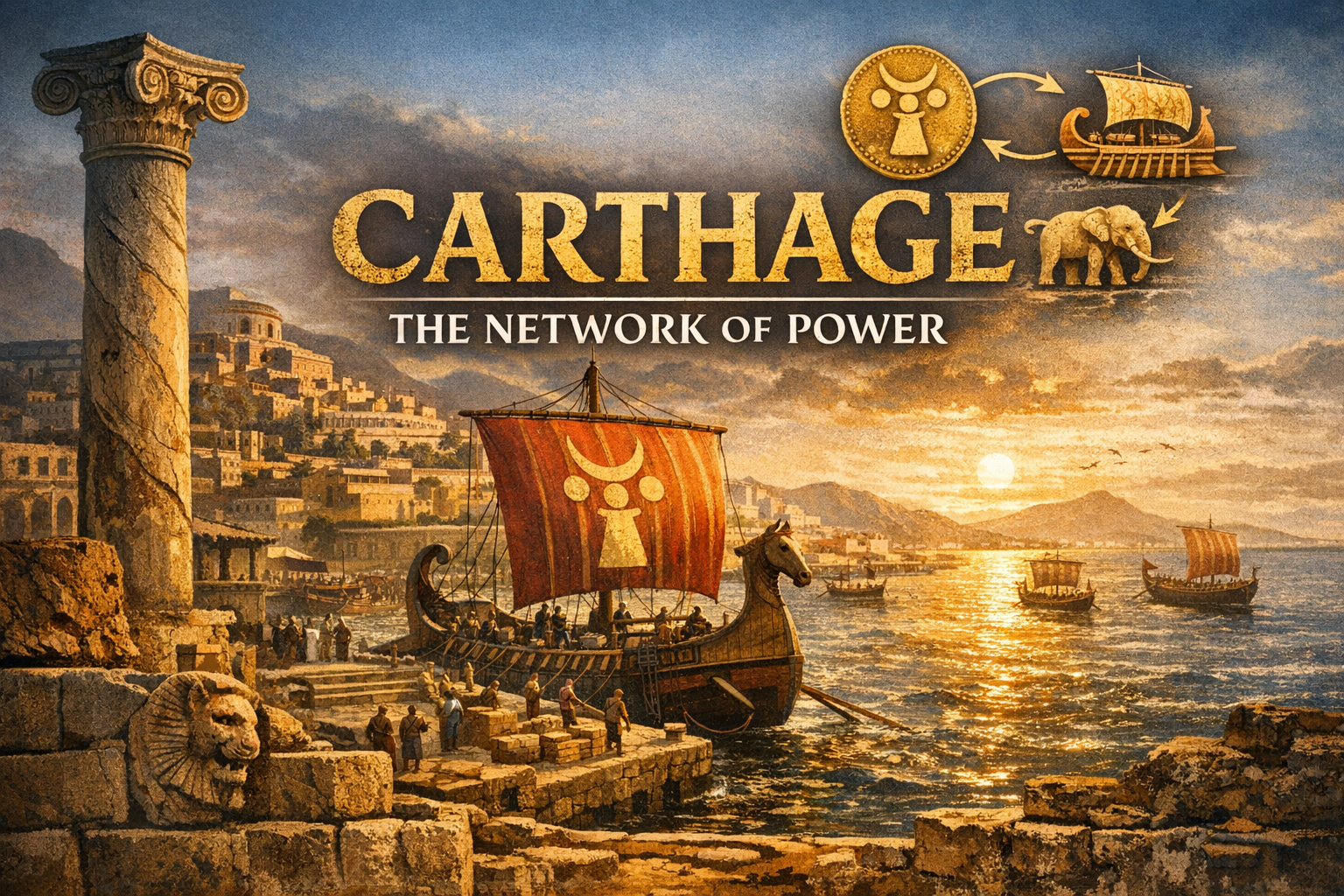
Carthage Network Power: Why Rome Brutally Destroyed the Dominant Maritime Empire
- 01 · ObservationThe core structural claim
- 02 · ContextGeography and the chokepoint
- 03 · The BarcidsHamilcar, Hannibal, and the oath
- 04 · StructureNetwork empire versus territorial empire
- 05 · Carthage as ColonizerHow Carthage built its own empire
- 06 · Seapower ModelFive states, one lineage
- 07 · Dutch ParallelWhat the VOC inherited from Carthage
- 08 · PsychologyWhy the deletion still works
- 09 · Systemic DynamicsWhy Carthage Network Power lost
- 10 · PositionThe defensible claim
- 11 · ConsequenceWhat survives after the archive burns
Carthage Network Power: Why Rome Brutally Destroyed the Dominant Maritime Empire
Carthage Network Power built the first maritime republic in the ancient western world. This is the full structural account of how it worked, who carried it, and why Rome chose total destruction over negotiation.

Carthage Network Power was not a conventional empire. It was one of the earliest, most sophisticated demonstrations in human history of what power looks like when it flows through routes rather than roads, through ports rather than provinces, through commercial coordination rather than territorial absorption. Most people receive Carthage through Rome. That is already the distortion. By the time Rome defined the terms of the story, it had already burned the archive that could have contested them. Understanding Carthage Network Power means reading against the grain of everything Rome wanted us to believe.
This article belongs with the Tunisia civilization pillar and the Kairouan deep dive. Tunisia’s history is not a sequence of disconnected episodes. It is a layered civilizational process. Carthage Network Power is its oldest imperial layer. Without understanding how Carthage Network Power organized trade, law, infrastructure, colonization, and alliance systems, the later story of Tunisia remains structurally incomplete.
This is structural historical intelligence applied to civilizational analysis. If you work in education, strategy, content architecture, or identity, the consulting framework goes deeper.
Carthage Network Power Built Something Rome Could Not Absorb
Carthage Network Power was not simply a city-state that grew powerful and then lost a war. It was a maritime-commercial republic built on chokepoint control, port infrastructure, trade flow management, legal coordination, and elite political accountability. Rome did not merely defeat a rival city. It eliminated a system that embodied a structurally different answer to the problem of how power should be organized in the ancient world.
That distinction matters because military defeat and systemic deletion are not the same thing. A city can lose a war and still remain part of the civilizational record. Carthage Network Power had to be physically burned, institutionally erased, textually redefined in the vocabulary of its conqueror, and its archive distributed or destroyed so that no future generation could read it in its own terms. That scale of destruction tells you what Rome believed it had confronted.
Carthage Network Power Began with Strategic Geography, Not Accident
Look at a map of the Mediterranean. Find the narrowest point between its eastern and western halves: the strait between modern Tunisia and Sicily, barely 140 kilometers at its widest. Every ship, every merchant, every military commander moving goods or armies between the Levant and the Atlantic had to pass through or around that strait. Carthage Network Power sat on the African side, on a triangular peninsula in the Gulf of Tunis, with a high defensive hill, a natural harbor, and fertile agricultural land at its back.
The Phoenicians who sent their settlers there in the ninth century BCE were not romantic wanderers. They were merchants with extraordinary geographic intelligence who had already built more than three hundred trading colonies across the Mediterranean coast from Lebanon to Spain. They understood chokepoints. Whoever controls the movement of goods controls the price of everything. The location they chose for Qart-Hadast, the New City, placed Carthage Network Power at the most significant commercial chokepoint in the ancient western world.
By 650 BCE, Carthage Network Power had grown beyond its Phoenician origins. It controlled ports in Sardinia, Corsica, western Sicily, and along the North African coast. Its dual harbor, a rectangular commercial port and a circular military harbor capable of housing 220 warships, was among the most sophisticated pieces of infrastructure in the ancient world. Merchants built houses six stories high above the port. The warehouses held silver from Iberian mines, grain from North African fields, purple dye from coastal mollusks, ivory from sub-Saharan Africa, tin from Britain. Hanno the Navigator sailed down the West African coast around 500 BCE, possibly reaching modern Cameroon. His brother Himilco navigated the European Atlantic coast as far as Britain. Carthage Network Power was the first civilization to systematically probe the Atlantic in both directions.
Click any card to reveal deeper context
Qart-Hadast
The New City begins as a Phoenician foundation and quickly develops into a western Mediterranean power center defined by geography before ideology.
The name means New City. Carthage Network Power’s significance was geographic first: positioned to mediate movement between multiple basins of trade and war. Aristotle would later praise its constitution as one of the finest in the world.
↩ Click to returnIndependence
Carthage Network Power breaks from Tyrian oversight and begins its own colonial expansion, building a system spanning Iberia, North Africa, Sicily, and the Atlantic.
When Tyre fell to Babylon, Carthage Network Power stopped paying tribute and began building its own empire. Unlike Tyre, it also had fertile agricultural land behind it, making it self-sufficient in a way that pure trading cities rarely were.
↩ Click to returnBarcid Intensification
The Barcid family pushes Carthage Network Power to its highest military intensity in direct confrontation with the expanding Roman Republic.
Hamilcar and Hannibal did not invent Carthage Network Power. They inherited an existing maritime-commercial machine and attempted to convert its strengths into a strategic answer to Roman territorial expansion. The attempt came terrifyingly close to succeeding.
↩ Click to returnTotal Deletion
Rome burns Carthage Network Power’s city for seventeen days, sells the survivors into slavery, and destroys or disperses its entire civilizational archive.
What Rome preserved was what it found useful: Mago’s agricultural treatise, because it made the province of Africa profitable to administer. What it burned was what might allow Carthage Network Power to remain intelligible on its own terms.
↩ Click to returnQart-Hadast
Aristotle would later praise Carthage Network Power’s constitution as one of the finest in the world. Geography before ideology was its founding logic.
Independence
Unlike pure trading cities, Carthage Network Power had fertile land behind it, making it self-sufficient in a way that allowed long-term structural independence.
Barcid Intensification
Hamilcar and Hannibal inherited an existing maritime-commercial machine and tried to weaponize it against Roman expansion. It almost worked.
Total Deletion
Rome preserved what was economically useful. What it burned was what might allow Carthage Network Power to be understood on its own terms.
The Barcids: The Family Who Carried Carthage Network Power to Its Breaking Point
History remembers systems through the people who embodied them. Carthage Network Power’s final and most consequential chapter is inseparable from one family. Barca in Punic means lightning, or thunderbolt. It was the cognomen that Hamilcar earned on the battlefield in Sicily, for the ferocity and speed of his attacks. It became his dynasty’s name. And that name became the most dangerous thing Rome had ever encountered, because it carried the full weight of Carthage Network Power’s unfinished strategic project.
Hamilcar entered history in 247 BCE, the same year his son Hannibal was born, when he took command of the Carthaginian forces in Sicily during the final desperate years of the First Punic War. Rome and Carthage had been grinding each other down for seventeen years. Carthage Network Power had lost its naval advantage. What Hamilcar received was a small mercenary force, no money to expand it, no authority to negotiate peace, and instructions that amounted to: hold what you can.
He did something remarkable. Without the resources to win, he refused to lose. For six years he conducted a guerrilla campaign from the mountain of Eryx in western Sicily, keeping his army intact, raiding the Roman coast of Italy, maintaining pressure with a force that Rome could never quite eliminate. His soldiers were Iberians, Gauls, Libyans, Greeks, Numidians. He held them together through personal force and a military skill that his enemies, including the Romans who eventually defeated Carthage Network Power, continued to acknowledge for centuries afterward.
When the peace treaty came in 241 BCE, Hamilcar did not negotiate it. He was not given the authority. The Carthaginian senate accepted humiliating terms. He sailed back undefeated in the field and spent the rest of his life believing that what Carthage Network Power had lost was not a war but a political failure. After suppressing the catastrophic mercenary revolt of 241 to 238 BCE, he convinced the government to fund a new imperial project in Iberia. The silver mines of Spain could replace revenues lost from Sicily and Sardinia. And his sons could be trained in the field, where military understanding is formed through lived experience, not theory. He died in battle in 228 BCE, drowning in a river while covering his army’s retreat from an Iberian ambush. Hannibal was nineteen. The boy who had sworn at nine years old never to be a friend of Rome inherited an army, a cause, and a grief that would animate the next three decades of Mediterranean history.
The most famous story of Hannibal’s childhood is also the most revealing. He was nine years old when his father prepared to depart for the Spanish campaign. He begged to come along. Hamilcar agreed on one condition. He brought the boy to the Temple of Melqart in Carthage, the Phoenician god of journeys and the sea, and made Hannibal place his hands on the altar and swear, before the gods, that he would never be a friend of Rome. The oath was not religious theater. It was a political education compressed into a single act.
What followed was the most comprehensive military education in the ancient world. Hannibal spent his adolescence and early twenties in the Spanish campaigns alongside Hamilcar and then his brother-in-law Hasdrubal. He learned to command multilingual armies of Iberians, Numidians, Gauls, and Libyans who had nothing in common except their commander. He learned the languages those soldiers spoke. He received a formal philosophical education in Greek alongside his military training. He read history, strategy, and philosophy in Greek. He was capable of diplomatic correspondence at the highest level and of administrative governance across occupied territory that even hostile Roman historians later acknowledged as disciplined.
When Hasdrubal was assassinated in 221 BCE, the army chose Hannibal, twenty-six years old, as commander in chief. Within three years he launched one of the most audacious strategic operations in recorded history: crossing the Alps in late autumn with 60,000 infantry, 12,000 cavalry, and 37 war elephants. He lost more than half his men to cold, altitude, and hostile mountain tribes. He also, within weeks of descending into Italy, began defeating Roman armies. Trebia in 218 BCE. Lake Trasimene in 217 BCE, where he ambushed a Roman army of 30,000 men in morning fog along a lakeshore and killed most of them before they understood what was happening. And then Cannae in 216 BCE, where he encircled and destroyed a Roman force of perhaps 80,000 men in a single afternoon using a double envelopment that military academies still teach as the foundational text of tactical encirclement.
Hannibal’s strategy was never to destroy Rome physically. It was to detach Rome’s Italian allies by demonstrating Roman vulnerability, forcing Rome into a negotiated settlement that would rebalance Mediterranean power. This is a network strategy applied to a military context: target the relationship structure, not the physical center. Rome refused to negotiate. It mobilized. It raised new armies faster than Hannibal could destroy them. And because Rome had made its Italian allies stakeholders in the Roman system through progressive grants of rights and citizenship, those allies held. Carthage Network Power’s client cities, bound only by tribute agreements, stayed neutral or calculated survival differently. That asymmetry in alliance loyalty, not Hannibal’s tactical genius, determined the outcome.
He died in Libyssa, modern Turkey, approximately 183 BCE, sixty-four years old. When he understood the Romans had surrounded the fortress where he was staying, he drank the poison he had carried for this eventuality. His reported last words: let us relieve the Romans of their anxiety, since they find it impossible to wait for an old man’s death. It was, even in its ending, the remark of a man who had never stopped contesting the terms of his existence.
Hamilcar’s sons were not born into comfort. They were born into a project. The family name meant lightning. The oath was sworn at nine years old, both hands on an altar in Carthage, before a god who witnessed journeys into the unknown.
Carthage Network Power Was a Network, Not a Territorial Empire
The easiest way to misread Carthage Network Power is to force it into Roman categories. Rome scaled through land conquest, road systems, military incorporation, and the progressive integration of conquered peoples into a territorial imperial machine. Carthage Network Power functioned on an entirely different logic. Its strength lay in maritime coordination, selective port control, strategic colonies, elite commercial management, and the taxation of flows between key nodes rather than the taxation of fixed populations on fixed land.
This architecture made Carthage Network Power extraordinarily effective and simultaneously structurally vulnerable under prolonged existential war. A network empire can move wealth and influence with great efficiency. But its cohesion under total military pressure differs fundamentally from that of a territorial state that binds populations through citizenship, military service, and layered institutional incorporation. Carthage Network Power excelled at extraction, mediation, and maritime leverage. Rome excelled at absorbing catastrophic defeat, mobilizing manpower generationally, and regenerating force across a deep territorial base.
| Dimension | Carthage Network Power | Rome · Territorial Empire |
|---|---|---|
| Power base | Ports, trade routes, chokepoints, maritime coordination, silver | Land control, roads, citizen manpower, territorial integration |
| Expansion logic | Strategic nodes and commercial leverage, not territory for its own sake | Conquest, annexation, institutional absorption, cultural assimilation |
| Military model | Professional mercenaries: Iberians, Gauls, Numidians, Libyans | Conscript citizen army with deep civic identity and survival stakes |
| Alliance logic | Extractive tribute from a loose coalition of client cities | Integrative: gradual extension of rights, status, and eventually citizenship |
| War resilience | High flexibility, lower deep manpower recovery, client loyalty shallow | High loss absorption, repeated remobilization, allied loyalty structural |
| Constitutional form | Merchant oligarchic republic: suffetes, senate, council of 104, popular assembly | Senate-led republic evolving toward imperial autocracy |
| Information post-conflict | Zero. Rome destroyed the archive. | Complete. Rome wrote all the history. |
What Aristotle Actually Said About Carthage Network Power
Aristotle, writing in the fourth century BCE, described the Carthage Network Power constitution as one of the finest in the known world. He called it a mixed constitution combining elements of monarchy, aristocracy, and democracy in a balance that produced admirable stability. Two suffetes elected annually held executive and judicial power but not military command. A council of elders held deliberative authority on policy. A tribunal of 104 judges, appointed for life, held generals accountable for their military conduct, with punishments ranging from fines to crucifixion. A popular assembly held final authority when the suffetes and senate disagreed. The system distributed power across four distinct institutions, each capable of checking the others. Aristotle noted that Carthage Network Power had never experienced a significant tyranny. This is separation of powers, with independent judicial accountability for military commanders, more than two thousand years before Montesquieu formalized the concept in Western political theory.
Carthage Network Power Was Itself a Colonial Empire Before Rome Arrived
This is the angle almost no mainstream article addresses directly: Carthage Network Power was not only a civilization that was destroyed by Rome in 146 BCE. Before that, Carthage Network Power was itself one of the most active colonial powers of the ancient world, building a network of subject cities, tribute-paying allies, and directly controlled outposts that stretched from the Atlantic coast of Morocco to the western tip of Sicily.
The Carthaginian colonial model was inherited from the Phoenicians but then transformed. Phoenician colonies were largely autonomous, expected only to send occasional tribute to their mother city. When Carthage Network Power emerged as an independent power in the sixth century BCE, it changed the structure fundamentally. Carthage Network Power appointed its own magistrates to rule the towns it controlled. It extracted systematic tribute in silver, grain, and military manpower. It imposed commercial treaties that required allied cities to trade through Carthaginian ports and under Carthaginian terms. It closed the Strait of Gibraltar to Greek shipping entirely at certain periods, asserting a monopoly on Atlantic access that would not be challenged again at that scale until the Portuguese in the fifteenth century.
The Port Network
Carthage Network Power directly controlled or extracted tribute from ports across Sardinia, Corsica, western Sicily, the Balearic Islands, the North African coast from modern Libya to Morocco, and large sections of the Iberian Peninsula including the silver-rich territories around modern Cartagena, which the Barcids literally named New Carthage.
Beyond the Pillars
Hanno the Navigator sailed down the West African coast around 500 BCE, possibly reaching modern Cameroon. His brother Himilco navigated the European Atlantic coast as far as Britain. Carthage Network Power was the first civilization to systematically explore both directions of the Atlantic, and their logs are almost entirely lost.
Extraction, Not Integration
Unlike Rome, which eventually offered citizenship and status to allied peoples, Carthage Network Power extracted tribute without offering political inclusion. Allied cities remained economically bound but politically excluded. This produced revenue but not loyalty, which proved fatal when existential pressure arrived.
Hybridization
Carthage Network Power had no ethnic restrictions on intermarriage or political advancement. The Barcid generals were themselves products of this hybridization, commanding armies of a dozen nationalities in multiple languages. Cosmopolitan before the word existed.
The Iberian silver mines were Carthage Network Power’s greatest colonial asset and its most consequential strategic vulnerability. When Hamilcar and then Hannibal built their Iberian empire, they financed it with silver revenues that allowed them to maintain professional armies independent of Carthaginian senate approval. This created the Barcid dynasty’s extraordinary operational freedom. It also made Iberia the strategic center of the entire Carthaginian system, which is why Scipio’s campaign to take Iberia was the decisive act that made Zama possible. Remove the silver, remove the army, end the war. Rome understood the logic perfectly.
Carthage Network Power and the Five Seapowers: Why Tunisia Built the First
In 2019, historian Andrew Lambert published the defining structural analysis of why Carthage Network Power matters beyond its conflict with Rome. Lambert identified five and only five civilizations that built a seapower identity: a state where maritime commerce, inclusive governance, network thinking, and a conscious orientation toward the sea became the foundation of national power rather than an auxiliary to it. Those five are Athens, Carthage, Venice, the Dutch Republic, and Britain. Together, Lambert argues, these five states did more to advance trade, knowledge, and political inclusion than all the continental empires of their respective eras combined. Tunisia produced one of the five, the first to operate at true western Mediterranean imperial scale with Carthage Network Power, the one that established the template the next four iterations would refine over two thousand years.
The Prototype
Athens established that maritime states require political inclusion to mobilize full human and fiscal capacity. The trireme required democratic tax policy. Democracy, trade, and empire became self-reinforcing. Carthage Network Power inherited and institutionalized this at larger scale and longer duration.
The Network Empire
The largest maritime trade system of the ancient western world. A constitutional republic praised by Aristotle. No ethnic restrictions on political advancement. Destroyed precisely because it worked as an alternative model. First of the five seapowers, foundational to the lineage.
The Refined Successor
Venice fixed Carthage Network Power’s fatal vulnerability: alliance loyalty. Where Carthage Network Power extracted tribute, Venice built a merchant aristocracy with shared stakes. It maintained genuinely elected leadership and built institutional memory to survive dynasty changes. Lasted 1,100 years.
The Commercial Peak
Small territory, outsized global reach. The VOC as a state-backed network empire. No ethnic restrictions. Inclusive merchant oligarchy. What Carthage Network Power built at Mediterranean scale, the Dutch built at global scale, formalized through corporate structure and insurance markets.
What the VOC Inherited from Carthage Network Power, and What Every Modern Empire Built on the Same Logic
The parallel between Carthage Network Power and the Dutch Republic is not poetic coincidence. It is structural. Both were small territories with no natural imperial advantage in land or population. Both built power through network control: ports, routes, commodities, and the financial instruments that made long-distance trade viable. Both operated merchant-oligarchic republics more politically inclusive than their continental rivals. Both were eventually overwhelmed by larger territorial powers, but not before leaving institutional DNA that their successors used for centuries.
The Original Network Model
Controlled Mediterranean trade through port monopolies, convoy systems, and treaty-based exclusions of rivals from key shipping lanes. Silver from Iberia, grain from North Africa, purple dye from coastal mollusks.
Colonial administration through appointed magistrates. Tributaries, not citizens. Enormous wealth. Shallow loyalty. No political integration of subject populations. The model generated revenue without solidarity.
The Refined Global Version
Controlled Asian trade through port monopolies, convoy systems, and treaty-based exclusions of rivals from key maritime routes. Spices from Indonesia, silk from China, silver from Japan.
Colonial administration through company-appointed governors. Tributaries and trade partners, not citizens. Institutionally more resilient than Carthage Network Power through the joint-stock company, insurance markets, and distributed share ownership.
The specific thing the Dutch learned, through Venice’s institutional correction of Carthage Network Power’s fatal flaw, was how to convert passive subject populations into active investors in the imperial project through share ownership. Carthage Network Power had wealthy merchants who funded wars through private means. The Dutch had a nation that owned its own empire as shareholders. The loyalty differential this produced was precisely what Carthage Network Power lacked when Rome’s pressure became existential.
Every great maritime commercial empire that came after Carthage Network Power can be read as an attempt to rebuild the same model with one critical correction: how do you make the people who live inside your system want to protect it when an existential rival arrives?
Modern Echoes: Singapore, Dollar Dominance, and the Continuing Lineage
The Carthaginian model did not end with the Dutch Republic. Britain at its commercial peak operated through port network control and treaty-based commercial exclusions, a direct structural echo of Carthage Network Power’s chokepoint logic. The East India Company was a joint-stock colonial administration that governed territories through tributary extraction without citizenship extension, precisely Carthage Network Power’s model applied to India and Southeast Asia. American hegemony after 1945 operated a version of this logic through dollar dominance, military basing rights, and the control of international financial institutions, which are ports of a different kind: chokepoints in the flow of capital rather than ships. Singapore today, the only twenty-first century city-state with genuine global commercial significance, derives its power from its position on one of the world’s most important maritime chokepoints rather than from territorial mass. Tunisia produced the founding instance of this lineage in 814 BCE, and the lineage is still operational in 2026.
it begins to tell itself in stone.
Why Carthage Network Power Disappeared from the Constitutional History Canon
The Roman victory over Carthage Network Power was not only military. It was psychological and linguistic. Once Rome defines Carthage as treacherous, decadent, alien, and ultimately disposable, that framing can travel centuries beyond the war itself. The phrase Punica fides, Punic faith, became embedded in Latin as a synonym for treachery and betrayal. Every institution that trained its intellectuals in Latin, which includes the foundation of Western law, theology, and medieval scholarship, trained them in a language that had made Carthaginian identity itself a synonym for moral failure. This was not accident. It was the information operation that completed the military one.
Modern audiences accept that deletion for several compounding reasons. First, Roman history sits near the center of mainstream Western education, so anything outside its narrative orbit tends to appear secondary or marginal. Second, Carthage Network Power is easier to consume as spectacle than as system. Hannibal and elephants are dramatic. Trade architecture, port networks, and comparative constitutional models require a more demanding kind of historical imagination. Third, many descendants of the regions shaped by Carthage Network Power have inherited later identity frameworks that do not always make Punic continuity feel immediately available as a living claim. And fourth: Western civilization narrates itself as Greek in philosophy, Roman in law, Christian in ethics. Carthage Network Power fits none of these genealogies. It is Semitic in language, African in geography, mercantile in ethos, and Phoenician in origin. Rehabilitating it as a constitutional innovator and seapower pioneer would require acknowledging that the origin story of Western civilization contains a deliberate deletion of one of its most significant alternatives.
Why Carthage Network Power Lost: Alliance Architecture, Not Military Failure
Carthage Network Power did not lose because it lacked intelligence or courage. It lost because the type of system it had built was less resilient under protracted existential war than the Roman system it confronted. Rome could repeatedly absorb defeat and regenerate manpower from a broad territorial-social base. Carthage Network Power had immense wealth and strategic sophistication, but its dependence on maritime leverage, hired military capacity, and looser alliance structures created limits under sustained total pressure.
The structural vulnerability was alliance architecture. Carthage Network Power extracted tribute from its allied cities rather than integrating them into the Carthaginian system. Rome’s allies received rights, status, and eventually citizenship. Carthage Network Power’s client cities paid tribute. When Roman pressure became existential, Roman allies held. Carthage Network Power’s clients calculated survival and chose neutrality or defection.
The concrete breaking point that most analyses miss: the moment Rome targeted Carthage Network Power’s network nodes through political maneuver rather than military force. When Rome seized Sardinia in 238 BCE while Carthage Network Power suppressed its mercenary revolt, it removed a critical network node at no military cost. Remove enough nodes and the network loses the revenue streams that pay the mercenaries, the trade flows that fund the harbor, and the chokepoints that give the center its power. The Barcids understood this. The Italian campaign was an attempt to apply the same logic in reverse: detach Rome’s Italian allies, and Rome becomes strategically unsustainable. It almost worked.
The Defensible Claim About Carthage Network Power
The destruction of Carthage Network Power was not simply the fall of a rival city. It was the suppression of an alternative civilizational model, rooted in routes rather than roads, exchange rather than territorial absorption, and strategic chokepoints rather than territorial depth. The fact that later powers rebuilt aspects of this model under different names, in Venice, in Amsterdam, in London, in Singapore, only strengthens the case. Carthage Network Power was not an anomaly. It was an early form of a recurring pattern in history. Tunisia produced the founding instance. The deletion was as complete as organized violence can make it. And the geography remained, shaping every subsequent civilization that tried to control it, because chokepoints cannot be burned.
What survived was only what Rome found useful to keep.
Carthage Network Power Lost the War but the Model Won the World
What survives after a civilizational deletion is rarely enough to speak in its own voice. That is the deepest damage Rome inflicted on Carthage Network Power. The city can be excavated. Harbors can be mapped. Coins, inscriptions, fragments, and hostile accounts can be studied. But a society whose archive is burned loses something more than data. It loses narrative sovereignty.
The structural consequence for North Africa is continuous and ongoing. The Amazigh, Tunisian, Algerian, and Moroccan populations whose deep civilizational roots connect to the Punic world have moved through the Roman, Byzantine, Arab, Ottoman, French colonial, and postcolonial periods without access to an indigenous civilizational archive in their own tradition. The narrative of Carthage Network Power that exists is Roman. The archaeology of Carthage Network Power is interpreted through European academic institutions with their own genealogical investments in the Roman tradition.
What Rome could not burn was the geography. The geography kept generating the same civilizational logic: a place at the chokepoint of the Mediterranean, shaped by the sea, built on movement, inhabited by people who had always understood that the real wealth was not in the land but in the flow. That is what Tunisia produced. Not just a city. Not just a dynasty of generals. A theory of power, a constitutional system, a network model, and a seapower identity that the world would not see matched until Venice rebuilt it a thousand years later on a different coastline. The lineage from Carthage Network Power to Venice to the Dutch Republic to modern Singapore is not a metaphor. It is a continuous structural pattern in how small states located at geographic leverage points have repeatedly organized themselves into civilizational forces disproportionate to their physical size.
What must be broken is the habit of reading Carthage Network Power only through Roman victory. Carthage Network Power deserves to be studied as a system in its own right: maritime, commercial, constitutional, networked, cosmopolitan, and strategically original. That is the only scale at which its destruction becomes fully intelligible, and the only scale at which Tunisia’s deeper civilizational history can be read honestly. Rome won the war. The seapower model won the world. Tunisia built it first. No archive fire can permanently erase an idea whose geography survives.
If this shifted how you think about power, history, and civilizational systems, the consulting work applies the same structural depth to strategy, identity, research, and platform building.
History of Tunisia: The Civilization They Forgot to Forget
The full civilizational framework connecting Amazigh roots, Carthage, Rome, Islamic civilization, Ottoman rule, and diaspora identity into one coherent arc.
Kairouan and Islamic Civilization: The City That Built North Africa
How Tunisia later produced a legal and institutional engine whose influence outlasted the dynasties that housed it, shifting power from the sea to the written word.
Hannibal Barca and the Limits of Genius
Why even one of history’s greatest commanders could not fully overcome the structural limits of the system he inherited, and what his campaign reveals about the difference between tactical and strategic victory.
Roman Africa: When Tunisia Fed an Empire
How Rome rebuilt on Carthaginian geography, extracted Carthaginian agricultural knowledge, and turned North Africa into the grain engine of a continental empire for six centuries.
Leave a Reply