Dougga Tifinagh Tunisia: The Hidden Amazigh Script of Tunisia
- 01 · ObservationDougga Tifinagh Tunisia: the core claim
- 02 · ContextWhy this layer matters for Tunisia
- 03 · StructureTamazight, Tifinagh and state hierarchy
- 04 · MechanismHow absorption replaced erasure
- 05 · DouggaThe stone that explains the problem
- 06 · Numidian CorpusBeyond Dougga: the wider inscription world
- 07 · PositionThe defensible conclusion
Dougga Tifinagh Tunisia: The Hidden Amazigh Script of Tunisia
How Dougga, Tifinagh, Tamazight and Numidian inscriptions reveal the buried Amazigh operating system beneath Tunisian identity, Darija and public memory.
Numidian-Punic bilingual key
from Libyco-Berber to Neo-form
not simple erasure
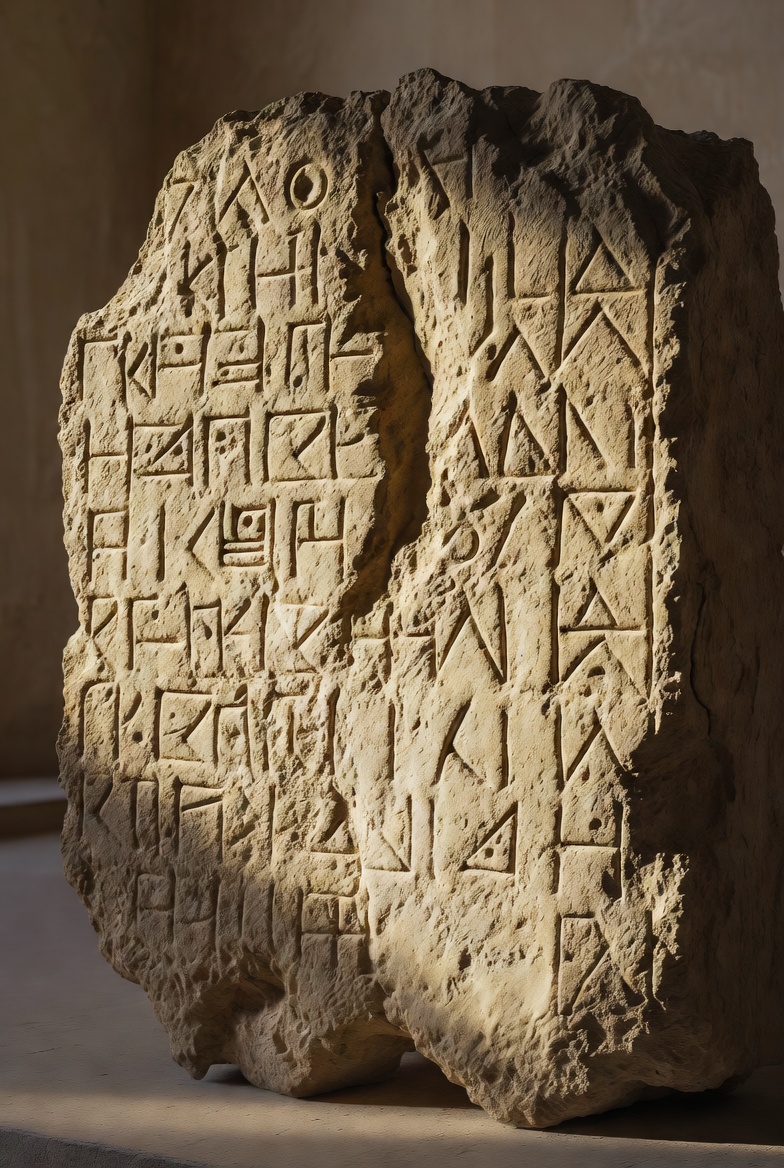
Dougga Tifinagh Tunisia is not just an archaeological subject. It is one of the clearest ways to see the hidden Amazigh layer beneath Tunisian identity, Darija, script history and state narrative.
Most people are taught Tunisia in disconnected fragments. Carthage appears first. Rome enters next. Then Islam, Ottoman rule, French colonialism and the modern republic. What gets flattened is the deeper layer that was already there before all of them and that never fully disappeared after them.
This article argues that Tunisia’s Amazigh foundation was not destroyed in a total sense. It was compressed, absorbed, renamed and pushed out of official visibility. Tamazight lost domains. Tifinagh lost public legitimacy. But the layer itself remained active in speech, place names, memory and civilizational structure.
That is why Dougga Tifinagh Tunisia matters. Dougga is not only a ruin. Tifinagh is not only a symbol. Together they expose a much larger truth about how Tunisia carries an older North African identity under later political narratives.
This is structural historical intelligence, not museum summary. If you work in education, culture or strategy, the full research archive goes deeper.
Dougga Tifinagh Tunisia and the Hidden Amazigh Layer
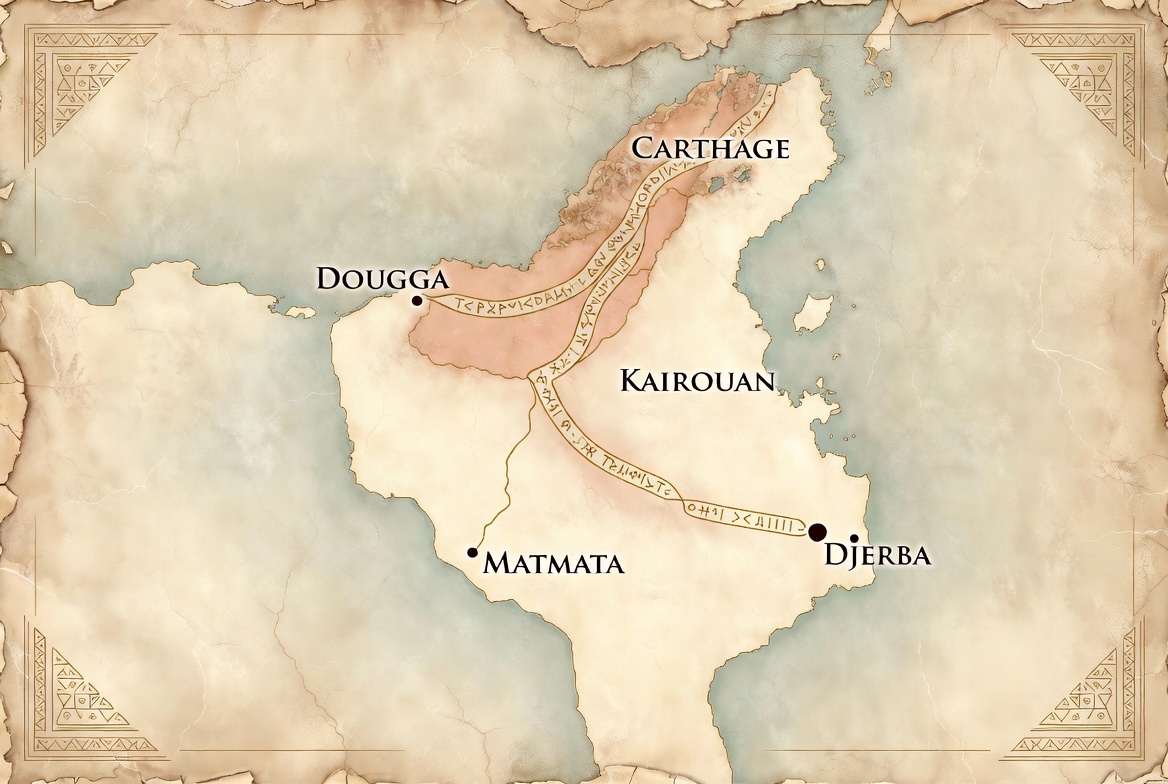
Tunisia is usually presented as overwhelmingly Arab-Muslim in official framing, yet large parts of what makes Tunisia distinct inside the Arab world point back to a deeper Amazigh substrate. That substrate appears in local memory, southern speech communities, place names, fragments of vocabulary, and in the older script history of the region.
Tamazight in Tunisia survives in fragmented southern pockets rather than as a state-recognized national layer. Tifinagh survives mostly as a symbolic script rather than a normalized public writing system. And yet traces of the older layer remain everywhere once you know how to read them.
The strongest way to say it is simple: Tunisia did not lose its Amazigh base. It lost the official grammar for naming that base in the present.
Why This Layer Matters for Tunisia
Amazigh populations predate every later imperial layer on the land that became modern Tunisia. The real historical sequence is not Arab identity first with a small indigenous footnote underneath. It is the reverse: a North African Amazigh base first, then later Punic, Roman, Islamic, Ottoman, French and national overlays.
The state narrative simplifies that complexity because states prefer clean identity stories. Clean stories are easier to teach, easier to administer, and easier to weaponize in nation-building. But Tunisia’s actual social and historical structure is layered, not pure.
That is why Dougga Tifinagh Tunisia is bigger than script history. It is a key to understanding how a society can be officially narrated one way while continuing to carry a different, older structure beneath the surface.
Tamazight, Tifinagh and the Hierarchy of Visibility
In Tunisia, Tamazight and Tifinagh do not sit inside the state as ordinary national layers. They exist closer to the edge: in villages, activist circles, symbolic banners, memory fragments and occasional acts of cultural assertion. Arabic dominates the official layer. French retains prestige in many institutional and economic domains. Tifinagh is largely excluded from both.
This creates a hierarchy:
state, law, public legitimacy
mobility, elite capital, administration
heritage yes, rights no
The result is not total disappearance. It is selective compression. Tamazight loses domains, but Amazigh residue remains inside Tunisian Darija and local culture. Tifinagh loses public normalization, but stays alive as symbol, memory and visual claim.
Tamazight in Tunisia is not best understood as simply dying. It is better understood as losing domains while leaving behind lexical, cultural and structural traces inside the dominant language itself. The buried layer continues to operate even when the state refuses to name it clearly.
How Absorption Replaced Erasure
The easy story says a people were conquered, their language faded, and a new identity replaced the old one. That is too crude to explain Tunisia. What happened is more intelligent and more unsettling.
First, Arabization and later state centralization rewarded Arabic in religion, school, law and administration. Then families shifted toward the language of mobility. Public domains narrowed for Tamazight. Once that happened, the older language no longer needed to remain visibly dominant in order to keep shaping daily life. It moved under the surface.
That is why the best description is not extinction, but absorption. Amazigh words, sounds, local naming patterns, social memory and script history continue to exist, even where active public recognition is weak.
Tifinagh followed a similar pattern. In Tunisia it survives mostly as a symbol rather than as a fully normalized civic script. In Morocco, by contrast, Neo-Tifinagh was absorbed into state infrastructure. Both cases preserve Arabic prestige, but through different methods: controlled inclusion in one case, managed absence in the other.
That is the deeper mechanism beneath Dougga Tifinagh Tunisia: not a simple war between one identity and another, but a long contest over which layer may appear as modern, official and public.
Why Dougga Tifinagh Tunisia Matters Beyond Archaeology
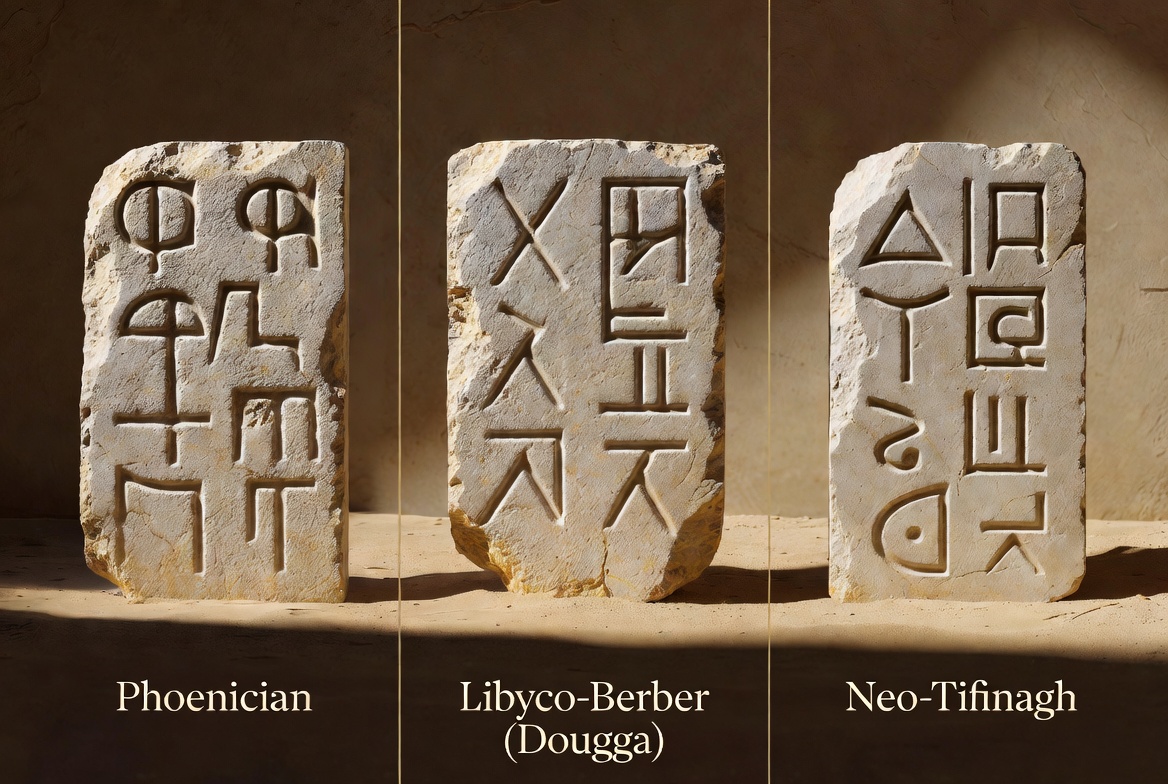
The famous bilingual inscription from the Ateban mausoleum at Dougga is one of the clearest physical demonstrations of layered identity in ancient North Africa. Punic and Libyco-Berber appear side by side. That matters because it shows a Numidian elite working through hybrid legitimacy rather than pure cultural surrender.
Dougga proves that a local North African layer did not vanish simply because a prestige language was present. It adapted, coexisted and remained visible. The bilingual inscription became crucial for decipherment, but its meaning is larger than epigraphy.
It shows that the territory of modern Tunisia once displayed multiple identity layers openly in public monument form. That makes the modern narrowing of public script visibility even more striking.
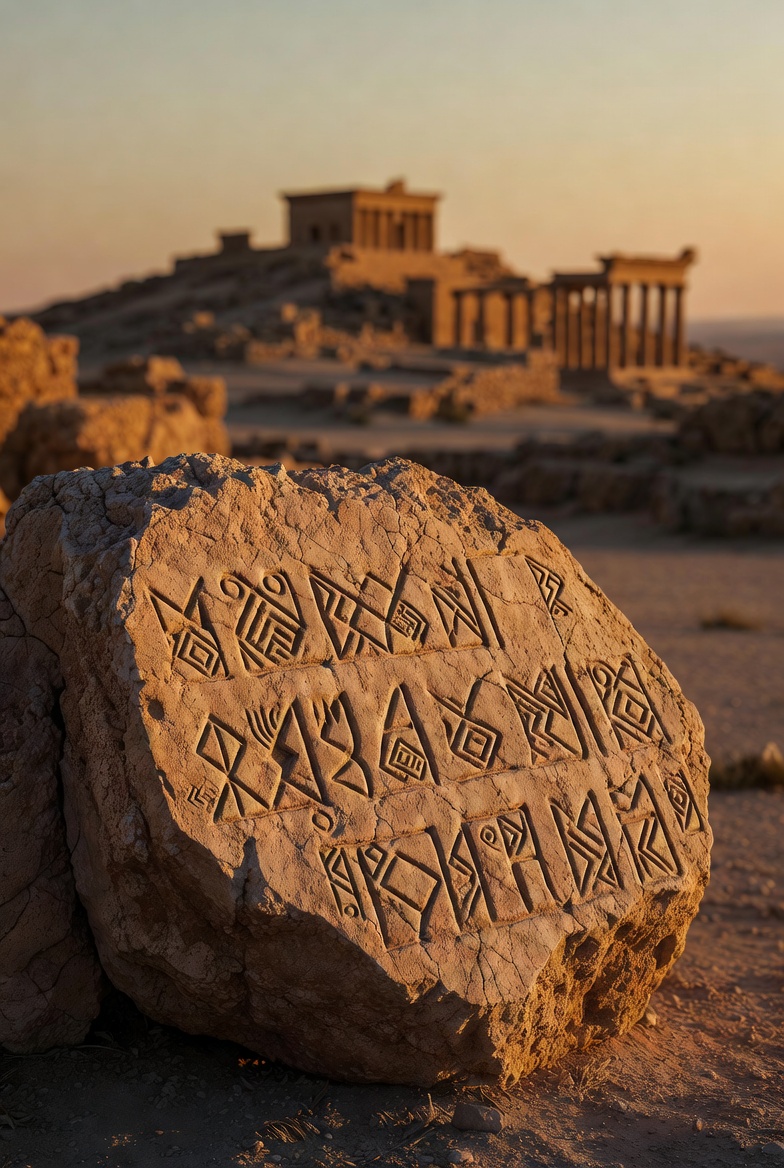
There is also a harder angle here. Dougga is safe because it is ancient. It can be curated, visited, aestheticized and absorbed into heritage discourse. But once the older layer tries to return as a living public sign, it becomes sensitive. That is why the pharmacy-sign story in Matmata matters so much. The same script family that is acceptable in archaeology becomes risky in daily life.
Beyond Dougga: The Wider Numidian Inscription World
Dougga was not an isolated exception. It was the clearest and most famous node in a broader Numidian inscription world. Across the wider region, especially in eastern Algeria and northern Tunisia, Libyco-Berber inscriptions appear on funerary stelae, monuments and selected bilingual texts. Most are short. Many follow repetitive lineage formulas. But that itself is revealing.
It shows that Libyco-Berber was not just decorative or ceremonial. It had routine commemorative use in naming, kinship and memory. In other words, it belonged to a functioning epigraphic system, not a single spectacular artifact.
Once you include the wider corpus, Dougga stops looking like a miracle and starts looking like the best-preserved summit of a larger Numidian script ecology. That changes the whole argument. The hidden Amazigh layer of Tunisia is not built on one stone alone. Dougga is simply the stone that makes the broader system hardest to ignore.
The wider Numidian corpus matters because it blocks the lazy response that Dougga was only an isolated elite anomaly. It was not. It was the clearest surviving window into a much broader world of script, lineage, legitimacy and North African continuity.
That is also why Dougga Tifinagh Tunisia should be understood as a cluster idea, not a single site idea. Dougga is the entry point. The wider inscription world is the proof of system.
The Defensible Conclusion
My position is that Dougga, Tifinagh and the wider Numidian inscription world reveal something far more consequential than script history. They reveal that Tunisia has always been civilizationally layered, and that the older Amazigh layer was never fully erased. It was absorbed, pushed downward, and made less visible by later prestige systems. What survives today in Darija, in southern memory, in place names and in script-symbol politics is not a minor residual curiosity. It is evidence of a buried foundation that still shapes the country.
The strongest conclusion is not that Tunisia must choose between Arab and Amazigh. It is that Tunisia makes far more sense once you stop pretending those layers were ever neatly separable. The official narrative flattened the archive. The archive itself did not disappear.
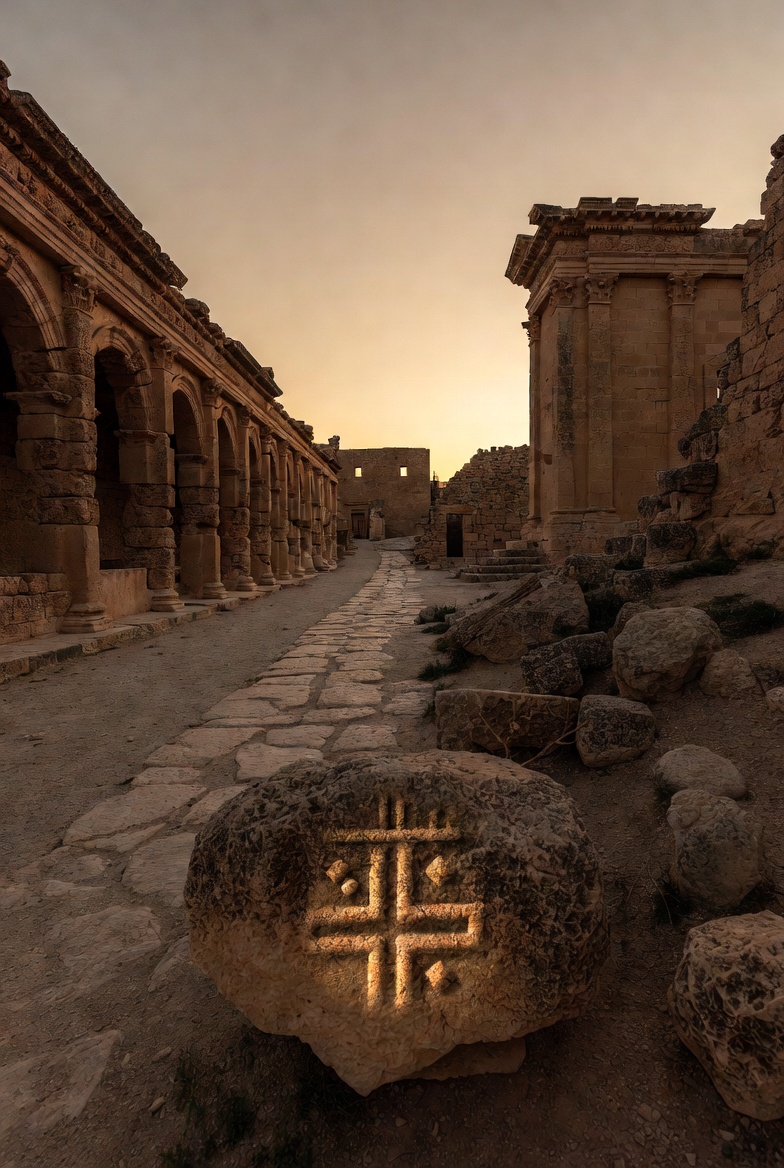
Dougga Tifinagh Tunisia matters because it forces a harder reading of Tunisia itself. The country did not become what it is by replacing one layer cleanly with another. It became what it is through selective absorption, hierarchy, memory and compression. Dougga preserves the stone proof. Tifinagh preserves the visual memory. Darija preserves the hidden operating system. That is the real story.
Structural historical intelligence applied to identity, culture and strategy. If this article changed your framework, the deeper consulting and archive work goes further.
History of Tunisia: The Civilization They Forgot to Forget
The full civilizational argument: Amazigh roots, Carthage, Rome, Islam, Ottoman layers and modern identity compression.
Carthage Network Power
How Carthage became one of the great power systems of the ancient Mediterranean and why that layer still shapes Tunisia’s civilizational memory.
Kairouan and Islamic Civilization
How a frontier military camp became a long-term legal and institutional engine for North Africa.
The Amazigh Roots of Tunisian Darija
Why everyday Tunisian speech still carries the traces of a deeper North African linguistic foundation.
External references: UNESCO World Heritage: Dougga / Thugga · Britannica on Amazigh languages · IWGIA on Amazigh in Tunisia
Leave a Reply