Author: Darja Rihla

  • Why Systems Thinking Matters in a Complex World

    Why Systems Thinking Matters in a Complex World

    Read the article as structure, not as isolated events

    This in-content layer is designed to enhance your existing WordPress article template, not replace it. It gives the page a sharper technical atmosphere, stronger hierarchy, and a more premium analytical rhythm while leaving your theme title, featured image, and article header intact.

    Core Lens events → structure → patterns
    Cyber Use map cascading dependencies
    Strategic Mode see second-order effects earlier
    Reader Benefit premium analysis without clutter
    Core Lens
    Systems thinking explains how hidden structures shape visible events.
    Cyber Angle
    Cyber incidents become dangerous when they move through dependencies and governance gaps.
    Reader Promise
    Clear, structured, premium analysis of complexity without empty jargon.

    Table of Contents

    Systems thinking is no longer a niche intellectual framework. In a world shaped by interconnected technologies, fragile infrastructure, geopolitical shocks, and cascading cyber risks, it has become one of the most essential ways to understand reality.

    The modern world is not built from isolated events. Economies, digital networks, societies, institutions, and individual decisions continuously influence one another through hidden structures, delayed effects, and feedback loops. What appears simple on the surface is often the visible expression of a much deeper system.

    Yet many people are still trained to think in fragments: isolated problems, simple causes, and quick solutions. This mismatch between reality and the way we think is one of the defining challenges of the twenty-first century.

    Systems thinking offers a different approach. Instead of looking at parts in isolation, it focuses on the relationships between those parts. It asks not only what is happening, but how things influence each other over time, what patterns repeat, where hidden dependencies exist, and why certain outcomes keep returning even when we think we have solved the problem.

    That is exactly why systems thinking matters: it gives us a way to understand complexity without pretending the world is simple.

    Complexity is rarely chaos. More often, complexity is structure moving faster than surface-level thinking can follow. Systems thinking helps make that structure visible.

    Systems Thinking vs Linear Thinking

    Traditional problem-solving often follows a linear model:

    Problem → Cause → Solution

    This approach works well in simple environments. If a machine stops working, you identify the faulty part and replace it. The cause is clear, the intervention is direct, and the effect is immediate.

    But many real-world problems do not behave like machines.

    Linear Model

    Simple cause, direct fix

    • single cause
    • short-term intervention
    • visible event chain
    • limited dependency awareness
    Systems Thinking

    Patterns, loops, dependencies

    • multiple interacting causes
    • feedback loops
    • delays and hidden dependencies
    • emergent outcomes

    Consider climate change, economic crises, cybersecurity threats, energy grid congestion, migration pressure, geopolitical conflict, and supply chain disruption. These issues involve multiple actors, competing incentives, feedback loops, delayed effects, and unpredictable interactions.

    A single cause rarely explains the outcome. What looks like one problem is often the result of a structure that has been developing over time.

    Linear thinking struggles in these environments because it assumes simplicity where complexity exists. It focuses on visible events rather than the structures that produce those events. That is why many solutions only treat symptoms, while the deeper dynamics remain untouched.

    Systems thinking begins with a different assumption: problems are rarely isolated. They are embedded within larger structures.

    To understand recurring problems, we must stop asking only what happened and start asking what system made this outcome likely.

    How Systems Thinking Explains Complex Systems

    A system is a collection of elements that interact with one another to produce a pattern of behavior over time. The parts matter, but the relationships between the parts matter even more.

    Examples of systems include ecosystems, financial markets, transportation networks, organizations, digital platforms, national economies, healthcare systems, and energy infrastructure.

    Even a city is a system. Infrastructure, governance, culture, technology, law, and human behavior interact continuously. Change one part of that web, and the effects can travel far beyond the original intervention.

    The key insight of systems thinking is that the behavior of the whole cannot be understood by examining its parts separately. A system is not just a sum of components. It is a pattern of relationships.

    Actors
    Relationships
    Patterns
    Outcomes

    Systems thinking helps us see that relationships generate patterns, and patterns generate outcomes.

    Systems thinking shows that small changes in one area can produce large and unexpected consequences elsewhere. In complex systems, outcomes are shaped not only by what exists, but by how everything connects.

    That idea matters across nearly every major domain of modern life. It matters in economics, where confidence and policy interact. It matters in technology, where software, users, incentives, and law collide. It matters in history, where institutions outlive leaders. And it matters in culture, where identities are not static facts but evolving social systems.

    If you want to build better institutions, understand social change, or navigate technological disruption, you need to see systems rather than fragments.

    Systems Thinking, Feedback Loops and Emergence

    One of the core concepts in systems thinking is the feedback loop.

    Feedback loops occur when the output of a system influences its own future behavior. In other words, the consequences of an action do not disappear. They feed back into the system and shape what happens next.

    Reinforcing Loop

    Systems thinking and amplification

    Reinforcing loops amplify change. Innovation attracts investment, which accelerates innovation, which attracts even more investment.

    Balancing Loop

    Systems thinking and stability

    Balancing loops stabilize systems. Supply and demand adjustments help absorb excess movement and restore equilibrium.

    These loops create patterns that are often difficult to predict when we focus only on individual events. They are one reason complex systems behave differently from simple mechanical systems.

    This is where systems thinking becomes powerful: it teaches us to look for loops, recurring patterns, and system-wide effects rather than one-off explanations.

    Another key concept is emergence. Emergent behavior arises when interactions between components create outcomes that were not explicitly designed or centrally planned.

    Traffic jams appear without a central controller. Financial bubbles emerge from collective behavior. Social media outrage spreads through network effects. Institutional cultures form without a single author. Market panic can grow from many rational local decisions.

    No single actor controls these outcomes, yet they shape entire societies. This is one of the most important lessons of systems thinking: the world is often governed by interaction effects rather than direct command.

    Why Systems Thinking Matters for Cybersecurity and Infrastructure

    This is where systems thinking becomes operational. Systems thinking is not just abstract theory. It becomes real in cyber risk, infrastructure fragility, identity exposure, and cascading failure across modern institutions.

    One reason systems thinking matters so much today is that modern risk rarely emerges from a single isolated failure. In critical infrastructure, cybersecurity, finance, and public governance, failures are often cascading rather than local.

    In cybersecurity, an incident is rarely just a technical problem. A phishing email might seem small at first, but its real consequences depend on identity management, employee awareness, access rights, network segmentation, vendor exposure, backup resilience, incident response maturity, and leadership decisions under pressure.

    That means a cyberattack is not only about malicious code. It is about the interaction between technology, process, governance, and human behavior. The system determines the severity of the breach.

    Phishing
    Identity Exposure
    Privilege Expansion
    Operational Impact

    Systems thinking shows that cyber incidents move through dependencies. They are not isolated technical moments.

    In cybersecurity, systems thinking is essential because incidents spread through dependencies, permissions, human behavior, governance weaknesses, and technical architecture at the same time.

    The same applies to infrastructure. Energy systems are no longer simple industrial machines operating in isolation. They are embedded in regulatory systems, investment cycles, climate policy, geopolitical dependence, data systems, labor capacity, public trust, and digital control environments.

    Take energy grid congestion as an example. It is not caused by one bad decision. It emerges from interacting pressures: electrification, renewable integration, permit delays, physical grid limitations, industrial demand, spatial planning, regulatory frameworks, and long infrastructure lead times. Looking for one single cause misses the real system.

    That is why systems thinking is becoming a strategic necessity for risk management. It helps organizations move beyond checkbox compliance and start understanding how vulnerabilities propagate through interconnected structures.

    For cybersecurity professionals, policymakers, and infrastructure operators, this shift matters. It means asking not only, “Where is the fault?” but also, “What dependencies made this failure dangerous?”

    For more on security, governance, and infrastructure strategy, see our broader work on Cybersecurity & Technology.

    Systems Thinking and Global Interconnection

    Supply chains, financial markets, communication platforms, and digital infrastructure now operate on a global scale. Events in one region can influence outcomes thousands of kilometers away.

    A disruption in semiconductor production can affect the automotive industry worldwide. A conflict near a shipping corridor can reshape prices and delivery schedules far beyond the immediate region. A software vulnerability in one vendor can cascade across thousands of dependent organizations.

    Understanding these relationships requires more than event-based analysis. It requires a systemic perspective capable of seeing dependencies, delays, and second-order effects.

    Systems Thinking and Technological Acceleration

    Artificial intelligence, automation, cloud infrastructure, and digital platforms are transforming industries at extraordinary speed. But technological systems do not operate in isolation. They interact with legal systems, labor markets, public institutions, financial incentives, and cultural norms.

    Decisions made in one domain often produce consequences in another. A new AI deployment may affect productivity, privacy, regulatory risk, and social trust all at once. Without systems thinking, it becomes difficult to anticipate these interactions before they become problems.

    Systems Thinking and Policy Consequences

    Governments increasingly face challenges that cannot be solved with simple interventions. Energy transitions, migration, housing shortages, climate adaptation, public health, and digital sovereignty all involve interacting systems.

    Policies designed without systemic awareness often create unintended consequences. A rule that solves one local issue may produce friction elsewhere. A short-term political fix may worsen a long-term structural problem. Systems thinking does not eliminate trade-offs, but it helps make them visible before they become crises.

    The Strategic Advantage of Systems Thinking

    For individuals, organizations, and institutions, systems thinking provides a major strategic advantage. It encourages long-term thinking, pattern recognition, anticipation of indirect effects, awareness of hidden dependencies, smarter prioritization, and more resilient intervention design.

    Instead of reacting only to visible events, systems thinkers analyze the structures that produce those events. This shift, from events to structures, is transformative.

    When you understand the structure of a system, you gain insight into where meaningful change can occur. These leverage points are often small interventions that produce disproportionately large outcomes because they affect the logic of the system itself.

    The value of systems thinking lies in helping decision-makers move from reactive judgment to structural understanding.

    The deepest advantage of systems thinking is not that it predicts everything. It is that it helps us stop being surprised by patterns we should have recognized earlier.

    Systems Thinking in Practice

    Applying systems thinking does not require advanced mathematics or complex software. It begins with a change in perspective and a better set of questions.

    At its core, systems thinking is a practical discipline: it changes the questions we ask before we try to force solutions onto complex environments.

    Can You Spot the System?

    1. What are the visible events?
    2. What hidden structure keeps producing them?
    3. Who are the actors in this system?
    4. Where do delays make the problem harder to see?
    5. What incentives reinforce the current outcome?
    6. Which small intervention could change the pattern?

    This is how systems thinking starts in practice: not with abstraction for its own sake, but with learning to see the architecture beneath recurring outcomes.

    Even a simple system map can reveal insights that linear analysis misses. Over time, this approach develops a deeper understanding of how complex environments behave.

    If you are leading a team, studying policy, analyzing infrastructure, researching history, or thinking seriously about cybersecurity, this perspective becomes increasingly valuable. The world rewards people who can see relationships others miss.

    Why Systems Thinking Matters in a Complex World

    The challenges of the twenty-first century are not simply larger versions of older problems. They are structurally different.

    They involve networks rather than simple hierarchies. They evolve faster than traditional institutions. They produce effects that spread across borders, sectors, and disciplines. They are shaped by interactions rather than isolated causes.

    To navigate such a world, we need tools that match its complexity. Systems thinking is one of those tools.

    It allows us to move beyond fragmented perspectives and see the patterns that shape our collective future. It helps us understand why short-term fixes often fail, why hidden dependencies matter, and why resilience must be designed at the level of structure rather than image.

    Understanding systems does not make the world simple. But it makes complexity more intelligible, and that is the first step toward acting wisely within it.

    For a foundational introduction to systems thinking, Donella Meadows’ work remains essential, especially Thinking in Systems. For applied cybersecurity guidance in complex environments, resources from NIST and ENISA are also highly valuable.

    Conclusion

    The goal of systems thinking is not to simplify reality. It is to understand how complexity actually works.

    In a world where technology, economies, infrastructure, and societies are increasingly interconnected, the ability to think in systems may become one of the most valuable skills of this century.

    That is not because systems thinking gives us total control. It does not. But it gives us something more realistic and more powerful: a better map of the forces we are moving through.

    And in a complex world, a better map is often the difference between reacting blindly and acting with intelligence.

    If you are building Darja Rihla from the beginning, this article is one of the foundations. It is not only about analysis. It is about learning to see the world as it really behaves.

    You can also explore related work on Culture & Identity and the wider logic of structure, history, and modern systems across the platform.

    Extend the Darja Rihla systems layer

    Darja Rihla · Systems Thinking · Cybersecurity · Infrastructure · Hidden Structure

  • What Is a Complex System?

    What Is a Complex System?

    Darja Rihla Systems Thinking

    What Is a Complex System?

    The systems that shape the modern world do not move in straight lines. They evolve through interaction, feedback, emergence, and hidden dependencies that make simple explanations increasingly unreliable.

    Article Type Foundational systems essay
    Core Concepts Non-linearity, feedback, emergence
    Applies To Markets, cities, platforms, cybersecurity
    Reading Time 10 min read
    Core property Interdependence Many connected parts influence one another continuously.
    Behavior Non-linearity Small inputs can create large effects and large efforts can fail.
    Mechanism Feedback loops Outputs return to shape what the system does next.
    Outcome Emergence Patterns appear that no single part fully controls.

    Opening observation

    The world we live in is not simple. Markets move unpredictably. Ecosystems evolve over time. Digital systems interact in unexpected ways. Societies change through millions of local decisions that no central planner fully controls.

    Many of the forces that shape modern life operate as complex systems. They are not governed by one actor, one rule, or one clean chain of cause and effect. They are shaped by many interacting parts whose behavior changes the system itself.

    To understand the modern world more clearly, you must understand what a complex system is.

    01 · Foundation

    From Simple Systems to Complex Systems

    To understand what a complex system is, it helps to begin with the opposite. A simple system behaves in relatively predictable ways. If you know the components and the rules that govern them, you can usually anticipate the result.

    A mechanical clock, a basic electrical circuit, or a calculator may contain multiple parts, but they still follow stable relationships. When something breaks, the problem can often be traced to one specific component.

    Complex systems are different. They contain many interacting elements whose behavior changes one another. That interaction makes the whole increasingly difficult to predict from the parts alone.

    Simple system
    • Clear rules
    • Direct causality
    • Predictable outcomes
    • Failures are usually localized
    • One part often explains the malfunction
    Complex system
    • Many interacting parts
    • Distributed causality
    • Unstable or delayed outcomes
    • Failures propagate across connections
    • Patterns emerge from interaction

    The global economy, ecosystems, cities, the internet, financial markets, and social networks all belong in this second category. In each case, no single component determines the outcome. What matters is the web of relationships.

    A system becomes complex when interaction matters more than isolated parts.
    02 · Core traits

    The Key Characteristics of Complex Systems

    Complex systems differ from simple ones through a few recurring traits. These traits do not belong only to science or mathematics. They are visible in markets, institutions, digital platforms, infrastructure, and everyday social life.

    Interconnected elements

    Everything influences something else

    A complex system contains many components linked together through relationships. In the global economy that means governments, firms, consumers, finance, logistics, and regulation. A decision in one zone ripples into others.

    Adaptation

    The system changes while you observe it

    Actors inside the system respond to incentives, pressure, and one another. This means the system is not static. It evolves while people try to understand or control it.

    These connections mean that even local actions can have distant effects. The more connected the system becomes, the harder it is to isolate consequences inside one box.

    Complexity grows when dependency chains become dense enough that local change stops staying local.
    03 · Behavior

    Non-Linear Behavior

    In simple systems, small causes tend to produce small effects. In complex systems, that assumption breaks down. A small change can produce a large outcome, while large interventions can produce surprisingly little.

    This is what non-linearity means. The relationship between input and outcome is unstable, disproportional, or delayed. That is one reason prediction becomes difficult.

    Cybersecurity

    One vulnerability, massive exposure

    A single software weakness can expose millions of dependent systems when the architecture is interconnected.

    Platforms

    One post, global reaction

    A single viral signal can spill into international discourse when network effects and amplification are already present.

    Finance

    Small shock, broad instability

    A limited disruption can travel through leverage, expectation, and market correlation until it becomes systemic.

    Key implication In a complex system, scale does not map cleanly from effort to outcome.
    Non-linearity is what makes systems feel surprising even when their structure is visible.
    04 · Mechanism

    Feedback Loops

    Another defining feature of complex systems is the presence of feedback loops. A feedback loop appears when the output of a system influences its future behavior.

    There are two broad types. Reinforcing loops amplify movement. Balancing loops constrain it. Together, they shape whether a system accelerates, stabilizes, or oscillates.

    Technological innovation offers an example of reinforcement. New capabilities attract investment. Investment accelerates further development. Development then increases perceived opportunity, drawing in still more capital.

    Markets also contain balancing loops. If prices rise too far, demand can fall, which may eventually slow or reverse the trend. But even balancing loops do not produce perfect stability. They operate inside larger structures that are themselves moving.

    signal response output feedback new behavior
    Feedback loops are what make systems historical. What happened before changes what happens next.
    05 · Emergence

    When the Whole Becomes Something Else

    Perhaps the most fascinating feature of complex systems is emergence. Emergent behavior appears when the interactions between many components generate outcomes that cannot be understood by looking at the parts in isolation.

    Traffic jams can arise without a single central coordinator. Ant colonies construct intricate systems without a leader issuing detailed plans. Social media trends spread across populations without anyone controlling the pattern as a whole.

    These are not random accidents. They are the result of repeated local interactions that produce higher-order behavior. The system becomes something more than a sum of components.

    That is why systems thinking focuses on relationships, not just objects. The pattern often lives between the parts.

    Emergence begins when interaction produces patterns no single actor explicitly designed.
    06 · Limits

    Why Complex Systems Are Difficult to Control

    Because complex systems contain many interacting elements, they often resist centralized control. Policies, strategies, or interventions that seem logical in isolation can create surprising consequences once they enter a living system.

    Economic regulation can create new market incentives. Urban planning can reshape migration patterns. Cybersecurity defenses can push attackers toward different techniques rather than ending the conflict entirely.

    This does not mean complex systems cannot be influenced. It means influence must begin with structure. If you do not understand the internal dynamics of the system, interventions often move the problem rather than solve it.

    Control weakens when the system keeps adapting faster than the intervention model assumes.
    07 · Modern world

    Complex Systems in the Twenty-First Century

    In the modern world, complex systems matter more than ever because digital technology has connected infrastructure, markets, information, and social behavior at global scale. Networks that were once separate now overlap continuously.

    A cyberattack on critical infrastructure can affect energy systems, transportation, finance, and public trust in one sequence. A technological breakthrough can restructure industries and labor markets far beyond its original field. A social platform can spread information, and misinformation, across continents in minutes.

    These are not separate stories. They are examples of interconnected systems interacting with one another. The twenty-first century is not just faster. It is more tightly coupled.

    The more connected modern systems become, the more valuable systems thinking becomes.
    08 · Practice

    Learning to Think in Systems

    Understanding complex systems requires a shift in perspective. Instead of asking only what caused one visible event, systems thinking asks what structure made that event possible.

    That means asking better questions:

    What structures produced this behavior?
    How do different parts interact?
    Which feedback loops are shaping outcomes?
    Where are the hidden dependencies?

    This approach does not eliminate uncertainty. It does something more useful. It makes uncertainty intelligible by locating it inside a structure.

    Systems thinking replaces isolated explanation with structural pattern recognition.
    09 · FAQ

    Frequently Asked Questions

    What makes a system complex?

    A system becomes complex when it contains many interacting components whose relationships produce outcomes that cannot be easily predicted from the parts alone.

    What is non-linearity in a complex system?

    Non-linearity means the relationship between cause and effect is disproportional. Small changes can create large outcomes, and large interventions can have weak or delayed effects.

    What is emergence?

    Emergence is the appearance of larger patterns that arise from interaction. The pattern exists at the level of the whole and cannot be fully explained by one component in isolation.

    10 · Final position

    Complexity as a Reality of Modern Life

    Complex systems are not an abstract concept reserved for scientists. They shape everyday life. From supply chains to social media, from financial markets to cybersecurity networks, the systems that govern the modern world are increasingly interconnected, adaptive, and difficult to reduce to one cause. Understanding complexity does not eliminate uncertainty, but it provides a framework for navigating it. In a world defined by interconnection and rapid change, learning to recognize complex systems may be one of the most valuable intellectual skills of our time.

    Explore the full Systems Thinking pillar

    Continue through Darja Rihla’s growing archive on feedback loops, emergence, institutions, systemic risk, and structural analysis.

    Darja Rihla · Systems Thinking · Premium Editorial Layout
  • The Hidden Logic of Complex Systems | How Systems Really Work

    The Hidden Logic of Complex Systems | How Systems Really Work

    Darja Rihla Systems Thinking

    The Hidden Logic of Complex Systems

    Why outcomes in complex systems rarely follow the intentions of the people inside them, and why the modern world increasingly punishes linear thinking.

    Article Type Systems essay
    Core Lens Feedback, emergence, incentives
    Applies To Institutions, markets, platforms, policy
    Reading Time 12 min read
    Core principle Intentions fail When structures, incentives, and interactions overpower individual plans.
    Driver Feedback loops Outputs do not end the process. They alter the next round.
    System effect Emergence Patterns appear that no participant explicitly designed.
    Strategic lesson Read structure Outcomes make more sense when you follow relationships, not events.

    Opening observation

    Modern life runs on systems we rarely see clearly. Governments operate through bureaucratic systems. Economies move through financial systems. Platforms scale through algorithmic systems. Even daily routines are shaped by networks of incentives and habits that become invisible through repetition.

    Yet these systems keep producing outcomes that surprise the people inside them. Policies generate unintended consequences. Technologies reorganize social behavior. Institutions built to solve problems begin reproducing them in new forms.

    The hidden logic of complex systems begins where intention stops being enough.

    01 · Context

    The World We Built Runs on Systems

    At first glance, many outcomes in society look like the result of individual decisions. A company launches a product. A government introduces regulation. A platform deploys an algorithm. These moves are easy to narrate because they can be attached to visible actors.

    But once we step back, patterns emerge that no single decision can explain. Financial crises rarely happen because one person failed. They emerge through networks of expectations, leverage, incentives, and mutual dependence across thousands of actors. Each participant may behave rationally inside a local context while the broader system drifts toward fragility.

    The same holds for digital platforms. Social media systems did not begin with the explicit goal of destabilizing discourse. Yet the interaction between ranking algorithms, user behavior, monetized attention, and emotional contagion produced precisely the kinds of environments that reward amplification over reflection.

    Systems become decisive when the pattern matters more than any single participant.
    02 · Structure

    When Intentions Collide with System Behavior

    One of the most persistent misunderstandings about complex systems is the assumption that outcomes follow intentions. In simple systems that often seems true. Replace a broken part in an engine and the machine may work again. Cause and effect remain close together.

    In complex systems, causality is distributed. Reforms introduced to improve efficiency can interact with institutional culture, hidden incentives, informal power networks, and reporting metrics in ways that produce the opposite of what leaders wanted. A policy can be sincere and still fail because the system it enters is already configured to reinterpret, resist, or distort it.

    Once structures, feedback, and incentives begin interacting, the system develops a logic of its own. Participants still matter, but they no longer control the full field of consequences.

    Linear thinking
    • Looks for one clear cause
    • Assumes direct chains of effect
    • Focuses on visible actors
    • Overestimates intention
    • Misreads delayed consequences
    Systems thinking
    • Tracks distributed causality
    • Follows networks of interaction
    • Reads structures and incentives
    • Expects unintended outcomes
    • Looks for propagation patterns
    In complex systems, what people want and what the system produces are often different questions.
    03 · Mechanism

    The Role of Feedback Loops

    A key part of hidden system logic is the presence of feedback loops. Outputs do not simply conclude a process. They return to influence future behavior. Some loops stabilize a system. Others accelerate it toward instability.

    A thermostat offers the simplest case. Temperature falls, heating activates, equilibrium is restored. But social, financial, and digital systems are rarely so clean. There, feedback often reinforces behavior instead of dampening it.

    Financial markets provide a classic example. Rising prices attract new investors. New capital pushes prices even higher. The increase itself becomes evidence in favor of the trend. What began as movement becomes belief, and belief feeds further movement. The system amplifies itself.

    Online platforms work similarly. Content that triggers high engagement receives wider distribution. Wider distribution creates further engagement. The loop rewards intensity, speed, outrage, and emotional charge because those behaviors fit the internal metric logic of the platform.

    signal reaction amplification reinforcement new baseline
    System warning Small inputs can create disproportionate outcomes when a reinforcing loop is already in motion.
    A system reveals its priorities through the behaviors its feedback loops repeatedly reward.
    04 · Emergence

    When the Whole Becomes Something Else

    Another defining characteristic of complex systems is emergence. Emergence appears when the interactions between many components generate patterns that cannot be explained by inspecting the parts in isolation.

    Cities are a familiar example. No single planner determines the exact cultural, economic, or social identity of a large metropolis. Yet through migration, infrastructure, capital flows, informal behavior, and daily coordination, a city develops a recognizable character and systemic logic of its own.

    Digital networks behave the same way. Millions of users interact through simple interface rules, yet the aggregate result can reshape elections, cultural trends, social norms, and political discourse. The whole becomes something that no individual user intended to build.

    Emergent behavior often surprises designers because it is not coded directly. It arises from relationships. A system is never just a collection of parts. It is a field of interactions.

    Emergence begins where interaction starts producing realities that no participant explicitly authored.
    05 · Institutions

    Institutions as Systems of Incentives

    Institutions such as governments, corporations, financial markets, and platforms do not simply contain behavior. They shape it. Their hidden logic often lives inside incentive structures more than inside mission statements.

    If an organization rewards quarterly performance above long-term resilience, people will optimize for immediate gain. If a platform rewards engagement above truth, content will gradually adapt toward attention capture. If a bureaucracy rewards procedural compliance above strategic learning, reports may improve while reality worsens.

    Over time, institutions become ecosystems optimized around their internal reward architecture. From the outside this can look irrational. From the inside it often feels normal because each local actor is responding to what the system makes legible, measurable, and desirable.

    Government

    Compliance over consequence

    When systems reward procedural success more than real-world outcomes, institutions can look orderly while problems deepen underneath the reporting layer.

    Platform

    Attention over accuracy

    Once engagement becomes the dominant metric, the platform does not merely host behavior. It gradually selects for emotionally efficient content.

    Market

    Yield over resilience

    Short-term reward systems routinely compress risk visibility. Fragility becomes visible only after the reinforcing loop has matured.

    Organization

    Metrics over mission

    Teams rarely betray goals on purpose. They adapt to what gets measured, promoted, funded, and defended.

    Institutions do not simply express values. They operationalize incentives.
    06 · Case Studies

    Three Real-World System Patterns

    Cybersecurity

    Supply-chain exposure

    One trusted vendor can become an attack path into thousands of organizations. Local trust creates global vulnerability when dependency chains are tightly coupled.

    Finance

    Bubble mechanics

    Expectation attracts capital. Capital lifts price. Price validates expectation. By the time the narrative breaks, the system has already built its own instability.

    Platforms

    Outrage amplification

    Emotion drives interaction. Interaction drives visibility. Visibility rewards emotional formatting. The platform optimizes what users slowly become.

    A modern system often fails at the point where local efficiency creates network-wide fragility.
    07 · Psychology

    The Limits of Linear Thinking

    One reason the hidden logic of systems remains difficult to see is that human intuition favors linear explanations. We prefer stories with one cause, one decision point, and one identifiable actor. These narratives are cognitively cheap and morally satisfying.

    Complex systems rarely cooperate with that preference. Small changes can produce large consequences if they propagate through tightly connected networks. Large interventions can produce weak results if the structural configuration remains unchanged. Delays, loops, indirect effects, and hidden constraints all obscure straightforward causality.

    This mismatch between human intuition and systemic reality is one reason policy failures, technological misjudgments, and strategic errors recur so often. We keep acting as if events are primary when structure is often the more powerful layer.

    The mind wants a story. The system runs on interactions.
    08 · Reflection

    Seeing the Structure Beneath Events

    When viewed from a systems perspective, many recurring historical patterns begin to look less mysterious. Economic cycles, platform crises, political polarization, institutional drift, and technological disruption often emerge from tensions already embedded within the system itself.

    Growth creates pressure. Innovation rearranges incentive structures. Networks amplify some behaviors while muting others. Over time the accumulation of interactions alters the trajectory of the whole.

    Recognizing these dynamics does not eliminate uncertainty. Complex systems remain partly unpredictable because they evolve through countless distributed interactions. But structural understanding gives us something more useful than false certainty. It gives pattern recognition.

    And pattern recognition changes what becomes thinkable, actionable, and visible.

    Systems thinking does not promise perfect prediction. It offers deeper intelligibility.
    09 · Final position

    The Defensible Claim

    My position is that the hidden logic of complex systems lies in the relationships between their parts, not in the intentions of the individuals moving inside them. Outcomes emerge through the interaction of incentives, feedback loops, network effects, and institutional constraints. This is why modern societies repeatedly misread their own crises. They explain events at the level of actors while the decisive logic operates at the level of structure. Those who focus only on events remain trapped in reaction. Those who understand systems begin to see where change truly begins.

    10 · FAQ

    Frequently Asked Questions

    Why do complex systems create unintended consequences?

    Because many interacting components alter one another over time. A decision enters an environment shaped by incentives, hidden constraints, delays, and feedback loops. The result is rarely a direct extension of the original intention.

    What is emergence in a complex system?

    Emergence is the appearance of larger patterns that cannot be explained by examining individual parts in isolation. The pattern exists because of interaction, not because any single element contains the whole design.

    Why do institutions behave irrationally?

    They often behave rationally relative to their internal metrics and incentive structures while producing outcomes that appear irrational from the outside. The mismatch comes from what the institution optimizes for.

    Explore the full Systems Thinking pillar

    Continue through Darja Rihla’s systems essays on complex systems, feedback loops, emergence, institutions, and structural analysis.

    Darja Rihla · Systems Thinking · Premium Editorial Layout
  • Feedback Loops in Systems: The Invisible Force Behind Complex Systems

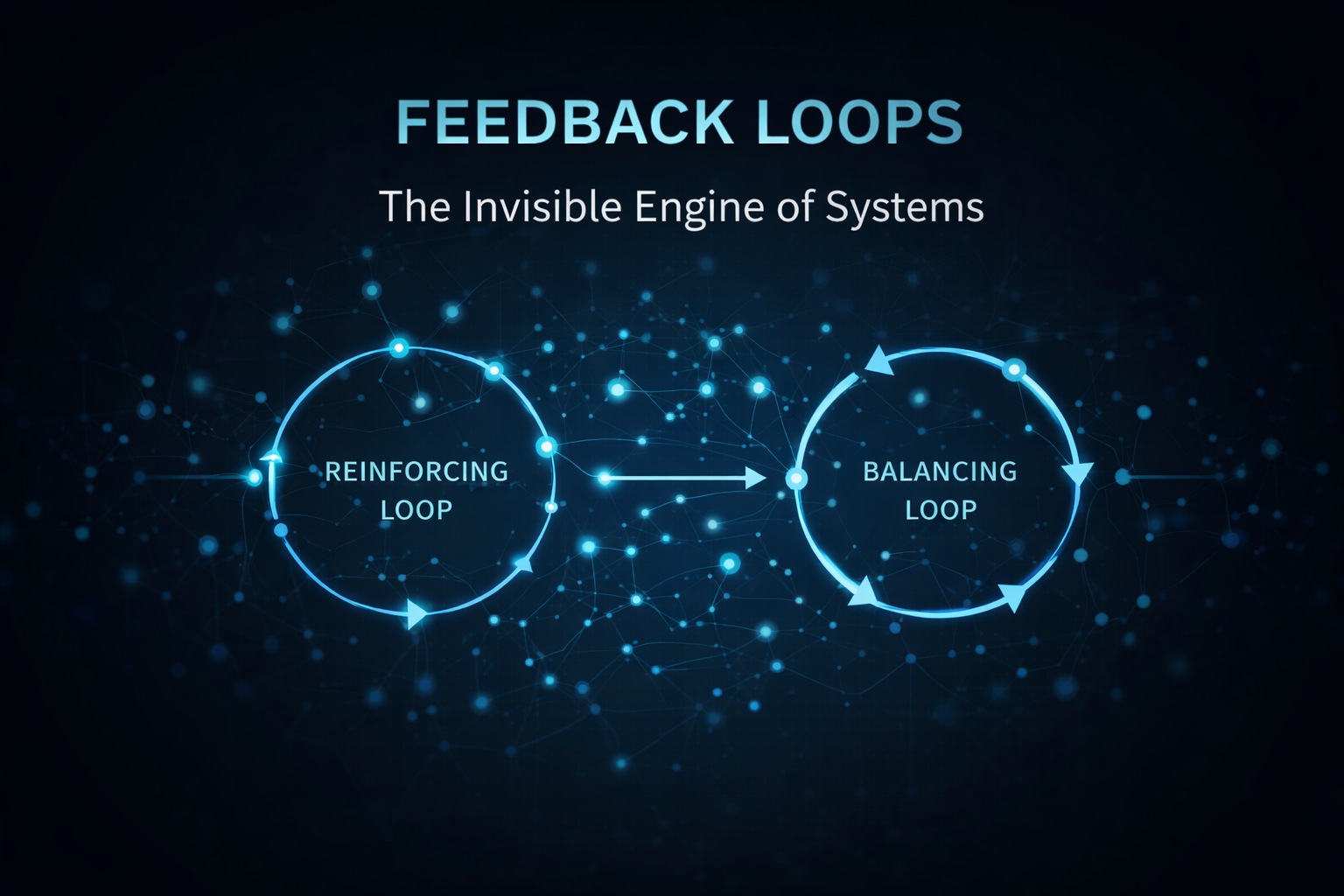
    Feedback Loops in Systems: The Invisible Force Behind Complex Systems

    Darja Rihla Systems Thinking

    Feedback Loops in Systems

    The invisible engine behind growth, stability, collapse, and emergence across markets, institutions, technologies, ecosystems, and everyday life.

    Core concept Circular causality
    Loop types Reinforcing + balancing
    Applies to Systems, markets, habits
    Reading time 9 min read
    Mechanism Feedback Outputs re-enter the system and shape what happens next.
    Loop A Reinforcing Amplifies movement, growth, bubbles, and virality.
    Loop B Balancing Pushes the system back toward equilibrium.
    Result Emergence Complex patterns arise from recursive interaction.
    01 · Introduction

    The Hidden Engine of Complex Systems

    Feedback loops are one of the most important mechanisms in systems thinking. Many systems appear stable and predictable on the surface, yet beneath that stability lies a structure that continuously reshapes behavior.

    Governments, companies, ecosystems, digital platforms, and even personal routines all depend on feedback. These loops determine whether a system corrects itself, accelerates, or drifts into collapse.

    If you understand the feedback structure, you begin to understand the system itself.
    02 · Definition

    What Is a Feedback Loop?

    A feedback loop occurs when the output of a system influences its future behavior. Instead of a straight line of cause and effect, the relationship becomes circular.

    action result feedback new action

    This circular structure exists in biological systems, economic networks, organizations, ecosystems, and technological infrastructures. Without feedback, systems cannot adapt or regulate themselves over time.

    03 · Core types

    Two Fundamental Types of Feedback

    Type A

    Reinforcing loops

    These loops amplify movement in the same direction. They accelerate growth, virality, speculation, momentum, and sometimes collapse.

    Type B

    Balancing loops

    These loops stabilize the system by counteracting drift and pushing behavior back toward equilibrium.

    Every complex system is shaped by the tension between amplification and correction.
    04 · Reinforcement

    Reinforcing Feedback Loops

    Reinforcing loops amplify change. The result of an action increases the probability that the same action will happen again.

    growth more resources more growth
    Platforms

    Social media algorithms

    Content receives engagement, the algorithm boosts visibility, and the added visibility generates even more engagement.

    Economy

    Economic growth

    Investment increases productivity, which increases profits, enabling further investment.

    Finance

    Asset bubbles

    Rising prices attract buyers, pushing prices even higher until confidence breaks.

    Reinforcing loops often produce exponential behavior, both positive and destructive.
    05 · Stabilization

    Balancing Feedback Loops

    Balancing loops act as correction mechanisms. They reduce drift and move the system back toward equilibrium.

    change correction stabilization
    Biology

    Body temperature

    Sweating and shivering regulate body heat to maintain internal stability.

    Markets

    Supply and demand

    High prices suppress demand, low prices stimulate it, creating market correction.

    Organizations

    Operational controls

    Monitoring and corrective processes prevent drift in large institutions.

    Balancing loops do not remove change. They shape the boundaries within which change remains stable.
    06 · Systemic risk

    When Feedback Loops Become Dangerous

    Poorly designed feedback structures can create systemic failure. Policy incentives, financial leverage, and algorithmic amplification often contain hidden reinforcing loops.

    Examples include subsidy cycles, speculative bubbles, panic selling, and political polarization on digital platforms.

    Systems often fail not because of one event, but because loops intensify the event over time.
    07 · Emergence

    Feedback Loops and Emergence

    Feedback loops are central to emergence. Simple local interactions can create sophisticated collective behavior.

    Ant colonies, cities, digital ecosystems, and financial markets all exhibit emergent order driven by recursive signals and repeated feedback.

    Emergence is what feedback looks like at scale.
    08 · Everyday systems

    Seeing Feedback Loops in Daily Life

    Feedback loops also shape habits and routines.

    Exercise increases energy, energy improves motivation, and motivation reinforces the habit. Stress can create negative loops that intensify unhealthy behavior.

    Recognizing these structures helps design better personal systems and routines.

    09 · Conclusion

    Why Feedback Is Central to Systems Thinking

    Feedback loops are the hidden engines of complex systems. Reinforcing loops accelerate change. Balancing loops maintain stability.

    Together they explain how systems grow, stabilize, adapt, and sometimes collapse.

    Once you begin to see feedback loops, it becomes difficult to see systems any other way.

    Continue the systems pillar

    Move deeper into how complex systems behave through hidden logic, emergence, and structural dynamics.

    Darja Rihla · Feedback Loops · Premium Systems Editorial
  • Emergence in Complex Systems

    Emergence in Complex Systems

    Darja Rihla Systems Thinking

    Emergence in Complex Systems

    How simple local interactions create global order, intelligence, structure, and behaviors that no single component controls.

    01 · Introduction

    When the Whole Becomes Something Else

    Emergence is one of the defining properties of complex systems. It describes how sophisticated patterns, structures, and behaviors arise from the interaction of many relatively simple elements.

    What makes emergence fascinating is that the outcome cannot be fully understood by analyzing the individual parts in isolation.

    The intelligence of the whole exceeds the simplicity of the parts.
    02 · From parts to patterns

    From Local Behavior to Global Structure

    In simple systems, understanding the parts is often enough to understand the whole. In complex systems, this assumption breaks down.

    A flock of birds offers a classic example. Each bird follows only a few simple rules, yet the flock moves with coordinated elegance as if guided by a central intelligence.

    Rule 01

    Maintain distance

    Avoid collisions with nearby neighbors.

    Rule 02

    Align direction

    Move with the surrounding local group.

    Rule 03

    Stay centered

    Move toward the collective mass.

    03 · Global order

    Local Rules, Global Order

    Emergence often appears when local interactions scale across thousands or millions of participants.

    Traffic jams, market prices, urban districts, and social trends all emerge from distributed interactions rather than top-down design.

    Traffic

    Congestion waves

    A single brake event can propagate into large-scale highway congestion.

    Markets

    Price formation

    Millions of transactions generate bubbles, corrections, and crashes.

    Cities

    Urban identity

    Neighborhoods evolve through decentralized human decisions.

    04 · Interaction

    The Role of Interaction

    Emergence requires interaction. Without interaction, a system is only a collection of isolated parts.

    Feedback loops, adaptation, learning, and self-organization all depend on the ability of components to influence one another.

    05 · Self-organization

    Order Without Central Control

    Self-organization is closely linked to emergence. Ant colonies, ecosystems, and decentralized digital networks all create sophisticated order without a single controlling authority.

    The system organizes itself through recursive local interactions.
    06 · Technology

    Emergence in Technology and AI

    The internet itself is an emergent system, formed through the gradual interconnection of countless networks, institutions, and users.

    Modern AI systems also display emergent capabilities, where complex behaviors arise from accumulated pattern learning across massive datasets.

    07 · Institutions

    Emergence Inside Organizations

    Corporate culture, institutional inertia, and organizational behavior often emerge from incentives, communication pathways, and informal networks.

    Leaders do not directly control outcomes. They shape the conditions from which outcomes emerge.

    08 · Conclusion

    Sometimes Systems Are Not Built – They Grow

    Emergence changes how we think about design, control, and prediction. Instead of micromanaging parts, systems thinking focuses on relationships, interaction patterns, and conditions.

    The most important structures in our world are often not designed. They emerge.

    Continue the systems series

    Bridge this article into feedback loops and hidden system logic.

    Darja Rihla · Emergence · Premium Editorial Systems Layout
  • Human Error in Cybersecurity

    Human Error in Cybersecurity

    Darja Rihla Cybersecurity Analysis

    Human Error in Cybersecurity

    Human error in cybersecurity is not simply a story about careless users. It is a systems problem shaped by cognition, design, workload, culture, incentives, and organizational structure.

    Focus keyword human error in cybersecurity
    Cluster Cybersecurity systems
    Search intent educational / analytical
    Reading time 14 min read
    01 · Core thesis

    Human Error Is a Systems Problem

    Human error in cybersecurity remains one of the most persistent drivers of incidents because digital environments are often built around idealized behavior rather than realistic human behavior. Employees work under time pressure, routine overload, fragmented interfaces, and competing incentives. Under these conditions, mistakes become predictable outcomes rather than isolated failures.

    This connects directly with the logic explained in How Cybersecurity Shapes the Modern World, where cybersecurity is presented as a structural layer of modern civilization rather than a narrow technical function.

    02 · Beyond tools

    Cybersecurity Is Not Only a Technical Problem

    Networks, code, segmentation, access management, monitoring, and endpoint protection are essential. But every one of those systems still depends on people: users, administrators, analysts, managers, and decision-makers. Every alert must be interpreted, every privilege assigned, every exception approved.

    Technology and human behavior are therefore inseparable. A technically mature environment can still remain operationally fragile when people are overloaded, unsupported, or incentivized incorrectly.

    03 · Cognition

    Why Human Error Remains So Powerful

    Attention

    Cognitive overload

    Too many alerts, messages, prompts, and verification requests reduce attention quality and increase routine clicking behavior.

    Pressure

    Time urgency

    Users prioritize immediate tasks and deadlines over abstract security expectations.

    Routine

    Behavioral shortcuts

    Password reuse, auto-approval, and warning fatigue emerge from daily workflow friction.

    Trust

    Social assumptions

    People naturally trust familiar language, authority signals, and internal communication patterns.

    This is why human error in cybersecurity should be analyzed as a predictable systems output rather than a moral failing.

    04 · Critical correction

    The Myth of the Weakest Link

    The phrase “humans are the weakest link” simplifies a complex issue into blame. It ignores design quality, operational burden, documentation, leadership incentives, and workflow realism.

    Better framing: humans are not the weakest link. They are embedded actors inside a larger cyber system whose design strongly shapes behavior.

    This systems framing aligns with What Is a Complex System? and Feedback Loops in Systems, where repeated outcomes are understood through structures and interactions rather than isolated events.

    Diagram showing human factors in cybersecurity including phishing misconfiguration fatigue and insider risk
    Human factors become risk multipliers when design and culture do not align with operational reality.
    05 · Attack behavior

    Phishing and Social Engineering

    Phishing attacks are less about code and more about behavioral design. Attackers exploit urgency, authority, familiarity, and routine. They study the rhythms of organizations and imitate internal workflows.

    That is why phishing succeeds even in technically strong environments. It targets the meeting point between systems and human cognition.

    Diagram showing how a phishing attack works from email to credential theft
    Phishing attacks succeed by aligning deception with normal workflow expectations.
    06 · Infrastructure risk

    Misconfiguration and Administrative Error

    Some of the most severe incidents come not from end-user clicks but from administrative mistakes: exposed cloud storage, excessive privileges, incomplete logging, delayed patching, or broken backups.

    These issues connect strongly to Emergence in Complex Systems, because small local configuration choices can scale into large systemic vulnerabilities.

    07 · Workload

    Security Fatigue and Constant Vigilance

    Security fatigue emerges when users are asked to maintain constant vigilance in environments filled with interruptions and friction. Over time, compliance becomes ritual rather than conscious decision-making.

    This creates the illusion of secure behavior while actual attention declines.

    08 · Institution

    Culture and Incentives

    Organizational culture determines whether secure behavior is operationally viable. If speed is rewarded more than verification, users will skip controls. If reporting suspicious behavior leads to blame, users remain silent.

    Cybersecurity therefore depends as much on leadership and culture as on technical tooling.

    09 · Design

    Systems Thinking: Error as Design Signal

    Human error should be treated as a design signal. Instead of asking only who made the mistake, serious analysis asks what made the mistake likely, repeatable, and consequential.

    This systems-thinking approach aligns with your broader Darja Rihla cluster and strengthens internal semantic linking for Rank Math and topical authority.

    10 · Position

    Final Position

    Human error in cybersecurity is not a weakness that can be eliminated. It is a permanent design condition of digital systems. The most resilient organizations are not those that expect perfect users, but those that build environments where mistakes are less likely, less damaging, easier to detect, and easier to recover from.

  • How Cybersecurity Shapes the Modern World

    How Cybersecurity Shapes the Modern World

    Darja Rihla Cybersecurity Pillar

    How Cybersecurity Shapes the Modern World

    Cybersecurity shapes the modern world by protecting the invisible digital infrastructure that modern societies depend on for communication, finance, healthcare, energy, logistics, and governance.

    Focus keyword How cybersecurity shapes the modern world
    Article type Pillar post
    Framework Systems, infrastructure, power
    Reading time 16 min read
    Core claim Infrastructure Cybersecurity protects the hidden systems behind modern life.
    Risk model Interdependence Connected systems turn local weaknesses into systemic threats.
    Strategic layer Trust Digital economies function only when users believe systems are secure.
    Analytical frame Complex systems Cybersecurity must be read through networks, feedback, and emergence.
    Cybersecurity infrastructure protecting global digital networks and showing how cybersecurity shapes the modern world
    Cybersecurity protects the invisible infrastructure that powers modern societies.
    01 · Observation

    How Cybersecurity Shapes the Modern World

    How cybersecurity shapes the modern world begins with a simple observation: modern civilization now runs on digital systems that most people never see directly. Payments clear through networked platforms. Hospitals rely on digital records. Governments coordinate through large administrative systems. Energy networks, logistics chains, and communication platforms all depend on software, data flows, and connected infrastructure.

    Cybersecurity shapes the modern world because it protects the operational layer beneath daily life. Without that protective layer, efficiency turns into fragility. Convenience turns into dependence. Interconnection turns into exposure.

    That is why cybersecurity is no longer a niche technical issue. It is a structural condition of modern social order.

    02 · Context

    Digitalization Turned Infrastructure into Attack Surface

    To understand why cybersecurity shapes the modern world, we must first understand what digitalization has done to society. Over the past decades, nearly every sector has become dependent on digital infrastructure. Banking systems process transactions at planetary scale. Hospitals store and move medical data digitally. Public administration, transport systems, education, supply chains, and media all operate through connected platforms.

    This digitalization created speed, scale, coordination, and convenience. It also created systemic vulnerability. When a society becomes dependent on digital infrastructure, its critical functions inherit the weaknesses of that infrastructure.

    The more society digitizes, the more cybersecurity becomes a public stability problem rather than a private IT problem.
    03 · Drivers

    Why Cybersecurity Became Central

    Technology

    Complexity expanded

    Cloud environments, APIs, software supply chains, identity systems, and connected devices dramatically widened the attack surface.

    Economics

    Digital assets gained value

    Data, financial transactions, credentials, and intellectual property created strong incentives for cybercrime.

    Geopolitics

    States entered cyberspace

    Governments increasingly treat cyber capabilities as tools of espionage, disruption, and strategic competition.

    Psychology

    Humans remain attack vectors

    Phishing, deception, and social engineering show that many successful intrusions exploit behavior more than code.

    Together these forces created a permanent cyber environment in which attackers, defenders, institutions, and infrastructures continuously adapt to one another.

    Digital world of cyber threats showing network vulnerability and global cybersecurity risk
    Digital dependence creates a world where cyber threats can move across sectors and borders with extraordinary speed.
    04 · Structure

    Cybersecurity as a Complex System

    Cybersecurity cannot be understood through isolated incidents alone. Modern digital infrastructure behaves like a complex system: many interacting components, distributed dependencies, and outcomes that are difficult to predict from individual parts. A weakness in one supplier can expose hundreds of firms. A compromised update can reach thousands of systems at once. A single credential theft can unlock wider institutional access.

    This is why the logic explained in The Hidden Logic of Complex Systems matters here. In cybersecurity, outcomes rarely follow intentions cleanly. A tool built for efficiency can enlarge systemic exposure. A defensive control in one layer may shift attackers toward a softer dependency in another.

    Cybersecurity shapes the modern world because digital risk is now networked, distributed, and cumulative.

    05 · Feedback

    Cybersecurity Runs on Feedback Loops

    Cybersecurity is shaped by reinforcing and balancing loops. The logic outlined in Feedback Loops in Systems applies directly.

    Reinforcing loop

    Attack success attracts more attack

    Profitable ransomware campaigns attract imitators, tooling improves, underground services expand, and the ecosystem becomes more capable.

    Balancing loop

    Defense reduces exposure

    Monitoring, patching, segmentation, user training, and incident response reduce the attacker’s room to operate and push systems back toward stability.

    Once you see cybersecurity through feedback, cyber incidents stop looking random. They start looking like the visible output of deeper system dynamics.

    06 · Emergence

    Threat Landscapes Are Emergent

    Cybersecurity also displays the logic described in Emergence in Complex Systems. No single actor designed the global cyber threat environment as a whole. It emerged from millions of interacting incentives: software complexity, state competition, criminal markets, automation, user behavior, platform dependence, and data concentration.

    The result is a constantly shifting environment in which new patterns appear without central direction. Botnet structures, phishing waves, zero-day trading, and coordinated influence operations all show how local decisions can generate global cyber behavior.

    Cyber threat is not just a collection of incidents. It is an emergent environment.
    07 · Psychology

    The Human Factor Is Not Secondary

    Despite the technical framing, many cybersecurity failures begin with human decisions. Staff click phishing links. Leaders delay updates. Organizations prioritize convenience, speed, or growth over resilience. Security culture remains uneven, and attackers know it.

    This means cybersecurity shapes the modern world not only through firewalls and encryption, but through institutional discipline, awareness, incentives, and trust boundaries. Human behavior is part of the system, not a side issue.

    08 · Institutions

    Cybersecurity Is Now a Governance Question

    As more critical functions move online, cybersecurity becomes inseparable from governance. Boards must treat it as operational risk. Governments must treat it as resilience policy. Hospitals, transport networks, banks, utilities, and educational institutions must treat it as continuity infrastructure.

    Useful public references on this broader institutional dimension include the Cybersecurity and Infrastructure Security Agency, the European Union Agency for Cybersecurity, and the NIST Cybersecurity Framework. These help show that cybersecurity is now embedded in national and organizational resilience planning, not only in technical operations.

    09 · Future

    What This Means for the Future of Society

    Artificial intelligence, cloud concentration, industrial control systems, digital identity infrastructure, and the Internet of Things will deepen dependency on networked systems. That means the answer to how cybersecurity shapes the modern world will only grow more consequential.

    The future challenge is not merely stopping attacks. It is maintaining trust, continuity, and resilience inside an increasingly complex digital civilization.

    10 · Position

    The Clear Position

    My position is that cybersecurity has evolved from a technical specialty into a foundational condition of modern civilization. It shapes economic resilience, institutional legitimacy, geopolitical stability, and everyday social trust. To treat cybersecurity as a back-office function is to misunderstand the architecture of the present.

    Cybersecurity does not merely protect computers. It protects the systems that make modern life possible.

    Continue through the systems architecture

    Move from cyber infrastructure into the deeper logic of complexity, feedback, emergence, and system behavior.

    Systems Series Flashcards
    Card 1 of
    Question
    Loading…
    Click or press space to reveal
    1
    Answer
    Answer
    1
    Did you know it?
    ← → Navigate Space Flip J Known N Not yet S Shuffle
    Session complete
    Correctly known
    0 known 0 not yet
    Darja Rihla · Cybersecurity Pillar · Systems, Infrastructure, Power
  • Detachment vs Sincerity: The Myth of Detachment (Part 1)

    Detachment vs Sincerity: The Myth of Detachment (Part 1)

    Between Detachment and Sincerity – Part 1 of 7
    A doctrine series on validation, identity, and inner stability.


    The Myth of Detachment

    “The myth of detachment is one of the most misunderstood ideas in modern thinking.”

    In recent years, the idea that strength means detachment has spread everywhere.

    Don’t care too much.
    Don’t depend on anyone.
    Stay emotionally independent.
    Be unbothered.

    This is the modern definition of strength.

    And it sounds convincing.

    Controlled. Disciplined. Untouchable.

    But it is built on a misunderstanding.

    What is presented as strength is often just withdrawal.


    Detachment as a Defense

    Most people don’t become detached because they mastered themselves.

    They become detached because they got hurt.

    They trusted and were let down.
    They gave and weren’t met equally.
    They opened up and got burned.

    So they adapt.

    Not by becoming stronger, but by reducing exposure.

    They stop expecting.
    They stop investing.
    They stop opening.

    This isn’t transcendence.

    It’s protection.


    The Illusion of Control

    Detachment feels like control.

    If you expect nothing, you can’t be disappointed.
    If you need no one, you can’t be rejected.
    If you stay distant, you can’t be hurt.

    But this control is conditional.

    It depends on distance.

    The moment something meaningful enters your life, the stability disappears.

    Which raises a critical question:

    Was it ever real control to begin with?

    Or was it stability that only existed in the absence of risk?


    Strength or Avoidance

    This is where the myth becomes dangerous.

    Because avoidance often looks like strength.

    Silence looks like discipline.
    Distance looks like independence.
    Emotional suppression looks like control.

    But these are not the same.

    Avoidance reduces friction.
    Strength handles it.

    Avoidance removes exposure.
    Strength remains stable within it.

    Real strength is not feeling less.

    It’s staying grounded while you feel.


    The Hidden Cost

    Detachment doesn’t lead to freedom.

    It leads to disconnection.

    From people.
    From meaning.
    From parts of yourself.

    You become harder to hurt,
    but also harder to reach.

    The same wall that protects you from pain
    also blocks depth, intimacy, and responsibility.

    This is the hidden cost of detachment.


    A symbolic visual of emotional detachment as a barrier.
    A symbolic visual of emotional detachment as a barrier.

    The Deeper Problem

    This is not just about behavior.

    It is structural.

    As introduced in Part 0, many people operate within what can be described as the Validation Dependency Loop.

    Their internal state is still influenced by external reactions.

    Detachment does not resolve this.

    It only reduces interaction with it.

    The dependence is still there.

    It is simply less visible.

    This is why detachment can feel like strength while leaving the underlying instability untouched.


    The System Behind the Myth

    Detachment is not just a personal coping strategy.
    It is reinforced by the environment people move in.

    In a culture shaped by individualism and constant exposure, emotional control is treated as a requirement rather than a byproduct of growth. The resurgence of Stoic language, stripped from its original philosophical depth has been repackaged into short, consumable rules: feel less, need less, depend on no one.

    This framing aligns perfectly with systems that benefit from emotionally self-regulating individuals.

    Platforms reward simplicity.
    Self-help industries monetize clarity without depth.
    Economic structures function more smoothly when frustration is internalized instead of expressed.

    Who benefits is clear: those who offer simplified control as a product, and systems that face less resistance from individuals who withdraw instead of confront.

    Who pays the price is less visible: individuals who suppress their need for connection, reinterpret meaning as weakness, and slowly detach not only from others, but from themselves.

    What is presented as independence often becomes isolation with better branding.

    Why People Accept It

    The appeal of detachment is not accidental.

    It solves a real problem pain but does so by redefining it.

    Instead of asking why something hurts, detachment teaches you to treat the source as irrelevant.

    This reduces internal conflict.

    If nothing matters, nothing can destabilize you.

    This is psychologically efficient.

    It removes cognitive dissonance.
    It creates a sense of control.
    It is socially reinforced as strength.

    But it comes with a condition:

    you only remain stable as long as you stay distant.

    The moment something breaks through that distance something real, something meaningful: the system is exposed.

    Because the stability was never built to handle presence.

    Only absence.

    The System Sustains Itself

    Detachment persists because it is self-confirming.

    People who adopt it experience short-term relief.
    That relief is interpreted as proof of strength.
    That proof is repeated and shared.

    What remains unseen are the long-term effects:

    emotional flattening,
    reduced depth in relationships,
    a quiet sense of disconnection that is hard to name.

    The more this becomes normalized, the harder it is to challenge.

    Because any alternative, openness, sincerity, emotional presence, risks being interpreted as weakness within the same framework.

    The system closes itself.

    A Necessary Distinction

    There is a critical difference between:

    Being free from unhealthy dependence,
    and being closed off.

    The first is development.
    The second is defense.


    Toward a Different Framework

    If detachment isn’t the answer, what is?

    That’s the question behind this series.

    The goal is not dependence.
    And it’s not detachment.

    It’s something harder:

    connection without dependency.

    To care without losing stability.
    To engage without needing validation.

    What Is at Stake

    Detachment is not neutral.

    It reshapes how people relate to themselves and to others.

    As long as it is framed as strength, individuals will continue to mistake withdrawal for growth and suppression for control.

    The systems that benefit from this will remain unchallenged.

    And the cost will continue to accumulate in silence. In disconnected relationships, in reduced meaning, in lives that feel stable but empty.

    The real danger is not that people feel less.

    It is that they forget what it means to be fully present at all.

    A society that calls emotional distance strength does not produce resilient individuals: it produces people who have learned to avoid life while believing they have mastered it.

    Series Navigation

    Series Navigation
    Part 1 → Part 2 → Part 3 → Part 4 → Part 5 → Part 6 → Part 7

    → Continue to Part 2 – Philosophy Misunderstood

  • Part 2: Philosophy Misunderstood

    Between Detachment and Sincerity: Part 2 of 7


    A doctrine series on validation, identity, and inner stability.


    Philosophy Misunderstood

    When people defend detachment, they often point to philosophy.

    Especially Stoicism.

    Discussions around Stoicism and detachment have become common online, but most of them are built on a misunderstanding.

    People quote lines about emotional control.
    About focusing only on what is within your control.
    About staying calm in all situations.

    On the surface, it seems to support detachment.

    It doesn’t.

    That is a shallow reading of both Stoicism and the idea of emotional discipline.


    What Stoicism Actually Teaches

    Stoicism does not teach emotional numbness.

    It teaches discipline in how you relate to emotion.

    The Stoic does not eliminate feeling.
    He refuses to be ruled by it.

    There is a difference.

    To feel anger is human.
    To be controlled by anger is weakness.

    To care is human.
    To lose yourself in that care is instability.

    This is where people confuse Stoicism and detachment.

    Stoicism is not about shutting down or disconnecting.
    It is about staying grounded while fully engaged.

    If anything, real Stoicism demands more presence, not less.


    Control and Misinterpretation

    One of the most quoted Stoic ideas:

    Focus only on what you can control.

    This principle, often traced back to thinkers like Epictetus, is frequently misused.

    It gets turned into something else:

    “If I can’t control people, I shouldn’t care about them.”

    That sounds logical.

    It’s wrong.

    You are not meant to control people.
    But you are meant to connect with them.

    Control and care are not the same thing.

    Letting go of control does not require detachment.
    It requires maturity.

    This is the key mistake in how people interpret Stoicism and detachment today.


    The Emotional Shortcut

    Modern interpretations turn discipline into avoidance.

    Instead of learning how to handle emotion,
    people reduce the number of situations that trigger it.

    Instead of becoming stable within connection,
    they avoid connection altogether.

    It feels like control.

    It’s not.

    It’s limitation.

    Easier is not stronger.

    Avoidance is not mastery.


    The Loss of Depth

    When philosophy is misunderstood, it creates distance.

    You engage less.
    You invest less.
    You start observing life instead of participating in it.

    This creates a false sense of clarity.

    You feel above things. Detached. Untouchable.

    But you are not more stable.

    You are less involved.

    And less involvement means less depth.

    This is where the modern narrative around Stoicism and detachment quietly collapses.


    Stability vs Indifference

    This distinction matters more than anything:

    Stability is not indifference.

    A stable person can care deeply without collapsing.
    An indifferent person avoids caring to stay safe.

    From the outside, both look calm.

    But they are not the same.

    One is strength.
    The other is disengagement.

    Understanding this difference is essential if you want to apply philosophy correctly instead of using it as a shield.


    Philosophy Without Distortion

    Properly understood, philosophy does not pull you away from life.

    It prepares you to face it.

    To engage without losing control.
    To care without losing yourself.
    To act without being driven by impulse.

    If you study classical Stoicism, through figures like Marcus Aurelius, you will see that engagement, responsibility, and duty are central.

    Not distance.

    Not avoidance.

    Steadiness.


    Toward the Real Problem

    If detachment is not the goal,
    and philosophy does not require emotional withdrawal, then why do people become unstable in relationships?

    The answer is not philosophy.

    The answer is not emotion.

    It is dependence.

    And that is where the real problem begins.

  • Detachment vs sincerity introduction: The Critical Framework Behind Emotional Stability (Part 0)

    Detachment vs sincerity introduction: The Critical Framework Behind Emotional Stability (Part 0)


    “A persistent idea dominates modern thinking: detachment vs sincerity is often framed as strength versus vulnerability.”


    This assumption shapes how people approach relationships, ambition, identity, and inner stability.

    But it is incomplete.

    It reduces a complex psychological and spiritual reality to a false binary: either you detach and remain in control, or you connect and risk losing yourself.

    This series begins from a different position.

    Not by accepting that binary, but by questioning it.

    Is it possible to remain grounded without disconnecting?

    Across philosophy, psychology, and Islamic thought, different answers have been proposed.

    Stoic philosophy emphasizes control and detachment from external outcomes.
    Modern psychology highlights attachment, emotional regulation, and relational meaning.
    Islamic thought introduces reliance (tawakkul), intention (niyyah), and an internal anchoring that is not dependent on human validation.

    Each of these frameworks captures part of the truth.

    But none fully resolves the central tension.

    Each framework solves a symptom, but not the structure.

    This framework of detachment vs sincerity is not just theoretical, but deeply practical.


    The Structural Problem

    Most people are not choosing between detachment and sincerity.

    They are oscillating between both.

    They detach to protect themselves, and reconnect when they seek meaning. They attempt control, then fall back into emotional dependence.

    This creates a hidden instability.

    What appears as balance is often just fluctuation.

    And this is where the debate around detachment vs sincerity becomes misleading.

    The problem is not choosing the right side.

    The problem is that both sides, as commonly understood, fail to resolve the underlying issue.

    Most frameworks break at the same point.

    They cannot answer a simple but critical question:

    How do you remain stable without becoming cold,
    and how do you remain sincere without becoming dependent?


    The Illusion of Detachment

    What makes detachment persuasive is that it often works, at least in the short term.

    It reduces emotional volatility.
    It creates the appearance of control.
    It protects the self from disappointment, rejection, and instability.

    But this apparent strength hides a deeper weakness.

    A person who feels stable only when emotionally unexposed is not necessarily free.

    That person may simply be less affected because less is at stake.

    This is the illusion at the center of modern detachment.

    Reduced exposure is mistaken for inner strength.
    Distance is mistaken for discipline.
    Emotional restraint is mistaken for resolution.

    But unresolved dependence does not disappear when contact is reduced.

    It becomes less visible.


    The Validation Dependency Loop

    This is where the real problem appears.

    The Validation Dependency Loop.

    People often believe they are independent, while their emotional state is still shaped by external validation, reactions, outcomes, and approval.

    Their mood follows attention.
    Their confidence follows feedback.
    Their sense of self follows perception.

    This creates a loop:

    External reaction → internal state → behavioral adjustment → renewed dependence.

    Detachment appears as a solution.

    But it does not resolve the loop.

    It only reduces exposure to it.


    “Most people think detachment creates strength.
    But in reality, it often removes meaning.”


    By cutting emotional ties, detachment reduces risk, but also reduces depth, responsibility, and connection.

    What remains is often not strength, but controlled disengagement.

    This is why many people feel stable, yet empty.


    Toward a Different Framework

    This series proposes a different approach.

    Not detachment as emotional withdrawal,
    and not sincerity as dependency,

    but a structured form of inner stability that allows connection without losing control.

    This requires a shift in where stability is anchored.

    Not in outcomes.
    Not in people.
    Not in validation.

    But in an internal structure capable of sustaining both connection and discipline.

    The goal is not emotional distance.
    The goal is not emotional exposure.

    The goal is internal anchoring.


    Questions the Framework Must Answer

    Before this framework can be taken seriously, several questions must be answered.

    Is detachment truly strength, or merely protection from emotional exposure?

    Can sincerity exist without dependency, or does openness always create vulnerability?

    If peace disappears the moment something meaningful is at stake, was it ever peace?

    Does detachment produce freedom, or simply reduce the number of things capable of disturbing the self?

    And if stability depends on distance, can it still be called stability at all?


    Detachment vs sincerity introduction:

    Understanding Detachment vs Sincerity

    Stoicism sought to minimize emotional disturbance by focusing only on what is within one’s control.

    Stoic philosophy emphasizes control and detachment from external outcomes (see Epictetus’ Enchiridion).


    Modern psychology attempts to regulate emotion through awareness, attachment theory, and behavioral adjustment.

    Modern psychology highlights attachment and emotional regulation (see attachment theory).


    Islamic thought, however, introduces a different anchor, one that is not rooted in human reaction, but in divine reliance.

    Each approach identifies part of the problem.

    But the question remains unresolved:

    Can stability exist without emotional distance,
    and can sincerity exist without dependency?

    This is the question that this framework attempts to answer.


    Structure of the Series


    This framework will be developed step by step through philosophy, psychology, and Islamic thought.

    Each part builds on the previous one:

    Part 1 – The Myth of Detachment
    Part 2 – Philosophy Misunderstood
    Part 3 – What Psychology Actually Says
    Part 4 – The Validation Dependency Loop
    Part 5 – The Islamic Framework
    Part 6 – Connection Without Dependency
    Part 7 – Conclusion


    This introduction serves as the entry point into that exploration.

    → Start with Part 1 – The Myth of Detachment