Author: Darja Rihla

  • How Cyber Attacks Happen: Step-by-Step Breakdown (Beginner Guide)

    How Cyber Attacks Happen: Step-by-Step Breakdown (Beginner Guide)

    Observation
    Context
    Structure
    Psychology
    Position
    Darja Rihla Cybersecurity Pillar

    How Cyber Attacks Happen

    A premium educational pillar on the real logic of cyber attacks: how attackers move from reconnaissance to access, from access to persistence, and from single weaknesses to full system compromise.

    SeriesCybersecurity
    FormatPillar article
    Reading modeEducational
    Core questionHow cyber attacks happen
    01 · Observation

    How Cyber Attacks Happen Is Usually Explained Too Late

    Most people encounter cyber attacks only at the moment of visible damage. They hear about the ransomware screen, the stolen credentials, the fraudulent payment, or the leaked data. By that stage the event appears sudden, technical, and almost mysterious. But cyber attacks do not begin where the damage becomes visible. They begin much earlier, often quietly, through reconnaissance, weak processes, trust exploitation, and unnoticed access.

    That is why the question is not only what is a cyber attack, but how cyber attacks happen in practice. Once you shift from the visible incident to the hidden sequence behind it, the subject becomes much clearer. Attackers gather information, locate the easiest entry point, exploit access, establish persistence, and then execute the real objective. The mechanics vary, but the structure repeats.

    This article treats cyber attacks as a system rather than a cinematic event. That shift matters because the same system logic appears again and again across phishing, credential theft, ransomware, insider misuse, and supply chain compromise. If you understand the structure, you are no longer only reacting to outcomes. You start seeing the conditions that make those outcomes likely.

    Cyber attacks do not succeed because every attacker is brilliant. They succeed because many systems remain predictable, overloaded, and easier to manipulate than the people inside them realize.

    02 · Context

    Why Modern Systems Invite Attack

    Modern society runs on digital dependence. Communication, finance, healthcare, logistics, energy, education, and governance all rely on interconnected systems. That dependence creates extraordinary efficiency, but it also creates concentration of risk. Once processes, identities, transactions, and records become digital, they become available for manipulation at scale.

    The result is a world in which a single weak credential, exposed portal, or successful phishing email can trigger consequences far beyond the original point of entry. This is why cybersecurity cannot be reduced to antivirus software or technical hardening alone. It is a structural issue involving infrastructure, identity, human behavior, process design, and organizational discipline.

    This broader logic connects directly to earlier Darja Rihla systems articles. If you have not yet read What Is a Complex System?, Feedback Loops in Systems, Emergence in Complex Systems, and The Hidden Logic of Complex Systems, this pillar extends that cluster into cybersecurity.

    Cluster bridge: Cyber attacks are best understood as system events. They move through dependencies, exploit behavior, reinforce success patterns, and create cascading effects. That is why cybersecurity belongs inside systems thinking, not outside it.
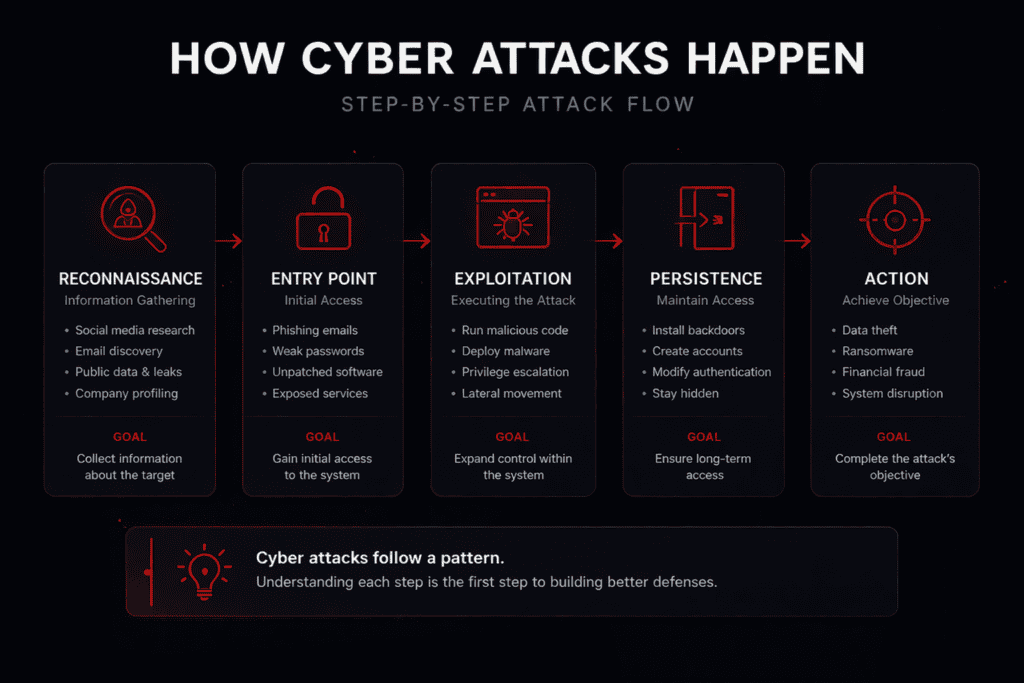
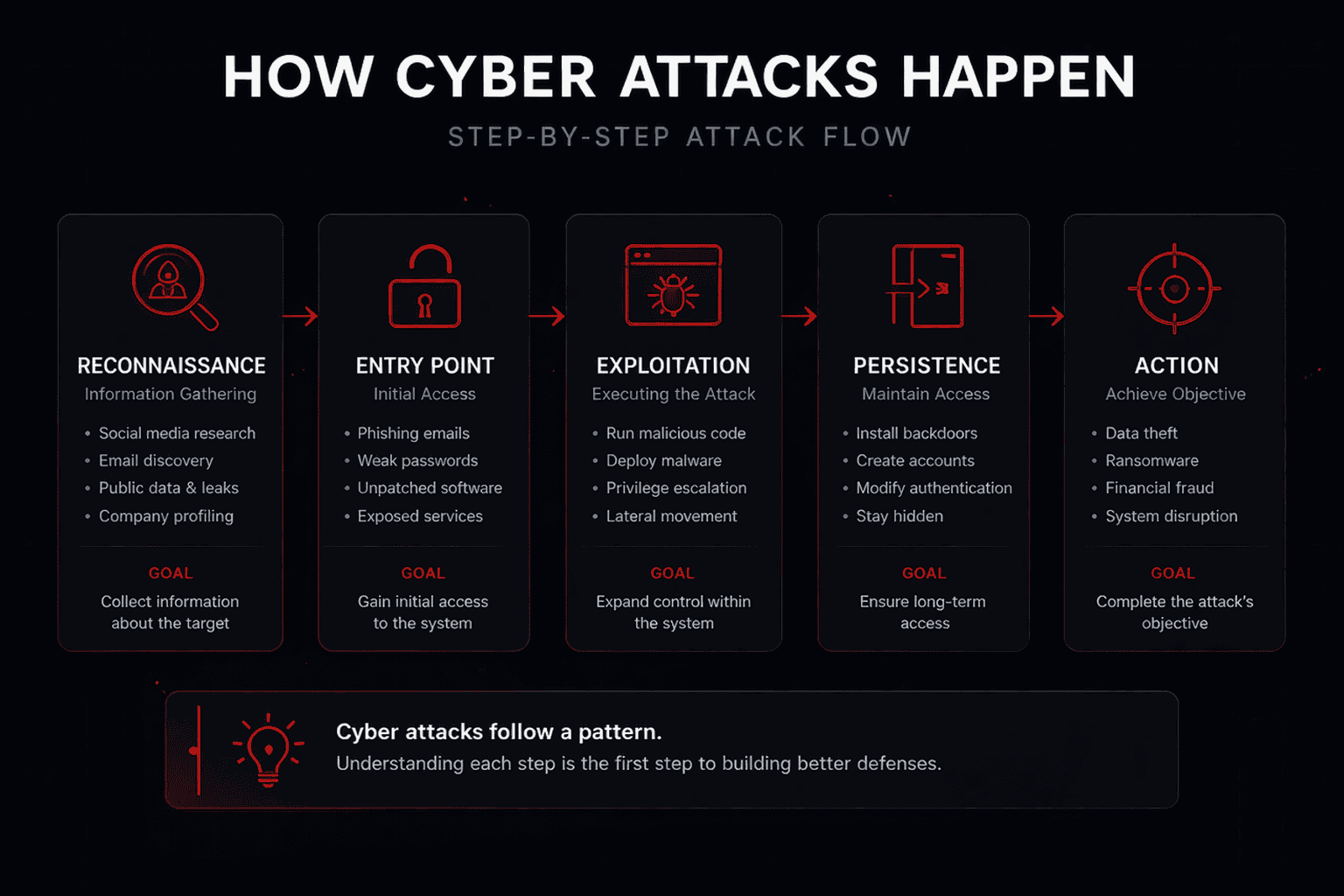
    How cyber attacks happen step by step diagram showing reconnaissance access exploitation persistence and final objective
    How cyber attacks happen: a recurring sequence from quiet observation to visible damage.
    03 · Structure

    The Five-Part Logic of a Cyber Attack

    Most cyber attacks are easiest to understand when broken into five phases. In reality, attackers may skip, combine, or repeat some of them. But as a teaching framework, these five phases explain how cyber attacks happen across many real-world cases.

    1

    Reconnaissance

    Information gathering on people, systems, technologies, suppliers, and exposed surfaces.

    2

    Initial Access

    Entry through phishing, weak passwords, exposed services, or unpatched software.

    3

    Exploitation

    Using the foothold to execute code, expand privileges, and move further inside.

    4

    Persistence

    Creating ways to stay inside or return later even if part of the attack is detected.

    5

    Objective

    Data theft, fraud, surveillance, ransomware, or disruption.

    1. Reconnaissance

    Every serious cyber attack starts with information. Attackers rarely move blindly. They gather names from LinkedIn, infer internal email patterns, identify external suppliers, scan websites, inspect exposed services, search public breach dumps, and study the technologies an organization uses. The point of reconnaissance is not drama. It is reduction of uncertainty.

    2. Initial Access

    This is the moment most people imagine as the start of the attack, but it is already the result of earlier preparation. Initial access usually comes through a familiar weakness: a phishing email, a weak or reused password, an unpatched system, a leaked token, an exposed remote service, or a misconfigured cloud interface.

    3. Exploitation

    Once attackers gain entry, they try to turn presence into capability. This can mean running malicious code, extracting secrets from memory, abusing legitimate tools, moving laterally, or escalating privileges.

    4. Persistence

    Temporary access is useful. Durable access is far more valuable. Attackers often create persistence by installing backdoors, generating hidden accounts, abusing scheduled tasks, planting web shells, or modifying authentication paths.

    5. Final Objective

    Only at the last phase does the attacker execute the visible goal: encrypting systems for ransom, stealing customer data, extracting payment flows, committing fraud, or silently maintaining surveillance.

    Internal link

    How systems fail under pressure

    Read How Cybersecurity Shapes the Modern World for the larger civilizational context behind digital dependence and fragility.

    External link

    Attack model reference

    For an external framework reference, see MITRE ATT&CK, which catalogs attacker tactics and techniques across real intrusions.

    04 · Narrative

    The Big Myth: Cyber Attacks Are Always Extremely Advanced

    The popular narrative says attackers are mostly elite technical geniuses who defeat strong systems through extraordinary skill. Sometimes that is true. But as a general public explanation, it is misleading. Most cyber attacks do not need the most advanced path. They only need the path of least resistance.

    Weak passwords, reused credentials, ignored updates, over-privileged accounts, poor monitoring, and users placed under time pressure are often enough. This is why cyber attacks feel sophisticated after the fact, but often depend on surprisingly ordinary weaknesses during the process.

    05 · Psychology

    Why People Still Open the Door

    Human behavior remains central to how cyber attacks happen. Attackers exploit trust, habit, urgency, fatigue, and routine. A finance employee in a hurry does not experience a fake invoice request as an abstract security problem. They experience it as a work task arriving at the wrong moment.

    This is why the phrase “humans are the weakest link” is too shallow. People are not simply a defective layer attached to otherwise perfect systems. They are embedded actors inside systems that often demand more sustained vigilance than real work environments can support.
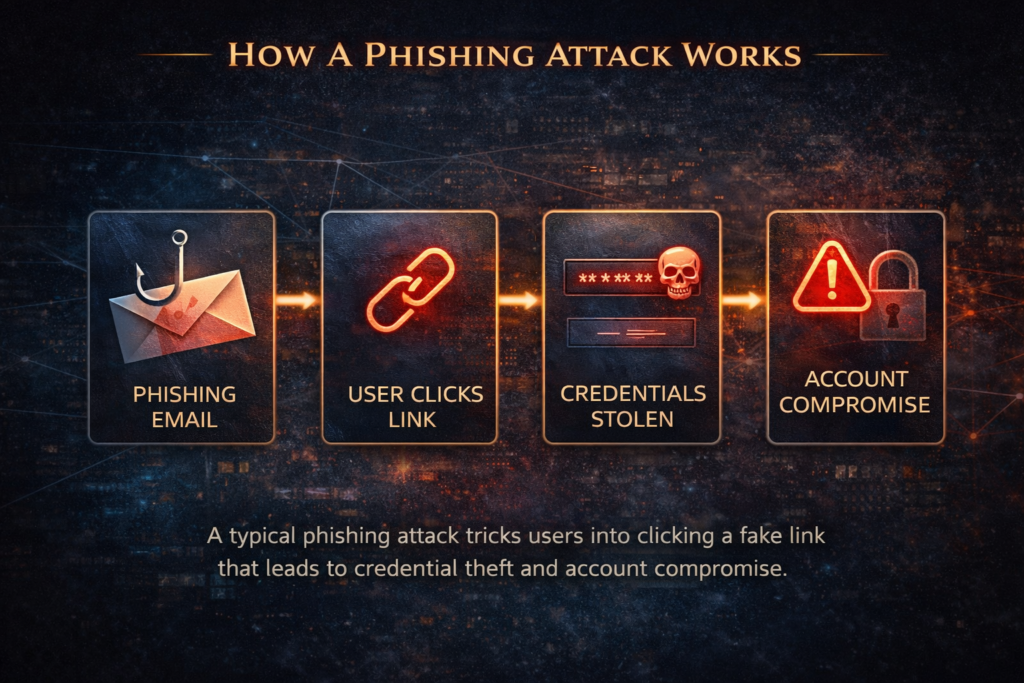
    Diagram showing how a phishing attack works from email to credential theft and account compromise
    Phishing works because it attacks the junction between digital routine and human trust.
    06 · Systemic dynamics

    Why Small Weaknesses Scale Into Large Incidents

    Cyber attacks behave like system events because digital environments are deeply interconnected. One stolen credential can expose multiple services. One compromised update can affect thousands of endpoints. One unmonitored identity can become the bridge between internal trust zones. In these environments, small failures do not remain isolated. They propagate.

    That is why cyber defense is strongest when it breaks chains early. Attackers rely on sequence. Good defense interrupts sequence.

    Failure pattern

    Cascading compromise

    Phishing becomes credential theft. Credential theft becomes lateral movement. Lateral movement becomes ransomware or fraud.

    Defense pattern

    Chain interruption

    MFA, strong monitoring, segmentation, fast patching, and low-friction reporting break the attack before it matures.

    07 · Educational defense

    How to Defend Without Becoming a Specialist

    You do not need elite technical skill to reduce cyber risk. You need better security habits and better system design. The core educational move is to stop treating defense as a bag of tools and start treating it as a repeatable behavior system.

    • Use a password manager so every important account has a unique password.
    • Enable multi-factor authentication on email, financial, and administrative accounts.
    • Keep systems updated and patch exposed services early.
    • Pause before urgent requests, especially payment, credential, or login requests.
    • Verify through a second channel when a message feels unusual, rushed, or powerful.
    • Report suspicious emails and prompts rather than silently deleting them.
    • Treat digital trust as something to check, not something to assume.
    08 · Flashcards

    Cybersecurity Flashcards

    Compact flashcards, like the earlier Darja Rihla pages, rebuilt in a button-based layout so they do not dominate the page. Use them as a quick revision layer under the pillar.

    Card 1 / 20
    Cyber pillar

    What is the first phase in how cyber attacks happen?

    Reconnaissance. Attackers usually begin by collecting information on people, systems, suppliers, exposed services, and technologies so they can reduce uncertainty before attempting access.
    This pillar article
    09 · Reflection

    What Most People Still Get Wrong

    Most people try to defend against cyber attacks by focusing only on tools. They ask what software to buy, what app to install, or what platform to trust. But tools are only one layer. If behavior is weak, responsibilities are unclear, and systems are designed badly, even expensive tools fail.

    The deeper defense comes from structure: identity hygiene, verification habits, better defaults, reduced privilege, good monitoring, realistic training, and a culture in which secure behavior is practical rather than theatrical.

    10 · Position

    The Clear Position

    My position is that cyber attacks should be taught first as structured processes inside vulnerable systems, not first as isolated technical events. That framing is more accurate, more educational, and more useful. It explains why phishing still works, why weak identities still matter, why small failures escalate, and why defense is strongest when it interrupts attack chains early.
  • Phishing Attack Explained: How Hackers Turn Trust Into Access

    Phishing Attack Explained: How Hackers Turn Trust Into Access

    🪝 The Reality Most People Still Don’t See: Phishing Attack Explained

    Most people misunderstand how a phishing attack works.

    Modern phishing attacks are no longer about suspicious emails: They are structured systems designed to exploit trust, identity, and workflow.

    “Check the sender.”
    “Don’t click suspicious links.”
    “Look for spelling mistakes.”

    That advice belongs to 2012.

    Modern phishing doesn’t look suspicious.
    It looks like work.

    And that changes everything.


    Key Insight

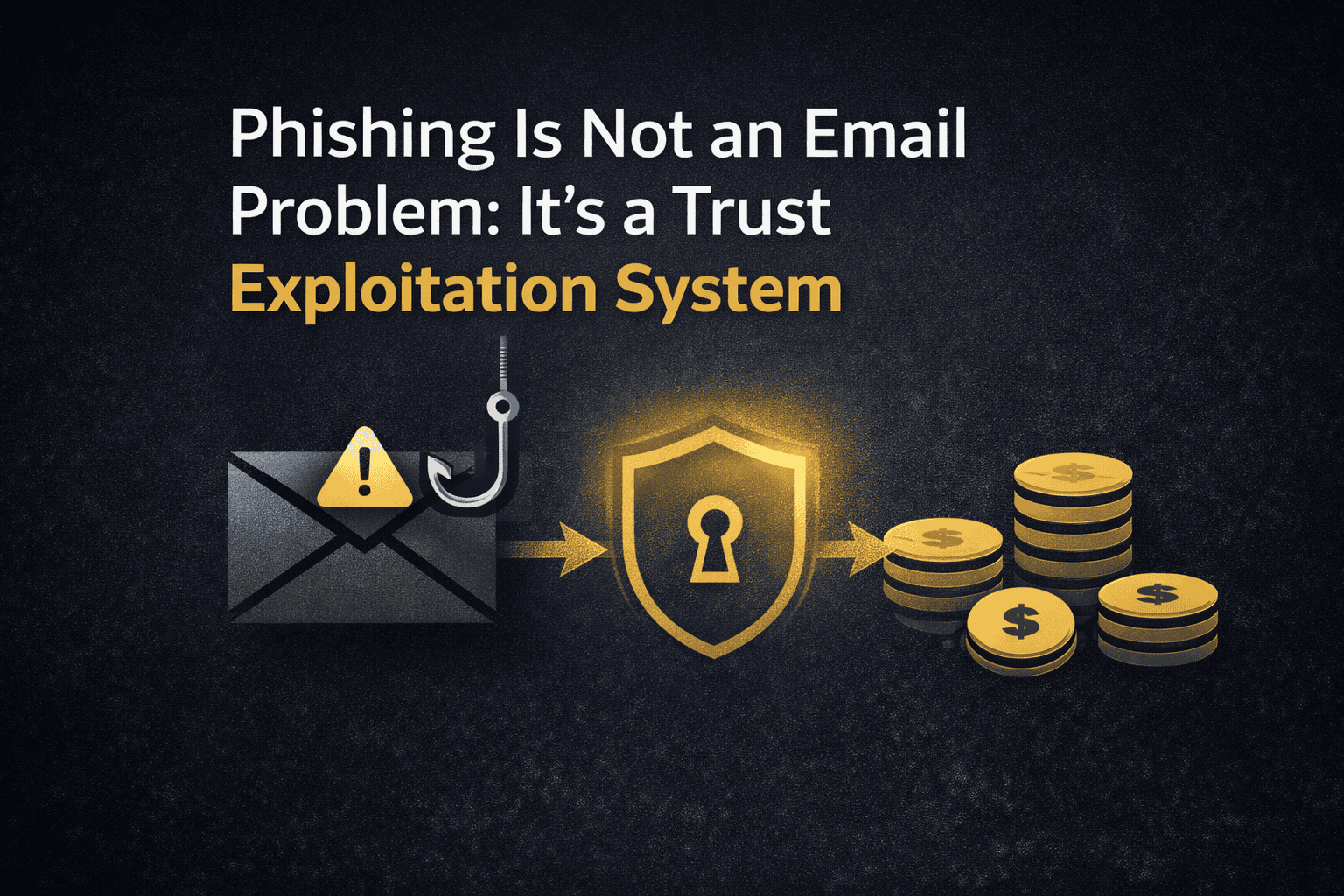
    Phishing is not about emails.

    It is about how attackers exploit trust to gain access to systems, identities, and money.


    The Core Shift: From Fake Emails to Fake Workflows

    Phishing used to be about deception.

    Today, it’s about simulation.

    Attackers no longer try to trick you with obvious scams.
    They recreate:

    • internal processes
    • real communication patterns
    • trusted platforms
    • decision-making moments

    This is called:

    Workflow Mimicry

    A phishing attack succeeds when it feels like a normal task.

    Not when it looks real,
    but when it behaves real.


    The Phishing System (The Phishing Attack System Explained)

    A phishing attack explained in simple terms shows how attackers move from trust to access without breaking systems.

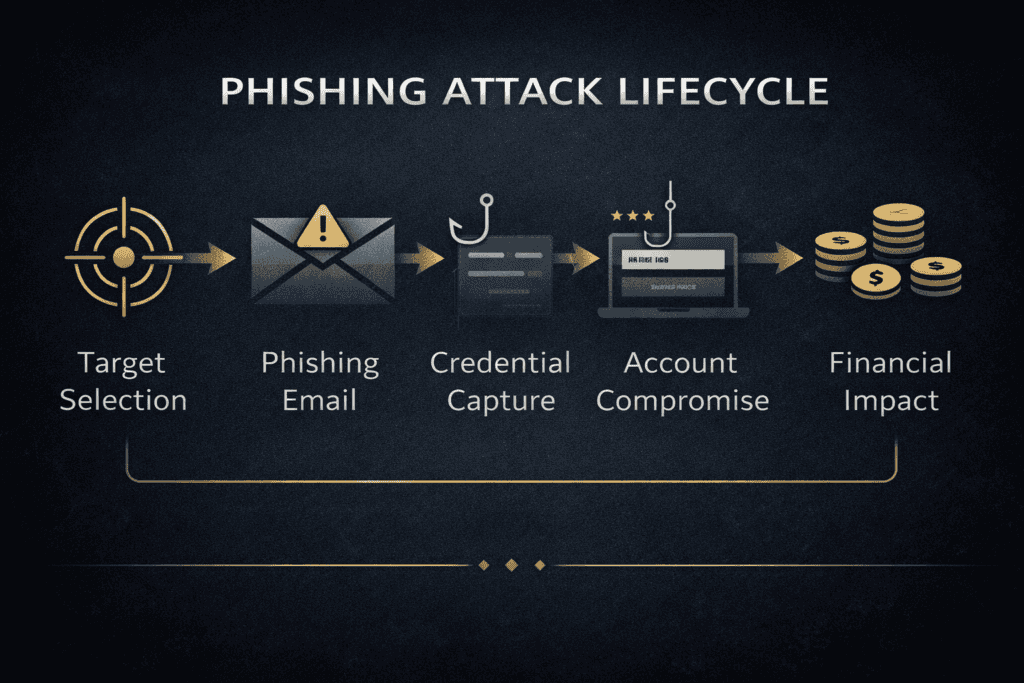
    phishing attack explained process diagram
    Phishing attack explained: a clear breakdown of how attackers move from target selection to credential theft and financial impact.

    Forget the idea of “a phishing email.”

    Phishing is a multi-layer system designed to convert trust into access.

    SYSTEM FLOW

    Target Selection
    → Context Mapping
    → Narrative Engineering
    → Infrastructure Setup
    → Delivery
    → Interaction
    → Identity Capture
    → Account Takeover
    → Persistence
    → Internal Exploitation
    → Monetization


    Layer 1: Narrative Engineering (The Real Weapon)

    The strongest phishing attacks are not technical.

    They are contextual.

    They answer one question:

    “What would this person realistically do right now?”

    Examples:

    • Finance → “Invoice needs approval today”
    • HR → “Updated contract document”
    • Employee → “Your session expired, re-login”
    • Manager → “Quick approval needed before meeting”

    Insight

    Attackers don’t break systems.

    They enter systems by behaving like them.


    Layer 2: Infrastructure (The Invisible Engine)

    Behind every phishing attack is a modular ecosystem.

    Attackers don’t build attacks.
    They assemble them.

    Common components:

    • phishing kits (ready-made login pages)
    • reverse proxies (session interception)
    • compromised websites (hosting)
    • lookalike domains
    • cloud abuse (legit platforms)
    • residential proxies (stealth)

    Insight

    Phishing is not hacking.

    It is logistics + psychology + infrastructure.


    Layer 3: Identity Capture (Where It Actually Happens)

    This is where most people misunderstand phishing.

    It’s not about stealing passwords anymore.

    It’s about capturing:

    • credentials
    • session cookies
    • authentication tokens
    • OAuth permissions

    The New Reality

    Identity is the new perimeter

    Attackers don’t need your system.

    They need to become you.


    Why MFA Alone Is Not Enough

    Many organizations think MFA solved phishing.

    It didn’t.

    Modern attacks use:

    • Adversary-in-the-Middle (AiTM)
    • token theft
    • session hijacking
    • OAuth consent abuse

    Result:

    The attacker logs in with your session, not your password.


    Insight

    Security that protects login
    but not session
    is incomplete.


    Layer 4: Post-Compromise (Where Damage Happens)

    Phishing is just the entry point.

    The real attack starts after access.

    What attackers do next:

    • read emails for context
    • set inbox rules (hide messages)
    • monitor financial communication
    • impersonate internally
    • expand access to other users

    The Most Common Outcome

    Business Email Compromise (BEC)

    Not malware.
    Not ransomware.

    Just:

    • trust
    • timing
    • manipulation

    Layer 5: Monetization (The Endgame)

    Phishing is not about access.

    It’s about value extraction.

    Outcomes:

    • fraudulent payments
    • selling access
    • data theft
    • ransomware staging
    • long-term espionage

    Brutal Truth

    Phishing is lead generation for cybercrime.


    Why Smart People Still Fall for Phishing

    According to CISA, phishing remains one of the most common initial access methods in cyber attacks.

    This is where most explanations fail.

    Phishing does not target stupidity.

    It targets human operating conditions.


    Psychological Triggers

    Phishing is also closely linked to human behavior and decision-making under pressure.

    Authority

    Looks like Microsoft, your boss, or finance.

    Urgency

    “Today.” “Now.” “Action required.”

    Familiarity

    Real logos, real platforms, real workflows.

    Cognitive Load

    You are busy. That’s enough.

    Process Compliance

    You are trained to act on requests.


    Insight

    Phishing works because it aligns with how work actually happens.


    Why Most Organizations Defend This Wrong

    Typical defenses:

    • awareness training
    • email filtering
    • warning banners

    These help, but they miss the core issue.


    The Real Problem

    Phishing is not an email issue.

    It is a:

    Trust + Identity + Process problem


    What Real Defense Looks Like

    This phishing attack explained demonstrates that modern attacks focus on identity, not just emails.

    You don’t fix phishing at one layer.

    You break the system.


    Defense by Layer

    Before Delivery

    • SPF / DKIM / DMARC
    • domain monitoring
    • filtering

    During Interaction

    • browser isolation
    • safe link analysis
    • reporting channels

    Identity Layer

    • phishing-resistant MFA
    • conditional access
    • token protection
    • OAuth governance

    After Compromise

    • detect abnormal inbox rules
    • session revocation
    • token invalidation
    • anomaly detection

    Insight

    Prevention is not enough.

    Detection and response define survival.


    Where Phishing Fits in the Bigger Picture

    Phishing is often the first step in a much larger attack chain.

    To understand how attackers move from initial access to full system compromise, read:

    How Cyber Attacks Actually Happen (Step-by-Step Breakdown)


    The Strategic Reality

    Phishing succeeds because organizations optimize for:

    • speed
    • usability
    • efficiency

    Not verification.


    Final Insight

    Phishing is not an email attack.
    It is a system designed to convert trust into access.


    Want to Go Deeper?

    Understanding how a phishing attack works is step one.

    But protecting yourself requires the right tools and systems.

    🔐 Essential Security Tools

    1. Password Manager (Critical Layer)

    If attackers target identity, your first defense is strong credential management.

    Recommended:

    👉 Use a password manager to:

    • generate strong passwords
    • prevent reuse
    • protect against credential stuffing

    2. Multi-Factor Authentication (MFA Apps)

    Passwords alone are not enough.

    Recommended:

    👉 Always enable MFA on:

    • email accounts
    • banking
    • cloud platforms

    3. Phishing Protection & Browsing Security

    Modern phishing often happens inside the browser.

    Recommended:

    👉 These help:

    • block malicious domains
    • reduce exposure to phishing pages

    4. Endpoint Security (Device Protection)

    If malware is involved, your device becomes the entry point.

    Recommended:


    5. Email Security Awareness (Behavior Layer)

    No tool replaces awareness, but systems help.

    Recommended:

    👉 For individuals:

    • create your own “pause rule” before clicking anything urgent

    6. Identity Monitoring (Advanced Layer)

    Because phishing often leads to identity compromise.

    Recommended:

  • Why MFA Doesn’t Stop Phishing: 7 Critical Weaknesses in Modern Identity Security

    Why MFA Doesn’t Stop Phishing: 7 Critical Weaknesses in Modern Identity Security


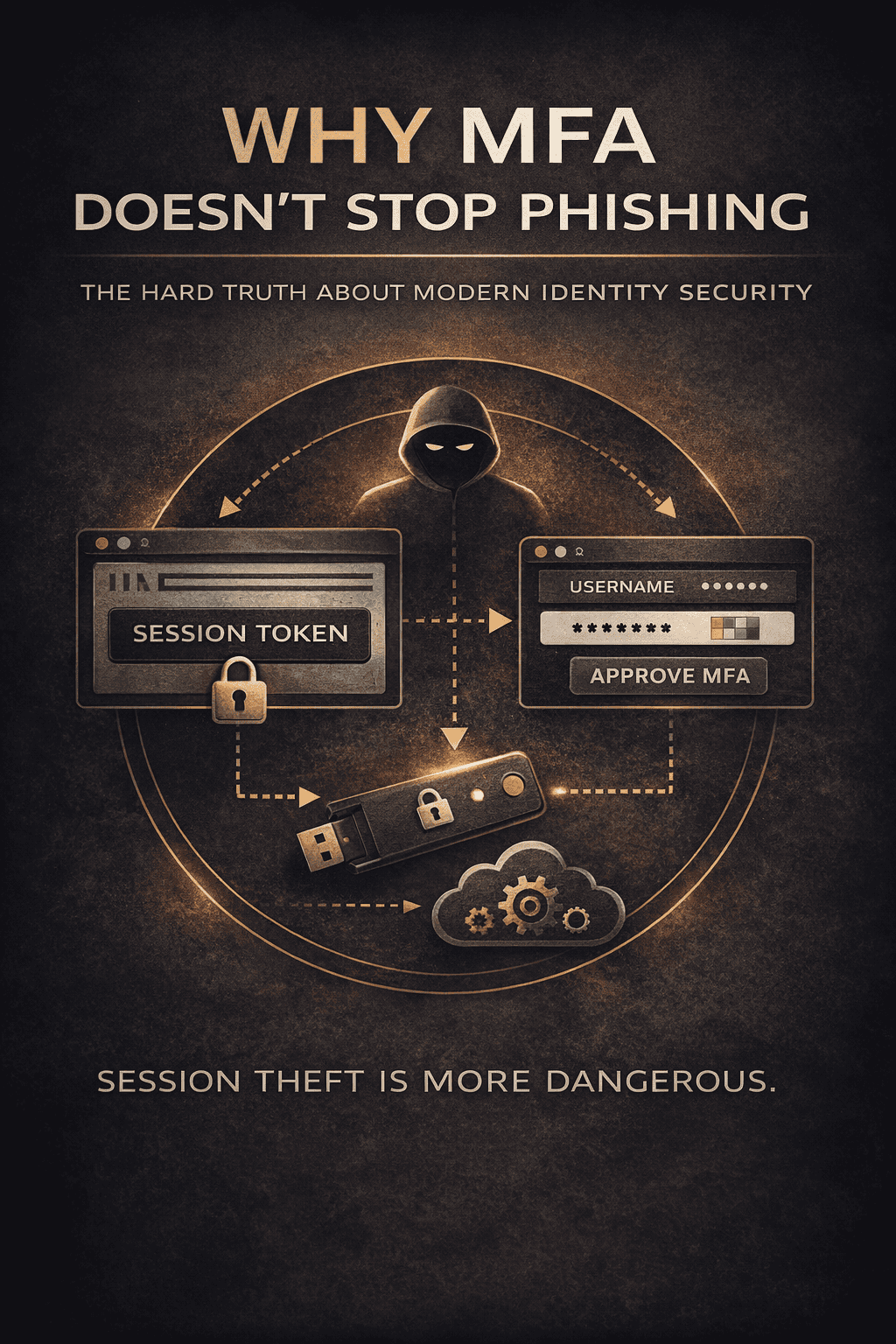
    Why MFA doesn’t stop phishing becomes clear when you understand how attackers target sessions instead of passwords.


    Intro

    Why MFA doesn’t stop phishing is one of the most misunderstood problems in modern cybersecurity.

    Most security teams still operate under an outdated assumption:

    password + MFA = secure account

    That model no longer matches how modern identity attacks work.

    MFA still helps against credential stuffing, password reuse, and basic account takeover. But attackers have adapted. They no longer need to defeat authentication in the old sense. Increasingly, they target the user during the login flow, the session after the login flow, or the trust model surrounding both.

    The result is simple but uncomfortable:

    MFA often protects the login challenge, not the authenticated state that follows it.

    That distinction matters because the real asset in modern cloud environments is no longer just the password. It is the authenticated session: the token, the cookie, the trusted state that survives after the prompt is gone.

    If your security model stops at “MFA enabled,” you are defending the wrong layer.

    This is exactly why MFA doesn’t stop phishing in many real-world attacks.


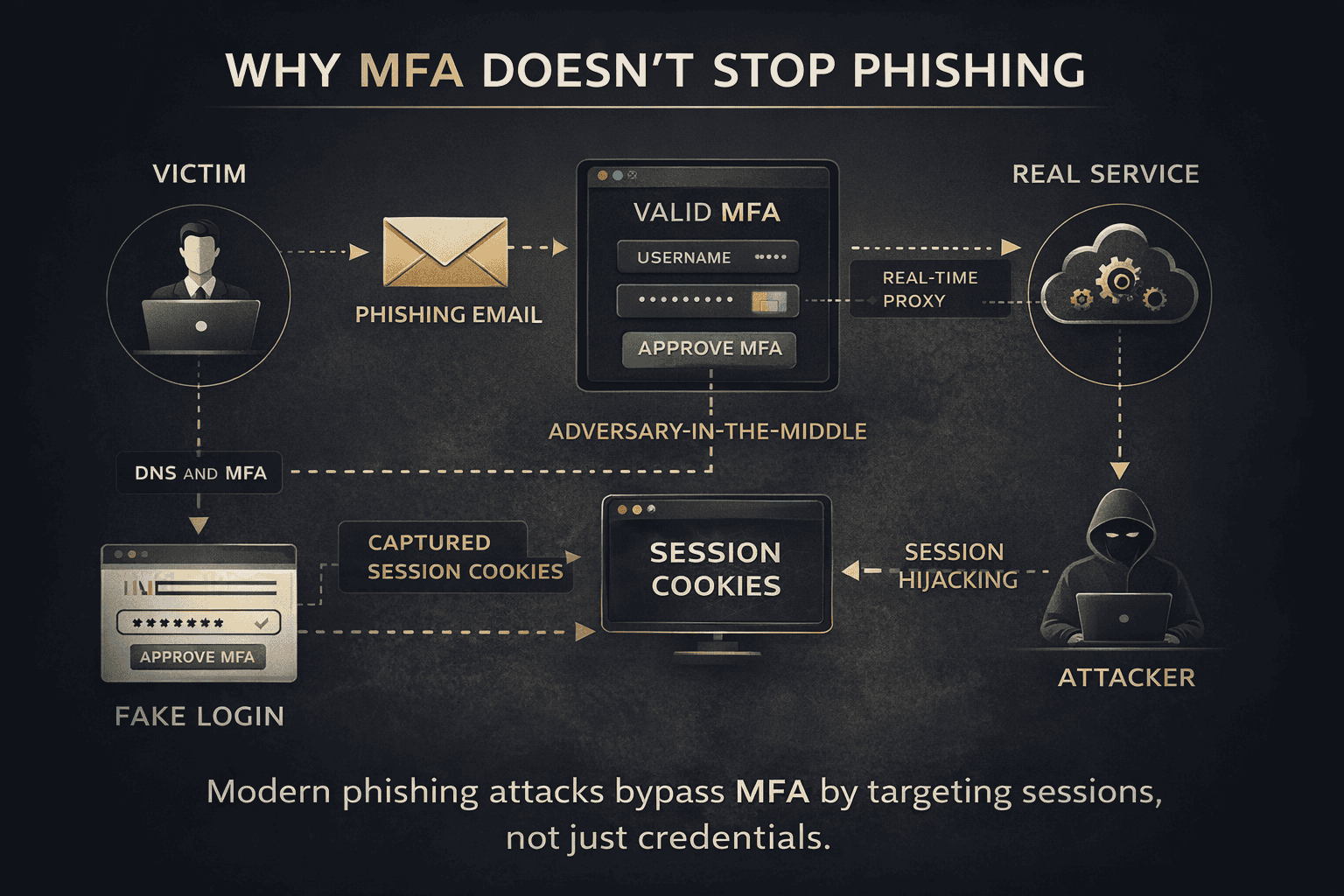
    The diagram below shows exactly how modern phishing bypasses MFA by targeting the session layer.


    why MFA doesn't stop phishing diagram showing session hijacking and AiTM attack flow
    Modern phishing attacks bypass MFA by targeting sessions, not just credentials.

    Why MFA Doesn’t Stop Phishing in Modern Identity Systems


    The Core Mistake: Treating Identity as a Login Event

    Many organizations still think of authentication as a single event. A user enters credentials, completes a second factor, and gets access.

    That is no longer how identity works in practice.

    Modern identity is a chain:

    authentication → token issuance → session establishment → reuse → refresh → policy reevaluation

    MFA protects only one point in that sequence. Everything after it depends on how well the platform protects sessions, evaluates context, enforces device trust, and reacts to risk.

    This is the core strategic mistake in modern identity security:

    teams protect the login, but attackers target the trusted state created by the login.


    Why MFA Solved Yesterday’s Problem

    MFA was designed for a different threat model.

    The old problem looked like this:

    1. attacker steals a password
    2. attacker attempts login
    3. second factor blocks access
    4. attack fails

    Against that model, MFA was and still is a strong improvement over password-only security.

    But identity systems evolved. Cloud services, SaaS platforms, federated sign-in, OAuth, OpenID Connect, SAML, session cookies, access tokens, and refresh tokens changed the attack surface.

    The attacker’s goal shifted from:

    “Can I steal the secret?”

    to:

    “Can I obtain or replay a valid identity state?”

    That is a much more dangerous problem, because a valid session can let an attacker operate as the user without needing to challenge MFA again.


    Where MFA Actually Breaks

    1. Authentication Is Not the Same as Session Trust

    MFA protects the challenge.

    It does not automatically protect what the system issues after the challenge succeeds.

    Once a service grants:

    • session cookies
    • access tokens
    • refresh tokens

    the security question changes. If those artifacts are stolen, replayed, or reused from another context, the service may continue to treat the attacker as legitimate.

    That is why many identity breaches today are not about defeating MFA directly. They are about abusing what happens after MFA succeeds.

    2. Tokens Are the Real Keys in Modern Environments

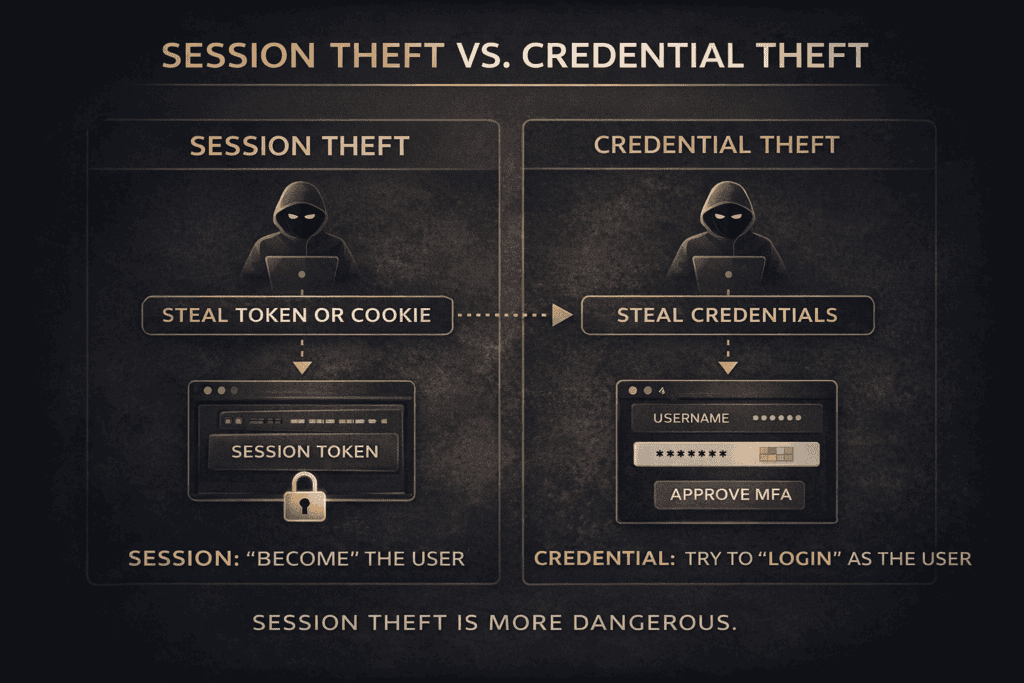
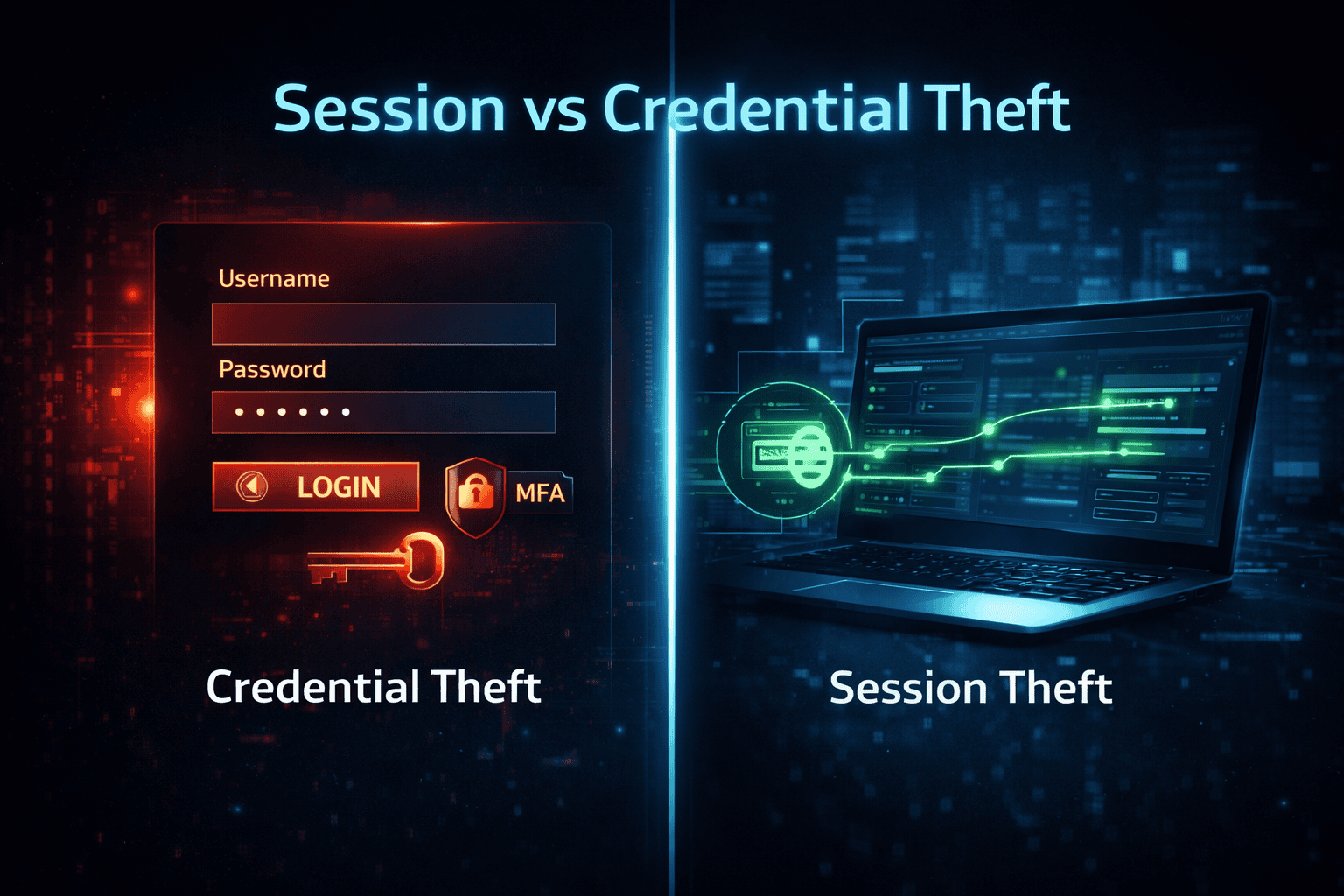
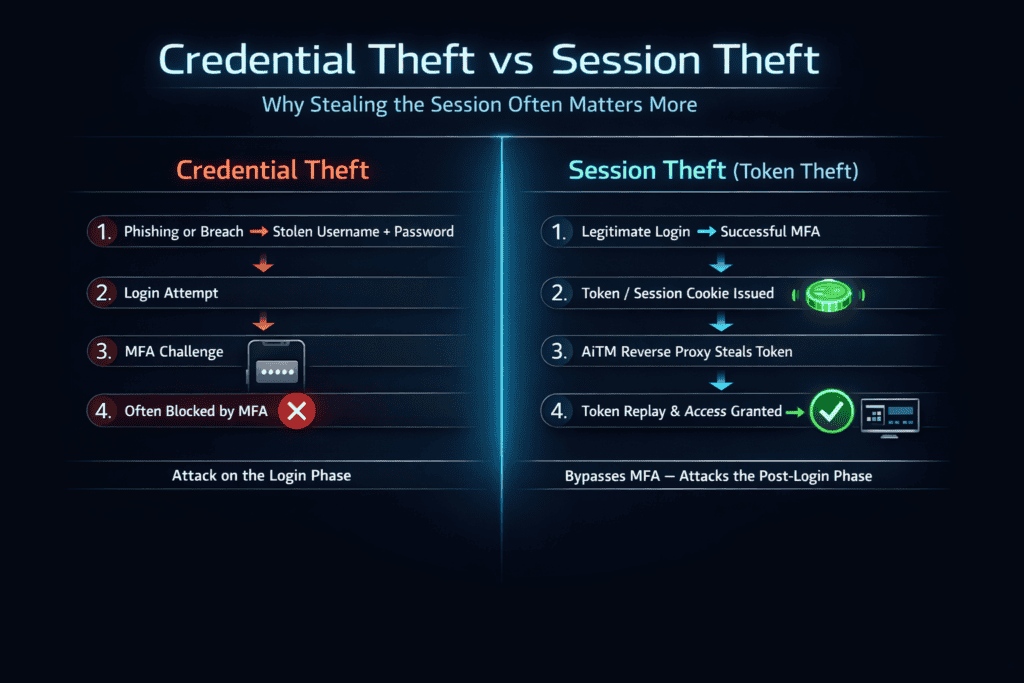
    The diagram below shows the difference between session theft and credential theft in modern identity attacks.

    session vs credential theft diagram showing how attackers hijack sessions instead of stealing passwords
    Session theft allows attackers to act as the user without logging in, making it more dangerous than credential theft.

    In Microsoft 365, Google Workspace, Slack, Salesforce, and similar platforms, access is often governed by tokens and sessions rather than by the password itself.

    That means:

    steal the token, and you may effectively become the user

    This is what makes session theft more dangerous than classic credential theft. The attacker is not trying to guess or crack authentication. The attacker is stepping into an already trusted state.


    3. Trust Often Persists Too Long

    Many organizations still allow sessions to remain valid too long, refresh silently, or avoid meaningful re-evaluation unless the token naturally expires.

    That creates operational space for attackers.

    An account owner may change the password, suspect something is wrong, or even sign out in one location, while a stolen session remains usable elsewhere. If risk-based reevaluation is weak, the attacker keeps the benefit of the earlier trust decision.

    4. The User Remains Inside the Security Boundary

    Push approvals, codes, and interactive login prompts all assume the user can reliably make safe decisions in real time.

    In reality, users are:

    • busy
    • conditioned by repetitive prompts
    • overloaded by email and app notifications
    • operating on mobile devices
    • trained to move quickly

    Modern phishing exploits exactly that environment.

    Attackers do not always need to beat the user. Sometimes they only need the user to cooperate at the wrong moment.

    5. Weak Fallback Paths Undermine Strong Primary Controls

    A company may deploy security keys or passkeys and still leave open:

    • SMS fallback
    • insecure recovery email flows
    • helpdesk override procedures
    • legacy authentication protocols
    • unmanaged device exceptions

    At that point, the environment is not protected by its strongest control. It is exposed through its weakest allowed route.


    The Real Attack Paths That Bypass Traditional MFA

    Adversary-in-the-Middle (AiTM) Phishing

    This is one of the most important identity attack patterns today.

    In an AiTM flow:

    1. the victim clicks a phishing link
    2. the phishing site acts as a reverse proxy between the victim and the real service
    3. the victim enters credentials
    4. the victim completes MFA on the legitimate service through the proxy
    5. the attacker captures the authenticated session
    6. the attacker reuses that session

    This is the hard truth many teams still resist:

    MFA can work exactly as designed and the organization can still lose.

    The problem is not always failed authentication. The problem is successful authentication being captured and repurposed.

    This is the core reason why MFA doesn’t stop phishing when attackers use AiTM techniques.

    Session Hijacking

    In some attacks, the phishing page is not even the main issue.

    If an attacker gets hold of a valid session cookie or token, they may bypass the entire authentication process and operate directly inside the user’s session context.

    This is post-authentication compromise, and it is exactly why login-centric defenses are no longer enough.

    Push Fatigue and Approval Abuse

    Not all MFA bypasses are technically advanced.

    Some are brutally simple:

    • flood the user with push prompts
    • pretend to be IT support
    • create urgency
    • tell the user to approve “to fix the issue”

    The weakness here is not cryptography. It is workflow manipulation.

    OAuth Consent Phishing

    Some attacks do not try to steal credentials at all.

    Instead, the victim is tricked into authorizing a malicious or overprivileged application. Once granted consent, that application may gain persistent access to data, mail, files, or APIs without ever needing the password.

    In these cases, “MFA enabled” is largely beside the point.

    Legacy Authentication and Weak Recovery

    Older protocols, weak password reset processes, unmanaged devices, and insecure exception handling remain common attack paths.

    Security teams often celebrate strong frontline controls while leaving side entrances open.

    Attackers notice that immediately.


    The Real Shift: From Credentials to Identity State

    The old mental model was simple:

    steal password → gain access

    The new model is more accurate:

    obtain valid identity state → operate as the user

    That identity state may include:

    • an authenticated session
    • valid access or refresh tokens
    • a trusted device context
    • an approved OAuth application
    • a low-risk sign-in posture in the identity provider

    This is why identity defense now has to move beyond passwords and beyond the login screen.

    The real perimeter is no longer static authentication.

    It is dynamic session integrity.


    Why Traditional Security Awareness Falls Short

    Most awareness programs still teach users to:

    • avoid suspicious links
    • check for spelling mistakes
    • look at the sender address

    That is not enough against modern phishing.

    Today’s attacks are often:

    • visually convincing
    • contextually relevant
    • timed to business processes
    • proxied through realistic login flows
    • designed to exploit approval habits, not obvious mistakes

    The skill users actually need is more advanced:

    they must know when not to approve identity-related actions, even when the flow feels familiar.

    Security awareness has to evolve from “spot the typo” to recognizing abnormal identity workflows under pressure.


    Why MFA Feels Safer Than It Sometimes Is

    There is a dangerous psychological effect here.

    When a user sees:

    • a familiar Microsoft or Google login flow
    • a real MFA prompt
    • a successful sign-in

    they often interpret that as proof of legitimacy.

    But in an AiTM attack, the attacker is relaying that exact flow in real time.

    That means MFA can become, in the user’s mind, a false signal of trust rather than a reliable signal of safety.

    This does not mean MFA is useless.

    It means traditional MFA is often context-blind.

    It verifies that a factor was completed. It does not always verify that the authentication request is happening in the right place, on the right origin, under the right conditions.


    What Actually Works

    1. Use Phishing-Resistant Authentication

    The strongest structural improvement is to adopt:

    • FIDO2 security keys
    • passkeys
    • device-bound cryptographic authenticators

    These methods are stronger because they use origin binding and asymmetric cryptography. The private key stays on the device, and the authentication response is tied to the legitimate domain.

    That sharply reduces the value of proxy-based phishing because the attacker cannot simply relay or replay the authentication on another origin.

    This is not just “better MFA.”

    It is a different security property.

    2. Enforce Device and Context Trust

    Authentication without context is weak.

    A stronger model asks:

    • is this a compliant device?
    • is the browser trusted?
    • does the location make sense?
    • is the sign-in risky?
    • is the user’s behavior consistent?
    • should this session exist under these conditions?

    This is where Conditional Access, device compliance, managed browsers, and risk-based policies become critical.

    3. Reevaluate Trust Continuously

    A session should not remain trusted simply because it was once established successfully.

    Continuous reevaluation matters because risk changes over time.

    A user account may become high risk. A token may appear in a suspicious context. A session may suddenly behave differently from its baseline.

    If reevaluation is slow, attackers keep access longer than they should.

    If reevaluation is fast, dwell time shrinks.

    4. Treat Tokens as High-Value Secrets

    Many teams still protect passwords more seriously than tokens.

    That is backwards.

    In modern cloud identity, tokens are temporary keys to systems, data, and workflows. They should be protected, bounded, monitored, and invalidated aggressively when risk changes.

    5. Detect Abuse After Authentication

    A major failure in many programs is that visibility drops after login succeeds.

    That is the wrong point to stop watching.

    Teams need detection for:

    • unusual session reuse
    • mailbox rule manipulation
    • abnormal API behavior
    • suspicious OAuth consent activity
    • unusual access patterns after sign-in
    • token reuse from unexpected contexts

    The breach often becomes visible only after authentication is complete.

    6. Eliminate Weak Fallbacks

    Strong identity systems cannot coexist comfortably with weak recovery and legacy exceptions.

    If you allow phishable fallback methods, attackers will route around your best control.

    This is why many identity hardening projects fail. The organization deploys something strong, then preserves enough weak exceptions to keep the overall environment exposed.

    7. Build Real Identity Incident Response

    A password reset is not enough for a modern identity compromise.

    Effective response may require:

    • global session revocation
    • token invalidation
    • mailbox rule review
    • OAuth application audit
    • device posture review
    • sign-in log analysis
    • consent and persistence investigation

    Identity incidents are not isolated events. They are distributed trust failures across time, devices, sessions, and services.


    The Strategic Reality

    MFA is not broken.

    The problem is that many organizations treat MFA as the end of the identity conversation when it is only one control inside a much larger trust system.

    That is the real failure:

    an incomplete identity model disguised as a mature security posture


    The Hard Truth in One Sentence

    MFA does not protect your account as a whole.
    It protects a single moment in the authentication flow.

    Modern attackers increasingly target:

    • the user during the flow
    • the session after the flow
    • the trust model around the flow

    That is why checkbox MFA is not enough.


    What This Means for Security Leaders

    If your message is still:

    “We enabled MFA, so we are covered”

    you are behind the current threat model.

    If your strategy is:

    • phishing-resistant authentication
    • session governance
    • device trust
    • continuous reevaluation
    • post-authentication detection
    • hard recovery architecture

    then you are defending identity at the level where modern attacks actually happen.

    That is the difference between compliance language and operational reality.


    Move Beyond Checkbox MFA

    Understanding why MFA doesn’t stop phishing is critical for modern identity security.

    Modern phishing does not stop at the login page. Your defenses should not stop there either.

    If you want a serious view of your exposure, the right question is not “Do we have MFA?”

    The right question is:

    Can an attacker still obtain, replay, or persist a trusted identity state in our environment?

    That is where real identity security starts.


    Book an Identity Architecture Review

    If your organization runs on Microsoft 365 or Microsoft Entra ID, we can map the identity attack surface that traditional MFA leaves behind.

    The review focuses on:

    • AiTM exposure
    • token and session risk
    • Conditional Access gaps
    • fallback weaknesses
    • identity recovery blind spots

    You get a prioritized hardening view based on real attack paths, not generic compliance talk.

    [Schedule Your Review →]


    Link this article to:

    • What Is AiTM Phishing and Why It Beats Traditional MFA
    • Passkeys vs MFA Apps: What Actually Changes
    • Why Session Cookies Matter More Than Your Password
    • How Conditional Access Shrinks the Damage of Identity Attacks
    • Why “MFA Enabled” Is a Weak Security KPI

  • What Is AiTM Phishing and Why It Bypasses MFA

    What Is AiTM Phishing and Why It Bypasses MFA


    Introduction

    A user enters their password.
    They approve the MFA request.
    Everything looks normal.

    And yet the attacker logs in anyway.

    This is not a failure of the user.
    It is a failure of how identity security is designed.

    Adversary in the Middle phishing is one of the most effective attack techniques today because it does not break authentication. It operates inside it.

    If your organization relies on passwords and MFA alone, you are exposed.


    What Is AiTM Phishing

    AiTM phishing is an attack where the attacker places a proxy between the user and the real login service.

    The user believes they are logging into a legitimate platform such as Microsoft 365. In reality, their traffic is routed through an attacker-controlled proxy.

    This allows the attacker to capture:

    • Credentials
    • MFA responses
    • Session cookies and tokens

    The critical detail is this:

    The attacker does not need to break authentication.
    They capture the result of successful authentication.


    How AiTM Attacks Actually Work

    Step 1: Lure

    The attacker sends a phishing message that looks legitimate. This could be a document share, login request, or security alert.

    Step 2: Proxy

    The victim lands on a page that perfectly mirrors the real login page.
    This is not a static fake site. It is a live relay to the real service.

    Step 3: Credential Input

    The user enters their username and password.
    The proxy forwards these to the real service.

    Step 4: MFA Challenge

    The real service triggers MFA.
    The user approves it.

    Step 5: Token Issuance

    The identity provider issues:

    • Session cookies
    • Access tokens
    • Refresh tokens

    This is the moment where trust is granted.

    Step 6: Interception

    The proxy captures these tokens in real time.

    Step 7: Session Replay

    The attacker reuses the tokens to access the account.

    No password required
    No MFA required


    Image Block

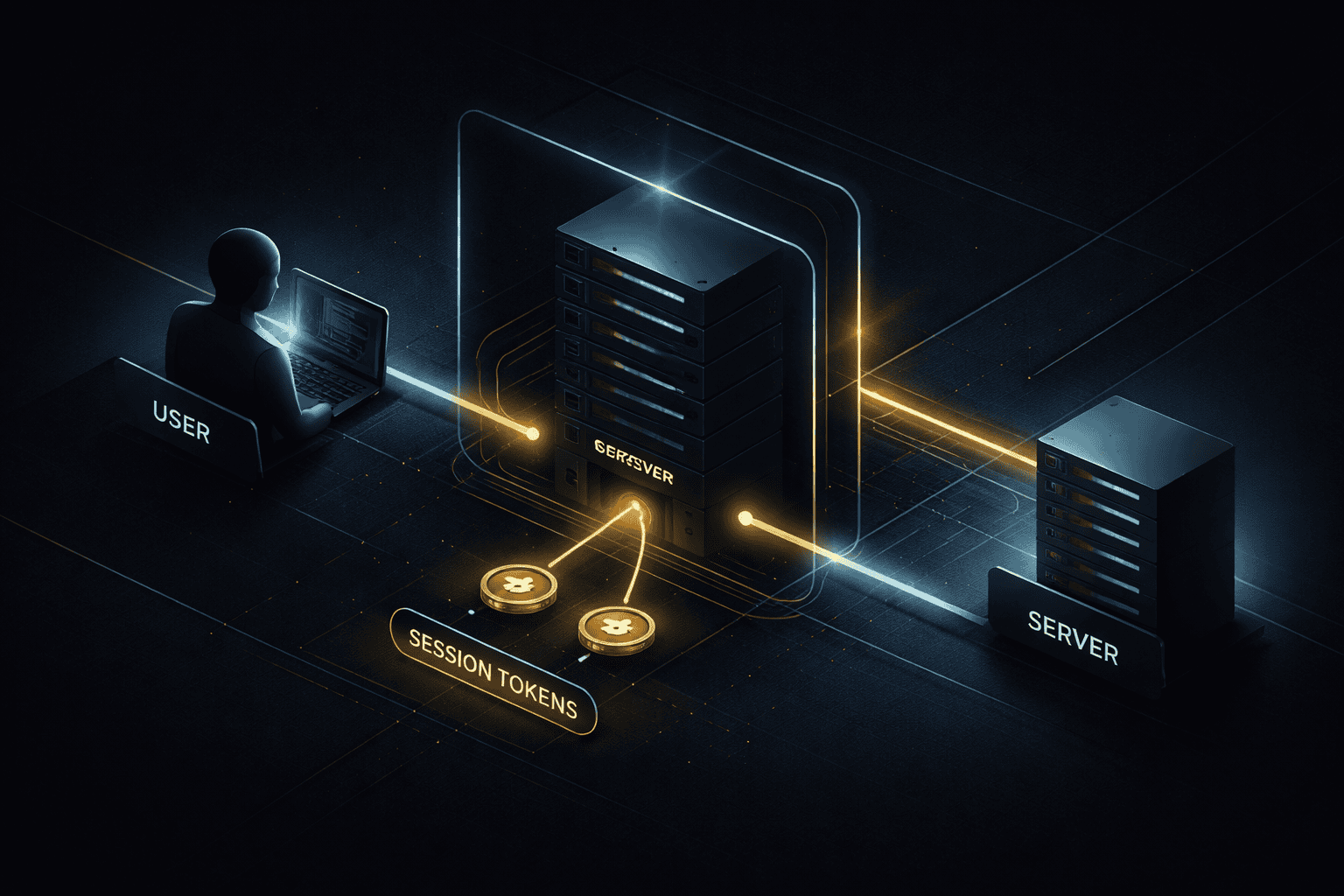
    Image prompt:
    A dark minimal cybersecurity diagram showing a user connecting to a login server through a hidden proxy layer in the middle. Clean flow arrows from user to proxy to server. Highlight the interception point at token issuance. Dark blue and black background with subtle gold accents. No hacker clichés.

    Alt text:
    AiTM phishing proxy intercepting authentication session between user and server

    Caption:
    AiTM attacks intercept trust at the moment authentication succeeds


    Why MFA Fails Against AiTM

    MFA was designed to protect against credential theft.

    It works when:

    • A password is stolen
    • An attacker tries to log in separately

    It fails when:

    • The attacker is inside the login flow

    Once authentication succeeds, the system issues a session token.

    That token represents access.

    AiTM attacks target this exact moment.

    This is why MFA enabled is not a strong security guarantee.


    The Real Problem: Session Trust

    Modern identity systems such as Microsoft Entra ID rely on token-based authentication models. According to Microsoft Entra ID documentation, session tokens represent authenticated access and are reused across services.

    Industry guidance such as the OWASP Session Management Cheat Sheet shows how improper session handling increases the risk of session hijacking attacks.

    Modern identity systems rely on:

    • Single Sign On
    • OAuth and OpenID Connect
    • Token-based authentication

    Authentication is no longer a single event.
    It is the beginning of a session.

    After login, the system grants trust through tokens.

    These tokens:

    • Are often not bound to a device
    • Are rarely continuously validated
    • Can be reused if stolen

    This creates a gap between authentication and session ownership.

    AiTM phishing operates inside that gap.


    Session Theft vs Credential Theft

    AiTM phishing changes how we should think about identity attacks.

    Most organizations still think in terms of credentials.

    They ask: did the attacker get the password?

    Modern attacks ask a different question.

    Did the attacker get the session?

    Credential theft:

    • Password is stolen
    • MFA may still stop access

    Session theft:

    • Token is stolen
    • MFA already completed
    • Immediate access

    This is a completely different threat model that many organizations fail to understand.

    AiTM phishing proves that session security is now the primary attack surface.


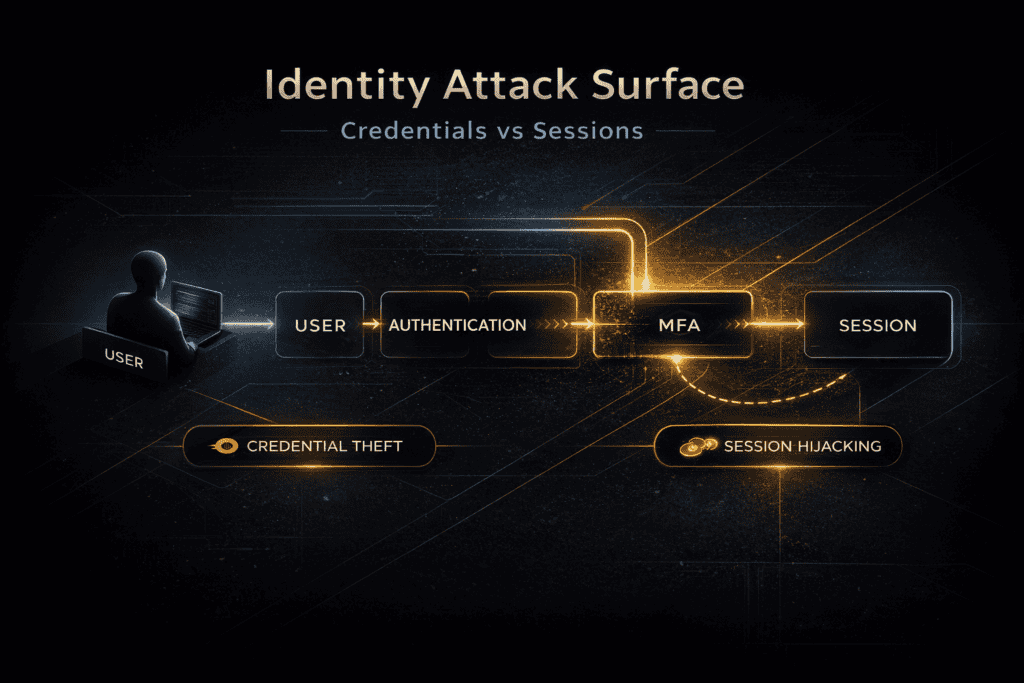
    AiTM phishing identity attack surface showing session theft after MFA token issuance
    AiTM phishing intercepts the session after MFA, highlighting why session tokens are the real attack target

    Why This Attack Works

    AiTM is not just technical. It leverages human behavior.

    • Trust in familiar login pages
    • Routine approval of MFA requests
    • Authority of known brands
    • Real-time interaction without delay

    The user completes the attack themselves without noticing.


    Impact of AiTM Attacks

    Direct Impact

    • Account takeover
    • Access to email and files

    Operational Impact

    • Business Email Compromise
    • Invoice fraud
    • Internal phishing

    Strategic Impact

    • Privilege escalation
    • Tenant-wide compromise
    • Supply chain exposure

    One successful session can lead to a full attack chain.


    How to Reduce AiTM Risk

    You cannot fully eliminate AiTM. You can reduce exposure.

    Identity controls

    • Conditional Access policies
    • Device compliance enforcement
    • Location-based restrictions
    • Risk-based authentication

    Session controls

    • Short session lifetimes
    • Session binding to device or context
    • Continuous evaluation of sessions

    Strong authentication

    • Passkeys
    • Hardware security keys

    These methods are resistant to proxy-based attacks.

    User awareness

    • Focus on login flow manipulation
    • Avoid generic phishing training

    • How Cyber Attacks Happen
    • Phishing Attack Explained
    • Why MFA Does Not Stop Phishing
    • Session vs Credential Theft
    • Why Session Cookies Matter More Than Your Password

    CTA

    Identity Security Review

    AiTM phishing risk assessment for Microsoft 365 environments.

    If your organization uses Microsoft 365 or Entra ID, relying on MFA alone is not enough.

    We analyze:

    • Where session theft is possible
    • Where MFA creates false confidence
    • Where Conditional Access reduces real risk

    You get a clear and prioritized hardening plan based on real attack paths.


    Conclusion

    AiTM phishing works because it targets the gap between authentication and access.

    Not the password.
    Not the MFA code.

    The session.

    As long as systems treat authentication as a one-time event and trust as persistent, this attack will continue to work.


    Internal Linking Suggestions

    Pillar:

    Supporting:

  • Session vs Credential Theft: 7 Critical Differences That Expose a Hidden Security Risk (2026)

    Session vs Credential Theft: 7 Critical Differences That Expose a Hidden Security Risk (2026)


    Session vs credential theft is no longer a theoretical distinction. It is the defining shift in modern identity attacks.

    Most security teams still focus on protecting login.

    Strong passwords. MFA. Reset flows.

    But attackers have adapted.

    They no longer break in.
    They steal the trust issued after login.

    According to Microsoft’s Digital Defense Report, adversary-in-the-middle phishing attacks are rapidly increasing as attackers shift toward session token theft. Meanwhile, OWASP and MITRE ATT&CK confirm the same reality: once a session token is stolen, authentication no longer matters.

    This is where most defenses fail.


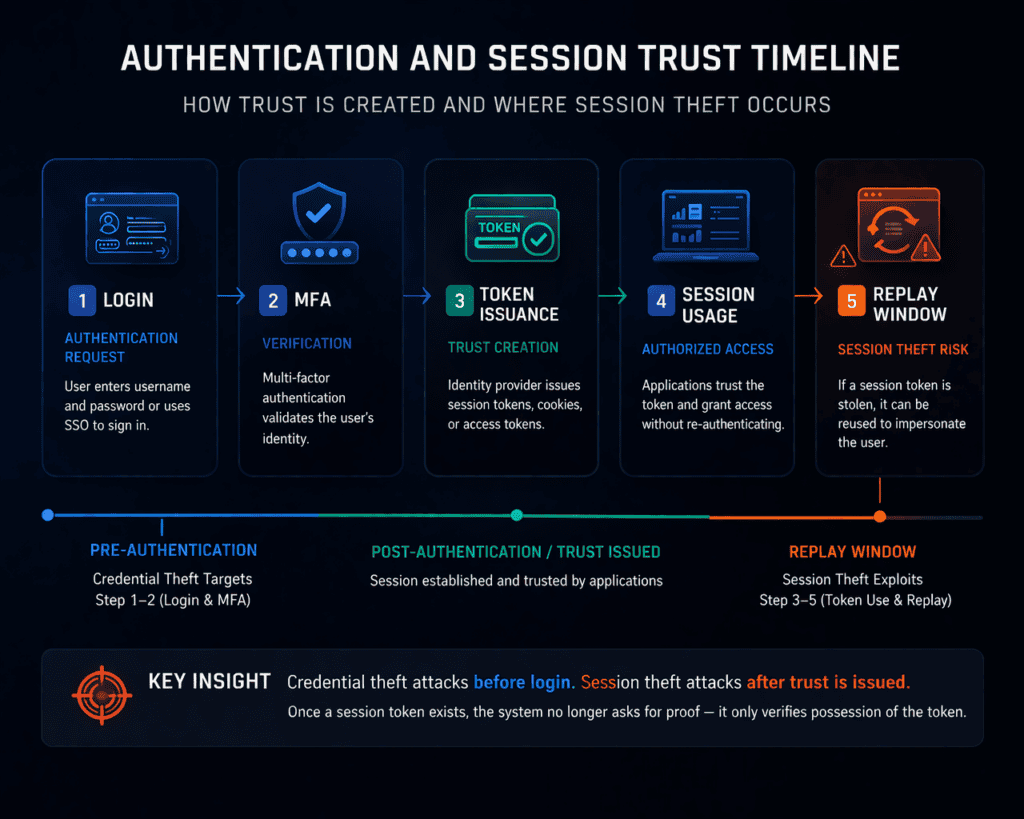
    The Trust Timeline Explained

    Every identity system follows the same structure:

    1. Authentication request
      User initiates login
    2. Verification
      Credentials and MFA validated
    3. Trust issuance
      Tokens and cookies are created
    4. Ongoing access
      System trusts the session
    5. Replay window
      Stolen tokens can be reused

    Key distinction:

    Credential theft attacks steps 1–2
    Session theft attacks steps 3–5


    Trust timeline showing the authentication flow from login and MFA to token issuance and where session theft occurs in session vs credential theft
    How digital trust is built during login and where attackers exploit the session after MFA is completed

    Extra variaties (voor verschillen

    Credential Theft vs Session Theft

    Credential theft targets login secrets:

    • Passwords
    • MFA codes
    • API keys
    • Stored browser credentials

    How it happens:

    • Phishing pages
    • Credential stuffing
    • Database breaches
    • Keyloggers
    • Credential dumping

    Real-world flow:

    1. Credentials stolen
    2. Login attempted
    3. MFA triggered
    4. Attack often blocked

    Key reality:

    Credential theft gives opportunity, not guaranteed access.


    Session Theft vs Credential Theft in Practice

    Session theft targets what happens after login:

    • Session cookies
    • Access tokens
    • Refresh tokens
    • SSO artifacts

    Once stolen, these allow full impersonation.

    How it happens:

    • AiTM phishing
    • Infostealer malware
    • Browser compromise
    • XSS attacks
    • Token replay

    Real-world flow:

    1. User logs in normally
    2. MFA succeeds
    3. Token issued
    4. Token captured
    5. Attacker reuses it
    6. Access granted

    No password needed
    No MFA needed


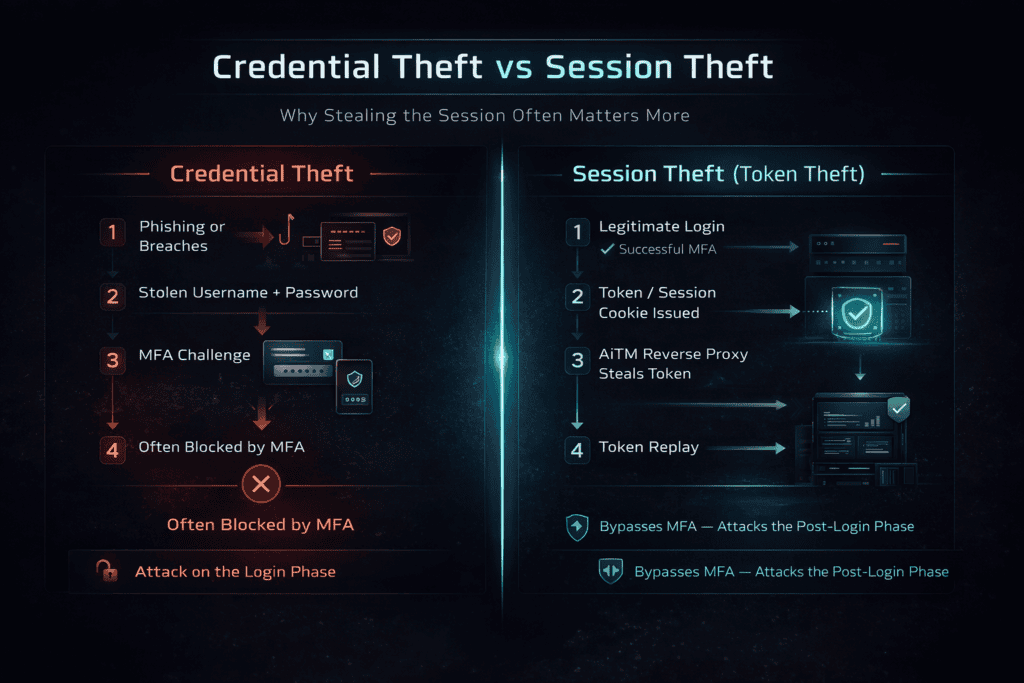
    Side-by-side comparison of credential theft vs session theft attack paths showing how MFA often blocks login attacks but session token replay bypasses MFA
    Clear difference between attacking the authentication phase (credential theft) and attacking the post-authentication phase (session theft). Session theft bypasses MFA because the token is stolen after successful login.

    How AiTM Connects Credential Theft and Session Theft

    Adversary-in-the-Middle attacks combine both layers.

    A reverse proxy sits between the victim and the real service:

    • Captures credentials during login
    • Captures tokens after login
    • Relays everything live

    Result:

    The attacker gets credentials and active session access.

    This is why MFA alone is no longer enough.

    👉 Related: AiTM Phishing Explained


    Credential Theft vs Session Theft Differences

    Target
    Credential Theft → login secrets
    Session Theft → session tokens

    Stage
    Credential Theft → pre-authentication
    Session Theft → post-authentication

    Goal
    Credential Theft → login attempt
    Session Theft → session reuse

    MFA Impact
    Credential Theft → often blocked
    Session Theft → bypassed

    Detection
    Credential Theft → visible login anomalies
    Session Theft → looks legitimate

    Persistence
    Credential Theft → until password reset
    Session Theft → until token expires


    Why Session Theft Is More Dangerous

    Attackers follow efficiency.

    As defenses improve:

    • Passwords get stronger
    • MFA adoption increases
    • Credential reuse decreases

    Attackers shift forward:

    From login to session.

    Today’s underground markets sell:

    • Live session cookies
    • Browser fingerprints
    • Authenticated sessions

    The attack surface has moved.


    The System Behind Session Theft

    Session theft exists because of system design:

    Identity providers
    Issue tokens after authentication

    Applications
    Trust tokens as identity

    Browsers
    Store tokens locally

    Security teams
    Measure login, not session

    Most dashboards show:

    • MFA enabled ✔️
    • Password strong ✔️

    But ignore:

    • token replay
    • session anomalies
    • device trust

    Defense Strategy for Session vs Credential Theft


    Defending the Login Layer

    • Strong passwords
    • Phishing-resistant MFA (passkeys)
    • Login anomaly detection
    • Credential stuffing protection

    Important but insufficient


    Defending the Session Layer

    Token Binding
    Tie tokens to devices

    Device Trust
    Allow only compliant endpoints

    Short Lifetimes
    Reduce replay window

    Session Monitoring
    Detect abnormal behavior

    Cookie Hardening
    Secure, HttpOnly, SameSite

    Endpoint Security
    Stop infostealers


    Real-World Scenarios

    Scenario A Credential Theft

    Phishing → login → MFA → blocked

    Scenario B Session Theft

    Proxy → MFA success → token stolen → access granted

    Same user
    Same MFA
    Different outcome


    Bottom Line

    Credential theft steals the ability to try.

    Session theft steals the proof that access was already granted.

    Once trust is issued, most systems stop asking questions.

    That is exactly where attackers operate.


    CTA Identity Security Upgrade

    If your organization relies on Microsoft 365 or Entra ID, you likely have blind spots in your session layer.

    Book an Identity Security Review:

    • AiTM exposure mapping
    • Token replay risk
    • Conditional Access gaps
    • Session lifecycle weaknesses

    Or download:

    Identity Hardening Checklist 2026
    Can your MFA survive session theft


    Internal Linking (Cluster)

    Pillar:
    How Cyber Attacks Happen

    Supporting:
    Phishing Attack Explained
    Why MFA Doesn’t Stop Phishing
    Why Session Cookies Matter More Than Your Password


    Next in this Series

    Next: Why Session Cookies Matter More Than Your Password

    This article will break down how cookies work, why they are a critical weak point, and how attackers exploit them in real environments.

  • Why Session Cookies Matter More Than Your Password

    Why Session Cookies Matter More Than Your Password


    Most people still think the password is the main thing protecting an account.

    It is not.

    Why session cookies matter more than your password becomes clear the moment you understand what happens after login. Your password only matters at the front door. After authentication, the system shifts trust to something else entirely: the session.

    Once a user signs in, the application stops checking the password on every request. It checks whether the browser presents a valid session token.

    That changes everything.

    Modern attackers don’t always need credentials anymore. If they can steal the active session, they can bypass login, bypass MFA, and inherit access instantly.


    credential theft vs session theft diagram showing MFA bypass with session cookies
    Credential theft targets the login. Session theft bypasses it completely.


    HTTP is stateless. Every request is independent unless the application adds memory.

    That memory is the session.

    After login, the server issues a session cookie. The browser automatically sends it with every request. The application treats those requests as authenticated.

    Key insight:

    The password gets you in once.
    The session keeps you in.

    This is exactly why session cookies matter more than your password becomes a critical concept in modern identity security.


    Why Session Cookies Matter More Than Your Password

    1. A session cookie can bypass authentication entirely

    A password is used to create trust. A session cookie represents trust that has already been granted.

    If an attacker steals a valid session cookie, they usually do not need to know the password at all. They also may not need to pass MFA, because MFA was already completed during the original sign-in flow. The attacker simply reuses the authenticated session.

    This is what makes session hijacking so dangerous. The attacker is not attacking the login process. They are skipping it.

    2. Session theft is often faster than credential theft

    Credential attacks usually require one or more steps:

    • phishing the victim
    • cracking weak passwords
    • reusing breached credentials
    • bypassing or intercepting MFA
    • avoiding login-based detections

    Session theft removes much of that work.

    If malware, an AiTM phishing proxy, a malicious browser extension, or a browser compromise can extract the active session, the attacker gets immediate usable access. In many cases, that is operationally easier than stealing credentials and then dealing with the controls that sit around th

    3. A valid session looks legitimate to the application

    That is one of the hardest realities in identity security. Many detections are designed around authentication events such as impossible travel, new-device sign-ins, unusual IP addresses, failed login bursts, or MFA fatigue patterns. But once a request arrives carrying a valid session token, the platform may treat it as normal application traffic.

    That makes session abuse quieter than credential abuse.

    4. Sessions can remain active for a long time

    Many users assume a session lasts only a few minutes. In reality, that is often false.

    Modern applications may keep users signed in for days or weeks. Some use refresh tokens, silent reauthentication, or “remember this device” behavior that extends practical access even further. In SaaS environments, that can give an attacker a large post-compromise window.

    A stolen password is dangerous. A stolen active session is dangerous right now.

    5. MFA protects the login event, not the ongoing session

    This is the misunderstanding that causes false confidence.

    MFA is valuable. It raises the cost of account compromise and blocks many basic attacks. But MFA does not automatically protect the session that exists after the user signs in. Once the platform has issued a valid session token, possession of that token may be enough to act as the user.

    This is exactly why session-based attacks keep growing. Organizations celebrate MFA adoption while attackers move one layer deeper.

    6. Modern attackers increasingly target sessions instead of passwords

    The industry is slowly learning that identity attacks are shifting from credential collection to session capture.

    That shift shows up in several places:

    • AiTM phishing kits that proxy the real login flow and steal the post-authentication session
    • info-stealer malware that extracts browser cookies and tokens
    • malicious browser extensions with excessive permissions
    • cloud identity attacks that focus on token replay rather than password guessing

    The logic is simple. Stronger passwords and wider MFA deployment made direct credential abuse harder

    7. The session is the real operational identity layer

    Security teams often talk about identity as if it begins and ends with passwords, MFA apps, or passkeys.

    That is incomplete.

    Operationally, the session is what the application trusts on each request. That makes session management one of the most important and most underestimated layers in account security. If the session is weak, poorly scoped, too long-lived, or easy to steal, then the strength of the password matters much less than people think.


    Understanding this attack surface is essential to grasp why session cookies matter more than your password in real-world breaches.

    Session cookie theft does not require one single technique. It can happen through multiple attack paths, and that is what makes it dangerous.

    AiTM Phishing

    Reverse proxy attacks capture sessions after MFA.


    How Cyber Attacks Happen: Step-by-Step Breakdown
    What Is AiTM Phishing and Why It Bypasses MFA


    In an adversary-in-the-middle phishing attack, the victim is lured to a phishing site that sits between them and the legitimate service. The victim enters credentials, completes MFA, and the real site issues a valid session. The phishing proxy captures that session token and hands it to the attacker.

    The attacker never needs to defeat MFA directly. They inherit the result of a legitimate MFA flow.

    Info-stealer malware

    Many modern malware families are designed to scrape browsers for stored credentials, cookies, and tokens. In practice, this means they are not just stealing usernames and passwords. They are stealing already authenticated states.

    That can give the attacker immediate access to email, development platforms, enterprise SaaS tools, and cloud-admin surfaces.

    XSS

    If a website is vulnerable to cross-site scripting and cookies are not properly protected with HttpOnly, malicious scripts may be able to read and exfiltrate them. That turns a client-side injection flaw into a session compromise.

    Malicious or over-permissioned browser extensions

    Extensions are often ignored in security conversations, but they can become a direct path into sessions. If an extension can read page content, intercept traffic, or access browser storage in dangerous ways, it may expose authentication artifacts.

    Unsecured transport or legacy weaknesses

    Plain HTTP, weak internal apps, bad reverse proxies, and poorly designed legacy systems can still expose session data in transit. This is less common than before, but it still matters in older environments and internal tooling.

    Physical access to an unlocked device

    Not every session attack is advanced. If a browser is open and the user is authenticated, an attacker with device access may not need the password at all. They already have the session in front of them.


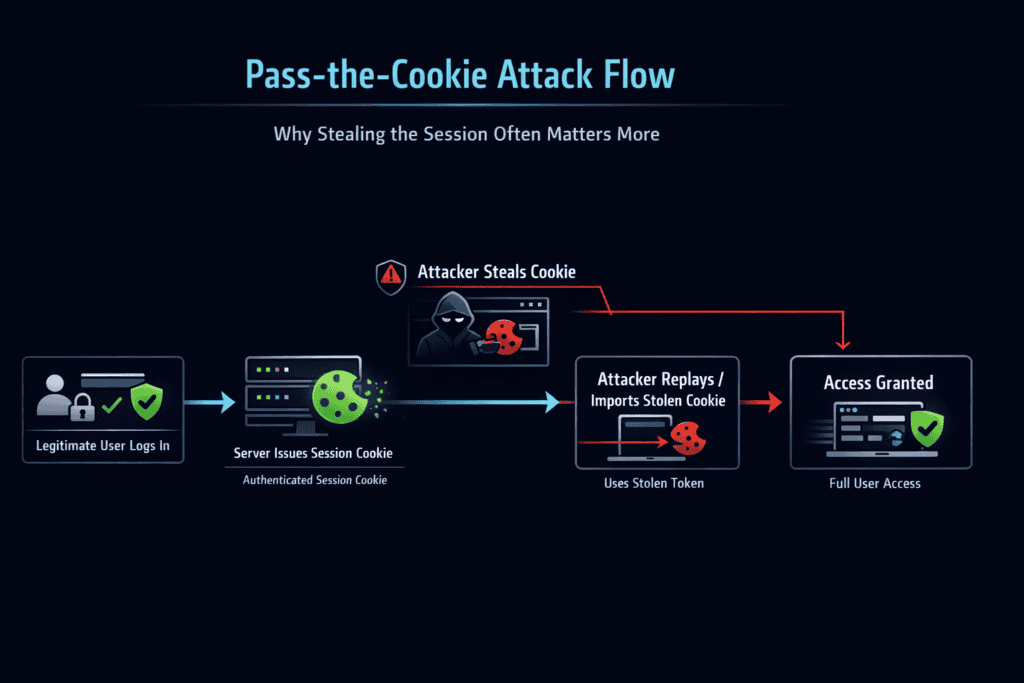
    pass the cookie attack flow showing how stolen session cookies bypass MFA and grant access
    A stolen session cookie allows attackers to replay an authenticated session and gain full access without needing a password or MFA.

    This is why session hijacking and pass-the-cookie attacks are more dangerous than traditional credential theft.

    Pass-the-cookie is the simplest way to explain the risk.

    The attacker obtains the cookie. Then they replay it.

    If the application accepts that cookie as valid, the attacker is treated as the user. They get the same permissions, the same active session context, and the same access level.

    This is why the phrase “stealing the password” can be misleading in modern identity incidents. In many cases, the attacker is not stealing identity at the credential layer. They are replaying it at the session layer.


    Session Fixation: A Different Route to the Same Outcome

    Session theft usually means stealing an already active session. Session fixation is different.

    In a session fixation attack, the attacker forces or tricks the victim into using a session ID that the attacker already knows. If the application fails to rotate the session ID after login, the attacker can later reuse that same authenticated session.

    The weakness here is not theft after login. It is bad session lifecycle management during login.

    A secure application must issue a fresh session after successful authentication. If it does not, it risks turning an unauthenticated session into an authenticated one that the attacker can predict or control.


    Session Prediction: When the Session ID Itself Is Weak

    Some systems fail even earlier.

    If session IDs are predictable, low-entropy, sequential, timestamp-based, or built from guessable values, attackers may be able to predict valid sessions without stealing or fixing them first. This is session prediction.

    This is mostly a legacy or custom-implementation problem now, but it still matters in badly designed applications. Strong session management depends on randomness. If the token is guessable, the whole model collapses.


    Why Defending the Session Is Harder Than People Think

    Developers and defenders do have controls available, but none of them are perfect on their own.

    OWASP Session Management Cheat Sheet
    Microsoft identity security guidance

    HttpOnly

    This helps prevent JavaScript from reading cookies. It is critical against some XSS-based theft paths. But it does not stop every kind of session abuse, and it does nothing against malware already running on the endpoint.

    Secure

    This ensures cookies are only sent over HTTPS. It is necessary, but it does not protect a session once the endpoint itself is compromised.

    SameSite

    This reduces some cross-site abuse patterns, especially around CSRF. It is useful, but it is not a complete defense against cookie theft or token replay from the user’s own environment.

    Short session lifetime

    Reducing session duration limits attacker dwell time, but it also creates friction for users. Most organizations compromise here, and attackers benefit from that tradeoff.

    Reauthentication for sensitive actions

    This is one of the better controls. Even if the session exists, the application can demand fresh proof before allowing high-risk actions such as password changes, payment updates, admin role changes, or privileged operations.

    Device and risk binding

    Some platforms bind sessions to device posture, browser characteristics, IP signals, or conditional access policies. These controls can reduce replay success, but they need careful tuning because legitimate users move, roam, and change networks constantly.

    This complexity further explains why session cookies matter more than your password in modern attack scenarios.


    What Users Can Do

    Users cannot solve session security alone, but they can reduce exposure.

    Log out of sensitive accounts when you are done, especially on shared or semi-trusted devices. Keep browsers updated. Avoid random extensions. Treat extension permissions seriously. Use reputable endpoint protection. Be cautious with phishing links even if they appear to support MFA. Review active sessions on major platforms and revoke sessions you do not recognize.

    The important mental shift is this: do not think only about protecting the password. Think about protecting the live authenticated browser.


    What Organizations Need To Change

    Organizations need to stop treating “MFA enabled” as the end of the identity story.

    A stronger model includes:

    • session-aware detection
    • stronger endpoint security against info-stealers
    • phishing-resistant authentication where possible
    • reauthentication for sensitive actions
    • shorter token lifetime for privileged access
    • conditional access and risk-based session controls
    • secure cookie configuration
    • session revocation and visibility for users and admins
    • testing for fixation, prediction, replay, and token handling flaws

    In other words, identity security has to extend beyond the login page.


    The Real Bottom Line

    Why session cookies matter more than your password comes down to one uncomfortable fact: once a session is active, the application usually trusts the session more than the credentials that created it.

    That is why attackers increasingly go after cookies, tokens, and authenticated browser state. It is faster than cracking passwords, often bypasses MFA, and can look like perfectly normal user activity.

    The password opens the door.

    The session decides who the system believes is already inside.


    Conclusion

    The traditional model of account security starts with credentials. The modern attack model starts after credentials.

    This is ultimately why session cookies matter more than your password in modern cybersecurity.

    That is the shift many teams still underestimate.

    If you only protect the login, but fail to protect the session, you are securing the entrance while leaving the occupied building exposed. Session cookies are not a minor implementation detail. They are the operational trust layer of the modern web.

    That is why session cookies matter more than your password in day-to-day account security, incident response, and modern identity defense.


    Want to understand how modern identity attacks really work beyond passwords and MFA?

    Read these next:

    If you are building a security strategy in 2026, start by asking a harder question:

    What happens after login?

  • How Conditional Access Reduces Identity Attack Damage: 7 Critical Security Layers

    How Conditional Access Reduces Identity Attack Damage: 7 Critical Security Layers


    Introduction

    Conditional Access reduces identity attack damage by shifting security from a one-time login check to continuous validation.

    Modern attackers do not break in. They log in.

    Using techniques such as AiTM phishing, token theft, and session hijacking, they bypass MFA and operate inside your environment as legitimate users.

    That means the real battle starts after authentication.

    Conditional Access, combined with Continuous Access Evaluation (CAE) and Token Protection, transforms identity security into a system that limits how long an attacker can stay and how much damage they can do.


    Why Identity Attacks Now Focus on Sessions

    Attackers have shifted from stealing passwords to stealing sessions and tokens.

    Related concept: Session Hijacking

    Once a user logs in, systems rely on tokens instead of rechecking credentials. If an attacker steals that token, they inherit access instantly.

    This is why AiTM phishing works:

    • MFA is completed legitimately
    • Token is captured
    • Session is reused
    • No further authentication required

    The password becomes irrelevant.


    How Conditional Access Reduces Identity Attack Damage

    Conditional Access reduces identity attack damage by continuously validating context.

    Implemented through Microsoft Entra ID, it evaluates:

    • Identity
    • Device
    • Location
    • Risk
    • Behavior

    Instead of granting full trust after login, it enforces conditional trust at every step.


    The Core Mechanism: From Login to Continuous Validation

    Conditional Access does not simply operate as a linear post-login control. In a technically accurate Zero Trust model, policy evaluation happens before access is fully granted.


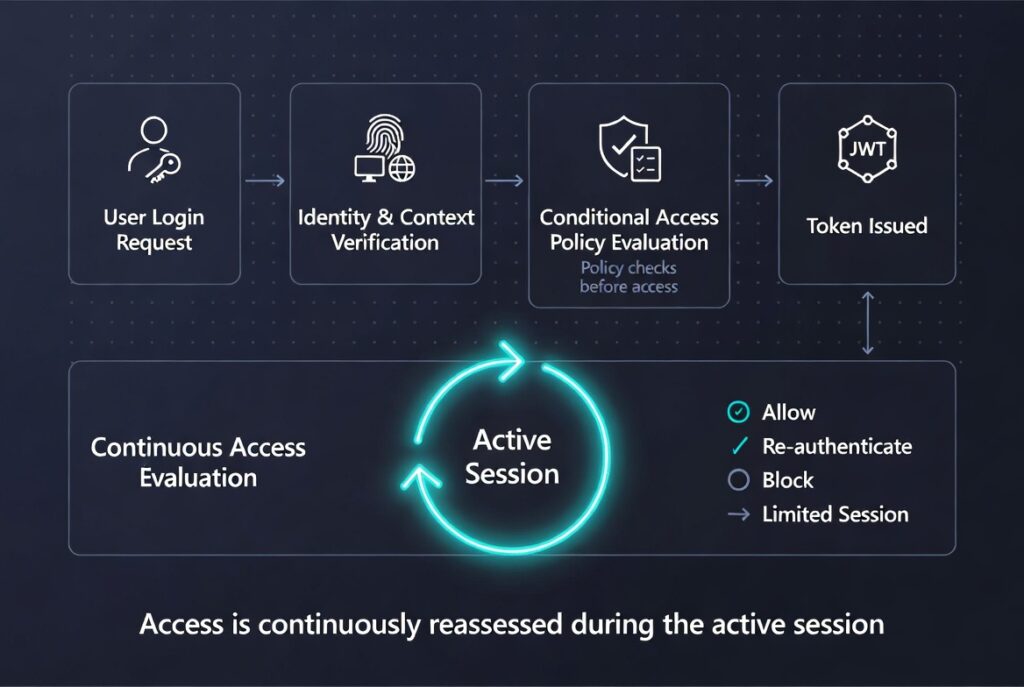
    The diagram below illustrates how Conditional Access and Continuous Access Evaluation work together in a Zero Trust model.

    Rather than granting permanent trust after login, the system continuously reassesses the session based on identity, context, and risk signals.

    Conditional Access flow diagram showing login verification, token issuance, active session loop and continuous access evaluation
    Conditional Access validates access before token issuance, while Continuous Access Evaluation continuously reassesses trust during the active session.

    The flow starts with the user login request and proceeds through identity and context verification before Conditional Access policies are evaluated.

    Only after these checks pass is the token issued and the session activated.

    From that point onward, Continuous Access Evaluation continuously reassesses the active session and can dynamically allow, challenge, block, or restrict access.


    The correct enterprise flow is:

    1. User Login Request
    2. Identity Verification
    3. Conditional Access Policy Evaluation
    4. Token Issuance
    5. Session Activation
    6. Continuous Access Evaluation (ongoing loop)
    7. Session Decision

    This means access is not trusted by default after authentication.

    Before the access token is issued, Microsoft Entra ID evaluates critical policy conditions such as:

    – MFA requirement
    – device compliance
    – trusted location
    – risk signals
    – user role sensitivity
    – application sensitivity

    Only if these conditions are satisfied is the token issued and the session activated.

    After the session starts, Continuous Access Evaluation acts as an ongoing validation loop rather than a separate linear step.

    This is a core Zero Trust principle:

    trust is temporary and continuously reassessed.


    Key Control Layer

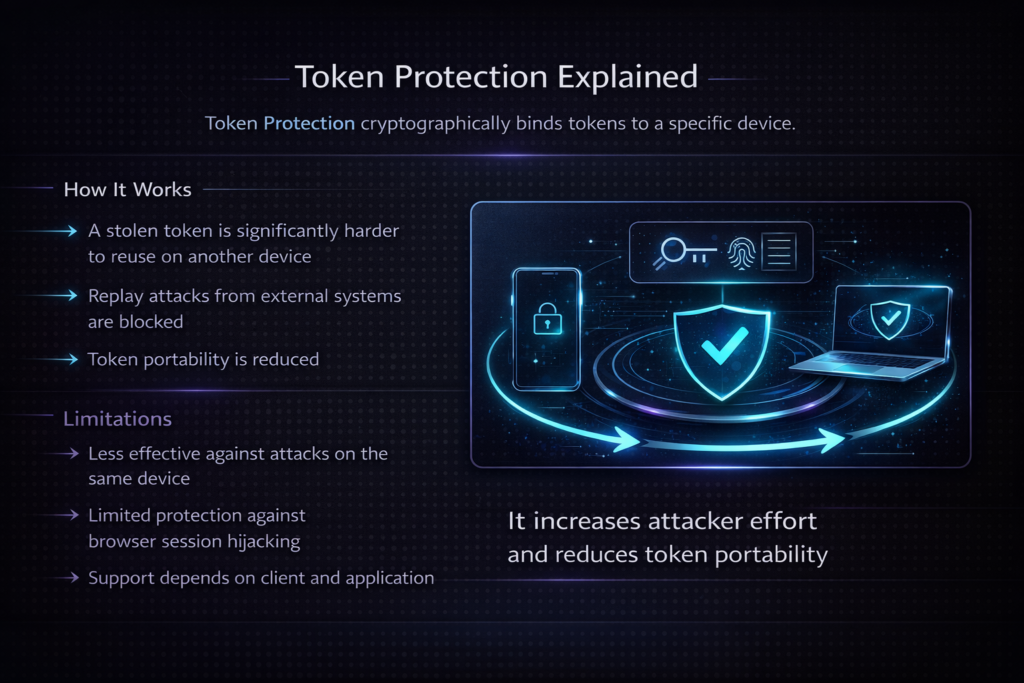
    Token Protection Explained

    Token Protection cryptographically binds tokens to a specific device.

    This means:

    • stolen tokens are significantly harder to reuse
    • replay attacks from external systems are blocked
    • token portability is reduced

    Limitations:

    • less effective against same-device attacks
    • browser session hijacking remains possible
    • support depends on client and application

    It increases attacker effort and reduces token portability.

    Token Protection diagram showing device-bound tokens, replay attack prevention and browser session hijacking limitations
    Token Protection cryptographically binds tokens to a device, making replay attacks significantly harder while reducing token portability across systems.

    Continuous Access Evaluation (CAE) Explained

    Continuous Access Evaluation introduces near real-time control.

    Triggers include:

    • Password change
    • Risk detection
    • Location change
    • Account disablement

    Instead of waiting for token expiration, access can be revoked quickly.

    This turns sessions into unstable environments for attackers.


    Why Continuous Evaluation Is a Loop, Not a Step

    Continuous Access Evaluation should not be visualized as a one-time stage after Conditional Access.

    Technically, it functions as an event-driven feedback loop during the active session.

    Risk events such as:

    – password reset
    – account disablement
    – impossible travel
    – IP location change
    – sign-in risk increase
    – device posture change

    can immediately trigger a re-evaluation of session trust.

    This can result in:

    – session continuation
    – forced re-authentication
    – limited access
    – immediate session revocation

    In Zero Trust architecture, every request can change the trust level of the session.


    Real-World Attack Scenario

    Without Conditional Access

    • Token stolen
    • Attacker logs in silently
    • Session remains valid
    • Data is accessed and exfiltrated

    Result: full compromise

    With Conditional Access

    • Unknown device blocked
    • Suspicious location triggers re-auth
    • Risk triggers session termination
    • Token replay fails

    Result: limited damage


    7 Critical Conditional Access Policies

    1. Block legacy authentication
    2. Require MFA for all users
    3. Enforce device compliance
    4. Restrict access by location
    5. Enable risk-based policies
    6. Limit session lifetime
    7. Require phishing-resistant MFA for admins

    These controls directly reduce attacker dwell time and limit post-login damage.


    Why MFA Alone Fails

    MFA protects the login event.

    It does not protect:

    • Session reuse
    • Token theft
    • Post-authentication actions

    Conditional Access replaces static trust with dynamic validation.


    Implementation Strategy

    1. Enforce MFA and block legacy authentication

    2. Add device compliance and location policies

    3. Enable CAE and risk-based access

    4. Implement Token Protection

    5. Simulate attacks and optimize policies


    Final Insight

    Identity security does not fail at the login moment. It fails when trust becomes static after access is granted.

    Conditional Access enforces trust before token issuance.

    Continuous Access Evaluation ensures that trust remains dynamic throughout the active session.

    Security is therefore not a one-time authentication event.

    It is a continuous trust lifecycle.


    Test Your Identity Security Before Attackers Do

    Most environments are secure at login but vulnerable after authentication.

    I help organizations identify:

    – token theft exposure
    – weak Conditional Access configurations
    – session control gaps
    – Zero Trust policy weaknesses

    Book a Conditional Access Security Audit and discover how long an attacker could remain inside your environment.


    Next in This Series

    Session vs Credential Theft: Why attackers now prefer stealing active sessions instead of passwords, and what this means for Zero Trust security.

  • Zero Trust Identity Security: The Modern Defense Framework for Access Control


    Why identity has become the control plane of modern cybersecurity.


    There was a time when cybersecurity was built around borders.

    The network was the fortress.
    The firewall was the gate.
    The assumption was simple: once a user entered the perimeter, trust followed almost automatically.

    That model no longer reflects reality.

    Modern organizations no longer operate inside a single physical boundary. Users authenticate from home networks, mobile devices, cloud applications, unmanaged endpoints, contractor systems, and third-party platforms. Data moves across SaaS ecosystems, APIs, collaboration tools, and identity providers. The perimeter has dissolved.

    What remains is identity.

    Identity is no longer one security control among many. It has become the control plane through which access to systems, applications, and data is granted, limited, or denied. This is why Zero Trust, at its core, is not simply a network philosophy. It is an identity philosophy.

    NIST’s Zero Trust framework formalizes this shift by rejecting implicit trust based on network location or asset ownership and replacing it with continuous verification of every access request.

    The modern question is no longer:

    “Are you inside the network?”

    The modern question is:

    “Can you continuously prove that you should still be trusted right now?”

    That is the real foundation of zero trust identity security.


    The Collapse of the Traditional Trust Model

    Traditional security models were built around permanence.

    A user logged in once.
    A session was created.
    Trust persisted.

    This persistence was convenient for operations, but it created a structural weakness: attackers no longer need to break in through hardened infrastructure if they can simply inherit trust.

    A stolen password.
    A phished MFA approval.
    A hijacked session cookie.
    A replayed access token.

    In each case, the attacker is not breaking the wall.

    They are borrowing legitimacy.

    This is why modern attacks increasingly target identity workflows rather than raw infrastructure exposure.

    The shift from perimeter compromise to identity compromise is one of the defining cybersecurity realities of 2026.

    Microsoft now explicitly treats identity protection and phishing-resistant authentication as foundational Zero Trust controls, not optional hardening layers.

    That shift matters.

    Because once identity becomes the new perimeter, every weakness in human trust, device assurance, session continuity, and policy design becomes part of the attack surface.


    How Zero Trust identity security actually works

    At a technical level, Zero Trust identity security is a continuously evaluated trust system.

    It is not a login screen.

    It is a sequence of trust decisions.

    1. Identity Claim

    A user, administrator, service account, or workload initiates an access request.

    This begins with a claim:

    “I am this identity.”

    That claim may be represented by:

    • username and password
    • passkey
    • certificate
    • smart card
    • workload identity
    • managed identity

    The claim itself is not trust.

    It is only the start of a validation process.

    2. Authentication Strength Validation

    Modern systems increasingly separate weak trust from resilient trust.

    Not all MFA is equal.

    SMS codes, email OTPs, and push prompts are all forms of MFA, but they remain vulnerable to phishing, fatigue attacks, SIM swaps, and social engineering.

    This is why Microsoft and CISA emphasize phishing-resistant MFA as the modern baseline for privileged access and sensitive environments.

    Passkeys and FIDO2 change the trust model entirely.

    Instead of transmitting a reusable secret, they rely on origin-bound public key cryptography.

    This means the credential is cryptographically tied to the legitimate relying party.

    A fake phishing domain cannot replay the same proof in the same way.

    That is not merely stronger MFA.

    That is a fundamentally different authentication mechanism.


    The Real Shift: From Credential Theft to Trust Theft

    Attackers are no longer focused only on credentials.

    They increasingly target trust itself.

    This includes:

    • password theft
    • session token theft
    • MFA fatigue
    • helpdesk impersonation
    • recovery workflow abuse
    • device trust bypass
    • browser session replay

    This is the real battlefield.

    An attacker who steals a valid session token may not need to reauthenticate at all.

    This is why strong login security alone is insufficient.

    The modern access chain looks like this:

    identity → authentication → token issuance → session continuity → authorization

    A weakness anywhere in that chain creates a usable trust artifact.

    And attackers only need one.


    Where the System Really Breaks: After Login

    Users often over-focus on the login moment.

    Psychologically, authentication is seen as the main security event.

    But modern attackers increasingly operate after successful authentication.

    After authentication, the system typically issues:

    • access tokens
    • refresh tokens
    • session cookies
    • device assertions
    • privilege claims

    These become the new trust objects.

    If these objects are stolen, replayed, or abused, the attacker can inherit the session without repeating the original challenge.

    This is why token protection and session control are no longer secondary features.

    They are core defense layers.

    Zero Trust becomes real not only by proving who the user is, but by continuously proving that the active session still deserves trust.sly proving that the current session still deserves trust.


    The Human Behaviour Layer: Why Users Still Misunderstand Identity Security

    The failure is not only technical.

    It is behavioural.

    People naturally think in doors.

    A door is either open or closed.

    Logged in or logged out.

    Allowed or denied.

    But Zero Trust does not work like a door.

    It works like a negotiation.

    Trust is dynamic.

    Trust decays.

    Trust must be re-earned.

    Once users successfully authenticate, many mentally conclude:

    “I am safe now.”

    That assumption is dangerous.

    Because security does not end at login.

    The actual high-risk layer often begins there.


    Security Theater and False Confidence

    People often mistake visible friction for actual strength.

    Examples include:

    • extra prompts
    • multiple codes
    • repeated push approvals
    • forced password resets

    These feel secure because they are visible.

    But visible friction is not the same as phishing resistance.

    A cryptographically bound passkey may be both faster and substantially stronger than a slower SMS-based MFA flow.

    This creates a psychological paradox:

    users trust what feels harder, not always what is architecturally stronger.


    Operational Psychology: The Helpdesk Problem

    Support teams are often rewarded for restoring access quickly.

    That incentive structure creates exploitable behaviour.

    An attacker who convincingly impersonates a user under time pressure can manipulate:

    • password resets
    • MFA re-enrollment
    • account recovery
    • device registration
    • emergency exceptions

    The weakness is not always the technology.

    It is the pressure environment around it.

    The system breaks where humans optimize for continuity over verification.

    That is a systems design flaw.


    Zero Trust as a Living Control Framework

    Zero Trust is not a product.

    It is not Microsoft Entra.
    It is not Okta.
    It is not passkeys.
    It is not Conditional Access.

    It is a living access philosophy.

    Every access decision must be:

    • explicitly verified
    • context-aware
    • least privileged
    • continuously re-evaluated

    Trust must be influenced by:

    • user risk
    • device compliance
    • geo anomalies
    • time-based patterns
    • impossible travel
    • privilege sensitivity
    • session anomalies

    This is why Continuous Access Evaluation is strategically important.


    The Deeper Truth

    Security is moving from:

    protecting places

    to

    validating claims

    That is a profound shift.

    The future of access control is not walls.

    It is trust economics.

    Who gets believed, for how long, under what conditions, and with what proof.

    That is the real Zero Trust question.


    Final Synthesis

    Zero Trust identity security recognizes a hard reality:

    trust is the most valuable asset inside any digital system.

    Attackers increasingly target people, sessions, tokens, recovery workflows, and mental assumptions rather than just infrastructure.

    The strongest organizations in 2026 are not the ones with the most prompts.

    They are the ones that understand how trust is created, abused, inherited, and continuously challenged.

    That is where security becomes strategy.


    FAQ BLOCK

    What is Zero Trust identity security?
    A framework where every access request is continuously verified based on identity, device, and risk context.

    Why is phishing-resistant MFA important?
    Because legacy MFA methods remain vulnerable to phishing and fatigue attacks.

    Can attackers bypass login security?
    Yes, through stolen session tokens and trust artifacts.


    Need a Zero Trust maturity review for your environment?

    Darja Rihla offers:

    • Conditional Access reviews
    • token protection scans
    • phishing-resistant MFA readiness
    • identity workflow audits
    • WordPress security hardening for SMEs

    Request a Zero Trust Quick Scan starting from €149.9.