Author: Darja Rihla

  • How Conditional Access Reduces Identity Attack Damage: 7 Critical Security Layers

    How Conditional Access Reduces Identity Attack Damage: 7 Critical Security Layers


    Introduction

    Conditional Access reduces identity attack damage by shifting security from a one-time login check to continuous validation.

    Modern attackers do not break in. They log in.

    Using techniques such as AiTM phishing, token theft, and session hijacking, they bypass MFA and operate inside your environment as legitimate users.

    That means the real battle starts after authentication.

    Conditional Access, combined with Continuous Access Evaluation (CAE) and Token Protection, transforms identity security into a system that limits how long an attacker can stay and how much damage they can do.


    Why Identity Attacks Now Focus on Sessions

    Attackers have shifted from stealing passwords to stealing sessions and tokens.

    Related concept: Session Hijacking

    Once a user logs in, systems rely on tokens instead of rechecking credentials. If an attacker steals that token, they inherit access instantly.

    This is why AiTM phishing works:

    • MFA is completed legitimately
    • Token is captured
    • Session is reused
    • No further authentication required

    The password becomes irrelevant.


    How Conditional Access Reduces Identity Attack Damage

    Conditional Access reduces identity attack damage by continuously validating context.

    Implemented through Microsoft Entra ID, it evaluates:

    • Identity
    • Device
    • Location
    • Risk
    • Behavior

    Instead of granting full trust after login, it enforces conditional trust at every step.


    The Core Mechanism: From Login to Continuous Validation

    Conditional Access does not simply operate as a linear post-login control. In a technically accurate Zero Trust model, policy evaluation happens before access is fully granted.


    The diagram below illustrates how Conditional Access and Continuous Access Evaluation work together in a Zero Trust model.

    Rather than granting permanent trust after login, the system continuously reassesses the session based on identity, context, and risk signals.
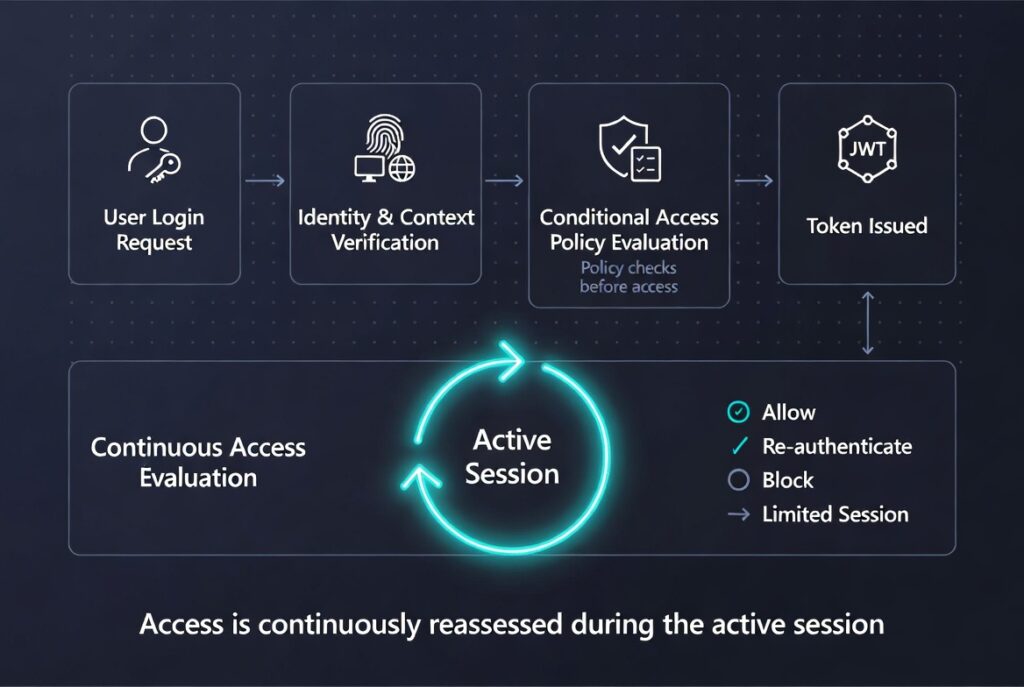
    Conditional Access flow diagram showing login verification, token issuance, active session loop and continuous access evaluation
    Conditional Access validates access before token issuance, while Continuous Access Evaluation continuously reassesses trust during the active session.

    The flow starts with the user login request and proceeds through identity and context verification before Conditional Access policies are evaluated.

    Only after these checks pass is the token issued and the session activated.

    From that point onward, Continuous Access Evaluation continuously reassesses the active session and can dynamically allow, challenge, block, or restrict access.


    The correct enterprise flow is:

    1. User Login Request
    2. Identity Verification
    3. Conditional Access Policy Evaluation
    4. Token Issuance
    5. Session Activation
    6. Continuous Access Evaluation (ongoing loop)
    7. Session Decision

    This means access is not trusted by default after authentication.

    Before the access token is issued, Microsoft Entra ID evaluates critical policy conditions such as:

    – MFA requirement
    – device compliance
    – trusted location
    – risk signals
    – user role sensitivity
    – application sensitivity

    Only if these conditions are satisfied is the token issued and the session activated.

    After the session starts, Continuous Access Evaluation acts as an ongoing validation loop rather than a separate linear step.

    This is a core Zero Trust principle:

    trust is temporary and continuously reassessed.


    Key Control Layer

    Token Protection Explained

    Token Protection cryptographically binds tokens to a specific device.

    This means:

    • stolen tokens are significantly harder to reuse
    • replay attacks from external systems are blocked
    • token portability is reduced

    Limitations:

    • less effective against same-device attacks
    • browser session hijacking remains possible
    • support depends on client and application

    It increases attacker effort and reduces token portability.
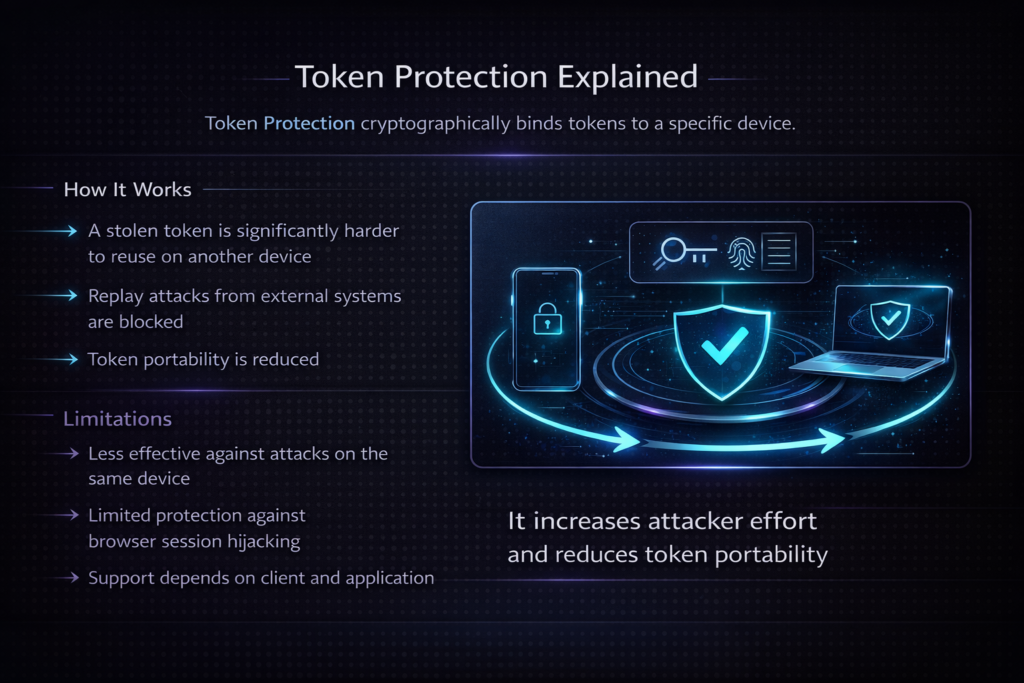
    Token Protection diagram showing device-bound tokens, replay attack prevention and browser session hijacking limitations
    Token Protection cryptographically binds tokens to a device, making replay attacks significantly harder while reducing token portability across systems.

    Continuous Access Evaluation (CAE) Explained

    Continuous Access Evaluation introduces near real-time control.

    Triggers include:

    • Password change
    • Risk detection
    • Location change
    • Account disablement

    Instead of waiting for token expiration, access can be revoked quickly.

    This turns sessions into unstable environments for attackers.


    Why Continuous Evaluation Is a Loop, Not a Step

    Continuous Access Evaluation should not be visualized as a one-time stage after Conditional Access.

    Technically, it functions as an event-driven feedback loop during the active session.

    Risk events such as:

    – password reset
    – account disablement
    – impossible travel
    – IP location change
    – sign-in risk increase
    – device posture change

    can immediately trigger a re-evaluation of session trust.

    This can result in:

    – session continuation
    – forced re-authentication
    – limited access
    – immediate session revocation

    In Zero Trust architecture, every request can change the trust level of the session.


    Real-World Attack Scenario

    Without Conditional Access

    • Token stolen
    • Attacker logs in silently
    • Session remains valid
    • Data is accessed and exfiltrated

    Result: full compromise

    With Conditional Access

    • Unknown device blocked
    • Suspicious location triggers re-auth
    • Risk triggers session termination
    • Token replay fails

    Result: limited damage


    7 Critical Conditional Access Policies

    1. Block legacy authentication
    2. Require MFA for all users
    3. Enforce device compliance
    4. Restrict access by location
    5. Enable risk-based policies
    6. Limit session lifetime
    7. Require phishing-resistant MFA for admins

    These controls directly reduce attacker dwell time and limit post-login damage.


    Why MFA Alone Fails

    MFA protects the login event.

    It does not protect:

    • Session reuse
    • Token theft
    • Post-authentication actions

    Conditional Access replaces static trust with dynamic validation.


    Implementation Strategy

    1. Enforce MFA and block legacy authentication

    2. Add device compliance and location policies

    3. Enable CAE and risk-based access

    4. Implement Token Protection

    5. Simulate attacks and optimize policies


    Final Insight

    Identity security does not fail at the login moment. It fails when trust becomes static after access is granted.

    Conditional Access enforces trust before token issuance.

    Continuous Access Evaluation ensures that trust remains dynamic throughout the active session.

    Security is therefore not a one-time authentication event.

    It is a continuous trust lifecycle.


    Test Your Identity Security Before Attackers Do

    Most environments are secure at login but vulnerable after authentication.

    I help organizations identify:

    – token theft exposure
    – weak Conditional Access configurations
    – session control gaps
    – Zero Trust policy weaknesses

    Book a Conditional Access Security Audit and discover how long an attacker could remain inside your environment.


    Next in This Series

    Session vs Credential Theft: Why attackers now prefer stealing active sessions instead of passwords, and what this means for Zero Trust security.

  • Zero Trust Identity Security: The Modern Defense Framework for Access Control


    Why identity has become the control plane of modern cybersecurity.


    There was a time when cybersecurity was built around borders.

    The network was the fortress.
    The firewall was the gate.
    The assumption was simple: once a user entered the perimeter, trust followed almost automatically.

    That model no longer reflects reality.

    Modern organizations no longer operate inside a single physical boundary. Users authenticate from home networks, mobile devices, cloud applications, unmanaged endpoints, contractor systems, and third-party platforms. Data moves across SaaS ecosystems, APIs, collaboration tools, and identity providers. The perimeter has dissolved.

    What remains is identity.

    Identity is no longer one security control among many. It has become the control plane through which access to systems, applications, and data is granted, limited, or denied. This is why Zero Trust, at its core, is not simply a network philosophy. It is an identity philosophy.

    NIST’s Zero Trust framework formalizes this shift by rejecting implicit trust based on network location or asset ownership and replacing it with continuous verification of every access request.

    The modern question is no longer:

    “Are you inside the network?”

    The modern question is:

    “Can you continuously prove that you should still be trusted right now?”

    That is the real foundation of zero trust identity security.


    The Collapse of the Traditional Trust Model

    Traditional security models were built around permanence.

    A user logged in once.
    A session was created.
    Trust persisted.

    This persistence was convenient for operations, but it created a structural weakness: attackers no longer need to break in through hardened infrastructure if they can simply inherit trust.

    A stolen password.
    A phished MFA approval.
    A hijacked session cookie.
    A replayed access token.

    In each case, the attacker is not breaking the wall.

    They are borrowing legitimacy.

    This is why modern attacks increasingly target identity workflows rather than raw infrastructure exposure.

    The shift from perimeter compromise to identity compromise is one of the defining cybersecurity realities of 2026.

    Microsoft now explicitly treats identity protection and phishing-resistant authentication as foundational Zero Trust controls, not optional hardening layers.

    That shift matters.

    Because once identity becomes the new perimeter, every weakness in human trust, device assurance, session continuity, and policy design becomes part of the attack surface.


    How Zero Trust identity security actually works

    At a technical level, Zero Trust identity security is a continuously evaluated trust system.

    It is not a login screen.

    It is a sequence of trust decisions.

    1. Identity Claim

    A user, administrator, service account, or workload initiates an access request.

    This begins with a claim:

    “I am this identity.”

    That claim may be represented by:

    • username and password
    • passkey
    • certificate
    • smart card
    • workload identity
    • managed identity

    The claim itself is not trust.

    It is only the start of a validation process.

    2. Authentication Strength Validation

    Modern systems increasingly separate weak trust from resilient trust.

    Not all MFA is equal.

    SMS codes, email OTPs, and push prompts are all forms of MFA, but they remain vulnerable to phishing, fatigue attacks, SIM swaps, and social engineering.

    This is why Microsoft and CISA emphasize phishing-resistant MFA as the modern baseline for privileged access and sensitive environments.

    Passkeys and FIDO2 change the trust model entirely.

    Instead of transmitting a reusable secret, they rely on origin-bound public key cryptography.

    This means the credential is cryptographically tied to the legitimate relying party.

    A fake phishing domain cannot replay the same proof in the same way.

    That is not merely stronger MFA.

    That is a fundamentally different authentication mechanism.


    The Real Shift: From Credential Theft to Trust Theft

    Attackers are no longer focused only on credentials.

    They increasingly target trust itself.

    This includes:

    • password theft
    • session token theft
    • MFA fatigue
    • helpdesk impersonation
    • recovery workflow abuse
    • device trust bypass
    • browser session replay

    This is the real battlefield.

    An attacker who steals a valid session token may not need to reauthenticate at all.

    This is why strong login security alone is insufficient.

    The modern access chain looks like this:

    identity → authentication → token issuance → session continuity → authorization

    A weakness anywhere in that chain creates a usable trust artifact.

    And attackers only need one.


    Where the System Really Breaks: After Login

    Users often over-focus on the login moment.

    Psychologically, authentication is seen as the main security event.

    But modern attackers increasingly operate after successful authentication.

    After authentication, the system typically issues:

    • access tokens
    • refresh tokens
    • session cookies
    • device assertions
    • privilege claims

    These become the new trust objects.

    If these objects are stolen, replayed, or abused, the attacker can inherit the session without repeating the original challenge.

    This is why token protection and session control are no longer secondary features.

    They are core defense layers.

    Zero Trust becomes real not only by proving who the user is, but by continuously proving that the active session still deserves trust.sly proving that the current session still deserves trust.


    The Human Behaviour Layer: Why Users Still Misunderstand Identity Security

    The failure is not only technical.

    It is behavioural.

    People naturally think in doors.

    A door is either open or closed.

    Logged in or logged out.

    Allowed or denied.

    But Zero Trust does not work like a door.

    It works like a negotiation.

    Trust is dynamic.

    Trust decays.

    Trust must be re-earned.

    Once users successfully authenticate, many mentally conclude:

    “I am safe now.”

    That assumption is dangerous.

    Because security does not end at login.

    The actual high-risk layer often begins there.


    Security Theater and False Confidence

    People often mistake visible friction for actual strength.

    Examples include:

    • extra prompts
    • multiple codes
    • repeated push approvals
    • forced password resets

    These feel secure because they are visible.

    But visible friction is not the same as phishing resistance.

    A cryptographically bound passkey may be both faster and substantially stronger than a slower SMS-based MFA flow.

    This creates a psychological paradox:

    users trust what feels harder, not always what is architecturally stronger.


    Operational Psychology: The Helpdesk Problem

    Support teams are often rewarded for restoring access quickly.

    That incentive structure creates exploitable behaviour.

    An attacker who convincingly impersonates a user under time pressure can manipulate:

    • password resets
    • MFA re-enrollment
    • account recovery
    • device registration
    • emergency exceptions

    The weakness is not always the technology.

    It is the pressure environment around it.

    The system breaks where humans optimize for continuity over verification.

    That is a systems design flaw.


    Zero Trust as a Living Control Framework

    Zero Trust is not a product.

    It is not Microsoft Entra.
    It is not Okta.
    It is not passkeys.
    It is not Conditional Access.

    It is a living access philosophy.

    Every access decision must be:

    • explicitly verified
    • context-aware
    • least privileged
    • continuously re-evaluated

    Trust must be influenced by:

    • user risk
    • device compliance
    • geo anomalies
    • time-based patterns
    • impossible travel
    • privilege sensitivity
    • session anomalies

    This is why Continuous Access Evaluation is strategically important.


    The Deeper Truth

    Security is moving from:

    protecting places

    to

    validating claims

    That is a profound shift.

    The future of access control is not walls.

    It is trust economics.

    Who gets believed, for how long, under what conditions, and with what proof.

    That is the real Zero Trust question.


    Final Synthesis

    Zero Trust identity security recognizes a hard reality:

    trust is the most valuable asset inside any digital system.

    Attackers increasingly target people, sessions, tokens, recovery workflows, and mental assumptions rather than just infrastructure.

    The strongest organizations in 2026 are not the ones with the most prompts.

    They are the ones that understand how trust is created, abused, inherited, and continuously challenged.

    That is where security becomes strategy.


    FAQ BLOCK

    What is Zero Trust identity security?
    A framework where every access request is continuously verified based on identity, device, and risk context.

    Why is phishing-resistant MFA important?
    Because legacy MFA methods remain vulnerable to phishing and fatigue attacks.

    Can attackers bypass login security?
    Yes, through stolen session tokens and trust artifacts.


    Need a Zero Trust maturity review for your environment?

    Darja Rihla offers:

    • Conditional Access reviews
    • token protection scans
    • phishing-resistant MFA readiness
    • identity workflow audits
    • WordPress security hardening for SMEs

    Request a Zero Trust Quick Scan starting from €149.9.

  • How to Build Personal Systems That Actually Work

    How to Build Personal Systems That Actually Work

    Personal systems · Systems & Strategy · Apply

    Build for the day you actually have.

    Personal systems work when they support action on ordinary days, including days with limited energy, attention or time. Trace one recurring outcome, find the structure producing it, and change one relationship you can observe for seven days.

    Start with the system canvas

    When an outcome repeats, look beyond the latest event.

    A missed workout, an unfinished task or an evening lost to distraction can look like a single failure. Repetition changes the question. What keeps producing this outcome? Which conditions arrive before it? What reward, delay or friction keeps the pattern in place?

    This page turns the ideas in Why Systems Thinking Matters in a Complex World into a small practice. You do not need to redesign your life. You need one recurring outcome, enough evidence to describe it, and one bounded intervention.

    What personal systems actually contain

    A to-do list records tasks. A routine repeats actions. Personal systems connect the conditions that feed those actions with the feedback that helps you adjust them.

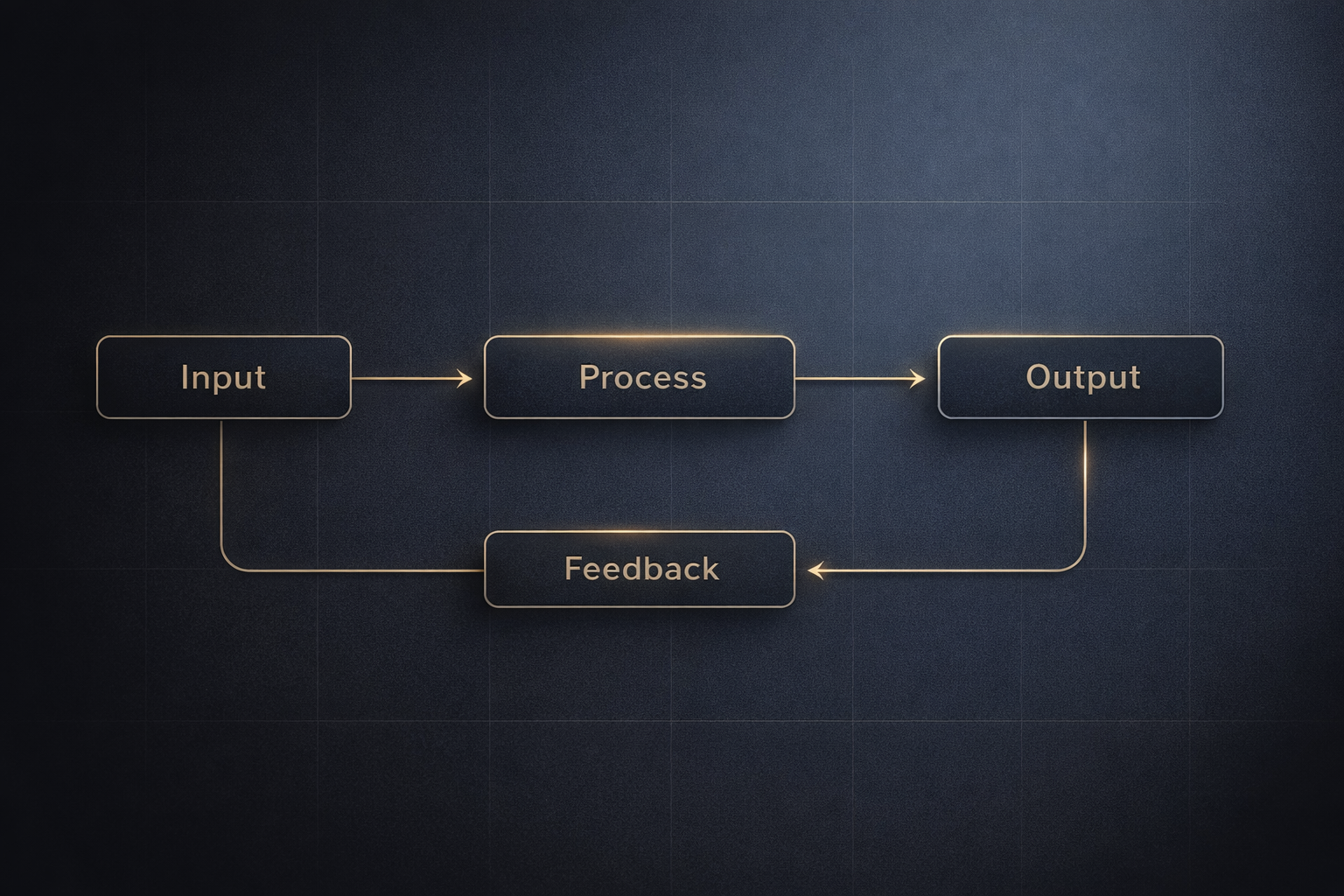
    1. InputTime, energy, attention and resources
    2. ProcessCues, habits, workflows and boundaries
    3. OutputThe observable result the system produces
    4. FeedbackEvidence used to keep, adjust or stop

    Five patterns that make a system look like a personal failure.

    These patterns are diagnostic prompts, not psychological diagnoses. More than one may be active at the same time.

    1. 01

      The museum problem

      The system was built for a life, workload or energy level that no longer exists.

    2. 02

      The showcase problem

      The tools and workflow look complete, but execution requires too many steps.

    3. 03

      Willpower dependency

      The desired action has no support when energy or attention is limited.

    4. 04

      The missing trigger

      Nothing reliably connects the intended action to a time, place or preceding event.

    5. 05

      The vague inventory

      Items such as “fix finances” hide several undefined decisions and next actions.

    Expressive breakdown of personal systems as connected structures breaking around a central point
    Expressive layer. A visual metaphor from the original draft for a system whose relationships are breaking down; it is not a diagnostic model.

    Trace the route from signal to review.

    Move in order. Each stage changes the object you are looking at: from a felt problem to evidence, structure, action and learning.

    1. STATE → EVIDENCE

      Name the recurring outcome

      Write what repeatedly happens without turning it into a verdict about your character. Use an observable sentence: “I begin important work after 11:00,” not “I am lazy.”

      Write
      One outcome you can observe.
      Avoid
      Identity labels and explanations you have not tested.
    2. EVIDENCE → SEQUENCE

      Find the pattern around it

      Look at three recent occurrences. Note what happened before, during and after. Repetition matters more than a perfect explanation.

      Before
      Time, place, cue, available energy and competing demands.
      After
      Immediate relief, reward, delay or new pressure.
    3. SEQUENCE → STRUCTURE

      Map what keeps the pattern alive

      Separate parts from relationships. A phone, a deadline and tiredness are parts. “Late work increases tiredness; tiredness increases avoidance; avoidance creates later work” is a reinforcing relationship.

      • What makes the unwanted action easy?
      • What makes the wanted action difficult?
      • Which delay hides the consequence?
      • Where does the system reward the current pattern?
    4. STRUCTURE → ACTION

      Change one relationship

      Choose an intervention small enough to test and close enough to the structure to matter. Change a cue, reduce friction, shorten a delay, add a boundary or make feedback visible.

      • Trigger: what will make the first action visible at the right moment?
      • Minimum version: what can still be completed on a low-energy day?
      • Friction: which unnecessary step can be removed?
      • Feedback: what simple signal will show whether the change helped?

      Do not ask, “What is the ideal routine?” Ask, “Which relationship can I change this week?”

    5. ACTION → LEARNING

      Review evidence, not motivation

      After seven days, compare the outcome with your baseline. Keep the change if the relationship improved. Adjust it if the signal moved but the cost was too high. Stop it if it produced no useful change.

      Keep
      The outcome improved without unacceptable cost.
      Adjust
      The direction is useful, but the design needs refinement.
      Stop
      The intervention did not affect the relationship you mapped.
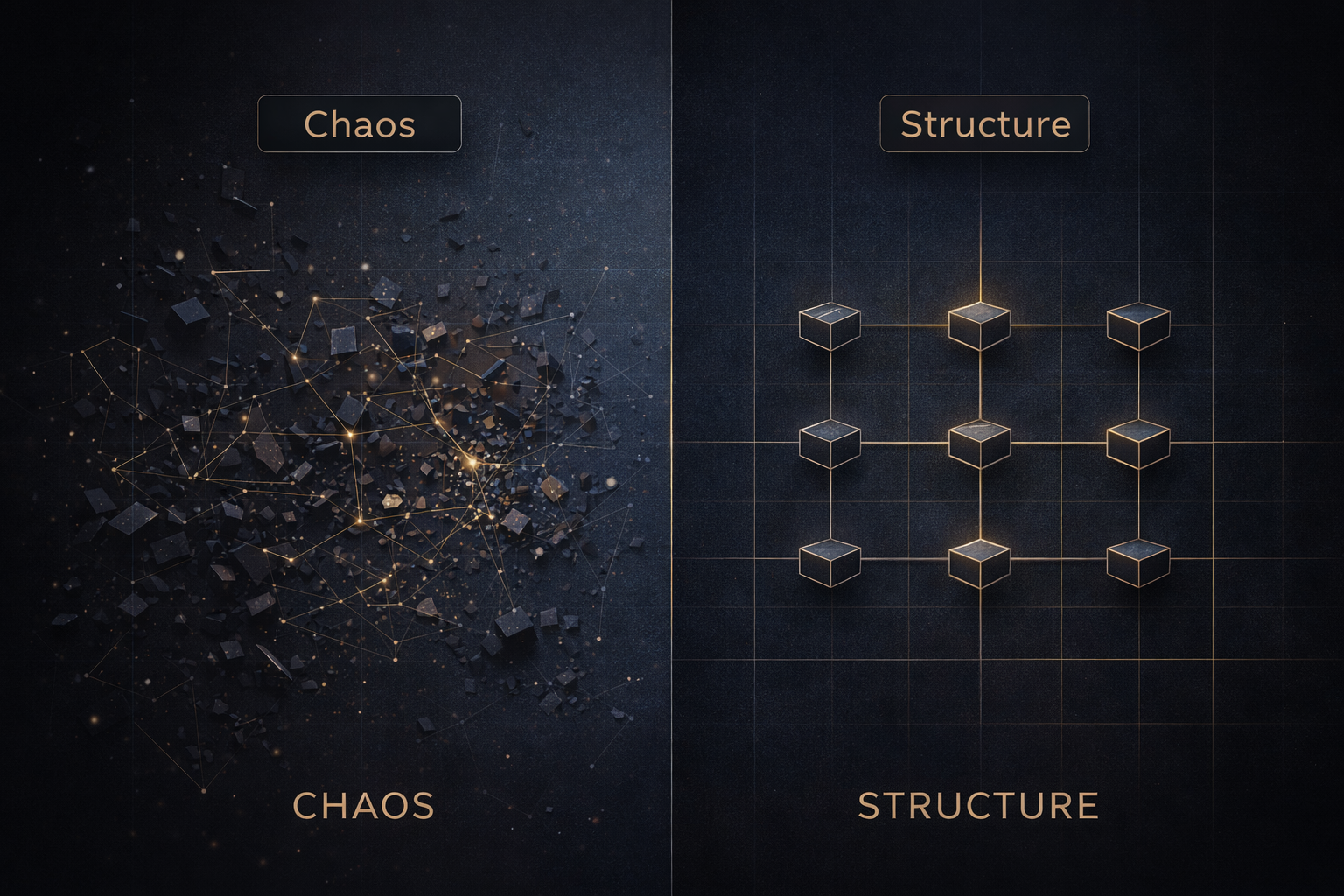
    Illustrative comparison between a tangled network and an orderly connected structure
    Expressive comparison. The image contrasts tangle and order. Real personal systems remain adaptive and imperfect; the ordered side is a metaphor, not the required end state.

    From “I never start on time” to a testable change.

    Before

    A character verdict

    “I need more discipline. Tomorrow I will force myself to start early.”

    No evidence · no boundary · no review signal

    After

    A bounded intervention

    “For seven days, the first work file stays open before I leave the desk. The phone charges outside the room. I record the actual start time.”

    Changed cue · reduced friction · visible evidence

    What changed? Not the ambition. The relationship between the evening environment, the morning cue and the first action.

    Run one seven-day experiment.

    Use paper, a note app or a calendar. The tool is secondary; the observation is the work.

    1. 01

      Outcome

      Write one repeated result in observable language.

    2. 02

      Baseline

      Record three recent examples or the current frequency.

    3. 03

      Relationship

      Draw one “more of this leads to more or less of that” connection.

    4. 04

      Intervention

      Change one cue, friction, delay, boundary or feedback signal.

    5. 05

      Review

      Choose in advance what will make you keep, adjust or stop it.

    Weekly review

    Use five questions to turn activity into feedback.

    1. What actually happened?
    2. What is on my plate now?
    3. What matters most next?
    4. What can I remove?
    5. What should I keep, adjust or stop?
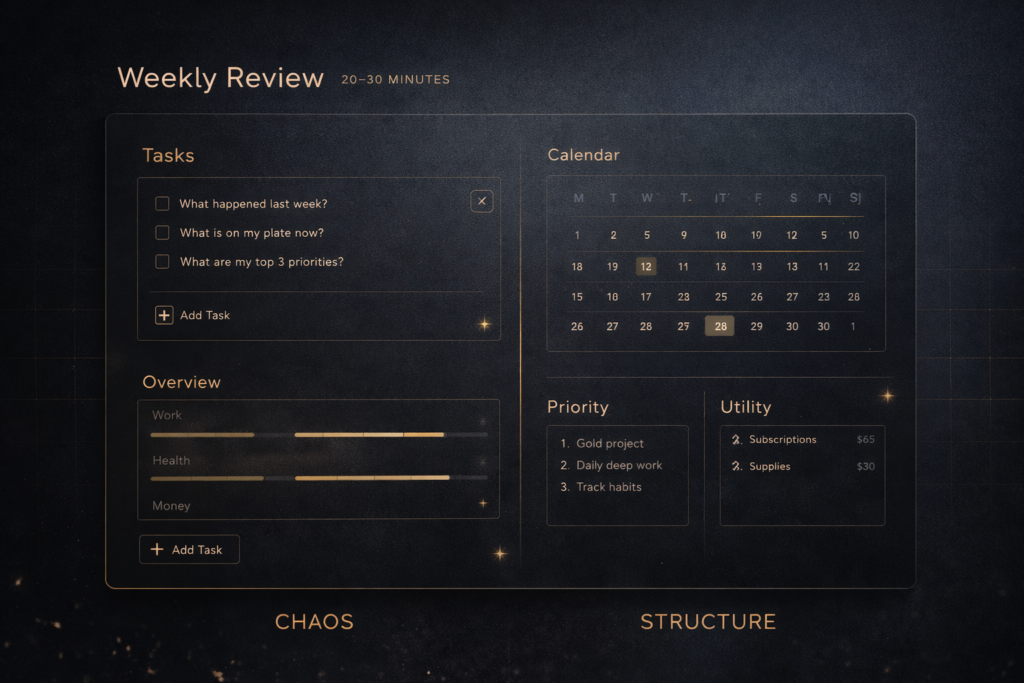
    Stylised dark weekly review interface with task, calendar, priority and overview areas
    Reference illustration from the original draft. It visualises review categories only; it is not a functioning dashboard and its displayed entries are not user data.

    Use the cluster when your map needs more depth.

    These are separate reading objects, so they are presented as a compact set of linked articles—not as steps you must complete first.

    A useful system makes the better action easier to repeat—and easier to evaluate.

    The best personal systems do not demand perfect motivation. Choose one outcome, map one relationship and run one bounded experiment.

    Return to Systems & Strategy