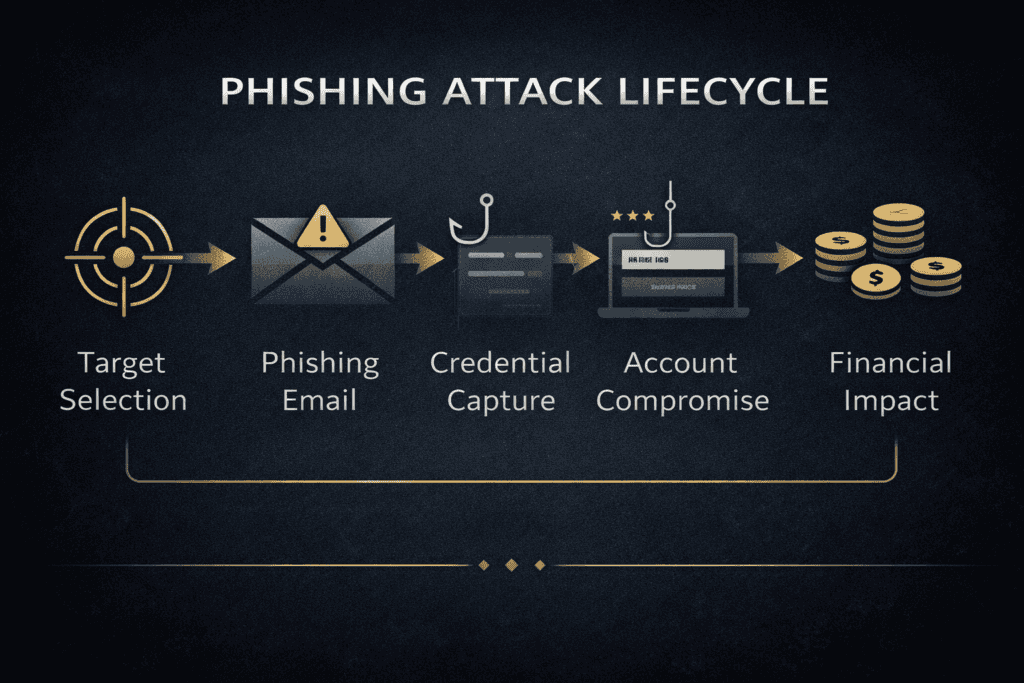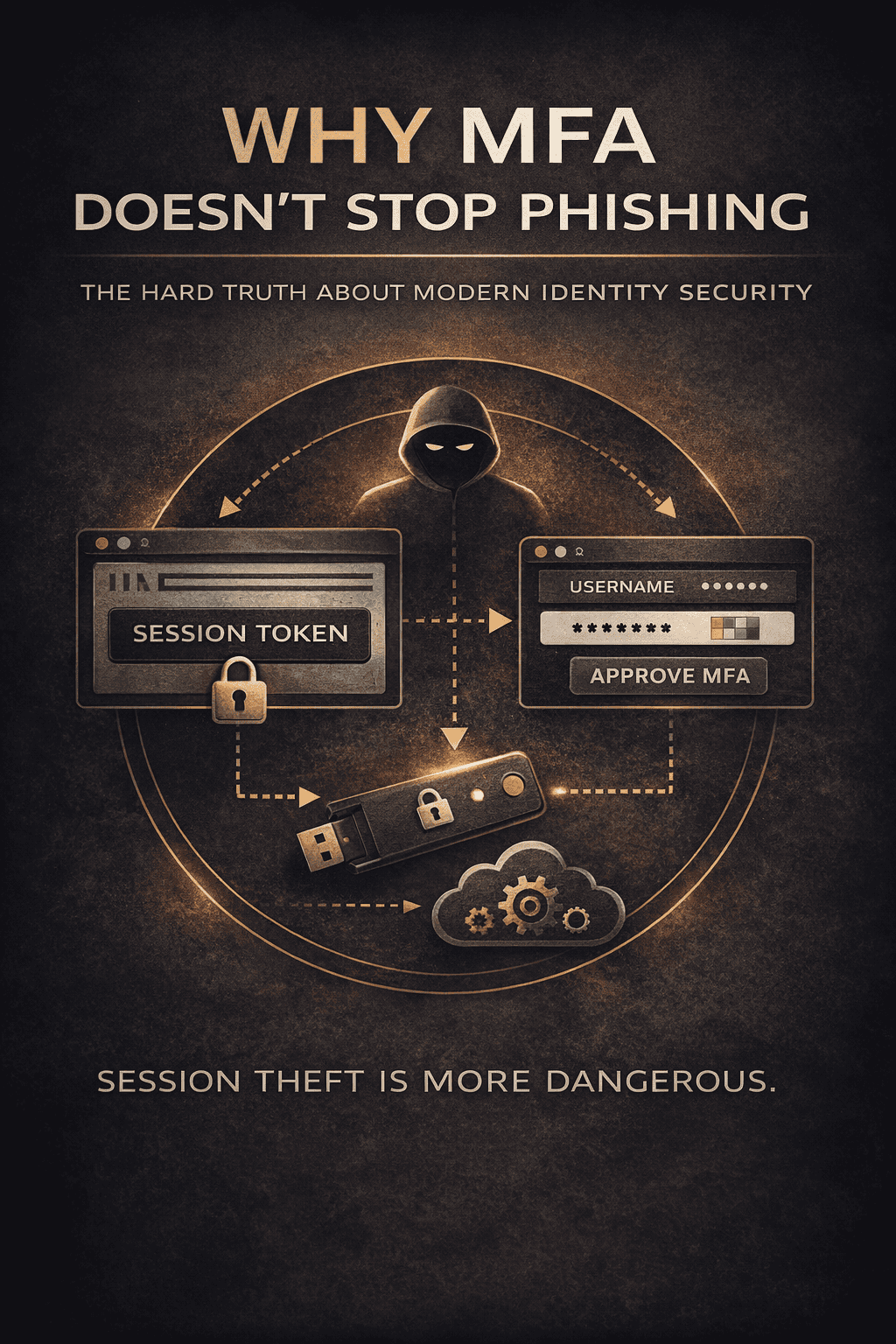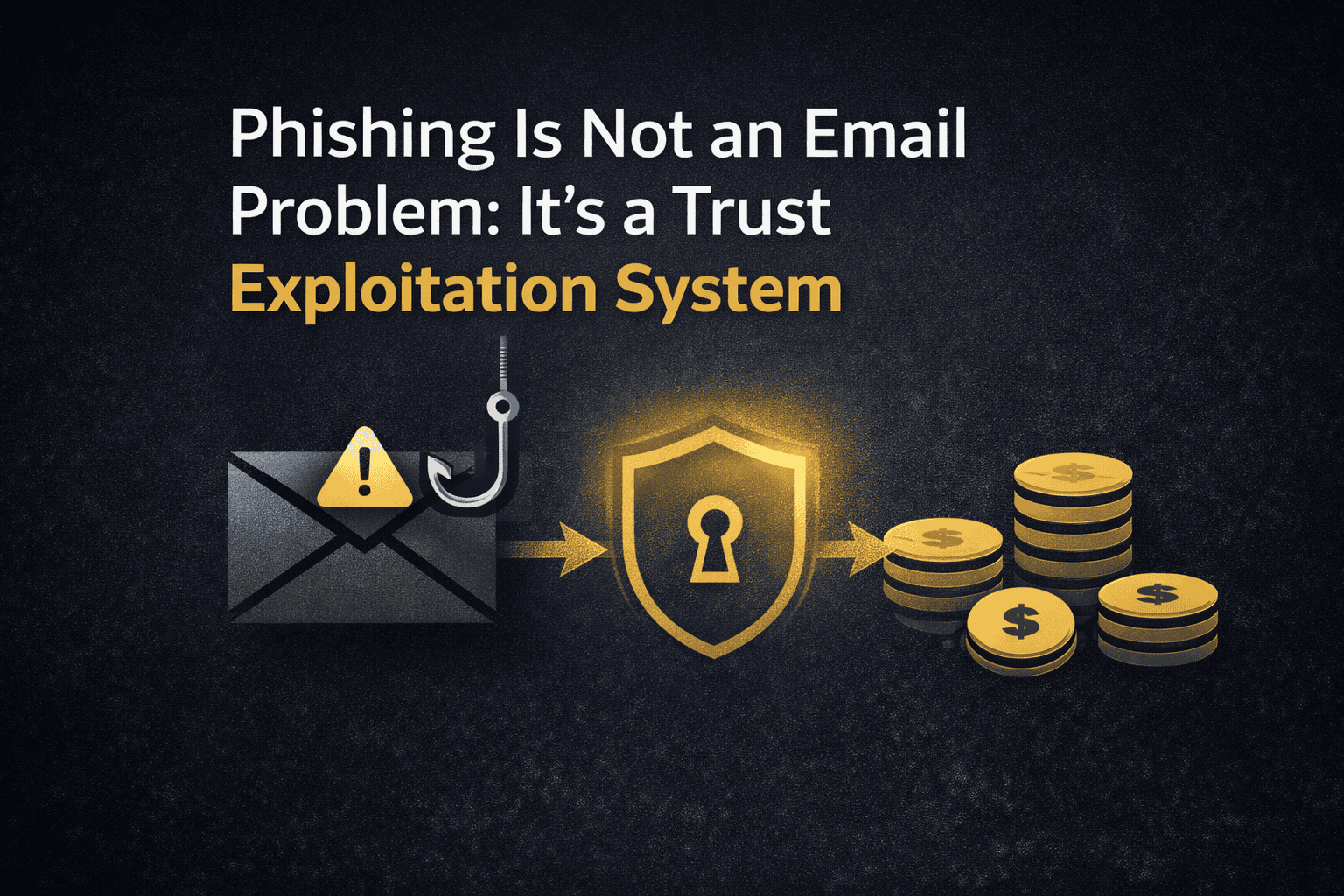
Why MFA doesn’t stop phishing becomes clear when you understand how attackers target sessions instead of passwords.
Intro
Why MFA doesn’t stop phishing is one of the most misunderstood problems in modern cybersecurity.
Most security teams still operate under an outdated assumption:
password + MFA = secure account
That model no longer matches how modern identity attacks work.
MFA still helps against credential stuffing, password reuse, and basic account takeover. But attackers have adapted. They no longer need to defeat authentication in the old sense. Increasingly, they target the user during the login flow, the session after the login flow, or the trust model surrounding both.
The result is simple but uncomfortable:
MFA often protects the login challenge, not the authenticated state that follows it.
That distinction matters because the real asset in modern cloud environments is no longer just the password. It is the authenticated session: the token, the cookie, the trusted state that survives after the prompt is gone.
If your security model stops at “MFA enabled,” you are defending the wrong layer.
This is exactly why MFA doesn’t stop phishing in many real-world attacks.
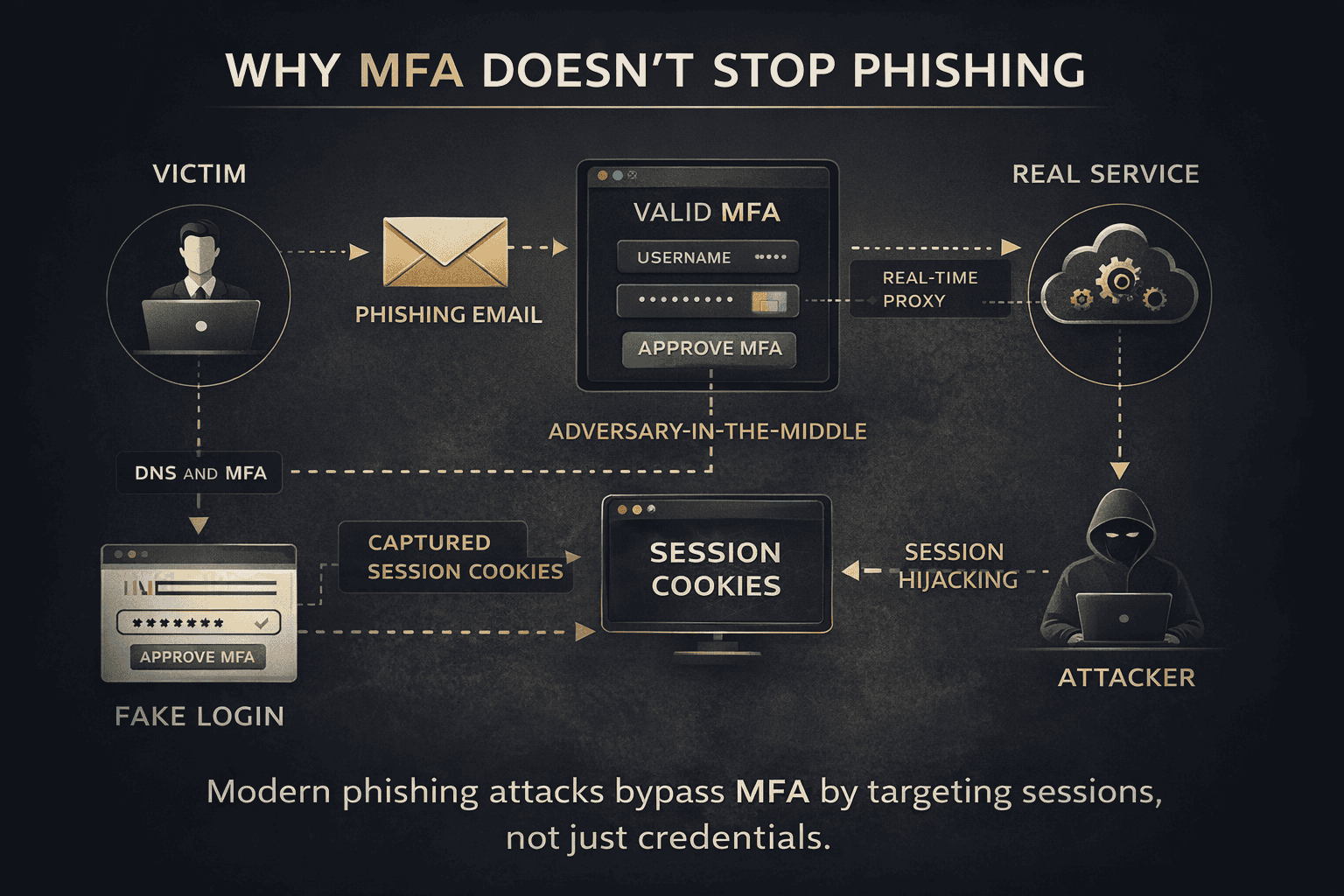
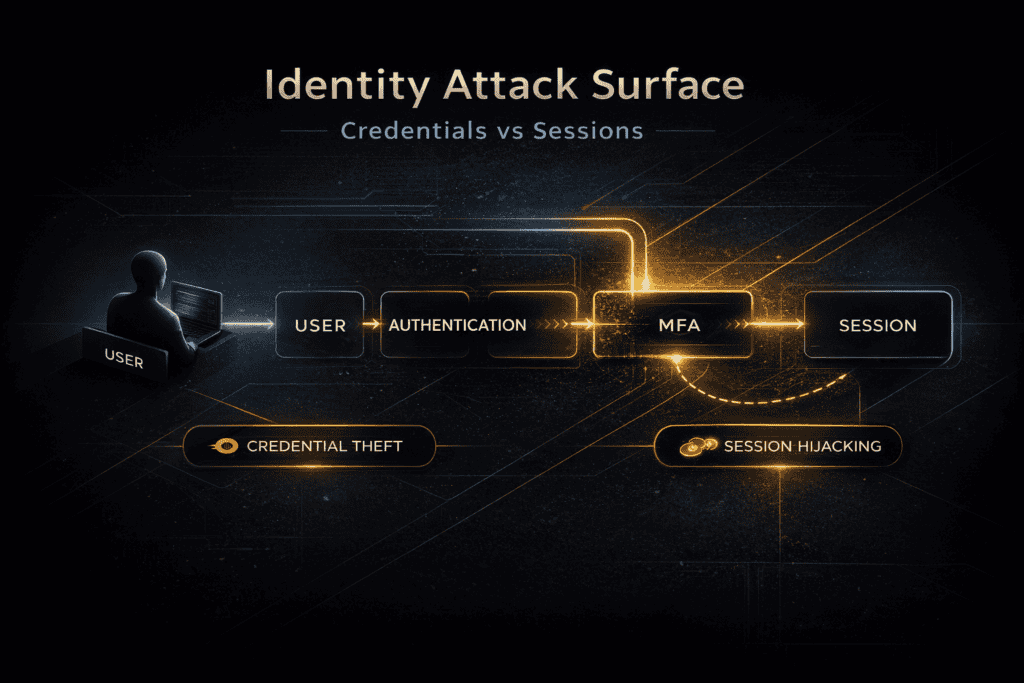
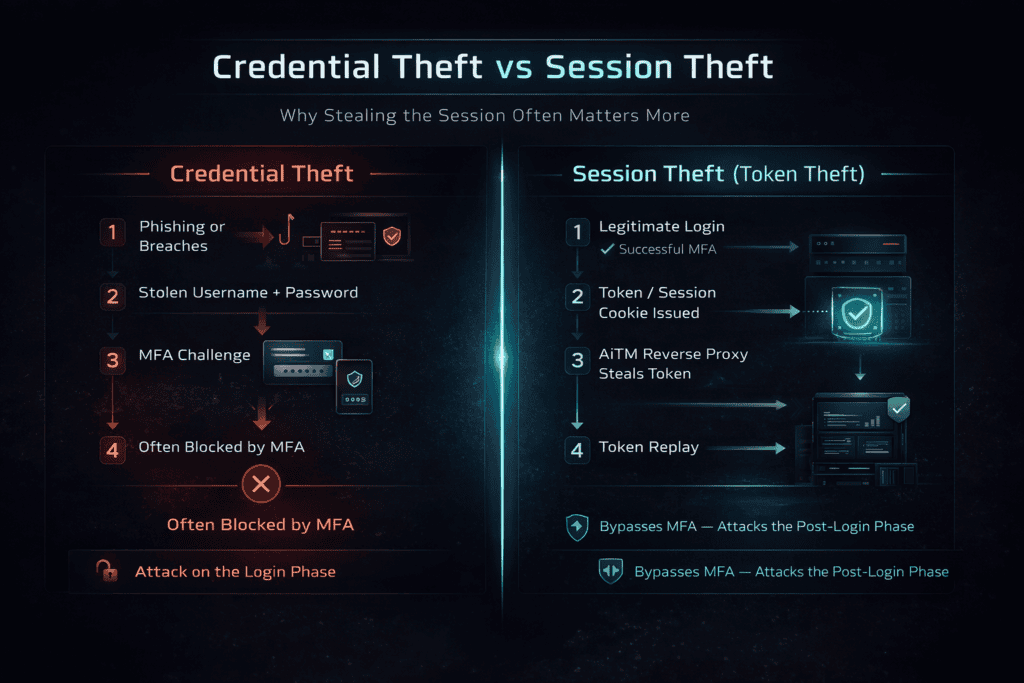
The diagram below shows exactly how modern phishing bypasses MFA by targeting the session layer.
Modern phishing attacks bypass MFA by targeting sessions, not just credentials.
Why MFA Doesn’t Stop Phishing in Modern Identity Systems
The Core Mistake: Treating Identity as a Login Event
Many organizations still think of authentication as a single event. A user enters credentials, completes a second factor, and gets access.
MFA protects only one point in that sequence. Everything after it depends on how well the platform protects sessions, evaluates context, enforces device trust, and reacts to risk.
This is the core strategic mistake in modern identity security:
teams protect the login, but attackers target the trusted state created by the login.
Why MFA Solved Yesterday’s Problem
MFA was designed for a different threat model.
The old problem looked like this:
attacker steals a password
attacker attempts login
second factor blocks access
attack fails
Against that model, MFA was and still is a strong improvement over password-only security.
But identity systems evolved. Cloud services, SaaS platforms, federated sign-in, OAuth, OpenID Connect, SAML, session cookies, access tokens, and refresh tokens changed the attack surface.
The attacker’s goal shifted from:
“Can I steal the secret?”
to:
“Can I obtain or replay a valid identity state?”
That is a much more dangerous problem, because a valid session can let an attacker operate as the user without needing to challenge MFA again.
Where MFA Actually Breaks
1. Authentication Is Not the Same as Session Trust
MFA protects the challenge.
It does not automatically protect what the system issues after the challenge succeeds.
Once a service grants:
session cookies
access tokens
refresh tokens
the security question changes. If those artifacts are stolen, replayed, or reused from another context, the service may continue to treat the attacker as legitimate.
That is why many identity breaches today are not about defeating MFA directly. They are about abusing what happens after MFA succeeds.
2. Tokens Are the Real Keys in Modern Environments
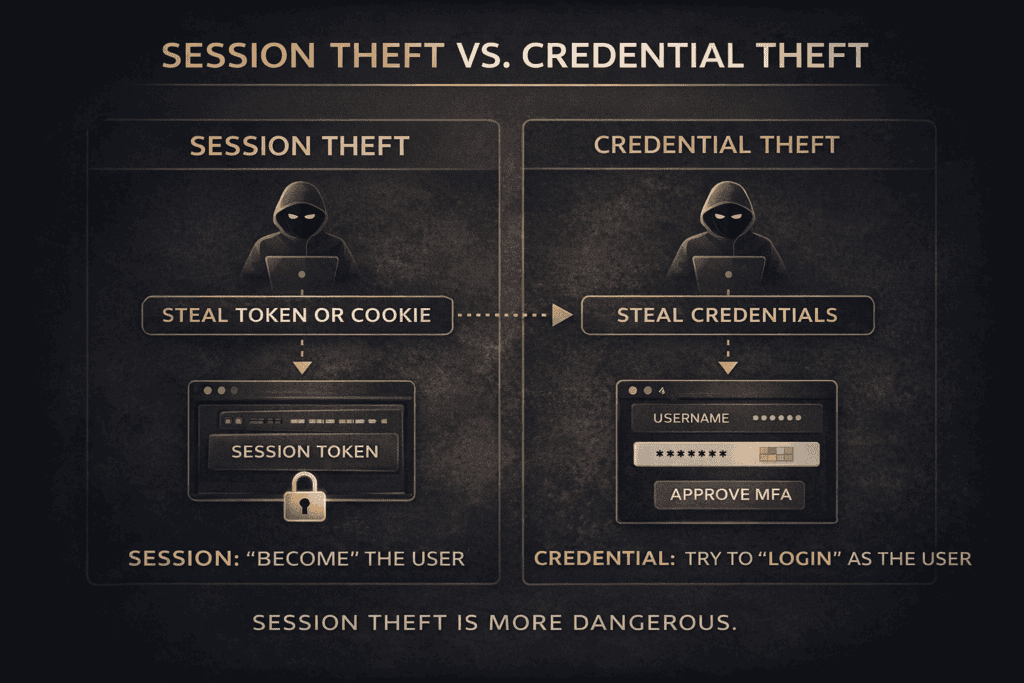
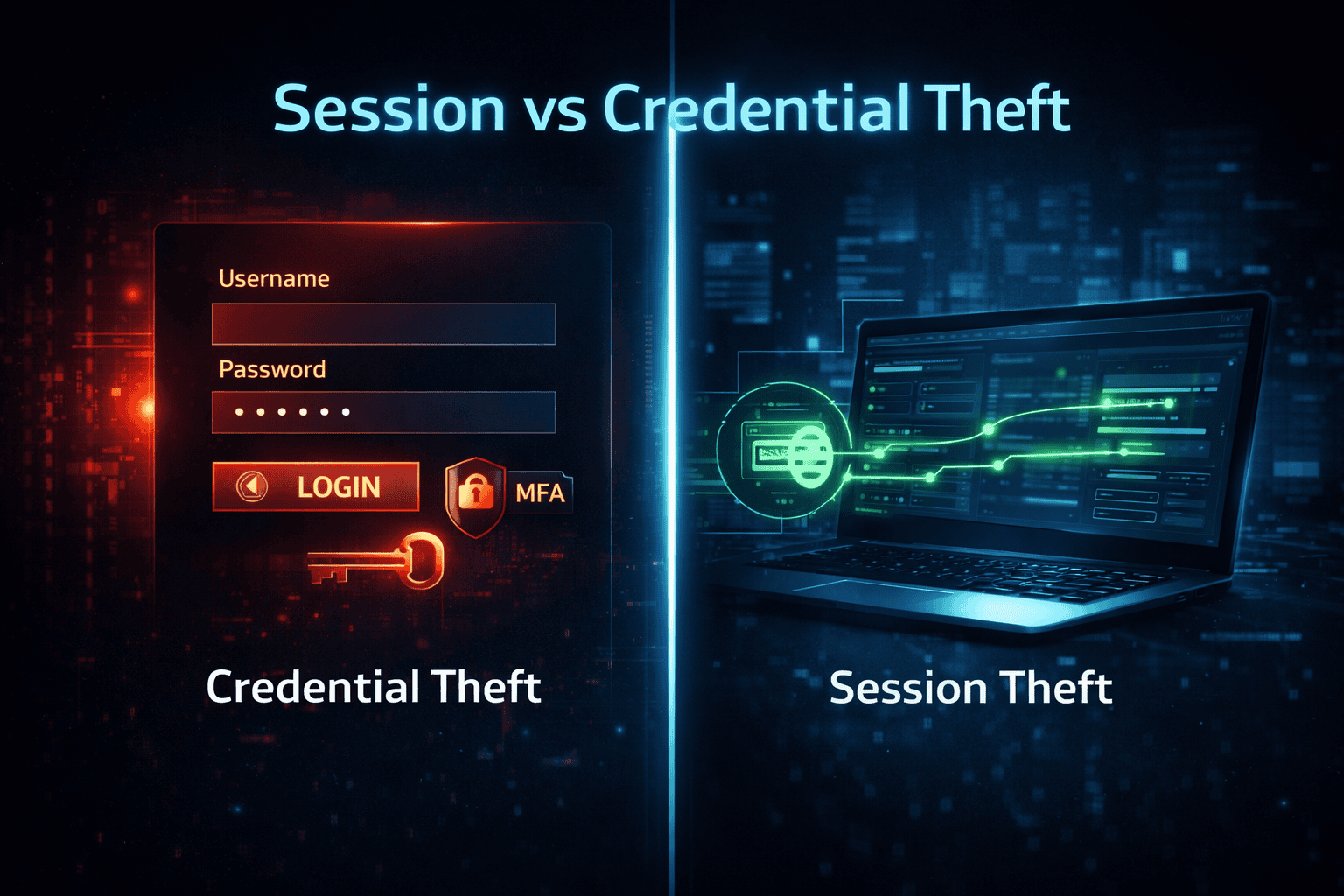
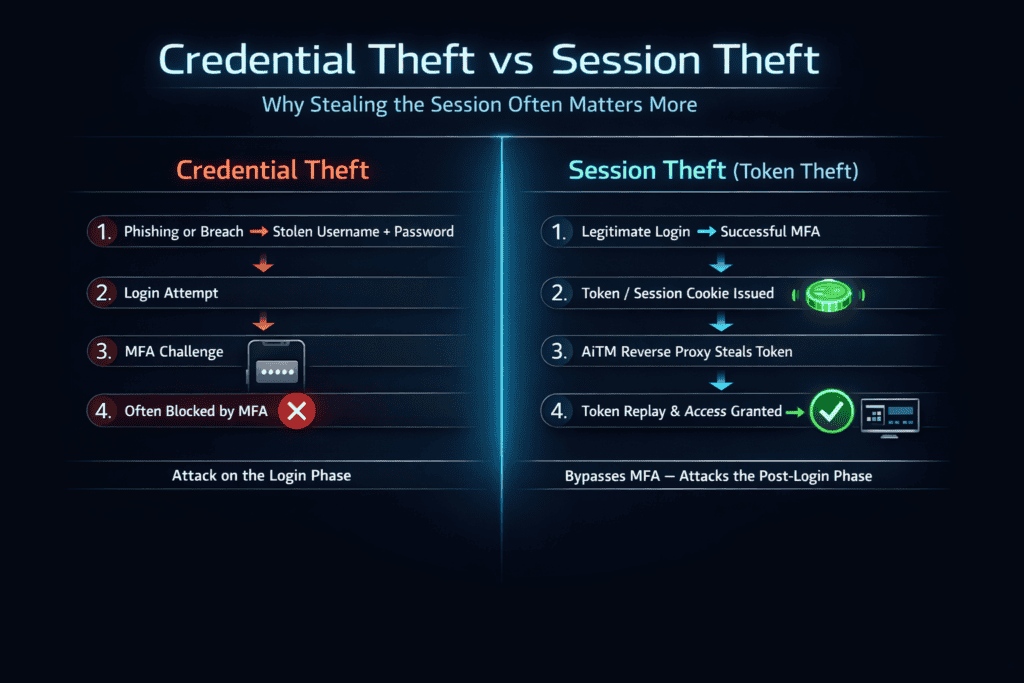
The diagram below shows the difference between session theft and credential theft in modern identity attacks.
Session theft allows attackers to act as the user without logging in, making it more dangerous than credential theft.
In Microsoft 365, Google Workspace, Slack, Salesforce, and similar platforms, access is often governed by tokens and sessions rather than by the password itself.
That means:
steal the token, and you may effectively become the user
This is what makes session theft more dangerous than classic credential theft. The attacker is not trying to guess or crack authentication. The attacker is stepping into an already trusted state.
3. Trust Often Persists Too Long
Many organizations still allow sessions to remain valid too long, refresh silently, or avoid meaningful re-evaluation unless the token naturally expires.
That creates operational space for attackers.
An account owner may change the password, suspect something is wrong, or even sign out in one location, while a stolen session remains usable elsewhere. If risk-based reevaluation is weak, the attacker keeps the benefit of the earlier trust decision.
4. The User Remains Inside the Security Boundary
Push approvals, codes, and interactive login prompts all assume the user can reliably make safe decisions in real time.
In reality, users are:
busy
conditioned by repetitive prompts
overloaded by email and app notifications
operating on mobile devices
trained to move quickly
Modern phishing exploits exactly that environment.
Attackers do not always need to beat the user. Sometimes they only need the user to cooperate at the wrong moment.
A company may deploy security keys or passkeys and still leave open:
SMS fallback
insecure recovery email flows
helpdesk override procedures
legacy authentication protocols
unmanaged device exceptions
At that point, the environment is not protected by its strongest control. It is exposed through its weakest allowed route.
The Real Attack Paths That Bypass Traditional MFA
Adversary-in-the-Middle (AiTM) Phishing
This is one of the most important identity attack patterns today.
In an AiTM flow:
the victim clicks a phishing link
the phishing site acts as a reverse proxy between the victim and the real service
the victim enters credentials
the victim completes MFA on the legitimate service through the proxy
the attacker captures the authenticated session
the attacker reuses that session
This is the hard truth many teams still resist:
MFA can work exactly as designed and the organization can still lose.
The problem is not always failed authentication. The problem is successful authentication being captured and repurposed.
This is the core reason why MFA doesn’t stop phishing when attackers use AiTM techniques.
Session Hijacking
In some attacks, the phishing page is not even the main issue.
If an attacker gets hold of a valid session cookie or token, they may bypass the entire authentication process and operate directly inside the user’s session context.
This is post-authentication compromise, and it is exactly why login-centric defenses are no longer enough.
Push Fatigue and Approval Abuse
Not all MFA bypasses are technically advanced.
Some are brutally simple:
flood the user with push prompts
pretend to be IT support
create urgency
tell the user to approve “to fix the issue”
The weakness here is not cryptography. It is workflow manipulation.
OAuth Consent Phishing
Some attacks do not try to steal credentials at all.
Instead, the victim is tricked into authorizing a malicious or overprivileged application. Once granted consent, that application may gain persistent access to data, mail, files, or APIs without ever needing the password.
In these cases, “MFA enabled” is largely beside the point.
Legacy Authentication and Weak Recovery
Older protocols, weak password reset processes, unmanaged devices, and insecure exception handling remain common attack paths.
Security teams often celebrate strong frontline controls while leaving side entrances open.
Attackers notice that immediately.
The Real Shift: From Credentials to Identity State
The old mental model was simple:
steal password → gain access
The new model is more accurate:
obtain valid identity state → operate as the user
That identity state may include:
an authenticated session
valid access or refresh tokens
a trusted device context
an approved OAuth application
a low-risk sign-in posture in the identity provider
This is why identity defense now has to move beyond passwords and beyond the login screen.
The real perimeter is no longer static authentication.
It is dynamic session integrity.
Why Traditional Security Awareness Falls Short
Most awareness programs still teach users to:
avoid suspicious links
check for spelling mistakes
look at the sender address
That is not enough against modern phishing.
Today’s attacks are often:
visually convincing
contextually relevant
timed to business processes
proxied through realistic login flows
designed to exploit approval habits, not obvious mistakes
The skill users actually need is more advanced:
they must know when not to approve identity-related actions, even when the flow feels familiar.
Security awareness has to evolve from “spot the typo” to recognizing abnormal identity workflows under pressure.
Why MFA Feels Safer Than It Sometimes Is
There is a dangerous psychological effect here.
When a user sees:
a familiar Microsoft or Google login flow
a real MFA prompt
a successful sign-in
they often interpret that as proof of legitimacy.
But in an AiTM attack, the attacker is relaying that exact flow in real time.
That means MFA can become, in the user’s mind, a false signal of trust rather than a reliable signal of safety.
This does not mean MFA is useless.
It means traditional MFA is often context-blind.
It verifies that a factor was completed. It does not always verify that the authentication request is happening in the right place, on the right origin, under the right conditions.
What Actually Works
1. Use Phishing-Resistant Authentication
The strongest structural improvement is to adopt:
FIDO2 security keys
passkeys
device-bound cryptographic authenticators
These methods are stronger because they use origin binding and asymmetric cryptography. The private key stays on the device, and the authentication response is tied to the legitimate domain.
That sharply reduces the value of proxy-based phishing because the attacker cannot simply relay or replay the authentication on another origin.
This is not just “better MFA.”
It is a different security property.
2. Enforce Device and Context Trust
Authentication without context is weak.
A stronger model asks:
is this a compliant device?
is the browser trusted?
does the location make sense?
is the sign-in risky?
is the user’s behavior consistent?
should this session exist under these conditions?
This is where Conditional Access, device compliance, managed browsers, and risk-based policies become critical.
3. Reevaluate Trust Continuously
A session should not remain trusted simply because it was once established successfully.
Continuous reevaluation matters because risk changes over time.
A user account may become high risk. A token may appear in a suspicious context. A session may suddenly behave differently from its baseline.
If reevaluation is slow, attackers keep access longer than they should.
If reevaluation is fast, dwell time shrinks.
4. Treat Tokens as High-Value Secrets
Many teams still protect passwords more seriously than tokens.
That is backwards.
In modern cloud identity, tokens are temporary keys to systems, data, and workflows. They should be protected, bounded, monitored, and invalidated aggressively when risk changes.
5. Detect Abuse After Authentication
A major failure in many programs is that visibility drops after login succeeds.
That is the wrong point to stop watching.
Teams need detection for:
unusual session reuse
mailbox rule manipulation
abnormal API behavior
suspicious OAuth consent activity
unusual access patterns after sign-in
token reuse from unexpected contexts
The breach often becomes visible only after authentication is complete.
6. Eliminate Weak Fallbacks
Strong identity systems cannot coexist comfortably with weak recovery and legacy exceptions.
If you allow phishable fallback methods, attackers will route around your best control.
This is why many identity hardening projects fail. The organization deploys something strong, then preserves enough weak exceptions to keep the overall environment exposed.
7. Build Real Identity Incident Response
A password reset is not enough for a modern identity compromise.
Effective response may require:
global session revocation
token invalidation
mailbox rule review
OAuth application audit
device posture review
sign-in log analysis
consent and persistence investigation
Identity incidents are not isolated events. They are distributed trust failures across time, devices, sessions, and services.
The problem is that many organizations treat MFA as the end of the identity conversation when it is only one control inside a much larger trust system.
That is the real failure:
an incomplete identity model disguised as a mature security posture
The Hard Truth in One Sentence
MFA does not protect your account as a whole. It protects a single moment in the authentication flow.
Modern attackers increasingly target:
the user during the flow
the session after the flow
the trust model around the flow
That is why checkbox MFA is not enough.
What This Means for Security Leaders
If your message is still:
“We enabled MFA, so we are covered”
you are behind the current threat model.
If your strategy is:
phishing-resistant authentication
session governance
device trust
continuous reevaluation
post-authentication detection
hard recovery architecture
then you are defending identity at the level where modern attacks actually happen.
That is the difference between compliance language and operational reality.
Move Beyond Checkbox MFA
Understanding why MFA doesn’t stop phishing is critical for modern identity security.
Modern phishing does not stop at the login page. Your defenses should not stop there either.
If you want a serious view of your exposure, the right question is not “Do we have MFA?”
The right question is:
Can an attacker still obtain, replay, or persist a trusted identity state in our environment?
That is where real identity security starts.
Book an Identity Architecture Review
If your organization runs on Microsoft 365 or Microsoft Entra ID, we can map the identity attack surface that traditional MFA leaves behind.
The review focuses on:
AiTM exposure
token and session risk
Conditional Access gaps
fallback weaknesses
identity recovery blind spots
You get a prioritized hardening view based on real attack paths, not generic compliance talk.
[Schedule Your Review →]
Link this article to:
What Is AiTM Phishing and Why It Beats Traditional MFA
Passkeys vs MFA Apps: What Actually Changes
Why Session Cookies Matter More Than Your Password
How Conditional Access Shrinks the Damage of Identity Attacks
A user enters their password. They approve the MFA request. Everything looks normal.
And yet the attacker logs in anyway.
This is not a failure of the user. It is a failure of how identity security is designed.
Adversary in the Middle phishing is one of the most effective attack techniques today because it does not break authentication. It operates inside it.
If your organization relies on passwords and MFA alone, you are exposed.
Table of Contents
What Is AiTM Phishing
AiTM phishing is an attack where the attacker places a proxy between the user and the real login service.
The user believes they are logging into a legitimate platform such as Microsoft 365. In reality, their traffic is routed through an attacker-controlled proxy.
This allows the attacker to capture:
Credentials
MFA responses
Session cookies and tokens
The critical detail is this:
The attacker does not need to break authentication. They capture the result of successful authentication.
How AiTM Attacks Actually Work
Step 1: Lure
The attacker sends a phishing message that looks legitimate. This could be a document share, login request, or security alert.
Step 2: Proxy
The victim lands on a page that perfectly mirrors the real login page. This is not a static fake site. It is a live relay to the real service.
Step 3: Credential Input
The user enters their username and password. The proxy forwards these to the real service.
Step 4: MFA Challenge
The real service triggers MFA. The user approves it.
Step 5: Token Issuance
The identity provider issues:
Session cookies
Access tokens
Refresh tokens
This is the moment where trust is granted.
Step 6: Interception
The proxy captures these tokens in real time.
Step 7: Session Replay
The attacker reuses the tokens to access the account.
No password required No MFA required
Image Block
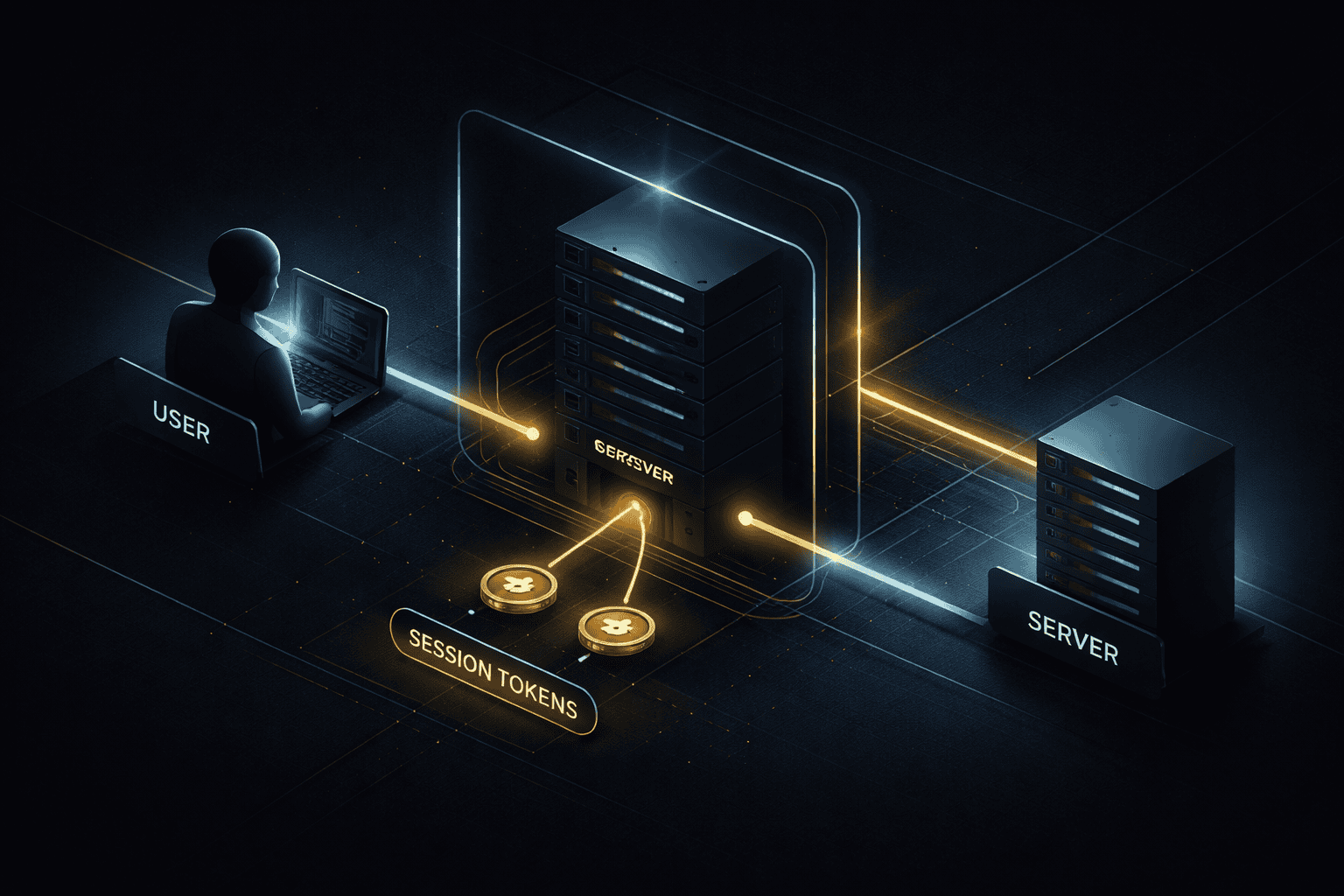
Image prompt: A dark minimal cybersecurity diagram showing a user connecting to a login server through a hidden proxy layer in the middle. Clean flow arrows from user to proxy to server. Highlight the interception point at token issuance. Dark blue and black background with subtle gold accents. No hacker clichés.
Alt text: AiTM phishing proxy intercepting authentication session between user and server
Caption: AiTM attacks intercept trust at the moment authentication succeeds
Why MFA Fails Against AiTM
MFA was designed to protect against credential theft.
It works when:
A password is stolen
An attacker tries to log in separately
It fails when:
The attacker is inside the login flow
Once authentication succeeds, the system issues a session token.
That token represents access.
AiTM attacks target this exact moment.
This is why MFA enabled is not a strong security guarantee.
The Real Problem: Session Trust
Modern identity systems such as Microsoft Entra ID rely on token-based authentication models. According to Microsoft Entra ID documentation, session tokens represent authenticated access and are reused across services.
Industry guidance such as the OWASP Session Management Cheat Sheet shows how improper session handling increases the risk of session hijacking attacks.
Modern identity systems rely on:
Single Sign On
OAuth and OpenID Connect
Token-based authentication
Authentication is no longer a single event. It is the beginning of a session.
After login, the system grants trust through tokens.
These tokens:
Are often not bound to a device
Are rarely continuously validated
Can be reused if stolen
This creates a gap between authentication and session ownership.
AiTM phishing operates inside that gap.
Session Theft vs Credential Theft
AiTM phishing changes how we should think about identity attacks.
Most organizations still think in terms of credentials.
They ask: did the attacker get the password?
Modern attacks ask a different question.
Did the attacker get the session?
Credential theft:
Password is stolen
MFA may still stop access
Session theft:
Token is stolen
MFA already completed
Immediate access
This is a completely different threat model that many organizations fail to understand.
AiTM phishing proves that session security is now the primary attack surface.
AiTM phishing intercepts the session after MFA, highlighting why session tokens are the real attack target
Why This Attack Works
AiTM is not just technical. It leverages human behavior.
Trust in familiar login pages
Routine approval of MFA requests
Authority of known brands
Real-time interaction without delay
The user completes the attack themselves without noticing.
Impact of AiTM Attacks
Direct Impact
Account takeover
Access to email and files
Operational Impact
Business Email Compromise
Invoice fraud
Internal phishing
Strategic Impact
Privilege escalation
Tenant-wide compromise
Supply chain exposure
One successful session can lead to a full attack chain.
How to Reduce AiTM Risk
You cannot fully eliminate AiTM. You can reduce exposure.
Identity controls
Conditional Access policies
Device compliance enforcement
Location-based restrictions
Risk-based authentication
Session controls
Short session lifetimes
Session binding to device or context
Continuous evaluation of sessions
Strong authentication
Passkeys
Hardware security keys
These methods are resistant to proxy-based attacks.
User awareness
Focus on login flow manipulation
Avoid generic phishing training
Internal Links
How Cyber Attacks Happen
Phishing Attack Explained
Why MFA Does Not Stop Phishing
Session vs Credential Theft
Why Session Cookies Matter More Than Your Password
CTA
Identity Security Review
AiTM phishing risk assessment for Microsoft 365 environments.
If your organization uses Microsoft 365 or Entra ID, relying on MFA alone is not enough.
We analyze:
Where session theft is possible
Where MFA creates false confidence
Where Conditional Access reduces real risk
You get a clear and prioritized hardening plan based on real attack paths.
Session vs credential theft is no longer a theoretical distinction. It is the defining shift in modern identity attacks.
Most security teams still focus on protecting login.
Strong passwords. MFA. Reset flows.
But attackers have adapted.
They no longer break in. They steal the trust issued after login.
According to Microsoft’s Digital Defense Report, adversary-in-the-middle phishing attacks are rapidly increasing as attackers shift toward session token theft. Meanwhile, OWASP and MITRE ATT&CK confirm the same reality: once a session token is stolen, authentication no longer matters.
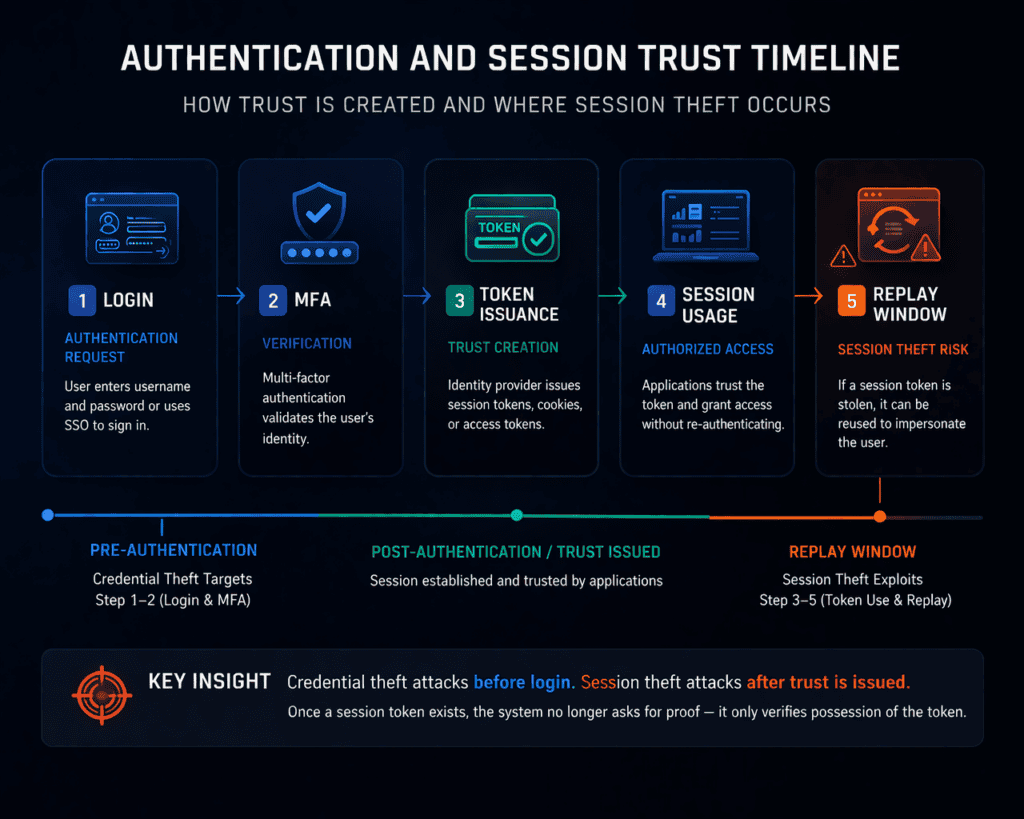
How digital trust is built during login and where attackers exploit the session after MFA is completed
Extra variaties (voor verschillen
Credential Theft vs Session Theft
Credential theft targets login secrets:
Passwords
MFA codes
API keys
Stored browser credentials
How it happens:
Phishing pages
Credential stuffing
Database breaches
Keyloggers
Credential dumping
Real-world flow:
Credentials stolen
Login attempted
MFA triggered
Attack often blocked
Key reality:
Credential theft gives opportunity, not guaranteed access.
Session Theft vs Credential Theft in Practice
Session theft targets what happens after login:
Session cookies
Access tokens
Refresh tokens
SSO artifacts
Once stolen, these allow full impersonation.
How it happens:
AiTM phishing
Infostealer malware
Browser compromise
XSS attacks
Token replay
Real-world flow:
User logs in normally
MFA succeeds
Token issued
Token captured
Attacker reuses it
Access granted
No password needed No MFA needed
Clear difference between attacking the authentication phase (credential theft) and attacking the post-authentication phase (session theft). Session theft bypasses MFA because the token is stolen after successful login.
How AiTM Connects Credential Theft and Session Theft
Adversary-in-the-Middle attacks combine both layers.
A reverse proxy sits between the victim and the real service:
Captures credentials during login
Captures tokens after login
Relays everything live
Result:
The attacker gets credentials and active session access.
Most people still think the password is the main thing protecting an account.
It is not.
Why session cookies matter more than your password becomes clear the moment you understand what happens after login. Your password only matters at the front door. After authentication, the system shifts trust to something else entirely: the session.
Once a user signs in, the application stops checking the password on every request. It checks whether the browser presents a valid session token.
That changes everything.
Modern attackers don’t always need credentials anymore. If they can steal the active session, they can bypass login, bypass MFA, and inherit access instantly.
Credential theft targets the login. Session theft bypasses it completely.
Table of Contents
What a Session Cookie Actually Does
HTTP is stateless. Every request is independent unless the application adds memory.
That memory is the session.
After login, the server issues a session cookie. The browser automatically sends it with every request. The application treats those requests as authenticated.
Key insight:
The password gets you in once. The session keeps you in.
This is exactly why session cookies matter more than your password becomes a critical concept in modern identity security.
Why Session Cookies Matter More Than Your Password
1. A session cookie can bypass authentication entirely
A password is used to create trust. A session cookie represents trust that has already been granted.
If an attacker steals a valid session cookie, they usually do not need to know the password at all. They also may not need to pass MFA, because MFA was already completed during the original sign-in flow. The attacker simply reuses the authenticated session.
This is what makes session hijacking so dangerous. The attacker is not attacking the login process. They are skipping it.
2. Session theft is often faster than credential theft
Credential attacks usually require one or more steps:
phishing the victim
cracking weak passwords
reusing breached credentials
bypassing or intercepting MFA
avoiding login-based detections
Session theft removes much of that work.
If malware, an AiTM phishing proxy, a malicious browser extension, or a browser compromise can extract the active session, the attacker gets immediate usable access. In many cases, that is operationally easier than stealing credentials and then dealing with the controls that sit around th
3. A valid session looks legitimate to the application
That is one of the hardest realities in identity security. Many detections are designed around authentication events such as impossible travel, new-device sign-ins, unusual IP addresses, failed login bursts, or MFA fatigue patterns. But once a request arrives carrying a valid session token, the platform may treat it as normal application traffic.
That makes session abuse quieter than credential abuse.
4. Sessions can remain active for a long time
Many users assume a session lasts only a few minutes. In reality, that is often false.
Modern applications may keep users signed in for days or weeks. Some use refresh tokens, silent reauthentication, or “remember this device” behavior that extends practical access even further. In SaaS environments, that can give an attacker a large post-compromise window.
A stolen password is dangerous. A stolen active session is dangerous right now.
5. MFA protects the login event, not the ongoing session
This is the misunderstanding that causes false confidence.
MFA is valuable. It raises the cost of account compromise and blocks many basic attacks. But MFA does not automatically protect the session that exists after the user signs in. Once the platform has issued a valid session token, possession of that token may be enough to act as the user.
This is exactly why session-based attacks keep growing. Organizations celebrate MFA adoption while attackers move one layer deeper.
6. Modern attackers increasingly target sessions instead of passwords
The industry is slowly learning that identity attacks are shifting from credential collection to session capture.
That shift shows up in several places:
AiTM phishing kits that proxy the real login flow and steal the post-authentication session
info-stealer malware that extracts browser cookies and tokens
malicious browser extensions with excessive permissions
cloud identity attacks that focus on token replay rather than password guessing
The logic is simple. Stronger passwords and wider MFA deployment made direct credential abuse harder
7. The session is the real operational identity layer
Security teams often talk about identity as if it begins and ends with passwords, MFA apps, or passkeys.
That is incomplete.
Operationally, the session is what the application trusts on each request. That makes session management one of the most important and most underestimated layers in account security. If the session is weak, poorly scoped, too long-lived, or easy to steal, then the strength of the password matters much less than people think.
How Session Cookie Theft Actually Happens
Understanding this attack surface is essential to grasp why session cookies matter more than your password in real-world breaches.
Session cookie theft does not require one single technique. It can happen through multiple attack paths, and that is what makes it dangerous.
In an adversary-in-the-middle phishing attack, the victim is lured to a phishing site that sits between them and the legitimate service. The victim enters credentials, completes MFA, and the real site issues a valid session. The phishing proxy captures that session token and hands it to the attacker.
The attacker never needs to defeat MFA directly. They inherit the result of a legitimate MFA flow.
Info-stealer malware
Many modern malware families are designed to scrape browsers for stored credentials, cookies, and tokens. In practice, this means they are not just stealing usernames and passwords. They are stealing already authenticated states.
That can give the attacker immediate access to email, development platforms, enterprise SaaS tools, and cloud-admin surfaces.
XSS
If a website is vulnerable to cross-site scripting and cookies are not properly protected with HttpOnly, malicious scripts may be able to read and exfiltrate them. That turns a client-side injection flaw into a session compromise.
Malicious or over-permissioned browser extensions
Extensions are often ignored in security conversations, but they can become a direct path into sessions. If an extension can read page content, intercept traffic, or access browser storage in dangerous ways, it may expose authentication artifacts.
Unsecured transport or legacy weaknesses
Plain HTTP, weak internal apps, bad reverse proxies, and poorly designed legacy systems can still expose session data in transit. This is less common than before, but it still matters in older environments and internal tooling.
Physical access to an unlocked device
Not every session attack is advanced. If a browser is open and the user is authenticated, an attacker with device access may not need the password at all. They already have the session in front of them.
Pass-the-Cookie: The Practical Attack Model
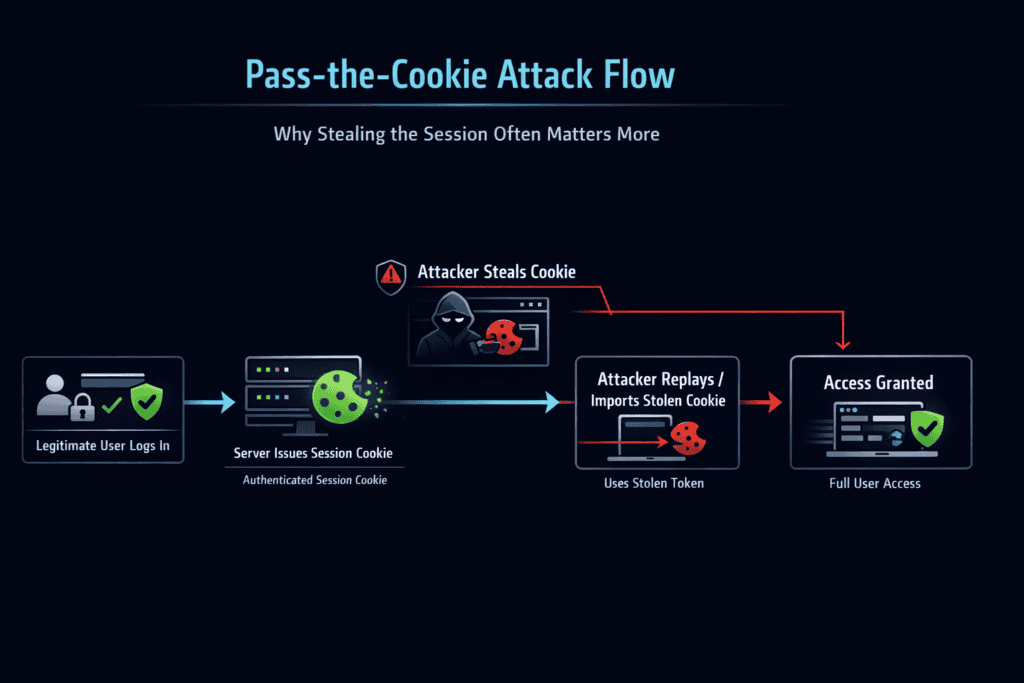
A stolen session cookie allows attackers to replay an authenticated session and gain full access without needing a password or MFA.
This is why session hijacking and pass-the-cookie attacks are more dangerous than traditional credential theft.
Pass-the-cookie is the simplest way to explain the risk.
The attacker obtains the cookie. Then they replay it.
If the application accepts that cookie as valid, the attacker is treated as the user. They get the same permissions, the same active session context, and the same access level.
This is why the phrase “stealing the password” can be misleading in modern identity incidents. In many cases, the attacker is not stealing identity at the credential layer. They are replaying it at the session layer.
Session Fixation: A Different Route to the Same Outcome
Session theft usually means stealing an already active session. Session fixation is different.
In a session fixation attack, the attacker forces or tricks the victim into using a session ID that the attacker already knows. If the application fails to rotate the session ID after login, the attacker can later reuse that same authenticated session.
The weakness here is not theft after login. It is bad session lifecycle management during login.
A secure application must issue a fresh session after successful authentication. If it does not, it risks turning an unauthenticated session into an authenticated one that the attacker can predict or control.
Session Prediction: When the Session ID Itself Is Weak
Some systems fail even earlier.
If session IDs are predictable, low-entropy, sequential, timestamp-based, or built from guessable values, attackers may be able to predict valid sessions without stealing or fixing them first. This is session prediction.
This is mostly a legacy or custom-implementation problem now, but it still matters in badly designed applications. Strong session management depends on randomness. If the token is guessable, the whole model collapses.
Why Defending the Session Is Harder Than People Think
Developers and defenders do have controls available, but none of them are perfect on their own.
This helps prevent JavaScript from reading cookies. It is critical against some XSS-based theft paths. But it does not stop every kind of session abuse, and it does nothing against malware already running on the endpoint.
Secure
This ensures cookies are only sent over HTTPS. It is necessary, but it does not protect a session once the endpoint itself is compromised.
SameSite
This reduces some cross-site abuse patterns, especially around CSRF. It is useful, but it is not a complete defense against cookie theft or token replay from the user’s own environment.
Short session lifetime
Reducing session duration limits attacker dwell time, but it also creates friction for users. Most organizations compromise here, and attackers benefit from that tradeoff.
Reauthentication for sensitive actions
This is one of the better controls. Even if the session exists, the application can demand fresh proof before allowing high-risk actions such as password changes, payment updates, admin role changes, or privileged operations.
Device and risk binding
Some platforms bind sessions to device posture, browser characteristics, IP signals, or conditional access policies. These controls can reduce replay success, but they need careful tuning because legitimate users move, roam, and change networks constantly.
This complexity further explains why session cookies matter more than your password in modern attack scenarios.
What Users Can Do
Users cannot solve session security alone, but they can reduce exposure.
Log out of sensitive accounts when you are done, especially on shared or semi-trusted devices. Keep browsers updated. Avoid random extensions. Treat extension permissions seriously. Use reputable endpoint protection. Be cautious with phishing links even if they appear to support MFA. Review active sessions on major platforms and revoke sessions you do not recognize.
The important mental shift is this: do not think only about protecting the password. Think about protecting the live authenticated browser.
What Organizations Need To Change
Organizations need to stop treating “MFA enabled” as the end of the identity story.
A stronger model includes:
session-aware detection
stronger endpoint security against info-stealers
phishing-resistant authentication where possible
reauthentication for sensitive actions
shorter token lifetime for privileged access
conditional access and risk-based session controls
secure cookie configuration
session revocation and visibility for users and admins
testing for fixation, prediction, replay, and token handling flaws
In other words, identity security has to extend beyond the login page.
The Real Bottom Line
Why session cookies matter more than your password comes down to one uncomfortable fact: once a session is active, the application usually trusts the session more than the credentials that created it.
That is why attackers increasingly go after cookies, tokens, and authenticated browser state. It is faster than cracking passwords, often bypasses MFA, and can look like perfectly normal user activity.
The password opens the door.
The session decides who the system believes is already inside.
Conclusion
The traditional model of account security starts with credentials. The modern attack model starts after credentials.
This is ultimately why session cookies matter more than your password in modern cybersecurity.
That is the shift many teams still underestimate.
If you only protect the login, but fail to protect the session, you are securing the entrance while leaving the occupied building exposed. Session cookies are not a minor implementation detail. They are the operational trust layer of the modern web.
That is why session cookies matter more than your password in day-to-day account security, incident response, and modern identity defense.
Want to understand how modern identity attacks really work beyond passwords and MFA?
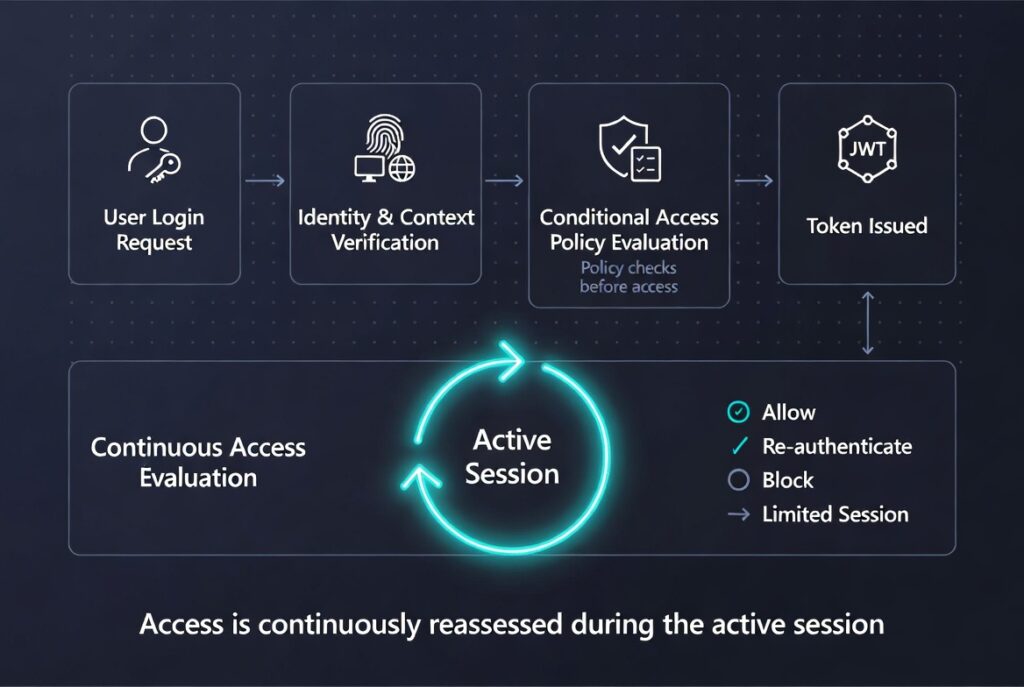
Conditional Access reduces identity attack damage by shifting security from a one-time login check to continuous validation.
Modern attackers do not break in. They log in.
Using techniques such as AiTM phishing, token theft, and session hijacking, they bypass MFA and operate inside your environment as legitimate users.
That means the real battle starts after authentication.
Conditional Access, combined with Continuous Access Evaluation (CAE) and Token Protection, transforms identity security into a system that limits how long an attacker can stay and how much damage they can do.
Table of Contents
Why Identity Attacks Now Focus on Sessions
Attackers have shifted from stealing passwords to stealing sessions and tokens.
Instead of granting full trust after login, it enforces conditional trust at every step.
The Core Mechanism: From Login to Continuous Validation
Conditional Access does not simply operate as a linear post-login control. In a technically accurate Zero Trust model, policy evaluation happens before access is fully granted.
The diagram below illustrates how Conditional Access and Continuous Access Evaluation work together in a Zero Trust model.
Rather than granting permanent trust after login, the system continuously reassesses the session based on identity, context, and risk signals.
Conditional Access validates access before token issuance, while Continuous Access Evaluation continuously reassesses trust during the active session.
The flow starts with the user login request and proceeds through identity and context verification before Conditional Access policies are evaluated.
Only after these checks pass is the token issued and the session activated.
From that point onward, Continuous Access Evaluation continuously reassesses the active session and can dynamically allow, challenge, block, or restrict access.
This means access is not trusted by default after authentication.
Before the access token is issued, Microsoft Entra ID evaluates critical policy conditions such as:
– MFA requirement – device compliance – trusted location – risk signals – user role sensitivity – application sensitivity
Only if these conditions are satisfied is the token issued and the session activated.
After the session starts, Continuous Access Evaluation acts as an ongoing validation loop rather than a separate linear step.
This is a core Zero Trust principle:
trust is temporary and continuously reassessed.
Key Control Layer
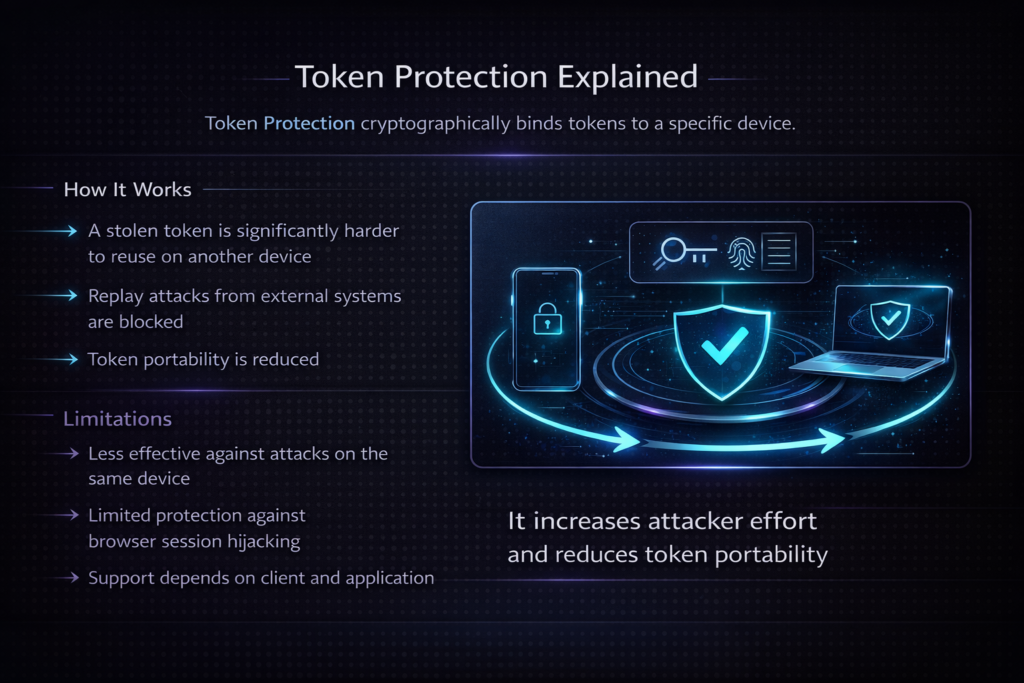
Token Protection Explained
Token Protection cryptographically binds tokens to a specific device.
This means:
stolen tokens are significantly harder to reuse
replay attacks from external systems are blocked
token portability is reduced
Limitations:
less effective against same-device attacks
browser session hijacking remains possible
support depends on client and application
It increases attacker effort and reduces token portability.
Token Protection cryptographically binds tokens to a device, making replay attacks significantly harder while reducing token portability across systems.
Continuous Access Evaluation (CAE) Explained
Continuous Access Evaluation introduces near real-time control.
Triggers include:
Password change
Risk detection
Location change
Account disablement
Instead of waiting for token expiration, access can be revoked quickly.
This turns sessions into unstable environments for attackers.
Why Continuous Evaluation Is a Loop, Not a Step
Continuous Access Evaluation should not be visualized as a one-time stage after Conditional Access.
Technically, it functions as an event-driven feedback loop during the active session.
Session vs Credential Theft: Why attackers now prefer stealing active sessions instead of passwords, and what this means for Zero Trust security.
Manage Consent
To provide the best experiences, we use technologies like cookies to store and/or access device information. Consenting to these technologies will allow us to process data such as browsing behavior or unique IDs on this site. Not consenting or withdrawing consent, may adversely affect certain features and functions.
Functional
Always active
The technical storage or access is strictly necessary for the legitimate purpose of enabling the use of a specific service explicitly requested by the subscriber or user, or for the sole purpose of carrying out the transmission of a communication over an electronic communications network.
Preferences
The technical storage or access is necessary for the legitimate purpose of storing preferences that are not requested by the subscriber or user.
Statistics
The technical storage or access that is used exclusively for statistical purposes.The technical storage or access that is used exclusively for anonymous statistical purposes. Without a subpoena, voluntary compliance on the part of your Internet Service Provider, or additional records from a third party, information stored or retrieved for this purpose alone cannot usually be used to identify you.
Marketing
The technical storage or access is required to create user profiles to send advertising, or to track the user on a website or across several websites for similar marketing purposes.