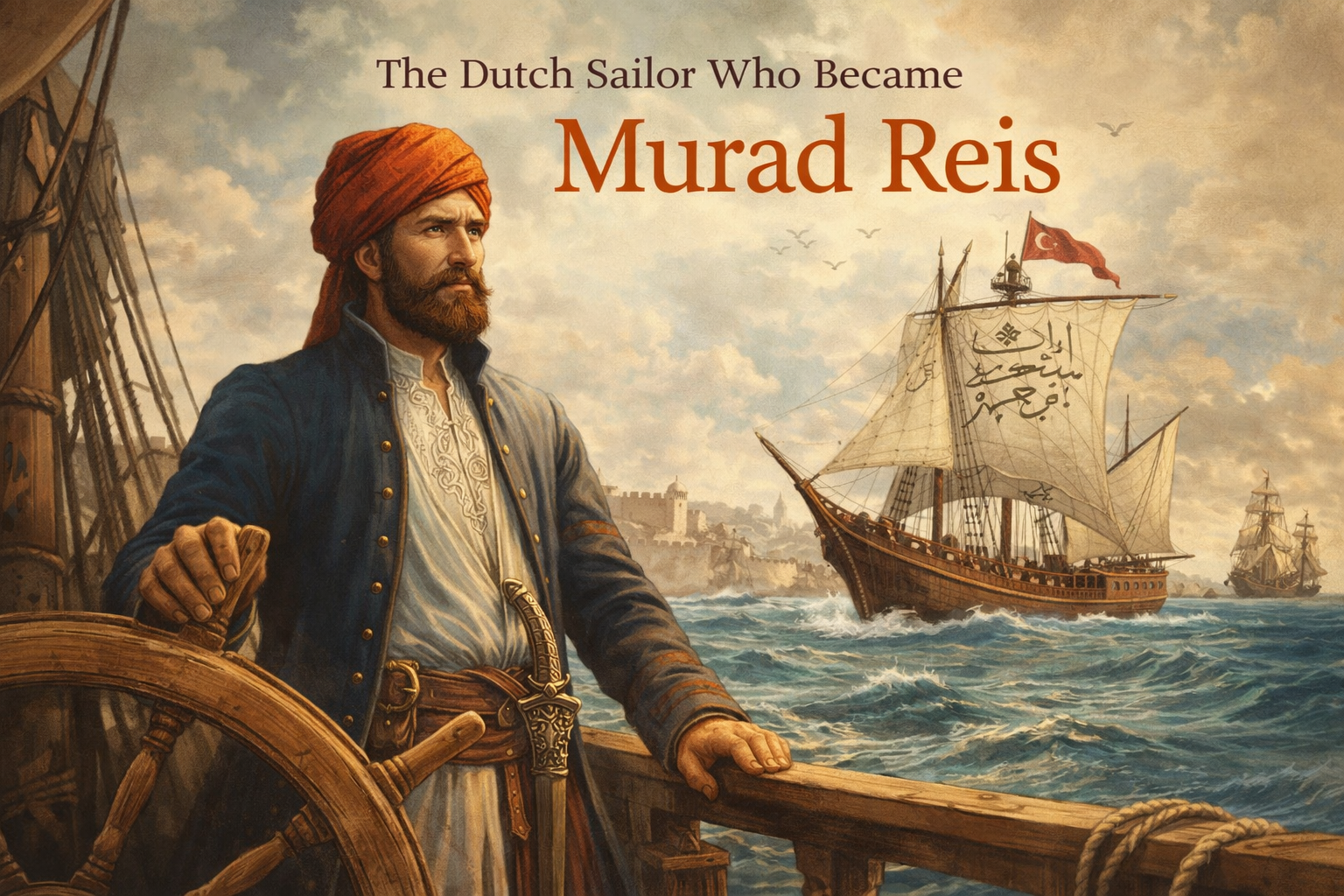
The Dutch Sailor Who Became Murad Reis
Jan Janszoon Murad Reis as a hinge figure between Dutch privateering, North African corsair systems, captive economies, and the Atlantic world, from Haarlem to the Bou Regreg and on toward Brooklyn

I. Jan Janszoon Murad Reis as a System Map
Jan Janszoon Murad Reis is best read not merely as a biography, but as a system map. Some lives are stories of character. Others are routes through wider forces: war, trade, law, religion, geography, and the institutions that move people through time. Jan Janszoon of Haarlem belongs to the second category. Under one name he was a Dutch privateer. Under another he became Murad Reis, operating from the Bou Regreg in a corsair order that reached Ireland, Iceland, and the Atlantic edge of Europe. His son later established himself in what became New York. His name would eventually touch land in Brooklyn.
That is not simply the path of an exceptional man. It is the path of a system that could absorb people, repurpose them, and transmit their consequences into the next generation. This essay reads that system. It begins with water.
II. Water as a Governing Principle
The Netherlands is not just a country with water. It is a country shaped by water. Early Dutch political logic was deeply tied to water management. Water boards existed from the medieval period onward as functional institutions built around dikes, drainage, shared risk, and collective maintenance.
That same logic later reappears in Dutch maritime capitalism. The sea is water, water is risk, risk becomes governance. Joint-stock ventures, maritime licenses, and pooled capital all reflect the same structural instinct: distribute danger, formalize responsibility, and turn instability into organized advantage.
This matters because the Dutch Republic was not simply a trading state. It was a trading state at war. And war at sea required legal instruments, private investors, and tolerated violence. That brings us to the letter of marque.
III. The Letter of Marque as an API Key
The difference between a privateer and a pirate is, in essence, a piece of paper. A privateer held a letter of marque, a state document granting legal permission to attack designated enemy shipping and bring captured goods before a prize court. Pirates had no such legal shield. The distinction was fundamental in law and unstable in practice.
The letter of marque as licensed violence
Think of the letter of marque as an early modern API key: a token that authorizes violence under state logic while outsourcing risk to private actors. The state does not have to bear the full cost of a permanent fleet. Investors finance ships and crews. The law provides a framework. Violence is privatized but not fully informal.
The system had three layers: (1) the license layer, state permission; (2) the legal layer, prize adjudication; (3) the investment layer, merchants, rederies, and local maritime networks funding the enterprise for profit.
Jan Janszoon began his career inside exactly that system. Around 1600, he sailed as a Dutch privateer in the context of the Eighty Years’ War. In 1618, he was captured off Lanzarote by Algerian corsairs. That moment is the hinge point of his life: the transfer from one licensed violence system into another.
This is also why Janszoon should not be presented as an isolated anomaly. European converts and maritime renegades already formed a recognizable infrastructure inside North African corsair systems. He did not invent the route. He entered it.
IV. Algiers: the First System
After his capture in 1618, Janszoon was taken to Algiers. His conversion to Islam, whether strategic, pressured, sincere, or some combination of all three, gave him entry into a new system of protection, advancement, and operational legitimacy. He took the name Murad Reis.
Algiers was one of the major corsair centers of the Mediterranean. It sat at the intersection of raiding, slavery, ransom, and diplomacy. But it also had constraints. Treaties with European powers could limit who might be legally targeted, which made the city less ideal for captains seeking broader operational freedom. That helps explain why Murad’s center of gravity shifted westward toward Salé.
V. The Republic of Salé: a System of Its Own
Salé, more accurately the urban-political complex around Salé and Rabat at the mouth of the Bou Regreg, was not simply a pirate harbor. It was a governance structure, an economic engine, and a maritime power center built under conditions of migration, fragmentation, and opportunity.
The Morisco foundation story
The roots of Salé’s rise lie in Iberian expulsion. Morisco refugees displaced from Spain in the early seventeenth century brought money, maritime skills, grievances, networks, and strategic knowledge. Their arrival helped transform the Bou Regreg zone into an Atlantic corsair environment capable of competing far beyond Morocco’s shoreline.
administration · arbitration · revenue
Murad Reis · multinational crews
plus separate allocations such as harbor maintenance
ransom · labor · slavery · diplomatic leverage
Political structure and internal tension
Salé’s political order was unstable but real. Urban factions, especially Hornacheros and later-arriving Andalusian Moriscos, struggled over representation, revenue, and control. Internal conflict did not weaken the analytical value of Salé as a system. It strengthens it. The republic was not chaos. It was contested order.
Moroccan instability as enabling condition
Early seventeenth-century Morocco was politically fragmented. The weakening of central authority after the death of Ahmad al-Mansur created a landscape where strong local actors could establish semi-autonomous zones of power. Salé’s rise should therefore be read not as a deviation from order, but as one of the forms order took when central sovereignty fractured.
VI. Murad Reis as Admiral: the Operational System
One of the most important documented moments in Murad’s career occurs in 1622, not in Veere, but in Salé. That year the Dutch ambassador Albert Ruyl arrived to negotiate the release of Dutch captives, explicitly expecting Murad’s help. Murad did assist, and dozens of Dutch prisoners were freed or delivered within days. This is crucial because it shows Murad as more than a raider. He functioned inside a triangle of violence, diplomacy, and brokerage.
In August 1624, Murad was appointed admiral of the Salé fleet under Moroccan authority. His crews were multinational, and his strength lay not in theatrical brutality but in calculation: distance, vulnerability, timing, and the conversion of movement into value.
The corsair as risk manager
A successful corsair captain was fundamentally a manager of risk. Profit depended on four variables: how vulnerable a target was, how likely resistance would be, how marketable the outcome was, and whether the home port could absorb the mission politically and logistically.
This is why Murad Reis remains analytically useful. His operations reveal maritime violence as managed process, not random chaos.
The Veere episode: identity as diplomatic leverage
The famous Dutch-family confrontation belongs in November 1623, not 1622. In that month Murad entered Veere to take on provisions. His wife and children traveled from Haarlem to plead with him to return. He refused and sailed away again. This is one of the strongest identity scenes in the entire story because it is not mythic. It is bureaucratic, familial, legal, and emotionally concrete all at once.
For Dutch authorities, renegades posed a problem: useful, dangerous, embarrassing, and difficult to classify. For Murad, multiple identities created room to maneuver. That is why this scene matters. It shows the collapse of neat categories more clearly than any abstract statement could.
VII. The Atlas of Violence: Iceland, Lundy, Baltimore
The reach of the Salé corsairs is easy to exaggerate and unnecessary to sensationalize. The real story is already strong enough. Their power extended beyond the Mediterranean into Atlantic Europe, and that alone was strategically shocking.
Iceland 1627: the Tyrkjaránið
In 1627, the raids on Iceland resulted in roughly 400 captives and roughly 30 deaths. A portion of those seized were sold into slavery in North Africa, and only a minority were later redeemed. These figures are far more defensible than the inflated ranges often repeated in loose popular accounts.
The Iceland case matters because of distance. It proves that corsair capacity could travel far beyond where many northern Europeans imagined North African maritime power could reach.
Lundy: a disputed claim, not a slogan
Lundy is one of the places where Darja Rihla-style source criticism matters. The familiar phrase that Murad “held Lundy for five years” is attractive, but too clean. It is safer and more historically serious to describe Lundy as a temporary or periodic corsair base, with the popular claim of a continuous five-year occupation treated as disputed rather than settled fact.
That does not weaken the argument. It improves it. The real question becomes: what did sovereignty, possession, or occupation even mean in a maritime world of fragmented authority?
Baltimore 1631: extraction, not chaos
On 20 June 1631, Baltimore in County Cork was attacked in one of the best-documented Atlantic corsair operations of the century. The strongest evidence supports 107 captives reaching Algiers.
Step 1: information as weapon. Local knowledge mattered. Pilots and informants reduced uncertainty and made precision possible.
Step 2: violence as logistics. The operation was planned, timed, and executed as an extraction rather than a battlefield confrontation.
Step 3: conversion into value. The captives entered a system in which human beings became saleable labor, ransom assets, and bargaining leverage.
The popular claim that “only English settlers were taken while the Irish were spared” should be treated cautiously. It may align with some later interpretive logic, but it should not be presented as a hard fact.
VIII. The Captive Economy: How Human Life Became Value
To understand the world in which Murad Reis operated, captivity has to be treated as infrastructure rather than anecdote. Captives were not incidental byproducts of raids. They were central outputs.
Scale without false precision
Large estimates about the total number of European captives in North Africa exist, but they are methodologically contested. For a pillar article, the stronger move is not to perform certainty. It is to state clearly that this was a long-running and substantial system whose scale has been debated, politicized, and sometimes abused in later discourse.
Three forms of value
A captive had at least three possible kinds of value: ransom value, if family or institutions could pay; labor value, if the captive could be used productively; and conversion value, if integration into the system became possible. This final category is what makes Murad’s story so analytically rich: the system could reproduce itself by absorbing some of the people it captured.
Ransom diplomacy
European states responded by negotiating, paying, or fighting. Over time, even states that initially resisted systemic ransom arrangements moved toward more institutionalized responses. That adaptation matters. It shows that the captive economy did not merely confront states from the outside. It altered how states behaved.
IX. Identity as a Functional System
It is tempting to frame Janszoon’s conversion as pure drama: the Dutchman who became Muslim, the Christian who became “Turk,” the privateer who became corsair. But analytically, this is too thin. In the early modern Mediterranean and Atlantic, conversion, renaming, and loyalty shifts often functioned less as moral melodrama and more as role transitions within larger systems.
The renegade as infrastructure
Renegades were not only religious defectors. They were translators, informants, navigators, brokers, and sometimes diplomats. Their value lay in their ability to cross boundaries that other actors could not. Murad Reis fits this perfectly. His identity did not merely change. It became operational.
That is why this story works so well for Darja Rihla’s identity-and-systems framework. Identity here is not decorative biography. It is a trust boundary under pressure.
The archival problem
Much of what we know about corsairs and renegades is fragmentary. Men who moved between systems had obvious incentives to conceal routes, relationships, and records. North African archival survival for this period is also uneven. This is not a weakness in the essay. It is part of the argument. The silence in the archive tells us something about how the system functioned.
The final documented phase
By late 1640, Murad appears in a documented diplomatic context as governor of El-Oualidia, and there is evidence of a meeting with his daughter Lysbeth. That alone is enough to complicate the lazy trope of a simple tragic ending. We know less than later narrative comfort would like us to know, and that makes caution stronger than mythmaking.
X. The Hidden New Yorker: Anthony van Salee
One of the most remarkable afterlives of Janszoon’s story lies not in the Mediterranean but in North America. His son Anthony Janszoon van Salee established himself in New Netherland and became associated with early landholding in what later became Brooklyn.
Who was Anthony?
Anthony emerged from a family world already shaped by movement, hybridity, and legal-cultural boundary crossing. In New Netherland he became a notable figure in colonial society. For the pillar article, the most important thing is not to overstate everything at once, but to hold onto one firm bridge: early documentation places him clearly inside the development of colonial landholding and social life in the New Amsterdam orbit.
Anthony as systems mirror
Anthony’s life shows that the line from Bou Regreg to Brooklyn is not poetic exaggeration. It can be traced through records, deeds, and institutional memory. That makes him ideal material for a dedicated supporting article.
One hard bridge is stronger than ten loose claims
For the pillar, it is better to anchor Anthony through a small number of strong documents than to overload the page with every later famous descendant claim at once.
XI. The Dutch-Moroccan Diplomatic Axis
The story of Jan Janszoon does not exist in a diplomatic vacuum. The Dutch Republic and Morocco had a meaningful relationship in the early seventeenth century, shaped in part by their shared hostility toward Spain. The treaty of 1610 provided an important legal and political background for later movements of trade, captives, and maritime actors.
This connection was not purely commercial. It had intellectual and diplomatic dimensions as well. Moroccan envoys, Dutch officials, and Leiden Oriental scholarship all moved within the same broader geopolitical moment. Murad Reis operated in that space rather than outside it. He was not simply a destroyer of systems. He was also a participant in multiple overlapping systems.
XII. Timeline of the System
XIII. The Netherlands as Mirror
Jan Janszoon’s life is not just an adventure story. It is a mirror for the Dutch Republic itself: a small state shaped by water, war, commerce, and legal innovation, willing to outsource violence while still trying to regulate it.
The power of this story lies in its structure. It reveals how licenses, ports, captives, diplomacy, and identity intersected. That is why Jan Janszoon Murad Reis matters. Not because he makes history colorful, but because he makes systems visible.
XIV. Cluster Architecture
This pillar should function as the center of a broader topic cluster. The goal is not to force every detail into one page, but to create a durable authority structure.
XV. Bibliography and Source Notes
This bibliography is structured for pillar use first and cluster expansion second. For the strongest live version, keep archive-near and academic sources as the backbone, and use public summaries only as supporting entry points.
Leave a Reply