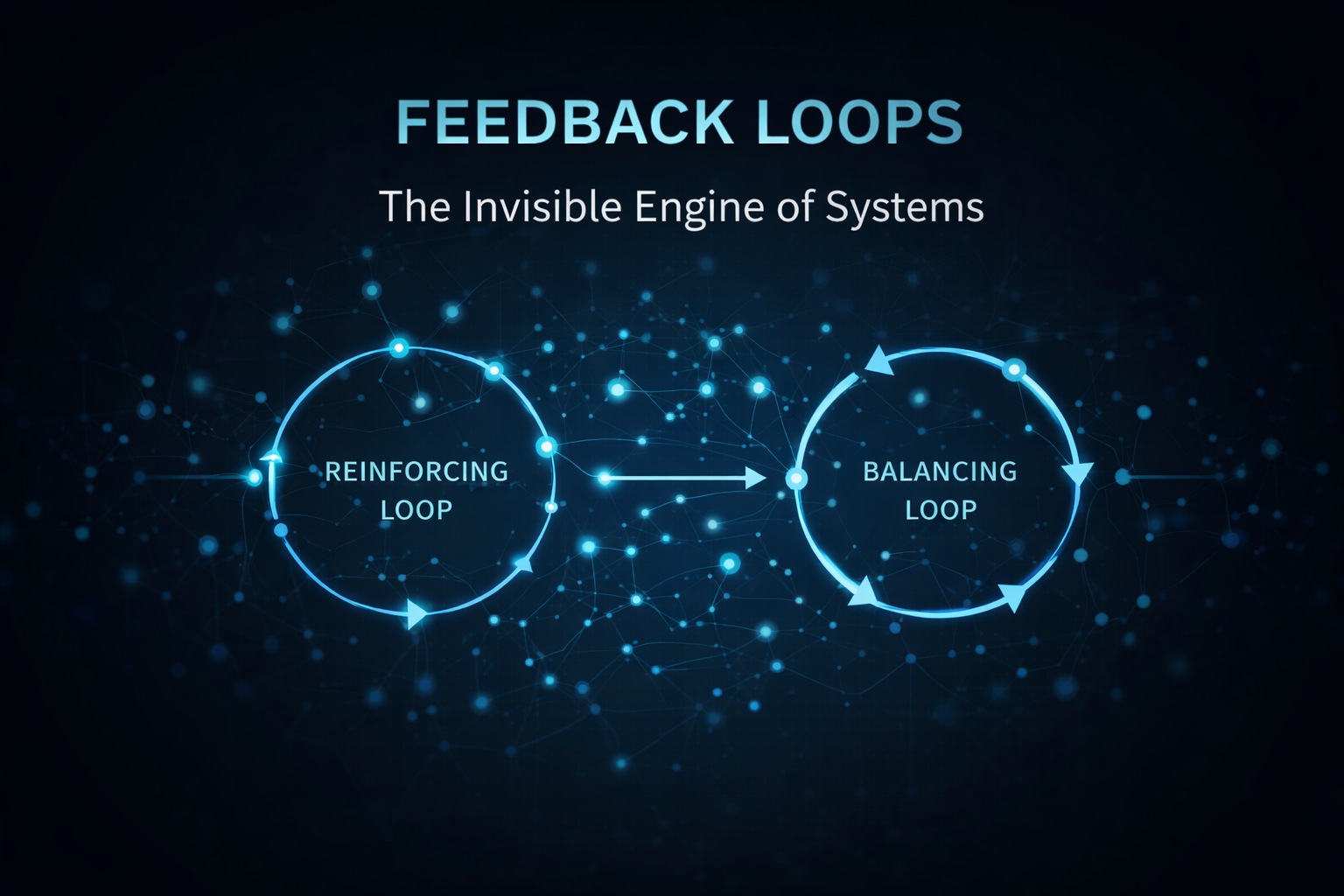
Feedback Loops in Systems
The invisible engine behind growth, stability, collapse, and emergence across markets, institutions, technologies, ecosystems, and everyday life.
The Hidden Engine of Complex Systems
Feedback loops are one of the most important mechanisms in systems thinking. Many systems appear stable and predictable on the surface, yet beneath that stability lies a structure that continuously reshapes behavior.
Governments, companies, ecosystems, digital platforms, and even personal routines all depend on feedback. These loops determine whether a system corrects itself, accelerates, or drifts into collapse.
What Is a Feedback Loop?
A feedback loop occurs when the output of a system influences its future behavior. Instead of a straight line of cause and effect, the relationship becomes circular.
This circular structure exists in biological systems, economic networks, organizations, ecosystems, and technological infrastructures. Without feedback, systems cannot adapt or regulate themselves over time.
Two Fundamental Types of Feedback
Reinforcing loops
These loops amplify movement in the same direction. They accelerate growth, virality, speculation, momentum, and sometimes collapse.
Balancing loops
These loops stabilize the system by counteracting drift and pushing behavior back toward equilibrium.
Reinforcing Feedback Loops
Reinforcing loops amplify change. The result of an action increases the probability that the same action will happen again.
Social media algorithms
Content receives engagement, the algorithm boosts visibility, and the added visibility generates even more engagement.
Economic growth
Investment increases productivity, which increases profits, enabling further investment.
Asset bubbles
Rising prices attract buyers, pushing prices even higher until confidence breaks.
Balancing Feedback Loops
Balancing loops act as correction mechanisms. They reduce drift and move the system back toward equilibrium.
Body temperature
Sweating and shivering regulate body heat to maintain internal stability.
Supply and demand
High prices suppress demand, low prices stimulate it, creating market correction.
Operational controls
Monitoring and corrective processes prevent drift in large institutions.
When Feedback Loops Become Dangerous
Poorly designed feedback structures can create systemic failure. Policy incentives, financial leverage, and algorithmic amplification often contain hidden reinforcing loops.
Examples include subsidy cycles, speculative bubbles, panic selling, and political polarization on digital platforms.
Feedback Loops and Emergence
Feedback loops are central to emergence. Simple local interactions can create sophisticated collective behavior.
Ant colonies, cities, digital ecosystems, and financial markets all exhibit emergent order driven by recursive signals and repeated feedback.
Seeing Feedback Loops in Daily Life
Feedback loops also shape habits and routines.
Exercise increases energy, energy improves motivation, and motivation reinforces the habit. Stress can create negative loops that intensify unhealthy behavior.
Recognizing these structures helps design better personal systems and routines.
Why Feedback Is Central to Systems Thinking
Feedback loops are the hidden engines of complex systems. Reinforcing loops accelerate change. Balancing loops maintain stability.
Together they explain how systems grow, stabilize, adapt, and sometimes collapse.
Continue the systems pillar
Move deeper into how complex systems behave through hidden logic, emergence, and structural dynamics.
Leave a Reply