History of Tunisia: The Civilization They Forgot to Forget
- 01 · ObservationThe sharpest thing that can be said
- 02 · ContextThree thousand years in two paragraphs
- 03 · TimelineCivilizational Timeline
- 04 · StructureWho built this story, and for whom
- 05 · NarrativeWhat the dominant story omits
- 06 · PsychologyWhy people accept the shortened version
- 07 · Systemic DynamicsWhy this does not correct itself
- 08 · PositionThe claim at the center
History of Tunisia: The Civilization They Forgot to Forget
Three thousand years of empire, faith, and identity: why Tunisia’s story is still being mistold.
years
Kairouan, Tunis
a civilization
The history of Tunisian civilization is one of the deepest and most compressed civilizational stories in the Mediterranean world. It is too often told as a sequence of disconnected episodes, even though this territory holds a continuous archive of Amazigh roots, Carthaginian power, Roman urbanism, Islamic scholarship, Ottoman rule, colonial fracture, and diasporic memory.
The sharpest thing that can be said
Tunisia is one of the most historically layered territories on earth, and it is systematically presented as though its story begins the moment it became useful to someone else.
Three thousand years in two paragraphs
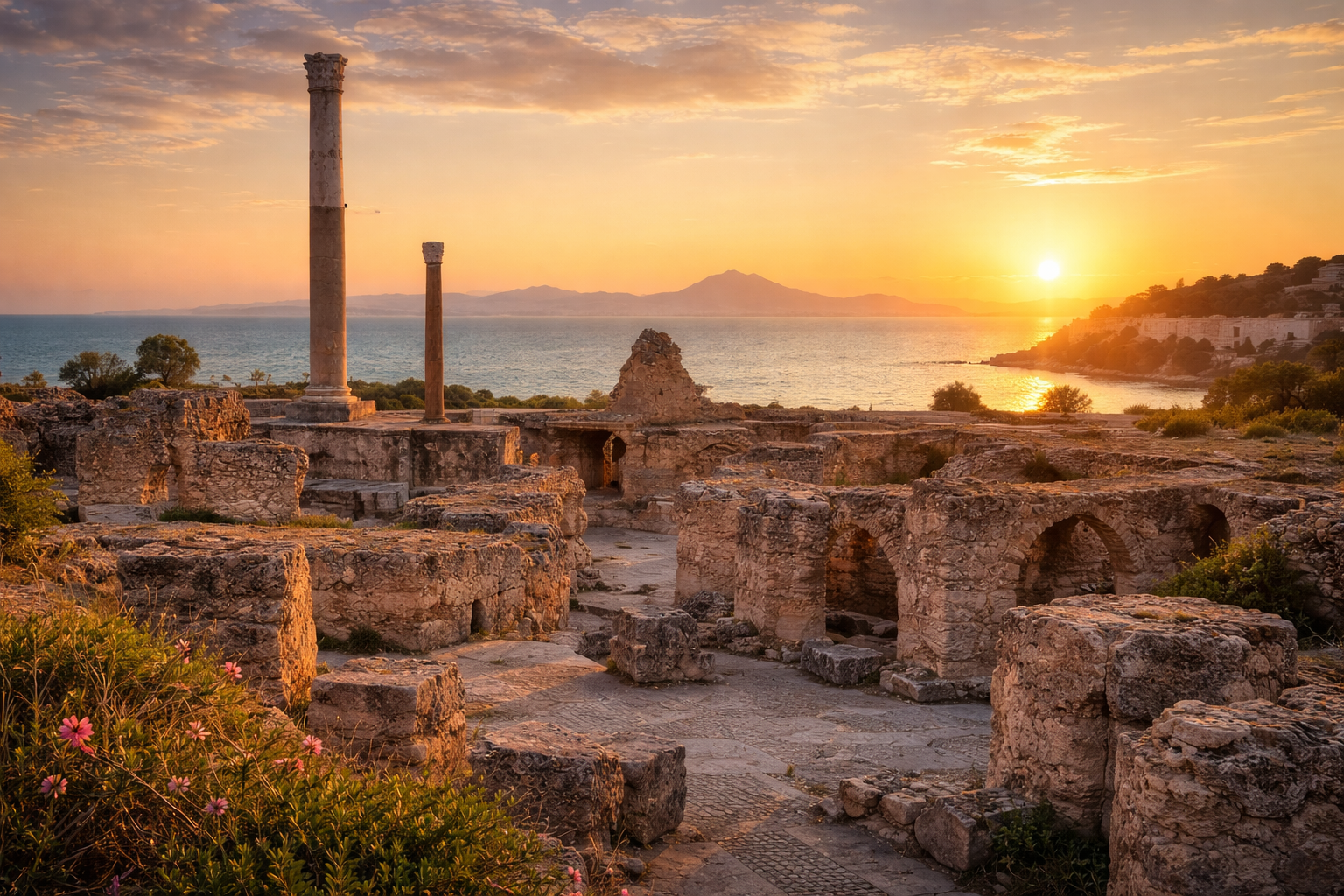
The territory we call Tunisia has been continuously inhabited, cultivated, and contested for more than ten thousand years. Long before the Phoenician ships arrived from Tyre around 814 BCE, the Amazigh people, the Berber nations, had already built a world here: agriculture, kinship networks, cosmology, resistance. Carthage, the city that would become one of the great Mediterranean powers, was founded on top of this existing civilization, not in an empty land. It grew into an empire that challenged Rome across three devastating wars, produced the general Hannibal Barca, whose crossing of the Alps in 218 BCE remains one of the most audacious military operations in recorded history, and sustained a commercial and cultural network that stretched from the Atlantic coast to the Levant. Rome destroyed Carthage in 146 BCE and then, a century later, rebuilt it as the capital of Roman Africa. The same soil held both empires.
What followed was not decline but transformation. Roman Africa lasted nearly six hundred years and produced figures as consequential as Augustine of Hippo. Then came the Arab conquest in the seventh century, the founding of Kairouan in 670 CE, one of the oldest Islamic cities in the world and a center of theology, medicine, and jurisprudence, followed by the Aghlabids, the Fatimids, the Hafsids, the Ottomans, and finally the French protectorate from 1881 to 1956. Independence came under Bourguiba. The 2011 revolution came under its own logic. Each of these transitions left sediment. None erased what came before.
Click any card to reveal deeper context
Amazigh Foundations
Before imperial history, Amazigh communities shaped the land through settlement, memory, kinship, and continuity.
The Amazigh are among the oldest continuous peoples of North Africa. Tamazight predates Arabic by millennia. Their erasure was structural: the postcolonial state needed a unified identity, and Amazigh plurality was its first casualty.
↩ Click to returnCarthage
Carthage became one of the great powers of the Mediterranean, linking trade, strategy, and imperial ambition.
Carthage controlled trade routes from Gibraltar to the Levant. Rome won the wars, then wrote the history. Most of what we know about Carthage comes from its enemies. Hannibal’s crossing of the Alps was calculated strategy, not desperation.
↩ Click to returnRoman Africa
Rome destroyed Carthage, then rebuilt the territory into one of its most valuable provincial centers.
Roman Africa was not a peripheral colony but a civilizational engine. It supplied grain to Rome, produced emperors like Septimius Severus, and gave the Western Church Augustine of Hippo, shaped entirely by North African culture.
↩ Click to returnIfriqiya and Kairouan
Islamic civilization made Tunisia a center of scholarship, theology, law, infrastructure, and political memory.
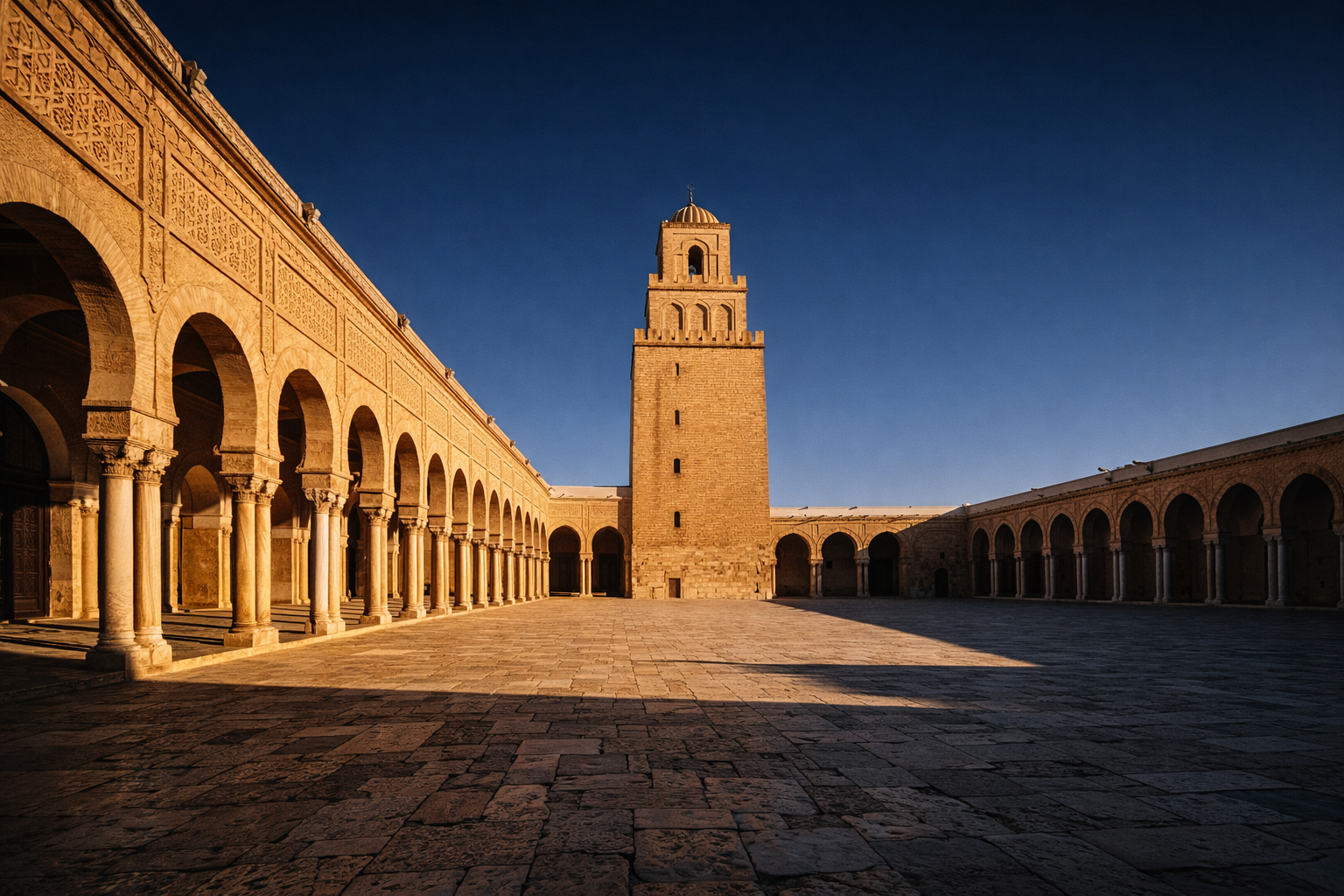
Kairouan’s Great Mosque (670 CE) became a global center of Islamic learning. The Aghlabid cisterns still supply water today. The Hafsid dynasty maintained diplomacy with Aragon, Genoa, and the Mamluk sultanate simultaneously. This was a peak, not a transition.
↩ Click to returnOttoman Tunisia
Under Ottoman influence and local beys, Tunisia remained embedded in Mediterranean trade and statecraft.
The beys of Tunis governed with significant autonomy. In 1861, Tunisia adopted the Dustur, one of the first written constitutions in the Arab world, predating many European constitutions in legal sophistication.
↩ Click to returnModern Tunisia and Diaspora
Statehood, revolution, migration, and Europe now shape how Tunisian identity is remembered and compressed.
Over 1.4 million Tunisians live in France alone. Their children navigate an identity that European institutions reduce to a security variable or integration case study. The full civilizational archive they carry is invisible in this framing. That is what this pillar contests.
↩ Click to returnAmazigh Foundations
The Amazigh are among the oldest continuous peoples of North Africa. Tamazight predates Arabic by millennia. Their erasure from the official Tunisian narrative was structural: the postcolonial state needed a unified identity, and Amazigh plurality was its first casualty.
Carthage
Carthage controlled trade routes from Gibraltar to the Levant. Rome won the wars, then wrote the history. Most of what we know about Carthage comes from its enemies.
Roman Africa
Roman Africa produced emperors like Septimius Severus and gave the Western Church Augustine of Hippo, shaped entirely by North African intellectual culture.
Ifriqiya and Kairouan
Kairouan’s Great Mosque became one of the foremost centers of Islamic learning in the world. The Aghlabid cisterns still supply water today. This was a peak, not a transition.
Ottoman Tunisia
In 1861, Tunisia adopted the Dustur, one of the first written constitutions in the Arab world, predating many European constitutions in its legal sophistication.
Modern Tunisia and Diaspora
Over 1.4 million Tunisians live in France alone. Their children navigate an identity that European institutions reduce to either a security variable or an integration case study.
Who built this story, and for whom
There are at least two dominant actors in how Tunisian civilizational history is framed, and their interests do not align with those of the people whose history is being told. The first is the Western academic and touristic apparatus, which treats Tunisia primarily as a Roman site: a place where one visits Carthage’s ruins, El Jem’s colosseum, Dougga’s temples, and which systematically sidelines the Amazigh substrate, the Islamic intellectual period, and the Ottoman complexity. The patrimony of Roman Africa is spectacular and well-funded; the patrimony of Ifriqiya, of Kairouan’s libraries, of Hafsid urban culture, is less photographed and far less marketed. The architecture of attention is not neutral. It reflects which civilizations are considered legible and worthy by the institutions that control the channels of dissemination.
The second actor is the postcolonial Tunisian state itself, which for decades managed a national narrative that emphasized modernization, Arabization, and secularization, and in doing so compressed the Amazigh dimension of identity into near-invisibility. The Amazigh people of Tunisia, who are among the oldest continuous inhabitants of North Africa, were for generations denied official recognition of their language, their names, and their cultural distinctiveness. The state profited from a unified national narrative. The Amazigh population absorbed the cost of that unity in the form of erasure.
What the dominant story omits
The dominant international narrative of Tunisia operates on two registers that seem opposed but are structurally identical. The first is the ancient-wonder register: Carthage, Hannibal, the Punic Wars, Rome’s breadbasket. This version is cinematic and safe, placing Tunisia firmly in the classical European imagination as a supporting character in the story of Rome’s greatness. The second is the modern-transition register: the Arab Spring, democratization, the question of Islam and modernity. This version is politically useful, framing Tunisia as a laboratory for Western-friendly reform, a Muslim country that might yet become legible to liberal international frameworks.
What structurally disappears in both registers is the Islamic civilizational period on its own terms, not as a stage between Rome and modernity, not as a geopolitical variable, but as one of the richest intellectual and architectural epochs in North African history. Kairouan in the ninth century was a city where mathematics, Quranic jurisprudence, and medical science developed in parallel. The Aghlabid dynasty built irrigation systems, mosques, and cisterns that are still standing. The Hafsid period produced a diplomatic and commercial sophistication that connected Tunis to Genoa, Aragon, and the Mamluk sultanate simultaneously. This is not peripheral history. It is the center, and it is routinely treated as connective tissue between more prestigious episodes.
Why people accept the shortened version
The acceptance of a compressed or distorted civilizational narrative is rarely the result of ignorance alone. It is the result of a structurally incentivized form of identification. For members of the Tunisian diaspora in Europe, a community navigating the daily demands of integration, belonging, and legitimacy, it is cognitively easier and socially safer to claim Roman ancestry than to assert Islamic intellectual heritage. The Roman frame is universally recognized, academically prestigious, and politically neutral. The Islamic frame triggers a different set of associations in the European public sphere, associations that have been hardened by decades of security discourse, by the equations of Islam with backwardness or danger, and by the careful erasure of any narrative in which Islamic civilization appears as a source of knowledge rather than as a problem to be managed.
This is not weakness. It is adaptation under pressure. But adaptation has a cost. When a diaspora community internalizes a version of its own history that begins with the stories its host society finds acceptable, it surrenders the deeper architecture of its identity. What remains is not heritage but a curated selection: impressive, photogenic, and fundamentally incomplete.
Why this does not correct itself
The system does not self-correct because the incentives for distortion are distributed across multiple institutions that are not in dialogue with each other. UNESCO heritage frameworks prioritize monumentality and photographic legibility: stone columns photograph better than manuscript traditions. Tourism industries require simplification because simplification sells. Academic departments in Western universities are structured around civilizational binaries that were built in the nineteenth century and have proven extraordinarily resistant to revision. And within Tunisia itself, the political economy of historical memory has historically served state-consolidation projects that required a unified and manageable national identity rather than a genuinely plural one.
The single concrete breaking point, the point at which this system becomes vulnerable, is the diaspora. The Tunisian diaspora in France, Italy, Germany, and the Netherlands occupies a position that no institution controls entirely. It is bilingual, cross-culturally fluent, increasingly educated, and deeply motivated by questions of identity that the compressed narrative cannot answer. When diaspora voices begin producing their own historical content, not through the filter of host-country institutions, not through the lens of tourism, but from within a framework of civilizational self-possession, the architecture of the dominant narrative becomes contestable. The condition under which this breaking point activates is access to rigorous historical frameworks paired with the platform infrastructure to distribute them. That condition is becoming real.
The claim at the center
My position is this: the civilizational history of Tunisia is not a collection of sequential foreign occupations. It is a continuous, internally generated process of transformation in which each layer metabolized what came before it, and in which the Amazigh substrate, the Punic maritime intelligence, the Roman urban ambition, and the Islamic intellectual synthesis were not competing stories but the same story told in different centuries. The political and cultural forces that have reduced this to a series of picturesque ruins and a cautionary tale about Islam and modernity are not engaged in neutral scholarship. They are engaged in the production of a manageable past, one that serves present interests at the expense of historical truth. To reclaim the full depth of Tunisian civilizational history is not a romantic act. It is a structural one. It is the refusal to accept a shortened identity.
The danger of the manageable past
The danger of a civilizational narrative built for external consumption is not primarily historical. It is psychological and political. A community that understands its past only through the eyes of those who defined it as a colony, a conquest, or a case study is a community that has been deprived of its own interpretive authority. This matters because interpretive authority over the past is one of the primary mechanisms through which political agency in the present is generated or suppressed. If the Amazigh dimension of Tunisian identity can be administratively erased for decades, it is partly because the narrative infrastructure that might have made that erasure legible as violence was never built. If the Islamic intellectual tradition can be systematically downgraded in the Western presentation of North African history, it is because no counter-archive has yet reached sufficient distribution to contest it.
The institutions that profit from the shortened version of Tunisia’s history are not primarily hostile, they are indifferent. Indifference is harder to contest than hostility, because it does not present itself as a position. It presents itself as common sense. The tourism board that emphasizes Carthage’s ruins over Kairouan’s libraries is not making an ideological argument. It is responding to market demand shaped by decades of prior ideological work that has already done its filtering. The Western university curriculum that covers Roman Africa in detail and treats Ifriqiya in a footnote is not consciously suppressing anything. It is reproducing a hierarchy of civilizational value that was built over centuries and that now operates automatically.
What must be broken is not the image of Carthage, because Carthage is magnificent and belongs to this story. What must be broken is the assumption that Tunisia’s civilizational depth begins where European legibility begins, and ends where European interest ends. Tunisia is not a series of useful episodes in someone else’s history. It is a civilization in its own right, Amazigh, Punic, Roman, Islamic, Ottoman, modern, and diasporic simultaneously, and the work of telling that story fully, without permission, without apology, and without the distortions of those who benefit from its incompleteness, is not optional. It is the condition under which any honest account of this part of the world becomes possible at all.
Carthage and Hannibal
How Carthage became one of the great Mediterranean powers, and why Rome still dominates its memory.
Kairouan and Islamic Civilization
Why Kairouan should be treated as a civilizational center, not a transition point.
The Amazigh Roots of Tunisian Identity
Before Carthage and before empire, the deeper human foundation of Tunisia was already there.
Tunisian Identity in Europe
How diaspora identity gets shortened, adapted, and politically filtered in Europe.
Read Britannica on Carthage and explore more on UNESCO’s Carthage page.

Leave a Reply to Rick Cancel reply